The Bamiyan Housing Design Competition
The Society of Afghan Engineers recently hosted an International Student Design Competition aimed at creating sustainable housing for war-displaced families in Bamiyan. With a focus on cultural preservation and social responsibility, the competition attracted 23 entries from around the globe, showcasing innovative solutions to improve living conditions while protecting Afghanistan’s rich heritage.
At the Society of Afghan Engineers (SAE), our mission extends beyond the immediate technical needs of infrastructure; we strive to integrate social responsibility, cultural preservation, and sustainable development into everything we do. To this end, the SAE Architecture and Planning Division proudly hosted an International Student Design Competition focused on providing sustainable housing and infrastructure for the war-displaced families of Bamiyan.
The Historical and Social Context
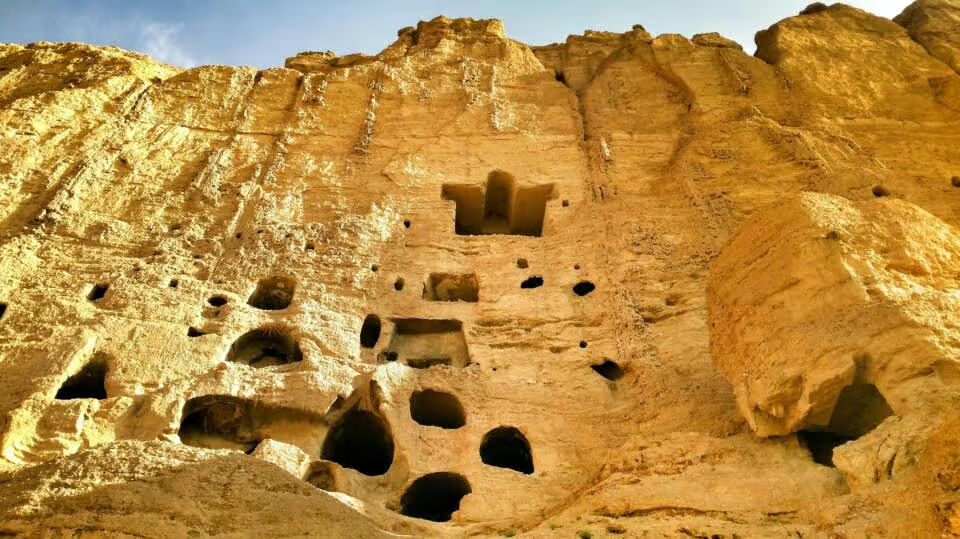
The sandstone cliffs of Bamiyan, globally renowned for the giant 6th-century Buddha statues that were tragically destroyed in 2001, have historically served as sites for meditation and spiritual retreat. However, since the 1990s, approximately 150 native families—totaling around 1,000 people—have sought refuge in these ancient caves for safety and shelter.
While providing a temporary haven, this prolonged occupation has posed a severe threat to our national heritage. As families have understandably tried to make the caves livable by installing doors, windows, makeshift extensions, satellite dishes, and solar panels, the historic site has suffered significant damage. Governor Ghulam Ali Wahdat of Bamiyan aptly noted that these caves must be preserved and kept open for tourism, highlighting the urgent need to relocate the families to protect both the people and the heritage site.
The Purpose of the Competition
We launched this design challenge to propose a viable, affordable, and sustainable housing solution for these low-income, displaced cave dwellers. Our goal was to develop a comprehensive plan encompassing two interrelated components: the creation of a manageable, self-sustaining community equipped with essential infrastructure, and the provision of culturally appropriate, affordable housing zones.
The re-settlement of these families will have a profound impact on the living conditions in Bamiyan City, offering far-reaching environmental, social, and economic benefits. We envision this project as a catalyst for economic growth, employment generation, and the reinvigoration of the local tourism industry.
The Site and Design Parameters
The competition site encompasses approximately 4 hectares on the north side of the Bamiyan valley, situated along the Charikar–Band-e Amir highway. Located 5.5 km east of the Buddhas and 4 km from the City Center, it features a south-facing orientation with a slight 10-20% slope.
We challenged participating students to address complex architectural and urban planning parameters:
- Community Infrastructure: Proposals were required to carefully consider land use planning, environmental impacts, and the provision of basic infrastructure such as water, sewer systems, paved walkways, schools, health facilities, and mosques. We asked competitors to formulate their designs so they could be constructed incrementally over 5-, 10-, or 15-year intervals based on funding availability.
- Cultural and Sustainable Housing: The housing units had to adhere to traditional Afghan practices and cultural norms regarding privacy, family structure, and neighborhood dynamics. Because Afghan households frequently retain multi-generational members, the designs needed to offer flexibility and incremental growth options. Furthermore, we emphasized the use of sustainable climate control strategies, renewable energy, rainwater retention, natural cross-ventilation, and proper solar orientation.
A Collaborative Educational Effort
Beyond addressing a humanitarian crisis, this competition was a deeply educational endeavor. Our objective was to foster collaboration and the exchange of ideas between Afghan university students and their peers at foreign institutions. We received an outstanding response, with twenty-three entries submitted from eleven universities worldwide, including three universities from Afghanistan.
Competition Results and Prize Winners
After thorough deliberation by an esteemed international jury, we were thrilled to announce our top winners and honorable mentions. The jury evaluated the projects based on sensitivity to Afghan traditions, support for self-sufficiency and economic growth, and the meaningful integration of the community.
Top Winners:
- First Prize ($2,500): Xi’an Jiaotong – Liverpool University, Department of Architecture (China). Student: Kaiqing Tan.
- Second Prize ($1,500): Universitas Sebelas Maret of Surakarta, Department of Architecture/Engineering (Indonesia). Students: Trevi Marisa, Adesti Ulfatun Nisa, Yulita Devina.
- Third Prize ($1,000): Nanjing Tech University, College of Architecture (China). Students: Yuxing WU, Yang ZHANG, Tianyi CHEN.
Honorable Mentions ($300 each): We also awarded honorable mentions to outstanding collaborative teams from the American University of Sharjah (UAE), Xi’an Jiaotong – Liverpool University (China), Kabul University (Afghanistan), the University of Hartford (USA), and Effat University (Saudi Arabia).
We are incredibly proud to highlight the overwhelming participation of female students in this competition. Out of 76 student participants, 41 (54%) were women. In fact, six of the nine winning teams were entirely composed of female students, including the brilliant team of four young women from Kabul University.
Our Generous Sponsors and Dedicated Organizers
This initiative would not have been possible without the generous financial support that funded the award money. We extend our deepest gratitude to the Kazimee Family Charity Funds, the Toba Roshan Education Funds, the Afshar Charity Funds, and the numerous esteemed members of SAE who contributed to this noble cause.
We also extend our sincere appreciation to our distinguished jury members: Dr. Daniela Ottmann (Bond University, Australia), Dr. Samia Rab Kirchner (Morgan State University, USA), Joseph Ashmore (International Organization for Migration), Professor Rafi Samizay (Washington State University), and Dr. Reinhard Goethert (MIT).
The competition was expertly guided by our Organizer Committee, led by Professor Bashir Kazimee (Chair), alongside SAE President Najim Azadzoi, Professor Mehdi Sabet, Professor Rafi Samizay, Dr. Reinhard Goethert, Eng. Donya Amiri, Arch. Hamayon Ibrahim, and Eng. Walid Hwaida.
We are hopeful that the innovative designs produced by these talented students will serve as a powerful catalyst for securing international funding, ultimately transforming these concepts into a reality that restores dignity to the displaced families of Bamiyan and protects Afghanistan’s invaluable historic heritage.