Internships, Fellowships, & Mentorship at the Society of Afghan Engineers
The Society of Afghan Engineers (SAE) empowers Afghan engineers, architects, and scientists through global internships, fellowships, and mentorships, fostering professional growth and capacity building. By connecting students with experienced mentors, SAE enhances skills crucial for Afghanistan’s infrastructure development and economic progress.
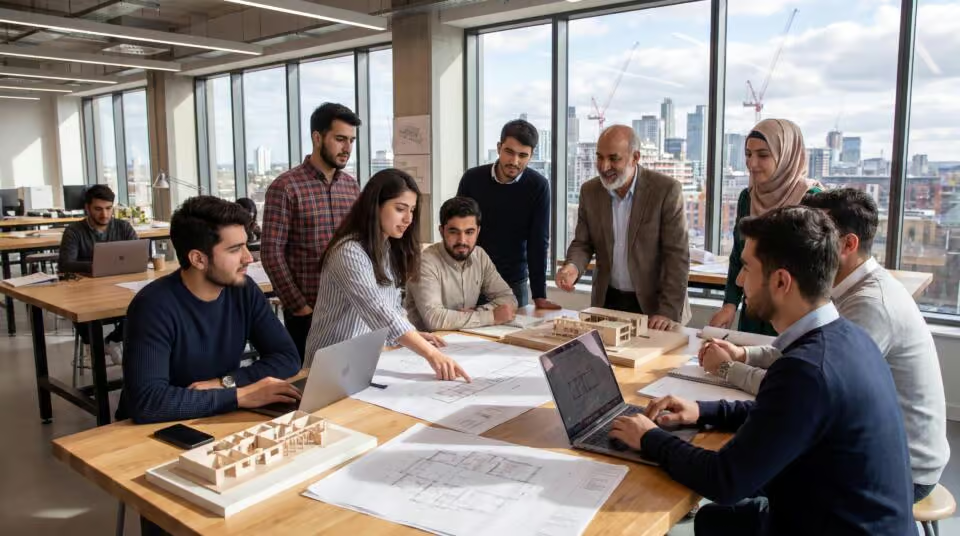
At the Society of Afghan Engineers (SAE), we are dedicated to fostering the professional growth of Afghan engineers, architects, and scientists through internships, fellowships, and mentorships. These capacity-building initiatives take place globally, including within the United States, the United Kingdom, and Afghanistan. Since our early involvement in the reconstruction of Afghanistan, we have continuously supported and expanded these programs. We achieve these goals by connecting Afghan students and professionals with experienced mentors, facilitating internship placements at private engineering firms, and collaborating with international organizations to sponsor and manage professional fellowships.
Fellowships
We actively collaborate with international agencies to secure and manage fellowship opportunities that enhance the technical and administrative capacities of Afghan professionals.
UNESCO-Technical Capacity Building Fellowship
In 2012, we participated in a capacity-building initiative funded by the US State Department through the United Nations Educational, Scientific and Cultural Organization (UNESCO). This program provided a $20,000 grant to fund a fellowship for two professionals from Afghanistan to travel to the United States. The objective of this fellowship was to strengthen and support professional engineering societies in Afghanistan so they could better represent the profession in matters involving the government and private industry.
Working in coordination with the American Society of Civil Engineers (ASCE), we helped arrange a three-week program for Ms. Dalia Akbarmir and Professor Jamil Khalid. During their stay in the Washington D.C. metropolitan area, the UNESCO Fellows visited several engineering professional societies, architectural design offices, and construction sites. Volunteer professional members from our Society accompanied the Fellows to provide guidance and technical information throughout their visits. The program also included visits to the ASCE and the American Society for Testing and Materials (ASTM) headquarters to study the standard development processes.
UNITAR Hiroshima Fellowship for Afghanistan
Our members have also been heavily involved in the United Nations Institute for Training and Research (UNITAR) Hiroshima Fellowship for Afghanistan. For example, Dr. Gul Afghan Saleh, an executive director and board member of our Society, joined the UNITAR program as a Fellow in 2007. He advanced to become a Coach in 2008, an Afghan Resource Person in 2011, and a Mentor in 2013. As a UN-certified trainer and mentor, he has continued to guide professionals in both Afghanistan and Iraq, demonstrating our Society’s long-term commitment to global mentorship and capacity building.
Mentorship
Mentorship is a cornerstone of our strategy to transfer knowledge and build human capital for the future of Afghanistan. We believe that providing guidance to the younger generation of engineers is vital for the stability and economic progress of our nation.
Guiding the Next Generation
We advise students starting their engineering education at both the high school and university levels on how to form career goals, learn fundamental concepts, and ultimately transition into the workforce. We strongly encourage young engineers to select an experienced mentor and work under their guidance for several years to gain practical experience and learn the essential methodologies of their chosen field. Our university faculty members provide vital mentorship to students by offering academic advice, writing recommendation letters, and guiding them toward scholarship and career opportunities.
Professional and Academic Mentorship Programs
We have utilized our network of experienced expatriate professionals to directly mentor Afghan students and engineers. Our members have established professional and academic partnerships to facilitate this knowledge transfer:
- Virtual Mentorship: Through our collaboration with the Afghan Education for a Better Tomorrow (AEBT), we have provided online courses where senior Afghan engineers and academics serve as instructors and mentors for students inside Afghanistan. This initiative connects students with experienced professionals, fostering guidance, motivation, and applied learning in areas such as seismic safety, landslide mitigation, and construction management.
- Academic Mentorship Abroad: Our members at international universities frequently mentor Afghan scholars. For example, Dr. Bahawodin Baha created a partnership between the University of Brighton in the UK and Kabul Polytechnic University (KPU). Through this initiative, twelve junior lecturers from KPU were invited to the University of Brighton, where they were mentored and successfully completed their master’s degrees before returning to teach in Afghanistan.
Internships
We view internships as a critical component for bridging the gap between theoretical academic education and practical engineering applications.
We advocate for engineering students, from their freshman to senior years, to be provided with internships lasting several months at various government ministries, large construction sites, or manufacturing facilities. To support this, our local engineering firm members in the United States have offered internship placements and practical training classes to interested young engineering graduates and students. Furthermore, we actively seek training and internship opportunities for Afghan engineers and architects within US-based engineering firms and government entities. These placements allow young professionals to gain hands-on experience, understand workplace ethics, and learn modern project management practices that can later be applied to the development of Afghanistan’s infrastructure.