Peer Review of National Building Codes and Standards
Our team provided urgent peer review for Afghanistan’s housing standards, identifying key deficiencies and offering vital recommendations to enhance clarity and practicality. We emphasized the need for accessible language, cultural sensitivity, and user feedback to ensure the standards are effective and enforceable.
When Afghanistan’s Ministry of Urban Development and Land (MUDL) required urgent assistance, we stepped forward to provide a peer review of the “Housing Standards of the Islamic Republic of Afghanistan”. These standards, comprised of two volumes covering Minimum Standards and Detailed Technical Standards, were initially drafted by a Nairobi, Kenya-based consulting firm and funded through the World Bank. MUDL approached us for this urgent peer review with a short turnaround time, requiring our professional input before the consulting firm finalized its submission.
Mobilization of the Peer Review Committee
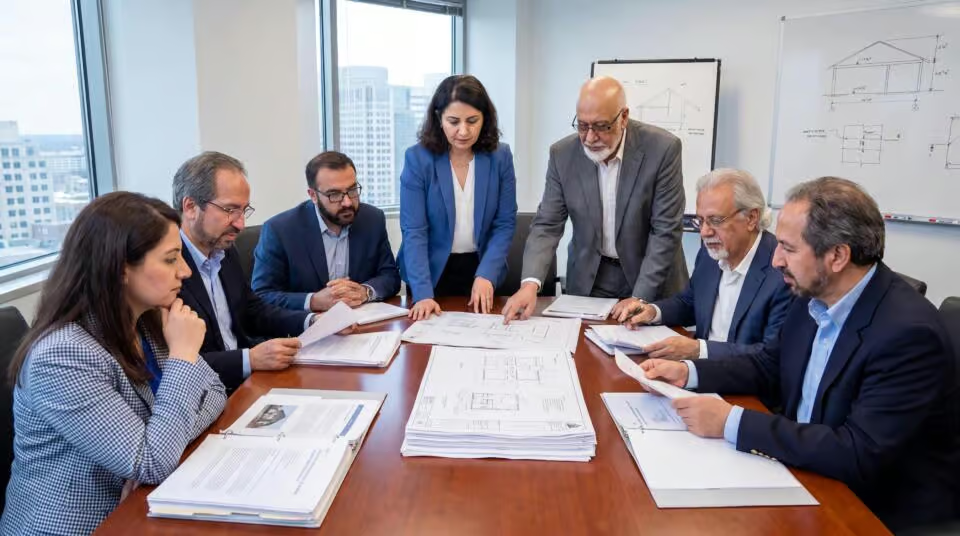
Upon receiving the formal request from MUDL, we rapidly formed a Peer Review Committee comprised of our experienced and knowledgeable volunteer experts, operating under the leadership of Ustad Aminullah Mahmood. In fewer than ten days, our committee reviewed over 300 pages of the draft standards according to their respective areas of expertise. We then compiled our findings into a 52-page report, which we officially forwarded to MUDL on August 24, 2020.
Review Findings and Identified Deficiencies
Due to severe time constraints, our reviewers were unable to perform a detailed review of all sections, opting instead for a brief and holistic review. The summary of our holistic review indicated that the developed standards contained multiple technical, formatting, and style deficiencies. We found that the standards in their current form were too complex to be easily understood, even by experienced engineers. Furthermore, we noted issues such as repeated and overlapping contents between the two volumes, formatting problems, and inconsistent use of units throughout the documents.
Key Recommendations for the Housing Standards
To ensure the standards would be suitable, applicable, and enforceable in Afghanistan, we provided several specific recommendations to MUDL:
- Language and Formatting: The two volumes must be carefully reviewed and rewritten concisely using easily understandable language and industry-standard terminologies. We also recommended that diagrams or illustrations be added to facilitate interpretation and understanding.
- Educational Accommodations: Considering that much of the construction workforce in Afghanistan is illiterate, we advised that the revised standards should be accompanied by short video tutorials to aid homeowners and homebuilders in implementation.
- Cultural and Structural Realities: We stressed that cultural and religious sensitivities must be considered, such as prioritizing common flat roofs with privacy parapet walls, and noted that introducing pitched truss roofs may make engineering sense but is impractical for Afghanistan.
- Regulatory Clarity: We recommended that items currently left to the discretion of “Approving Authorities” be made as specific as possible, warning that standards cannot be properly enforced if they rely solely on the judgment of individual decision-makers.
- Document Cleanup: We advised cleaning up overlapping content, making the use of units consistent, and shortening the 26-page Glossary of Terms in Volume I by removing commonly understood dictionary terms.
- End-User Feedback: We suggested that end users be given an opportunity to review the documents to highlight sections that are not quantifiable or understandable.
Suggested Path Forward
To ensure these housing standards provide true value to our country, we outlined a clear path forward for the Ministry. We recommended that a detailed review of the newly revised documents be performed by the same or an expanded committee of our volunteer experts. However, due to the personal and professional obligations of our members, we requested that this detailed review be allocated at least six months from the date of any new request by MUDL. Additionally, we stipulated that for a detailed review to be successful, all external codes referenced within the standards must be made available to our reviewers.