Tele-Education and Virtual Classes
The Society of Afghan Engineers, in collaboration with Afghan Education for a Better Tomorrow and Afghan Architecture Studio, is transforming education in Afghanistan through virtual engineering and architecture classes. By leveraging tele-education, they empower both male and female students, ensuring access to vital STEM knowledge and skills essential for rebuilding the nation’s infrastructure.
Background
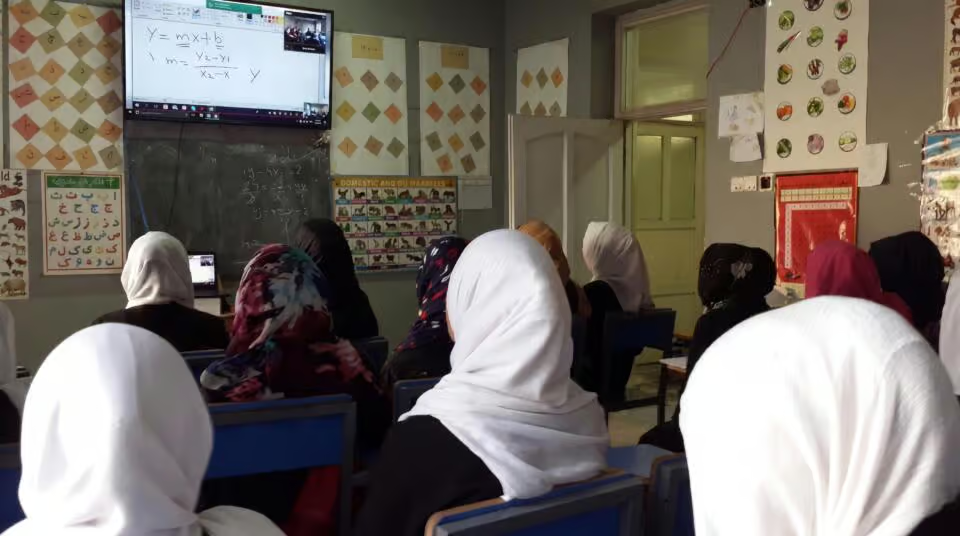
The Society of Afghan Engineers (SAE), in partnership with the Afghan Education for a Better Tomorrow (AEBT) and the Afghan Architecture Studio (AAS), have developed and delivered comprehensive virtual engineering and architectural classes for male and female university students located in Afghanistan. Initiated as early as 2016 through a pilot program at Herat University, and significantly expanded between 2021 and 2026, we utilize tele-education technologies—including synchronous video conferencing and satellite internet—to bridge the educational gap caused by conflict and institutional restrictions. Through the volunteer efforts of our expatriate experts, we broadcast real-time instruction from the United States and other global locations directly to students at institutions like Kabul University, Kabul Polytechnic University, and Herat University. Our goal is to transfer critical knowledge, expose Afghan students to global best practices, and equip them with the skills required to rebuild our beloved homeland’s infrastructure.
The SAE and AEBT Tele-Education Partnership
Our collaborative initiative with AEBT focuses on expanding online learning opportunities to address the severe disruption of higher education in Afghanistan. By pairing Afghan expatriate professors with students inside the country, we have delivered a robust curriculum that aligns with international engineering standards.
Our specialized online classes have covered a wide array of critical engineering topics:
- Structural Analysis and Design: We offered classes covering the “Fundamental and Advanced Concepts of Structural Analysis,” taught by our member Eng. Hafiz Wardak, which focused on evaluating the stability and load-bearing capacity of buildings and bridges. Eng. Amin Mahmood also provided instruction on “Structural Design, Building Code Definition and Earthquake-Resistant Design” and the replacement of damaged precast concrete structures.
- Precast Concrete: To introduce modern construction methodologies, Eng. Amin Mahmood taught specialized courses on “Precast Concrete” and “Architectural Precast Concrete”.
- Electrical Circuit Analysis and Power Systems: In the realm of electrical engineering, Eng. Naim Hakimi delivered instruction on “Electrical Circuit Analysis,” while Eng. Ghulam Feda taught courses on “Power System Distribution” and “Digital Design and Computer Architecture”.
- Construction Management and Hydrology: Dr. Gul Afghan Saleh delivered lectures on the “Foundational Understanding of Construction Management Roles,” while Eng. Amanullah Mommandi led seminars on “Fundamentals of Hydrology and Stream Stats” to address Afghanistan’s water management challenges.
Ensuring Educational Access for Female Students
A core component of our tele-education mission has been addressing the systemic educational barriers faced by female students. When higher education institutions were banned for women, we immediately expanded our efforts to provide targeted online classes specifically for Afghan university girls. This initiative ensured that young women retained uninterrupted access to quality STEM education, helping to prevent their long-term exclusion from the professional workforce and deepening economic and social inequalities.
The Afghan Architecture Studio (AAS) Initiative
In tandem with our engineering courses, we have heavily supported the Afghan Architecture Studio (AAS), a program founded by a group of our volunteer Afghan architects and educators. The AAS program specifically enrolled young women who had been unable to complete their architectural education.
The curriculum was carefully structured to accommodate different academic levels and was taught by a dedicated faculty including Najim Azadzoi, Bashir Kazimee, Mehdi Sabet, Mehrangez Danishwar, Tooba Rooshan, Hamayon Ibrahim, and Aziz Ghani.
- Advanced Studio (Group A): Graduate-level and advanced students were assigned capstone projects, such as the conceptual and architectural design of a “War Trauma Center for Children in Kabul”. This project prioritized safety, psychological healing, and climate-responsive strategies.
- Intermediate Studio (Group C): Third and fourth-year students were tasked with designing the “Bagh-e-Babur Visitor Center,” aiming to create an eco-conscious public space seamlessly integrated into the historic garden landscape.
- Foundational Skills (Group B): Newer students were introduced to fundamental architectural drawing skills, orthographic drawing, and 2D/3D design presentation techniques, culminating in the design of a 3-bedroom house in Kabul.
Program Impact and Outcomes
Through these classes, participants not only gained advanced theoretical knowledge but also learned practical applications directly relevant to Afghanistan’s reconstruction needs. Upon the successful completion of these rigorous 14-week programs, we awarded our students with beautifully designed certificates of accomplishment, recognizing their resilience and academic excellence. By connecting students with senior Afghan engineers and academics, we have fostered an environment of mentorship and motivation that will empower the next generation to lead the sustainable development of Afghanistan.