SAE Newsletter – 2013-10 – Volume 3, Issue 4
Prioritizes structural resilience through a detailed review of seismic safety for building design and features a compelling interview with the former Deputy Minister of Education.
October 2013, Volume 3, Issue 4, Mizan 1392
P.O. Box 11097 Alexandria, Virginia 22312
Dear Colleagues:
This issue of the SAE eNewsletter (newsletter) features an article by Mr. Amin Mahmood about Seismic Safety for Building Design in Afghanistan. The article provides a brief introduction about the seismic design and code enforcement. The highlights of the formation of the earthquake, terminologies, case histories, and recommendations related to earthquake design are depicted in this article.
There is an informative Interview with Dr. Saif R. Samady, former Deputy Minister of Education, Afghanistan.
A Message from Mr. M. Q. Kadir, the Chairman of the Board of Directors is addressed to the readers of the SAE eNewsletter. In the message he has discussed the highlights of SAE activities since it establishment. The report about the appointment of Chapter Coordinators of the Society of Afghan Engineers is also included.
We are looking forward to the receipt of your technical news, articles, comments, suggestions, questions, and opinions about SAE and this publication.
Very Truly Yours,
Ghulam Mujtaba G. Mujtaba, MS- CE, P.E.,
CPM; M.ASCE
Editor- In- Chief,
SAE eNewsletter
“This issue of the SAE eNewsletter (newsletter) features news… about Seismic Safety for Building Design in Afghanistan..”
Inside This Issue
- 2 Greetings from SAE President
- 2 A Message from the Chairman of the Board of Directors
- 4 Responses to Readers’ Comments
- 5 Technical news from Afghanistan
- 6 Afghan Professional Community News From Abroad
- 6 SAE Local Chapter Coordinators
- 12 Seismic Safety for Building Design in Afghanistan
- 25 Interview with Dr. Saif Rahman Samady, former Deputy Minister of Education, Afghanistan
- 31 Membership News
- 31 The Appointments of the SAE Committee/Subcommittee Leaders
- 31 Resignation
- 34 Achievements and Awards
- 33 Membership Contributions in 2013
- 35 The Society of Afghan Engineers Organization
- 36 Membership Application/Updates
Greetings From The SAE President
Dear Members of the Society of Afghan Engineers:
I am pleased to inform you that, during their September meeting, the Board of Directors of the Society of Afghan Engineers (SAE) approved the nomination of the Chapter Coordinators. Accordingly, the Coordinators will call their regional meetings, discuss SAE related issue, and appoint their staff members. The formation of local chapters will make it possible for the SAE members to hold their face-to-face meetings without lengthy travel plan and being off from their jobs. These types of meetings improve the developmental activities of the Society and assistance to their communities and beloved country.
The members through the Local Chapters and SAE Committee/ Subcommittees would be able to participate in the development of the technical tasks of Afghanistan. The improvement of effective communication between the SAE members within and outside of Afghanistan is the key to the accomplishment of the aforementioned tasks.
Please send us your comments and suggestions that how each one of us can and should participate in the technical activities of Afghanistan.
Very Truly Yours,
Ghulam Mujtaba
G. Mujtaba, MS- CE, P.E., CPM
President, the Society of Afghan Engineers
A Message From The Chairman Of The Board Of Directors
Dear readers of the SAE eNewsletter:
This year is the 20th anniversary of the establishment of the Society of Afghan Engineers (SAE). The Society of Afghan Engineers was established in 1993 in response to the demand of Afghan Diasporas to be professionally involved in the rebuilding and reconstruction of their war torn homeland.
I am very delighted to have the opportunity to provide the highlights of the SAE activities during the past two decades and to look forward to the successful future of this Organization. I have been actively involved with the SAE since 1995 and I would like to summarize my observation of the SAE development and progress in three phases.
Phase one of the SAE activities was from the establishment of the SAE until the change in the political reality and establishment of a new government in Afghanistan.
Phase two of SAE activities may be described as the time, when windows of opportunities, hopes, and expectations opened for all professionals in Afghanistan, until now. The changes of political environment in Afghanistan created a unique opportunity for all Afghans, especially for the professional communities, to get actively involved in the reconstruction of Afghanistan.
Phase three of the SAE activities shall be the evaluation of its past performance and development of missions and goals to meet the challenges of the future.
During the initial stages of SAE establishment generally it was unfavorable for any direct involvement and activities inside Afghanistan. Therefore, the activities of the colleagues were mainly focused on organizing annual meetings and professional gatherings inside the United States of America. The SAE leadership conducted professional and informative gatherings and invited Keynote speakers and scholars, mostly in East Coast USA. Nevertheless, the SAE leadership at that time scheduled a few trips to Afghanistan and discussed their vision of supporting the reconstruction process with the government of Afghanistan; it was a challenging time for any direct professional involvement.
The next phase started with hopes and expectations that had not existed before and no Afghan had dreamed of before. A new window of opportunity started and the Diasporas hoped to be the needed bridge between the war torn homeland and Western society, in order to start the reconstruction and the rebuilding of Afghanistan without further delay.
The SAE members traveled to Afghanistan, worked as consultants on governmental and non- governmental projects, took active roles in the reconstruction process. They worked with the Afghan government in leadership capacities, as technical advisors as coaches and remained relevant during this phase.
The SAE organized many high level professional gathering inside Afghanistan and in the USA, with high profile national and international speakers and participants, cabinet members of the Afghan government, with the objective to push further the much needed reconstruction and rebuilding of Afghanistan.. The SAE hoped to actively support the reconstruction process, build a professional bridge between Afghanistan and western countries and to satisfy the expectations of Afghans and desire to assist members and the professional communities both inside and outside Afghanistan. The following are examples of some of the activities during years of this phase:
- 2002: SAE was the first professional organization to send a team of professionals to Kabul. SAE, with assistance of Afghanistan Assistant Coordination Authority ( AACA ) established the first volunteer capacity building program. SAE sent 37 volunteer professional members to Afghanistan
- 2002: SAE, in cooperation with the Ministry of Housing and Urban Development, Habitat for Humanity and the Japanese Society of Civil Engineers, organized the first International Conference in Kabul, entitled “National Urban Visions and the Future of Kabul City”.
- 2003: SAE organized a conference at Stevens Institute of Technology in New Jersey, entitled “Empowerment of Afghan Professionals”.
- 2004: SAE organized a conference at U.C. Berkeley, California, en titled “Infrastructure Rehabilitation and Development in Afghanistan“.
- 2005: SAE / SAAE (Society of Afghan Architects and Engineers) organized a conference at Kabul University, entitled “The Role of the Private Sector in the Reconstruction and Development of Afghanistan”.
- 2007: The SAE jointly with the American Society of Civil Engineers (ASCE) were awarded a capacity building contract. The ASCE was the prime contractor of this training contract. Twelve SAE members and five Kabul University staff were involved in this training program. The prime objective was to start a program, hosted by Kabul University, for the enhancement and creation of private sector engineering consulting capability, in Afghanistan, in all engineering disciplines. Seventy-four (74) Afghan engineers, including 3 female engineers, participated in one of three 10-day workshops taught by SAE trainers.
Just recently, SAE advised the Ministry of Public Works of the Islamic Republic of Afghanistan on the Salang Tunnel Project. The SAE members traveled to Afghanistan, visited the Salang-Pass, and offered professional-training at different governmental institutions, including Ministry of Public Works and Faculty of Engineering, Kabul University.
The training at Ministry of Public Work was in 15 different areas and was focused on the practical applications to the country highway system; we can mention few of the training such as Rockfall Mitigation along the Highways, Avalanche Control, Snow Removal, Rest Areas along the Highways, Permit and Port of Entries and Hydrology (StreamStats).
To the best of our knowledge the Ministry of Public Works with Assistance from PRT have already developed and implemented the Avalanche Control for the first time in the history of Afghanistan.
We are now at the beginning of a new phase for this Professional Organization. For the future, it is important to position SAE in such a way that it remains relevant as a Professional organization and be available to contribute in the future for any possible professional assistance to Afghan communities, within and outside Afghanistan.
Therefore, I invite all Afghan Professionals to join SAE now and to lead and prepare this organization to meet the challenges of the future with their active participation and with valuable expertise . This organization needs the dynamic involvement of the younger professional population, inside and outside Afghanistan. I also ask active participation of the respected current members, in order to define the future path and guide this organization in the fulfillment of its mission.
Your comments and suggestions regarding the future mission of the Society would be greatly appreciated.
Best Regards
Mohammad Qasem Kadir
Chairman of the Board of Directors
The Society of Afghan Engineers
Responses To Readers’ Comments
Comments from Bashir A. Kazimee, AIA Professor School of Architecture & Construction Management at Washington State University
Professor Kazimee, former professor of the Department of Architecture of the Faculty of Engineering of Kabul University has sent an Eid Mubarak note. In his greeting message he has mentioned about the publication of the newsletter. The SAE eNewsletter related part of his email and our responses are included herein.
August 8, 2013
Dear Ustad Mujtaba:
I finally had a chance to go over the SAE recent newsletter, and thought should send you this note, to thank you and your editorial team for doing such a wonderful job of keeping us informed of our colleagues and friends recent activities and their strive for effectively contributing to the cause of rebuilding Afghanistan. I am also very pleased in particular to know about Dr. Bahaudin’s eye- catching scholarly work, books and accomplishments – congratulation to him and he makes us all very proud in this circle. Please pass my regards to him and I wish him much success on his career.
Bashir A. Kazimee, AIA
Professor
School of Architecture & Construction Management
Washington State University
Pullman, WA 99164 – 2220
bkazimee@arch.wsu.edu
Response to Professor Bashir A. Kazimee’s Comments
August 10, 2013
Dear Professor Kazimee Sahib:
Thanks for your kind words about Editorial Board of the newsletter and Professor Bahaudin’s article and publications.
The Editorial Board and Dr. Bahaudin will be very glad to read such comments from a respected scholar. I have copied them in this email so that they directly read your message.
Best regards,
Ghulam Mujtaba
Editor-In-Chief SAE eNewsletter
Technical News From Afghanistan
Mr. Mohammad Mirwais – SAE Kabul Chapter Coordinator and the SAE eNewsletter Regional Representatives has recently started his M.S. degree program in Japan. In the last few years, in his capacity as newsletter regional representative he has represented the SAE an excellent manner.
The President of the Society of Afghan Engineers and the Editorial Board Members of the SAE eNewsletter are wishing him good luck in his graduate study program.
Afghan Professional Community News From Abroad
SAE Local Chapter Coordinators
September 11, 2013
The President of the Society of Afghan Engineers (SAE) nominated the Local Chapter Coordinators and the Board of Directors approved their appointments during the Board meeting of September 11, 2013. The following is the list of the Local Chapter Coordinators:
- Mr. Najim Azadzoi – Massachusetts Chapter Coordinator
- Mr. M. Qasem Kadir – Southern California Chapter Coordinator
- Mr. A. Manan Khalid – New York and New Jersey Chapter Coordinator
- Mr. Mohammad Mirwais – Kabul Chapter Coordinator
- Mr. Amanullah Mommandi – Colorado Chapter Coordinator
- Mr. M. Qaseem Naimi – Toronto, Canada Chapter Coordinator
- Mr. Atiq Panjshiri – Virginia and Washington DC Chapter Coordinator
- Mr. M. Nagib Poya – North California Chapter Coordinator
- Dr. Shad M. Sargand – Ohio Chapter Coordinator
Mr. Mirwais is currently working on his M. S. degree program in Japan. He asked the President to nominate another colleague as his replacement.
Mr. Khalid, Mr. Mirwais, and Mr. Panjshiri are the newly appointed Chapter Coordinators. The other Coordinators will continue in their current positions.
The Chapter Coordinators perform volunteer work like any other officers of the Society. The Coordinators call the meetings, prepares the agenda, preside over the Local Chapter membership meetings. During their meetings, the SAE Chapter members discuss any SAE related technical issues, especially, items that are related to the technical developmental activities of our beloved country, Afghanistan.
The Chapter Coordinators will appoint their assistants and Local Chapter Secretaries. Upon the development of the Local Chapter Bylaws the future appointments and other activities will be performed in accordance with the Chapter Bylaws.
The Editorial Board of the SAE eNewsletter congratulates the appointed SAE Local chapter coordinators and wishing them continued Success.
The following are the pictures and biographies of the appointed Coordinators:
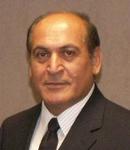
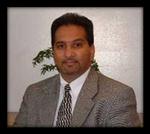
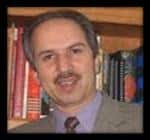
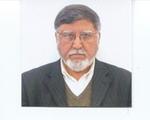
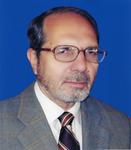
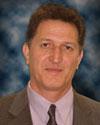
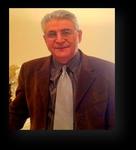
SAE Local Chapter Coordinators at USA
Biographies
Mr. Najim Azadzoi – Massachusetts Chapter Coordinator
Najim Azadzoi, AIA, is the co-founder and a member of the SAE since 1995. He is the founder and Principal of Azad Architects in Newton, Massachusetts, USA, established in 1993. He was formerly an Assistant Professor of Architecture at the Faculty of Engineering in Kabul University. He received his master degree in Architecture and Planning from the Massachusetts Institute of Technology (MIT) in 1984 and his Bachelor degree in architecture from the Faculty of Engineering, Kabul University, in 1978. Azad Architects is currently working on several large scale projects in Afghanistan funded by the World Bank, Asian Development Bank, and the USAID. Azad Architects is a leading architectural firm in Boston, Massachusetts.
Mr. M. Qasem Kadir; Southern California Chapter Coordinator
Mr. Kadir works as Metro Director of Information Technology, for the Southern California Metro at DeVry University. Mr. Kadir also teaches as Adjunct Professor graduate courses of Information Technology at the Keller Graduate School of Management of DeVry University. He received his Master of Information System Management from Keller Graduate School of Management, Pomona, CA and completed graduate coursework in Advanced Management Program at UC Riverside. He received his B.S. degree in Electrical Engineering from Aachen Technical University, Aachen, Germany.
SAE Involvement and Leadership
- Joined the Society of Afghan Engineers (SAE) 1995
- Responsible for the Southern California Chapter of SAE 1996, President
- Vice President of the Society of Afghan Engineers 2002- 2004
- Actively organized and supported the first volunteer capacity building program with assistance of Afghan Assistance Coordination Authority (AACA)
- 2002 SAE organized in cooperation with the Ministry of Housing and Urban Development, Habitat for Humanity and the Japanese Society of Civil Engineers organized the first International Conference in Kabul, titled “National Urban Visions and the Future of Kabul City”.
- 2003 Chairperson of the SAE organized conference at Stevens Institute of Technology in New Jersey titled “Empowerment of Afghan Professionals.” This conference was attended by Afghan Scholars from all over the world. The Conference was attended by many government leadership team from Afghanistan. The Minister of Higher Education, Minister of Public Affair, Vice-Minister of Water and Power, Minister of Afghan Diasporas, Economic Advisor to Afghan President and Permanent Ambassador to United Nations were among guest from Afghanistan.
- 2004 Chairperson of the SAE organized conference at U.C. Berkeley, California, titled, “Infrastructure Rehabilitation and Development in Afghanistan”
Mr. Abdul Manan Khalid, P.E., LEED AP (BD+C)- New York and New Jersey Chapter Coordinator
Manan Khalid works as a Managing Engineer with the New York City School Construction Authority, which has a five year capital budget of over $13 billion dollars. In his current capacity, he manages the design of the rehabilitation of existing and new school buildings. Over the past two decades, he has acquired valuable knowledge and experience in the rehabilitation and forensics of infrastructures, particularly bridges and buildings.
He was born in Kabul; finished his high school at AIT (Afghanistan Institute of Technology), and graduated from the Department of Civil Engineering of the Faculty of Engineering of Kabul University in 1981. Upon graduation, and up to July of 1983, he taught at the Faculty of Engineering of Kabul University. In 1984, he received his Master degree in the field of Hydrology from then, the Roorkee University (now Roorkee IIT) in India. He was the recipient of the University’s Gold Medal for that year. He also completed post graduate studies in the field of Infrastructural Rehabilitation at Polytechnic University in 1996, and Leadership at Baruch College in 2008. Both of these schools are in New York City.
For almost a decade, he worked in the capacities of structural engineer, project manager and projects coordinator in the Kingdom of Saudi Arabia. Since immigration to the United States, he has worked as an engineer with the Bureau of Bridges of the New York City Department of Transportation, and also, with the division of Traffic Planning, Construction Mitigation and Control of the same Department. Prior to his current assignment, he worked as Administrative Engineer, managing building rehabilitation projects with the largest Housing Authority in the United States, the owner of 2600 buildings in New York City.
Mr. Amanullah Mommandi, M.S., P.E. Colorado Chapter Coordinator
Mr. Mommandi was born in Logar, Afghanistan in 1947. He attended school in Logar, Paktia, and Kabul before finishing secondary school at the Afghan Institute of Technology (AIT). After AIT, Mr. Mommandi attended Kabul University where he graduated from the College of Engineering with a degree in Civil Engineering in 1968.
Upon graduation from Kabul University Mr. Mommandi went on to complete a year in the Reserved Military Officer Corps. Next, he joined The Soil and Water Survey Authority in the Ministry of Agriculture and Irrigation and served as a water resource engineer until 1973.
After working for the Ministry of Agriculture Mr. Mommandi went on to complete graduate studies in Water Resource and Hydraulics at Colorado State University located in Fort Collins, Colorado.
After completing his graduate studies in the United States, Mr. Mommandi returned to Afghanistan and started working for the Ministry of Water and Power. He started as a water resource engineer, then assumed the roles of Director of Planning, General Director of Planning and General Director of Technical Monitoring and Inspection and finally as the President of Kunduz Khanabad Water Resource Authority.
Mr. Mommandi then transitioned to the private sector as a consultant after immigrating to the United States. His next career move landed him at the Colorado Department of Transportation (CDOT), for the past 29 years out of which he served as CDOT Hydraulic Program Manager for the past ten years.
Present day, Mr. Mommandi is a professional engineer holding the position of CDOT Director of Applied Research and Innovation Branch. His current responsibilities are to initiate, participate, conduct and supervise research projects related to transportation. He is enjoying teaching classes in the area of Water Resource and Hydraulics.
Mr. Mommandi joined SAE in the early nineties and serves as the SAE Chair for Colorado Chapter and served two terms in SAE Board of Directors.
Mr. M. Qaseem Naimi-Toronto, Canada Chapter Coordinator
Engineer Mohammad Qaseem Naimi graduated from Habibia High school in 1341 H.S. He got his BS degree from the Faculty of Engineering, Kabul University in Mechanical Engineering in 1345 H.S. and start working in the Ministry of Agriculture and Irrigation in Kabul. He went for higher education in the field of Civil Engineering to the United States of America and got another BS in Civil Engineering from the University of Idaho in 1970. Returning back to his country he started his work with the Irrigation and Water Resources Development Department of the Ministry of Agriculture and Irrigation which later changed to Water and Power Authority and then to Ministry of water and Power. He worked in deferent positions as design engineer, Planning Director, President of Salma Storage Dam Project, Vice President and Acting President of Water and Power Engineering Co. of Afghanistan (WAPECA) and as adviser to the Ministry of Water and Power.
In 1988 he became refugee to Peshawar and started working with United Nation (WFP) and FAO for the cross border irrigation rehabilitation program in the areas under the control of Mujahedeen. In 1994 he became an immigrant to Canada.
After the fall of Taliban, he was asked to join the Afghan Assistance Coordination Authority (AACA) team in January 2002 and from 2003 to 2011 he worked as water resources adviser to the Ministry of Energy and Water of the Islamic Republic of Afghanistan.
Mr. Atiq Panjshiri- Virginia and Washington DC Chapter Coordinator
ATIQ PANJSHIRI is Manager at Division of Land Development at Montgomery County Government, Maryland. He is born and raised in Kabul, Afghanistan. Mr. Panjshiri has been living in the United States since 1981. He obtained his B.S. degree in Civil Engineering from the University of Maryland in 1988. From 1993 to 1997, Mr. Panjshiri served as Treasurer and Board member of the Society of Afghan Engineers (SAE). He is currently serving as the SAE Vice President.
Mr. Panshiri is the Founding President of the Afghan American Chamber of Commerce (AACC). He is the CEO and partner of United Insurance and Financial Services, Inc., which provides insurance, financial services, and corporate accounting services for clients in the Washington D.C. metropolitan area. In 1998, he co-founded the Afghan Sports Federation (ASF) and has served as its Treasurer and Executive Vice President.
Mr. Panjshiri participated in the history making, first Afghan nationwide general assembly “Loya Jirga”, which was held in Kabul, Afghanistan in 2002. He was one of the five elected representatives of the Afghan-American community in the United States.
Also in 2002, along with other businesspersons, including women, he was instrumental in the establishment of AACC. In the same year, he was elected as the founding President of AACC and served the organization as its Founding President and CEO from it inception until 2008.
Mr. Panjshiri has over twenty years of management experience in private and public sectors; served in several non-profit organizations of USA as part of their management team over the past fifteen (15) years.
Mr. Mohammad Najib Poya, P.E.; North California Chapter Coordinator
Mr. Poya is a member of the Society of Afghan Engineers and serving as the member of the Board of Directors and Chairman of the N. California Chapter of the Society. He has actively participated in several Society conferences, meetings and capacity building activities. He participated as a trainer in the Afghanistan Capacity Building Training Program of the American society of Civil Engineers, which was held in Kabul, Afghanistan by Society of Afghan Engineers in November 2007. He received his B.S. Degree in Civil Engineering from Kabul University Polytechnic Institute, Kabul, Afghanistan in 1974. He is a licensed as a Professional Engineer (P.E), California, License number C74478. He is currently working as the Transportation Engineer with California Department of Transportation (CALTRANS). During the last 25 years with CALTRANS he has performed planning, design and cost estimate for variety of the transportation facilities in Bay Area with focus on drainage, geometric design, transportation planning, surveying and project study reports.
From 1975 -1981, Mr. Poya was working with Ministry of Public Works, Kabul, Afghanistan. During his work in Kabul, he served as Project Engineer and Structural Engineer with the Ministry of Public Works. His duties included engineering management and design of variety of structures such as industrial, commercial, institutional, and public buildings. He also participated in the design and analysis of Afghan Embassy Building of New Delhi, India. During his service with the Ministry of Public Works, he worked as the Supervising Engineer, in charge of the construction activities of Afghan Embassy Building in New Delhi, India.
Dr. Shad M. Sargand – Ohio Chapter Coordinator
Professor Sargand earned his PhD in civil engineering from Virginia Tech in 1981. Since then he has been on the faculty of the civil engineering department of Ohio University’s Russ College of Engineering and Technology, and named Russ Professor in 1990. He has authored over 200 journal articles, conference papers, and technical reports. Since its inception in 1995, he has been the lead researcher of the Ohio Strategic Highway Research Program National Test Road on US Route 23 in Delaware County, Ohio, which has contributed enormous amounts of valuable data for the Long Term Pavement Performance (LTPP) database. He also led another test road effort on US Route 30 in Wooster, Ohio. He is the Associate Director of the Ohio Research Institute at Ohio University, which operates the National Asphalt Laboratory and Accelerated Pavement Load Facility in Lancaster, Ohio. He also supervised a major study of deeply buried thermoplastic pipes.
Besides rigid and flexible pavement instrumentation and modeling, his areas of research interest and expertise include geotechnical engineering, drainage structures, thermoplastic pipes, steel and concrete culverts, asphalt materials, nondestructive infrastructure test methods, quality assurance/quality control, and finite element modeling.
Professor Sargand organized two international conferences on perpetual pavement since 2006. He has received several nationally recognized awards and honors for his research, including the D.R. Harting Award of the Q Society of Experimental Mechanics in 1992 and 1999 and Certificates of Achievement for the SHRP Test Road from Ohio Governor George Voinovich in 1995 and the Federal Highway Administration in 1998. Most recently, he was awarded the William W. “Bill” Baker Award from Flexible Pavements of Ohio in March 2011 for his “commitment to quality and overall impact on the Ohio asphalt paving industry.”
Professor Sargand’s studies have often delivered real value to industry and government sponsors. For example, his early evaluations of drainable bases under rigid and flexible pavements indicated that they did not provide any significant benefits as early as 2002, six years before the national pavement community came to the same conclusion. The Ohio Department of Transportation (ODOT) adopted Professor Sargand’s recommendations, and during the next six years (2002-2007) saw an estimated savings of at least $22 million based on the cost difference of base materials installed in road construction projects. ODOT modified their specifications on pipes to include recommendations for materials and cover based on his research. Other areas where ODOT has adopted practices based on Dr. Sargand’s research include the use of tack coats, the selection of base materials under asphalt concrete and Portland cement concrete pavements, specifications for dowel bars used in Portland cement concrete pavements, and the use of the Federal Highway Administration’s HIPERPAV software for rigid pavement design, as calibrated by Professor Sargand.
Seismic Safety for Building Design in Afghanistan
By: Amin Mahmood, PE, SE
Abstract
The article provides a brief introduction about some of the earthquake related damages and deaths throughout the world. The proper seismic design and code enforcement can eliminate or reduce the structural damages and loss of lives. The importance of development of seismic design standards and their implementation have been described. The highlights of the formation of the earthquake, terminologies, case histories, and recommendations related to earthquake design are depicted in this article.
1. Introduction
Earthquakes throughout the world have caused the death of hundreds of thousands of people. No other natural event can take human life and cause property damage to such a massive scale in such a short time as earthquakes. Earthquakes do not happen on regular or predictable bases which make them more dangerous and terrifying as there is no preparation for it or escape from it. According to the United States Geological Survey (USGS) statistics, earthquakes have killed and injured millions of people worldwide during the past 25 years. According to the survey, the death toll in the 2004 earthquake in Indonesia was 228,000 in the 2010 earthquake in Haiti was 316,000. Loss of human life due to earthquakes is greatest in the undeveloped countries due to poor design of buildings and lack of enforceable building codes. The 1989 San Francisco, California earthquake caused only 63 deaths despite the existence of numerous high rise buildings and sky scrapers in the city. The main reason for the low death toll was good seismic design and code enforcement in California. Structural engineers can play a vital role in designing structures that are seismically safe, thus minimizing loss of life.
Afghanistan is one of those poor countries, located in an earthquake prone region of the world which needs seismic design standards. War and insecurity during the past thirty five years in Afghanistan have resulted in major loss of skilled design professionals and workforce. The author was involved in the capacity building training in 2002 at the Ministry of Housing and Urban Planning (MoHUP) and realized the need for seismic design standard that could be easily understood by someone with basic engineering training. Seismic design of structures could be very complex and requires a structural engineering background. It may also need the use of computer programs. These programs are also complex and require training by the software developers to understand it; but this article is written in a plain language that anyone with minimum engineering background can understand and implement it in relatively simple projects. Most of the projects currently under construction in Afghanistan fall under this category and I hope that the article will provide some help.
2. How are seismic loads generated?
Any mass that is in static condition (resting) stays in static condition. When the surface under the object moves laterally, it takes a force to move the object with it. If not anchored properly, this object can tip over or fall apart. A simple example will be a several boxes placed on top of a car (similar to multi level building placed on moving earth). When the car moves suddenly, the boxes (if not tied up properly) will most likely tip over or fall down (the building will collapse if not designed & constructed properly). This force (called the inertia force) is the seismic load that should be used to design the building for.
3. Seismic design terminology and discussion
3.1 Shear walls
These are vertical cantilever structural members designed to resist lateral loads. Shear wall are built vertically from the foundation to the highest floor to be supported laterally. Shear walls can be built from reinforced concrete, reinforced masonry or wood shear panels such as plywood.
3.2 Floor and roof diaphragms
These are the floor or roof structural slabs that are designed to transfer lateral loads to the shear walls in addition for holding vertical loads such as dead load, live load, snow load and vertical load generated from an earthquake. Diaphragms can also be built from reinforced concrete, sheet metal decking or wood shear panels. Wood shear panels are common and the least expensive type of shear wall and diaphragm construction in the developed countries but are highly vulnerable to fire damage. Fire insurance covers any damage or loss due to fire but may not be practical for Afghanistan (no insurance). Therefore, wood systems are not discussed further in this paper.
Shear walls and floor diaphragms work together to support each other during an earthquake. Figure 1 shows a floor plan of a simple structure with shear walls. Shear walls are effective in resisting seismic load only when the load is in line with the wall. Wall A & B resist seismic load in east west direction while wall C & D resist seismic load in north south direction. In fact walls with seismic load perpendicular to them needs lateral support from the floor or roof diaphragm to prevent it from collapsing. Therefore, shear walls and floor/roof diaphragms support each other and they must be securely attached to each other to perform satisfactorily. A north south shear wall will collapse during an east west earthquake if not connected properly to the floor/roof diaphragm.
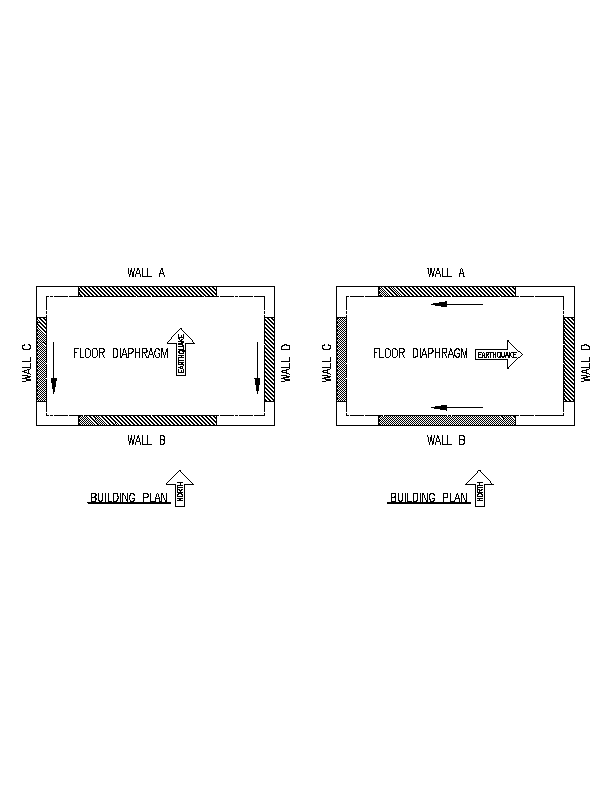
Figure 1: Shear walls and floor diaphragm in a building.
3.3 Diaphragm chords
When seismic or wind load acts on a building, the floor slab between shear walls act as a very deep beam deflecting (flexing) horizontally with the direction of the load. This deflection generates tension and compression loads along the diaphragm edges as the slab deflects back and forth. The purpose of the diaphragm chord is to resist this tension/compression load. Diaphragm chord in a concrete slab usually consists of added rebars in the slab. These rebars must be continuous and should be lapped adequately to resist full tension load.
3.4 Collectors
Collectors (drag struts) are structural members within floor/roof diaphragm that carry seismic loads to shear walls. Collectors are needed when the shear wall is not directly connected to portions of the diaphragm. Rebars should be provided to transfer the seismic load in tension and compression to the shear wall. Collectors are also needed at re entry (inside) corners as shown in Figure 2. Diagonal rebars are also needed next to corners of slab openings such as at stairways. Detailed discussion of chords and collectors is beyond the scope of this article.
3.5 Braced frames
Braced frame is another type of lateral load resisting system. Braced frames can be made from structural steel or reinforced concrete members. They can be used vertically (within a wall) or horizontally (within a floor).
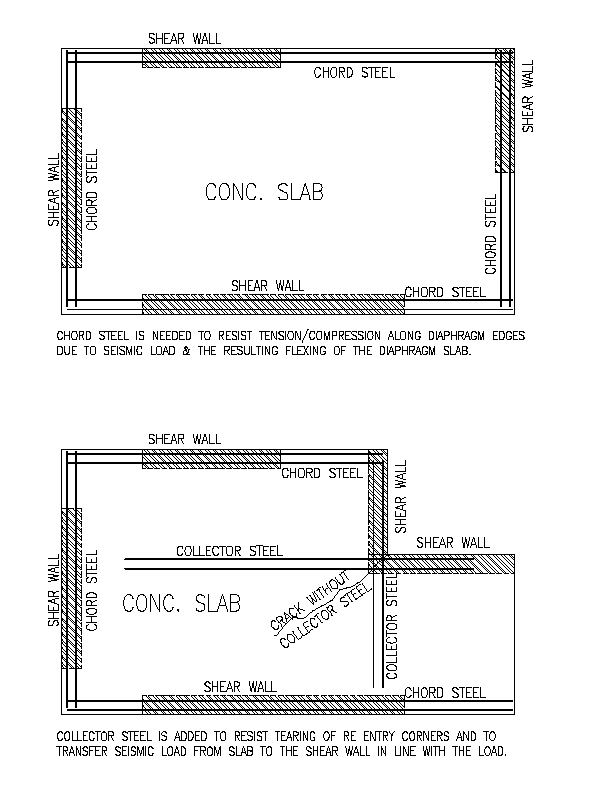
Figure 2: Chords and collectors in a floor diaphragm
4. Flexibility and stiffness
Flexibility is the property of structural members that bends (flexes) easily without breaking. An example will be a steel wire that can be bent (flexed) without breaking (steel column that can bend several inches over a 15 feet floor to floor height) without failing. Stiffness is the opposite of flexibility such as a sheet of glass that cannot bend that much without breaking (concrete wall or floor slab). Generally, concrete shear walls and diaphragms are the stiffest structural systems while moment frames are the least stiff (most flexible) systems in a building. Braced frames are somewhere between the two systems.
5. Seismic Joints
Seismic joints are gaps between different parts of a building. They allow part of a building to flex (bend laterally) independently without colliding against each other. Any collision of two building parts against each other can cause disastrous failure of the entire system. A good location of seismic joint is the joint between different wings of the multi wing building. A good candidate for this type of building would be the Kabul University dormitory building. Seismic joint is also needed where different level sections of the same building meet each other. A good example of this type of building in Afghanistan would be the Kabul Intercontinental Hotel ballroom to be separated from the main tower. Stair system forms a vertical truss with each run of the stairs behaves as a web member of a stiff vertical truss. When used in a flexible (moment frame) system, the stair system cannot flex as much as the main building. Therefore, it must have a seismic joint everywhere it joins the main structure (floor slabs) to allow the main building flex without restrained by the stairs.
6. Behavior of building systems during an earthquake
Flexible systems (moment frame) generate the least lateral loads as it allows the building structure to flex considerably without failing. This is similar to pushing against a soft surface (a cushioned chair). The drawback for this system is that any non structural components such as curtain wall (glass systems) stairways, balcony parapets, etc. must be detailed in such a way that will freely allow large lateral movements of the floor system. Any restriction against such movement will cause the failure of the non-structural component or of structural members and the collapse of the entire building system. Paying close attention to details is paramount in this system to make sure that lateral deflection of the structural system is allowed freely. A reinforced column/beam system forms a rectangular opening surrounded by the columns on its vertical sides and floor beams above and below. A 12 feet tall column can easily deflect (flex) 2 inches before it fails and as a result the rectangular opening is no longer a rectangle but a parallelogram. When this opening is filled with stiff non structural system such as masonry blocks (bricks) or large window panels, this stiff system cannot stretch to the shape of the parallelogram and it will fail. Large pieces of glass falling down can be extremely dangerous and can cause serious injuries or death. The same can be said about non reinforced masonry units falling down will cause serious injuries and death along with considerable damage to anything in its path.
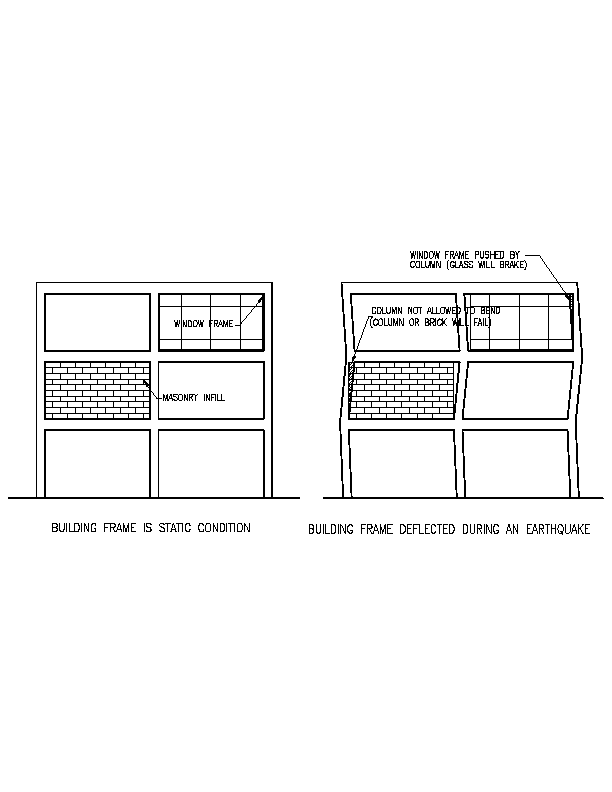
Figure 3. Behavior of moment frame and non structural infill components within frame
On the other hand, stiff systems such as concrete shear walls and diaphragms don’t flex that much and non structural members are less likely to be squished by the lateral movement of the structure but generate large lateral force such as pushing against a hard surface (non cushioned bench).
7. Mass Distribution of a Building System
Seismic loads generated on a building system are directly proportional to its mass. Large mass generate large seismic load and small mass generates small seismic load. Furthermore, the magnitude of seismic load is directly proportional to the elevation (height above ground level) of the mass. Large mass on higher levels of a building generates large over turning moments due to large seismic force combined with its large moment arm and are more susceptible to tipping over. Therefore, it is advisable to place heavy floors in the lower levels and lighter floors at the higher levels. This is similar to transporting heavy goods on top of a bus makes the bus very likely to tip over compared to the same bus carrying heavy goods inside the bus (below roof). Placing swimming pool or large water storage tank on roof top may sound like a good idea but is extremely dangerous during an earthquake as the weight of water plus the impact of water sloshing against its walls creates a large lateral force with the maximum overturning moment on the structure and its foundation. Similarly, storing heavy construction material on roof top, even temporarily such as reinforcing steel (as the author witnessed in Kabul during his 2002 trip) can be very dangerous during an earthquake.
8. Regular and Irregular Structures
Engineering textbook examples usually depict simple rectangular frames with everything simple and symmetrical but actual buildings in the real world are usually more irregular and complex. Detailed design of irregular buildings is beyond the scope of this article but a few basic concepts are discussed here. There are different types of irregularities in the building structures. These irregularities make structural analysis more challenging and needs to be addressed. These irregularities are listed as horizontal irregularity, vertical irregularity, and mass irregularity. If feasible, these irregularities should be avoided in the layout of the building or a more complex analysis and design will be necessary. Computer programs such as RISA, STAAD, ETABS, etc. can be used for such projects. These programs are complex and require training by the software developer to understanding them adequately. The price of the software and the training can be very expensive. Using the computer program without a full understanding of how the program works can result in false results and should not be used. Interested reader can find more information on the internet.
9. Continuous Load Path
When designing any structure, a close attention must be paid to the load path (seismic or gravity) from its point of origin to anchorage to foundation or other structure. Making design changes during construction should not be done in a hurry. Any proposed change must be studied by the original designer to make sure the original design intent is not violated and the load path is not interrupted. It is very important for the engineer to study the change as it is probable that the original design was done several months before and the engineer may not remember all of the details and will need time to refresh his memory. Making changes without consultation with the original engineer can potentially cause a major structural error. Case in point, a pedestrian walkway suspended over the ballroom from the roof structure of a luxury hotel in Kansas City caused the collapse of the walkway in 1981, killing 114 guests in a wedding party. The cause of failure was seemingly a minor change in the original structural connection detail (Figure 4). This change was made during construction to facilitate assembly of the suspended deck but the revision had a major change in the load path. The original design was so that the load from the lower walkway (lets called it P) was transferred to the steel rod via nut #1 and carried all the way to the roof (continuous load path from the lower walkway to the roof structure). The upper walkway load was added to the same rod via nut #2. The load at each nut was the DL + LL from one walkway (1P) while the tension on the rod was (1P) below upper walkway and (2P) above the upper walkway.
The change interrupted the load path from the lower walkway as the rod was terminated above the upper walkway. The load from this rod was carried by the horizontal cross member and transferred to nut #2. Therefore, the load on the nut #2 was (2P) after the change. The added load on nut #2 caused the weld above nut #2 to fail and the nut punched through the cross member, resulting a collapse of both walkways. Figure 4 & 5 below describe the detail and the failure of the walkway.
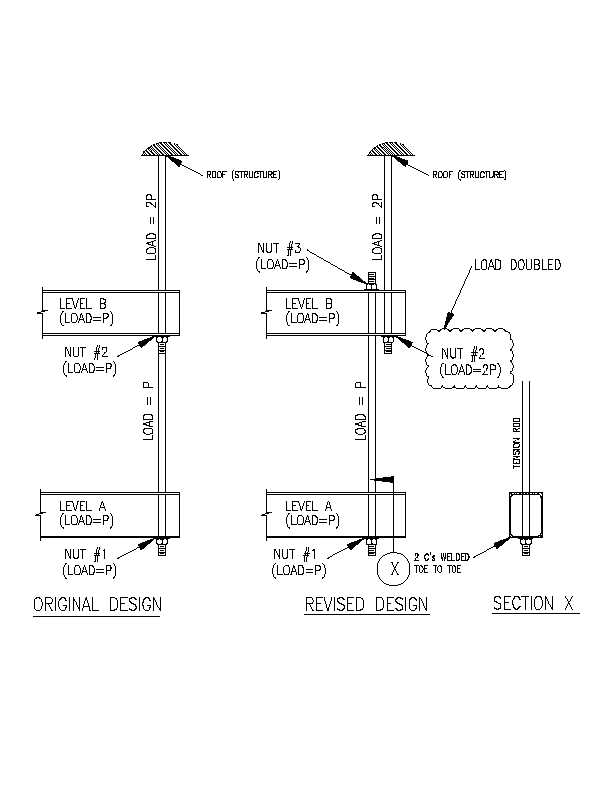
Figure 4. Revision made to the original design resulted in doubling the load on nut #2.
10. Constructability
The building designer must give careful consideration to the constructability issues of the structure. If a contractor cannot build it the way it is depicted in the design documents, the original designer must be able to pick up the tools and practically demonstrate that how to do it. One of the reasons for the design change in the walkway in the Kansas City hotel (Figure 4) was most probably the constructability of the original design as the nut supporting level B (Nut #2) would have required the portion of the rod below level B to be threaded all the way to its lower tip. Otherwise it would have been impossible to insert the nut below level B. This was not acceptable architecturally in the ballroom of a five star hotel. Therefore the change was requested. A better design would have been to add a coupler nut (elongated nut) above the upper deck to splice the rod. Even better design (architecturally) would have been to house the coupler nut inside the cross beam, to be completely concealed from view.
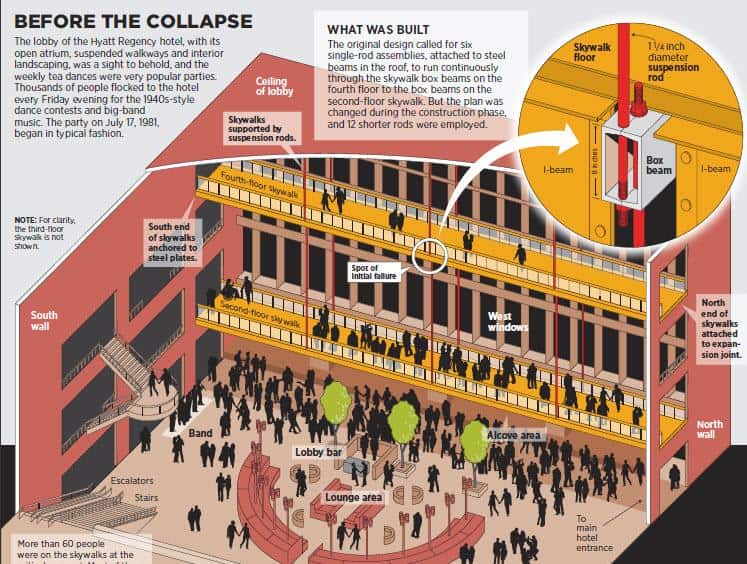
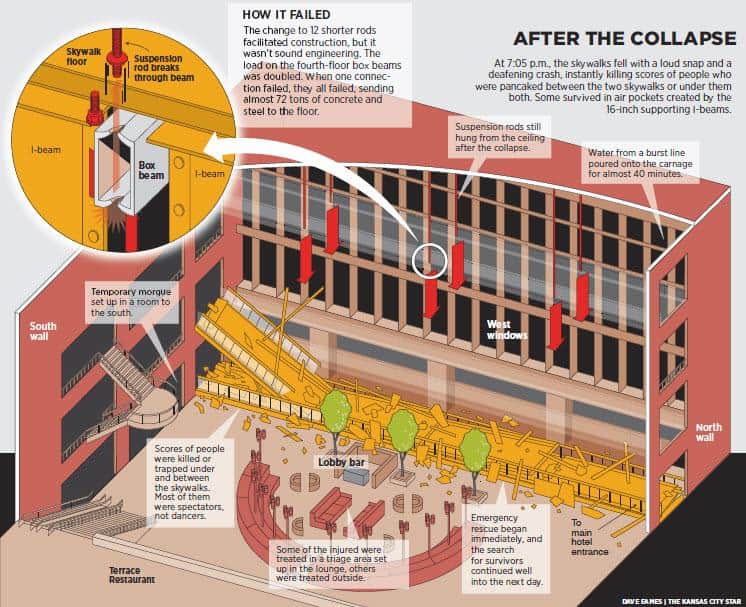
Figure 5. Diagram of the suspended walkway, before and after the collapse (Source Kansas City Star)
11. Concrete Consolidation
Reinforcing steel must be incased in concrete completely or it will not be able to develop fully. Attention should be paid that rebars are not congested and there is enough gap around rebars that concrete or grout can easily flow and incase rebars completely from all sides. Concrete and grout shall be fully vibrated. The author was a SAEOC (Structural Engineers Association of California) inspector at the aftermath of the 1994 Northridge (Los Angeles) earthquake and documented numerous masonry fence walls that had collapsed. The reason for the collapse was that the Building Code at the time (Uniform Building Code) did not require engineering calculations or construction inspection of fence walls that were six feet tall or less. These walls were six feet tall privacy fences around residential properties (common in southern California) were constructed of reinforced masonry block 4 inches thick. The walls were reinforced vertically and horizontally but the grouting operation was done poorly. As a result of no engineering and inspection, the grout was not vibrated properly and was clearly visible that the rebars had grout near the top of the wall but no grout near the base of the wall (location of maximum bending moment). Therefore, when these walls were shaken by the earthquake, the reinforcing steel was not effective at all and the walls collapsed.
12. Importance Factor
Buildings which must remain operational after an earthquake need to be designed for higher seismic loads. These building include hospitals, fire department (Etfayya) buildings and other emergency response centers. Additionally, large capacity buildings such as mosques, movie theaters, stadiums, gymnasiums, and other structures that their collapse can result in a large number of casualties should be designed for higher seismic loads. Depending on the importance of the structure, the seismic load on these building should be multiplied by importance factor (called I factor in the code). This factor ranges from 1.0 to 1.5. Most important structures such as hospitals deserves an I factor of 1.5. Furthermore, medical equipment that will be needed after an earthquake such as X-ray, Cat scan, MRI and other equipment that are vital for a hospital must be securely connected to the floor so they do not tip over or get damaged otherwise by an earthquake.
13. Consequence Factor
There are no current provisions in the code for this factor. Keeping in mind that the building code mandates minimum safely requirement for the design, it is therefore highly recommended that the building designer consider the consequence of any failure. An example of this factor will be a roof parapet on top of a warehouse. This type of structure is not very important from the code point of view and can be designed per minimum requirement. But if there is a mosque or an auditorium close to the warehouse, the parapet can fall on the roof of the adjacent building and can cause roof to collapse, thus resulting a major loss of life. Therefore, a higher design standard shall be used for such a structure or its components.
14. Richter Scale vs. Seismic Load
Building codes never used Richter scale for designing structures. A majority of previous codes used in the United State were based on UBC (Uniform Building Code). This code used seismic zones ranging from zero to 4. Zone zero was an area or a region with no seismic fault (crack in the earth’s crust) nearby. Therefore it was considered to be far away from any earthquake hazard and no seismic design was necessary. Zone 4 was assigned to the area where a known seismic fault existed nearby and was to the most earthquake prone regions of the world. San Francisco and Los Angeles were both located within seismic zone 4. Hindukush mountain range in Asia was also zone 4. The code had tables listing factors (called Z factors) for each zone to be multiplied among other factors by the building weight as the seismic load on the structure. These factors were inversely proportional to the distance from the seismic fault. Building closest to a seismic fault were designed for the maximum Z factor while buildings located far away from the fault were designed for smaller Z factors (ranging from zero for zone zero to 0.4 for zone 4).
Although IBC (International Building Code) was first published in the year 2000 but there were many problems with the new code language and California (a leader in the seismic design) did not adopt it. The state continued using UBC 1997 until the problems with IBC language were finally resolved with its 2006 edition. California adopted the IBC 2006 but added hundreds of pages as the California amendments to be used as the California Building Code 2007 (CBC 2007). This new code uses seismic maps developed by the USGS which lists seismic acceleration as a percentage of the gravity (g). Any further discussion is beyond the scope of this article. Interested readers are encouraged to visit the USGS web site for more information.
- Light Weight Construction Material: When not needed structurally, it is highly desirable to use light weight construction material for non load bearing components such as partition walls. Use of light gage steel studs and dry wall (gypsum board) can result in tremendous reduction of the dead load compared to brick and mortar wall which is common in Afghanistan. A four inch thick brick wall weight is about 40 psf compared to stud wall of the same thickness weight about 6 psf. This reduction in dead load will require smaller beams, columns and foundation, resulting overall savings in the construction cost. More importantly, it will result in a much smaller seismic load and can be built much faster than brick wall construction. Unreinforced brick walls easily collapse during earthquake, causing loss of life and are therefore not allowed in earthquake prone areas in most developed countries.
- Escape Route: Building must be designed so that there is a clear escape route in case of an earthquake, fire or other emergency. There shall also be a secondary escape route in case the main route is blocked or not usable otherwise. Emergencies such as earthquakes or fire causes panic as everyone is trying to get out in a hurry without thinking properly. This panic results in stamped which cause more casualties and death than the emergency itself. A fire in a disco bar in Brazil last year killed a large number of people. The cause for the large death toll was lack of secondary escape route as the only escape route was blocked, which resulted a deadly stampede. Stairs shall not be covered with loose rugs (common in luxury wedding halls in Kabul). If rug or carpet is used on stairs, it must be glued or screwed to the stairs conforming tightly to the shape of the stair risers and runs. Loose rug creeps downward as people walk on it, and changes the appearance of the stair’s shape. This change of shape is extremely dangerous (even during non emergency), especially for someone walking downward and steps on the rug’s bended shape (assuming to be stair nosing). This miscalculation will most likely cause the person to fall down and get injured. During an emergency this fall will be definitely followed by a deadly stampede. The stairway shall be an enclosed structure from the rest of the building so the smoke from the building doesn’t enter the stairway. Doors to the stairway must be self closing for the same reason. Stair risers within the same run of the stairway must be the same size as any variation in stair heights will be a tripping hazard during an emergency. All escape routes shall be kept clear of any obstructions such as shoes, flower pots, bicycles etc. It is highly recommended that all wedding halls and other large assembly buildings be inspected regularly by the building department to make sure, all exit routes are adequate, clear and safe.
- Household Items: Water heaters and furnaces must be securely connected to the structure. Tipping over of this type of equipment can cause gas leak or electrical short circuit resulting in a fire in the building. It is common in rural Afghanistan to display china pottery such as large platters, tea pots and other decorative household items on a high shelve in their living rooms which are also used as sleeping rooms (probably to keep them safe from children). Some people also place large flower pots on these shelves. These items can fall down during an earthquake and it cause severe injury or death to anyone sleeping on the floor below (especially small children). Therefore, heavy items should not be placed on such high shelves.
18. Recommendations
- Locate shear walls in each direction of the building to transfer load from floors to the foundation.
- Design shear walls to transfer seismic load to the foundation (shear and uplift)
- Design floor and roof diaphragms to transfer load to the shear walls.
- Provide continuous chord rebars to resist lateral bending of the diaphragm.
- Provide collector steel to transfer seismic load to shear walls as needed.
- Provide a continuous load path from its origin to its destination.
- Locate heavier weight items on lower floors and light weight items on upper floors. No swimming pools on the roof.
- Try to avoid structural irregularities or use appropriate computer program to analyze it.
- Design buildings of higher importance or potential for higher loss of life for higher seismic loads.
- Vibrate concrete properly so it consolidates well. Self consolidating concrete may be used without need for vibration.
- Use light weight construction material for non structural components when possible.
About Author: Amin Mahmood
Education: B.S. in Civil Engineering from Faculty of Engineering, Kabul University in 1975, M.S. in Structural Engineering from University of Nebraska, 1981
Professional Experience: Mr. Mahmood has over 30 years of experience in structural design in the United States. He obtained his first professional Engineer’s license in 1981 in the state of Iowa and in 1982 in the state of Nebraska. He is currently licensed as a civil and structural engineer in the states of California and Oregon, Professional engineer in the state of Colorado and structural engineer in the state of Hawaii.
Affiliations: Member of the board of directors, Structural Engineers Association of California (SEAOC), Professional member, Precast Concrete Manufacturers Association of California (PCMAC), Professional member, International Code Council (ICC) and member, Society of Afghan Engineers (SAE)
Employment History: Faculty member, department of Civil Engineering, Faculty of Engineering, Kabul University, 1975 to 1978. Engineer in various architectural/engineering firms in the United States 1979 to 1986. Self employed, president of AM Structural Design Inc. Stockton, California since 1987.
Interview with Dr. Saif R. Samady, former Deputy Minister of Education, Afghanistan
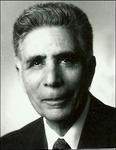
By: Dr. Bahaudin G. Mujtaba, SAE member, Professor of Management at Nova Southeastern University
Dr. Saif R. Samady has served in different administrative positions in Afghanistan. He completed his secondary education in Habibia High School and earned his undergraduate degree in chemical engineering from the University of Illinois; and a doctoral degree in chemistry from the University of Colorado. He has done research at the American Potash and Chemical Company (Trona, CA) and at the University of Durham in the United Kingdom. In terms of employment in Afghanistan, he was an associate professor in Faculty of Science, Kabul University, and served as the President of the Department of Vocational Education and Teacher Training; and Deputy Minister of Education. He was elected as Chairman of the Independent High Commission of Education for Afghanistan (2002/2003). The following are the author’s interview questions (Q) and Dr. Samady’s responses (R).
(Q): When did you begin teaching in Afghanistan, and what was the situation at that time?
(R): I began teaching inorganic and analytical chemistry to science and pre-medical students (PCB) at the Faculty of Science in 1959. It was an interesting period, as the Faculty of Science, including the chemistry department was being developed. I was appointed assistant dean of the Faculty, and I was able to participate in this process. The University of Kabul had initiated significant reform and development projects. The Faculties of Engineering and Agriculture were being established in new facilities. A team of professors from the University of Illinois was invited in 1960 to advise the education authorities on the training programs and structure of Kabul University. An important development during 1960 was the introduction of coeducation for the first time in Kabul University. In 1963 the university administration was moved to new facilities in Ali Abad, and a modern central library was established. In the early 1960s several Faculties were cooperating through an affiliation arrangement with universities in Europe and the USA. A significant personal experience for me was the preparation of a short paper on applied research, at the request of President of the University, Professor M. Asghar. He endorsed my proposal and with the assistance of the Asia Foundation (USA), the first research laboratory was set up at the Faculty of Science in 1960. Based on this initiative, the university set up a research center and a board for promotion of scientific research. In the 1970s different Faculties carried out some twenty research projects.
(Q): How are things different now in Afghanistan regarding education?
(R): It should be recognized that the development of modern education in Afghanistan was slow due to government policy, cultural constraints, and limited resources. In the 1960s and 1970s some progress was made in development of education according to government policy and strategies in the context of a democratic movement, peace, and stability. The roles of dedicated education leaders, Afghan experts, and teachers were significant. The war and conflicts of the 1980s and 1990s devastated the social and economic infrastructure including the education system in the country. In 1980, there were 1.2 million students, including (18 %) girls in all levels and types of education in Afghanistan. After twenty years, at the end of the century, the total enrolment in the education system was less than one million with only (7 %) girls. During this period the quality of education suffered and the system did not function effectively due to conflicts and instability. Since 2002, with the assistance of the international community, efforts have been made to develop the education system. There has been significant expansion of education. In 2012 the enrolment in general education was 8.6 million, including 2.9 million girls (38 %). The enrolment in higher education was 110,000, including 19,200 female students (19 %). However, the quality and efficiency of education continue to be a major challenge. There has been no significant progress in adult literacy which remains under 30%.
(Q): What is the status of general education in Afghanistan now? What can the Afghan people do to make the best of use of available resources to educate more people?
(R): The development of education requires resources. In Afghanistan the education system is financed through the government budget, contribution of the international community and public participation. Currently the development of education depends largely on external assistance and support. To make the best use of available resources, it is necessary to develop relevant strategies and ensure the efficiency of the system. This requires proper management, transparency, and accountability. The support of communities and civil societies, professional organizations; such as teachers’ associations, and school councils will contribute in the improvement of quality and efficiency of education. The use of new technologies and innovative methods such as distance education can increase educational opportunities. There has already been significant development of private vocational and higher education in Afghanistan. This trend can be further encouraged and facilitated by the authorities. The enterprises can participate in the training of young people. According to the Education Law in Afghanistan, education in government schools and institutions is free. Ways and means should be explored to encourage voluntary participation and contribution of the people in education.
(Q): What should Afghan educators, government officials, and business leaders specifically do to help more adults become literate in a shortest period of time?
(R): Adult literacy has been a major problem in Afghan society. The main reasons are limitation of resources for an effective literacy program and lack of schooling for a significant portion of school age population. In order to improve the situation, it is necessary to undertake a national campaign for adult literacy with appropriate strategies and adequate resources, and continue efforts for achievement of basic education of all children. Substantial private and public resources will have to be mobilized; large number of teachers from the formal and non-formal education systems and volunteers, including university students should be trained; and innovative methods and relevant materials should be developed for functional literacy. The use of technology and distance learning could be explored. The national program for eradication of illiteracy should be decentralized and conducted in cooperation with all governmental and non-governmental organizations, agencies, institutions, enterprises, development projects, and communities. Realistically, at present it seems unlikely that adequate resources could be mobilized for an accelerated national program of adult literacy. There are also social and cultural constraints for literacy program, especially for women. Furthermore, in 2012 only 58% of school age children were in basic education. The out of school children and young people will impact literacy efforts. Nevertheless, in addition to governmental measures, the communities and voluntary groups could play an important role in literacy efforts. The non-governmental organizations and private sector should be engaged.
(Q): What can be done to quickly increase the number of qualified master’s degree and doctoral educators in Afghanistan?
(R): I believe the training of faculty for higher education in Afghanistan is of utmost importance, which could be organized by developing graduate studies and sending qualified candidates abroad for higher degrees. The Ministry of Higher Education has undertaken such programs, largely through scholarships to USA, Europe, and other countries. Currently, 175 faculty members study abroad for the master’s and doctoral degrees. There are also 16 master’s programs in several faculties of the universities in Kabul and another 7 programs have been approved in 2013. I understand the Ministry of Higher Education intends to expand these programs as soon as the conditions permit. It is important to ensure the quality and standards of graduate studies. It is also necessary to make the employment conditions (salary, opportunity for research and professional growth) of the higher education faculty more attractive and interesting to encourage trained Afghans return home. Peace and security is also a factor. In general Afghans love their country, and in the 1960s and 1970s the majority of Afghans who were trained abroad came back to Afghanistan.
(Q): What are your thoughts regarding technical education in Afghanistan? What new technologies are needed and how can they be integrated to enhance the quality of education?
(R): Technical education is very important for economic development in Afghanistan. Engineers and technicians need to be trained for all sectors of development. In 2012 a total of 18,112 students including 893 female students were enrolled in the Faculties of Engineering, computer science, geology and mining, and agriculture. There were also 350,000 trainees in about 600 public and private technical and vocational centers. A survey of 420 centers found that 58% of trainees are in computers, mechanics, electronics, and construction, and 17% received training in business. The quality of teachers and facilities are not always at desired standards. The government departments, agencies, and the private sector have developed separate strategies, and there is a need for coordination and a comprehensive national strategy for the training of engineers and technicians. The application of technologies in the management of education has been very limited and used primarily for data collection and statistics, communication, libraries, etc. The application of new technologies initially in higher education and teacher training in Afghanistan will improve the quality of education. The gradual provision of appropriate facilities including hardware and software and necessary training programs will be required.
(Q): What do you think about online or distance education modalities for university students in Afghanistan? What role does virtual education play in the cost of education in Afghanistan?
(R): Virtual education or e-learning have developed extensively in the United States, Europe and many developing countries. The first successful distance teaching university was the Open University, which was established in 1970 in London. There are many advantages in virtual education, as it provides flexible distance education for working people, who may not have access to standard universities. It is assumed that the cost of on-line education will be less than the cost of standard education. Virtual education depends largely on computers and telecommunication. There is a need to plan and manage effectively this new mode of teaching and learning. While hundreds of thousands of students receive education through distance and virtual mode around the world, questions remain about accreditation and the quality of assessment. In Afghanistan distance education was used for teacher training as early as the 1960s. In recent years some higher education institutions have made limited use of e-learning. At present the technical capacity (computers and internet facility) and managerial experience for virtual education in Afghanistan is very limited. But it is important that higher education institutions and teacher training colleges consider the development of distance education modalities in their system.
(Q): What are your thoughts regarding the privatization of education as for-profit institutions in Afghanistan?
(R): According to the Constitution of Afghanistan the government has a responsibility to provide education. The Constitution and Education Law allow private education, and that is why a number of private institutions have been developed in the last few years especially in economics, business and management, computer science, engineering, medical technology, journalism, etc. Not all private education institutions are for-profit. For example the American University of Afghanistan is a non-profit private institution. I believe the number and capacity of private higher education institutions will rapidly increase. Hopefully the majority will be non-profit or minimum-profit to allow young Afghans have higher education and contribute in the development of the country. Many private universities in Europe and the USA find additional funds from philanthropic foundations, charities and private contributions from individuals and enterprises in order to keep the cost to students as minimum. The concept of making significant profit in universities is not generally appreciated by public. In Afghanistan, the ideal situation will be for government to increase the capacity of university education as much as feasible and for the private sector to offer higher education at reasonable cost. The wealthy people and enterprises have a moral responsibility to contribute in the education of young people. The government should provide incentive for enterprises and private individuals through the tax system for their contribution to education. Ways and means should be explored to help qualified needy students with scholarships or low interest loans.
(Q): Can the existing public and private institutions absorb and educate all the eligible students in the coming decade?
(R): In Afghanistan education at all levels is free in public schools and educational institutions. Private higher education institutions charge tuition fees. The public universities at present can admit about 40,000 new students. Last year 130,000 students graduated from secondary schools. It is estimated that about 5000 joined private institutions, several thousand students were admitted to post-secondary teacher training and technical and vocational training programs. The remaining presumably joined the labor force or they are waiting for opportunities next year. The number of secondary school graduates will substantially increase in the years to come. It is necessary that greater efforts should be made to expand post-secondary and higher education. The Ministry of Higher Education intends to develop community colleges. Measures should be taken to develop part-time and distance education as well. The possibility of virtual education also needs to be explored. Unless substantial resources become available, it seems unlikely that all eligible students will be absorbed in higher education. Flexible higher and post-secondary education and increasing participation of private sector will be essential to meet this need.
(Q): Should all colleges begin teaching their curriculums in English as is currently the case in Indian and Pakistani universities?
(R): The English language is important in higher education especially for studies such as science, technology, business, and management. Afghan students should learn English to be able to study English texts and communicate with fluency in this international language. It would be very useful and efficient in terms of quality if science and technology subjects and business courses could be taught in English. However, the teaching of all subjects in English is neither doable nor advisable. In India and Pakistan the English language as the medium of instruction in colleges is part of their colonial heritage. The great majority of Afghan students and faculty will not be able to use English as a means of instruction and learning effectively. It would be highly desirable to be able to make use of available English textbooks, references and resource materials. They should also be able to study abroad when the opportunity comes up. In this perspective efforts should made to provide intensive English language training to university students. It is also important that textbooks and educational resource materials are prepared in our national languages (Pashto and Dari). These are important languages with rich literature, which should be further developed and used to produce texts in all areas of modern knowledge including science and technology.
(Q): Some companies hire experienced professionals from outside of Afghanistan. What should be the government’s role and responsibilities in this area to employ more Afghans?
(R): In reality the number of current university graduates is much smaller than the development needs of the country. If many graduates are unable to find jobs, and companies hire professionals from outside the country, it is a question of matching qualifications with jobs and perhaps a problem of management as well. At present there is no national strategy for human resource development. The number and qualification of manpower needed for the country has not been established. There is currently no mechanism for communication and effective cooperation between universities and enterprises. The employment system for recruitment of new graduates is also inadequate. Companies with foreign participation find it convenient to hire experienced professionals from neighboring countries. The English language ability and experience could also be in favor of foreign professionals. It should be recognized that the country has experienced very significant social and economic changes during the last few years. There are many deficiencies in the administration and management of human resources, including training and employment of graduates. The government should encourage and if necessary regulate that companies in their employment policies give preference to Afghan nationals, based on qualification.
(Q): What is the role of science and technology in social and economic development of Afghanistan?
(R): Science and technology play an important role in economic development and improvement of standard of living. The application of science and technology, development of scientific infrastructure, education and training are essential for sustainable development and progress in modern societies. The teaching of science and technology to children and young people, training of engineers and scientists, and promotion of public understanding of science and technology facilitate the application of science and technology to development. During the last decade some efforts have been made in developing science and technology education and training in the country. However greater resources and efforts are needed to promote the application of science and technology not only in education and training but in all sectors of the economy. I have advocated the development of a national policy and long term strategic plan for science and technology. Special attention needs to be given to applied research and development of appropriate infrastructure and mechanism such as a National Council for Science and Technology. The promotion of scientific literacy and public understanding of science and technology will contribute to modernization and development of Afghanistan.
(Q): What are the future challenges for educational development in the country?
(R): One of the most important constraints in the development of education in Afghanistan is lack of resources. The education system is largely funded through international contributions. It is hoped that with exploitation of natural resources including minerals and other economic activities, the country will be able to finance its development. The important challenges are not only lack of capacity in the education system, but also the quality and efficiency of education. These challenges include shortage and qualification of teachers and university faculty, lack of adequate physical and learning facilities such as laboratories and libraries, outdated curricula and lack of appropriate textbooks especially in vocational and higher education. The achievement of a basic education for all children, which according to the Constitution should be compulsory up to middle school level; and adult literacy, will be a continuing challenge in education. Social and cultural constraints for the education of girls and women especially in the South and East of the country will affect the development of education. Peace and stability will be the most important factor for progress in education.
(Q): Finally, have you visited Afghanistan recently regarding any educational activities?
(R): The last time I visited Kabul was in August 2010. I was invited to participate at the inaugural conference of the Association of Natural Science and Mathematics Educators. I spoke on the subject of science and society in Afghanistan. Another recent activity was a short paper that I prepared in early 2013 for setting up a national science museum in Kabul, which could be developed in cooperation with universities. The Ministry of Higher Education and a senior American advisor seem favorable to the proposal. I believe non-formal programs of science education and information such as a science museum can be an effective means for inspiring children and young people in science and technology. I hope the Afghan scientists and engineers in the United States, especially the Society of Afghan Engineers (SAE), could support a science museum in Kabul.
Membership News
In this section, the news about new membership, awards, promotions, retirement and loss of the Society members will be provided.
The Appointments of the SAE Committee/Subcommittee Leaders
During the July 10, 2013 Board of Directors meeting the following appointment for the SAE Website Development and Maintenance Subcommittee were approved:
- Dr. Abdul Saboor Rahim- Chairman
- Dr. Y. M. Ebadi- Member
- Mr. Amanullah Mommandi- Member
- Mr. M. Q. Kadir – Member
The appointments of the following leaders and counselors of the committees/subcommittees have been approved by the Board of Directors on August 14, 2013.
- Dr. Shad Sargand: Chairman of Materials and Specification Committee
- Mr. Amanullah Mommandi: Board Counselor of the Materials and Specification Committee
- Dr. Yar M. Ebadi: Board Counselor of the following Committees/subcommittees:
Capacity Building and Academic Development Subcommittee
Student Subcommittee
Advisory Subcommittee
The Editorial Board of the SAE eNewsletter congratulates the aforementioned appointments and wishes them continued success.
Resignation
Mr. Mohammad Hashim Rayek a former SAE President and current member of the Board of Directors resigned from his position as Board member. The Board of Directors approved his resignation request during their meeting of September 11, 2013. The SAE eNewsletter Editorial Board wish him success in his endeavor.
Please contact the Chairpersons of the committees or SAE President, Ghulam Mujtaba at Email: mujtabaghulam@bellsouth.net if you are interested to serve on any of the SAE Committees/Subcommittees.
Membership Renewal 2013
The attached form includes application for the new members and membership renewal. The application forms may be viewed at SAE website. The members are requested to take a few minutes of their time to inform the Society by sending their updated contact information.
The completed application/renewal forms may be mailed to Mr. Jawad Ibrahim or Mr. Atiq Pnajshiri P.O. BOX 11097 Alexandria, Virginia 22312
Thanks to members who have updated their membership renewal and have paid their annual membership fee. Also, the treasurer has received donations checks from a few members. Thanks for their generosity. In this issue of the newsletter, the list of the contributed colleagues and their contribution amounts in year 2013 are included.
Membership Contributions in 2013
The Society of Afghan Engineers
| Date | Member’s Name | Fee Paid | Donation | Total Payment | Year |
| 1/19/2013 | Said Maqsod Mosmer | 60 | 50 | 110 | |
| 1/19/2013 | Zarjan Baha | 60 | 40 | 100 | |
| 1/19/2013 | Ghulam Mujtaba | 60 | 50 | 110 | |
| 1/19/2013 | Atiq Panjshiri | 60 | 40 | 100 | |
| 1/21/2013 | Abdul M. Khalid | 60 | 0 | 60 | |
| 1/21/2013 | M. N. Poya | 60 | 40 | 100 | 2012 |
| 1/21/2013 | M. N. Poya | 60 | 40 | 100 | 2013 |
| 1/22/2013 | Yar M. Ebadi | 60 | 40 | 100 | |
| 1/23/2013 | Moheb Argand | 60 | 0 | 60 | |
| 1/24/2013 | Amanullah Mommandi | 60 | 40 | 100 | |
| 1/28/2013 | Wahid Enayat | 60 | 0 | 60 | |
| 1/22/2013 | Mohammad Keshawarz | 60 | 0 | 60 | 2012 |
| 1/22/2013 | Mohammad H. Rayeq | 60 | 40 | 100 | |
| 1/31/2013 | Najim Azadzoi | 60 | 0 | 60 | 2012 |
| 1/31/2013 | Najim Azadzoi | 60 | 0 | 60 | 2013 |
| 1/25/2013 | Mohammad Qaseem Naimi | 60 | 0 | 60 | |
| 4/9/2013 | Wahed Hassani | 60 | 0 | 60 | |
| 4/9/2013 | Farid Kazi | 60 | 0 | 60 | 2012 |
| 4/9/2013 | Farid Kazi | 60 | 0 | 60 | 2013 |
| 1/22/2013 | Mohammad Keshawarz | 60 | 0 | 60 | 2013 |
| 8/12/2013 | Hafizullah Wardak | 60 | 40 | 100 |
1- The list includes only the contributions during 2013. A few members have sent two checks. One for the year 2012 and the second one for 2013.
Achievements and Awards
The newsletter will inform their readers of winners of awards or any other successes of Afghan professionals and students, especially, their Society members. You can help the SAE eNewsletter editors by providing the news of the achievements, award winners, promotions, and any other success stories.
“Advise us of success stories or achievements of the Society members and any Afghan professionals and students.”
Research and Presentations by a Member of the Society of Afghan Engineers
Dr. Bahaudin G. Mujtaba, an SAE member and professor at Nova Southeastern University (NSU) Huizenga School, has been invited to China and Thailand for conducting research and presentations respectively. The following information has been included in the July 3, 2013 issue of SharkBytes, NSU publication regarding his trips:
During the week of June 4-12, 2013, H. Wayne Huizenga School of Business and Entrepreneurship Professor Bahaudin G. Mujtaba was invited by the School of Management at the Xi’an Jiaotong University to conduct research with Han Ping and to speak on the following topics to master and doctoral students at the university: “The Role of Management Expectation or the Pygmalion Effect in Motivating Employees toward High Performance” and “A Cross-Cultural Analysis of Management Skills.”. More information may be at the following website:
Trip to China: http://nsunews.nova.edu/huizenga-school-professors-publish-present-research-agba-conference-bangkok-2/
Huizenga School Professors Publish and Present Research at AGBA Conference in Bangkok. Professors Bahaudin G. Mujtaba and Frank Cavico, both of the H. Wayne Huizenga School of Business and Entrepreneurship, had their paper entitled, “Employee Wellness Programs Carrots and Sticks,” accepted for publication and presentation at the Academy for Global Business Advancement (AGBA), which recently took place in Bangkok, Thailand. Mujtaba presented the paper at the AGBA Conference that was sponsored by the King Mongkut’s Institute of Technology at Ladkrabang. More information may be at the following website:
Trip to Bangkok- AGBA Conference publication in Bangkok: http://nsunews.nova.edu/huizenga-school-professors-publish-present-research-agba-conference-bangkok/
The Society of Afghan Engineers Organization
SAE E-Executive Committee Members:
President: Ghulam Mujtaba
Vice President: Atiq Panjshiri
Treasurer: Jawad Ibrahim
Secretary: Luis Durani
SAE Board of Directors:
Chairman: M. Qasem Kadir
Members: Yar M. Ebadi, Abdul Hamid (Farid) Kazi, Mohammad Saleh Keshawarz, Abdul Manan Khalid, Amanullah Mommandi, Mohammad Najib Poya, Abdul Saboor Rahim
SAE Past Presidents: Malik Mortaza, Sohaila Sanie Shekib, Ahmad Wali Shairzay, Mohammed Hashim Rayek, Abdul Hadi Rakin, M. Qasem Kadir, Abdul Hadi Rakin
Chairpersons SAE Committees/Subcommittees: Sohaila S. Shekib, M. Saber Sarwary, Samay Stanackzai, Ghulam Mujtaba, Nazeer Babakarkhial, Hasan Nouri, Najim Azadzoi, Atiq Panjshiri, Abdul Karim Yusufzai, A. S. Rahim, Shad M. Sargand
SAE Local Chapter Coordinators: Najim Azadzoi – Massachusetts; M. Qasem Kadir – Southern California; A. Manan Khalid – New York and New Jersey; Mohammad Mirwais – Kabul; Amanullah Mommandi – Colorado Chapter Coordinator; M. Qaseem Naimi – Toronto, Canada; Atiq Panjshiri – Virginia and Washington DC
SAE Manager Membership Committee: Naim Shahab Email: naim.shahab@gmail.com
SAE eNewsletter Editorial Board:
Editor-In-Chief: Ghulam Mujtaba, M.S, CE, P.E., CPM E-Mail: mujtabaghulam@bellsouth.net Editorial Board Members: A. Wahed Hassani, Ph.D.,P.E. Email: awhassani@gmail.com
A. Manan Khalid, M.S., P.E., LEED AP E-Mail: manank10@gmail.com
SAE eNewsletter Regional Representatives: Mohammad Mirwais Email: mirwaisarchitect@gmail.com; Daod Mohammad Email: dmohammad@suncor.com
Subscribe/Unsubscribe: The subscription to the SAE eNewsletter is free. If you are not receiving the SAE eNewsletter directly and would like to subscribe, please send a note to: mujtabaghulam@bellsouth.net with the subject “Subscribe: SAE eNewsletter”. To unsubscribe, send a note with the subject “Unsubscribe: SAE eNewsletter”.
Disclaimer: The author, reporter, or agency of each publication, project, news, and products is included in this newsletter. Additional contact information of the authors and their agencies are available with the Editorial Board of the newsletter and may be provided upon request. The Editorial Board of the Society of Afghan Engineers, Executive Committee, Board of Directors, or any of its members is not liable for the accuracy or contents of the information. The reports and information are included as provided by the authors and agencies without any changes in the substance of the documents. The information about the agency products or services is not the SAE endorsement.
The Society of Afghan Engineers
http://afghanengineers.org/donate
P.O. BOX 11097 Alexandria, Virginia 22312
Telephone: 703-407-2600
Email: info@afghanengineers.org