SAE Newsletter – 2017-01 – Volume 7, Issue 1
Analyzes Afghanistan’s complex energy supply and consumption dynamics, complemented by an exclusive interview with the Chief Adviser to the President of Afghanistan.
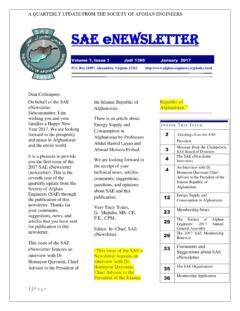
SAE Newsletter – January 2017, Volume 7, Issue 1, Jadi 1395
Dear Colleagues:
On behalf of the SAE eNewsletter Subcommittee, I am wishing you and your families a Happy New Year 2017. We are looking forward to the prosperity and peace in Afghanistan and the entire world.
It is a pleasure to provide you the first issue of the 2017 SAE eNewsletter (newsletter). This is the seventh year of the quarterly update from the Society of Afghan Engineers (SAE) through the publication of this newsletter. Thanks for your comments, suggestions, news, and articles that you have sent for publication in this newsletter.
This issue of the SAE eNewsletter features an interview with Dr. Homayon Qayoumi, Chief Adviser to the President of the Islamic Republic of Afghanistan.
There is an article about Energy Supply and Consumption in Afghanistan by Professors Abdul Hamid Layan and Ahmad Murtaza Ershad.
We are looking forward to the receipt of your technical news, articles, comments, suggestions, questions, and opinions about SAE and this publication.
Very Truly Yours,
G. Mujtaba, MS- CE, P.E., CPM;
Editor-In-Chief, SAE eNewsletter
“This issue of the SAE eNewsletter features an interview with Dr. Homayon Qayoumi, Chief Adviser to the President of the Islamic Republic of Afghanistan.”
Inside This Issue
- Greetings from the SAE President
- Message from the Chairperson, SAE Board of Directors
- The SAE eNewsletter Interviews
- An Interview with Dr. Homayon Qayoumi, Chief Adviser to the President of the Islamic Republic of Afghanistan
- Energy Supply and Consumption in Afghanistan
- Membership News
- The Society of Afghan Engineers’ 2017 Annual General Assembly
- The 2017 SAE Membership Renewal
- Comments and Suggestions about SAE eNewsletter
- The SAE Organization
Greetings From The SAE President
Dear SAE Colleagues Salaam:
Happy New Year 2017, I wish everyone a happy, healthy and Prosperous New Year.
Over the past few months, the Executive Committee has been meeting regularly to discuss issues of interest, including the upcoming Annual General Assembly (AGA) meeting. The committee discussed a few options regarding this year’s AGA meeting and it was decided to hold the meeting by teleconference from 2:00 to 4:00 PM Eastern Standard Time (EST) on Saturday, January 7, 2017. Initially, the Executive Committee, similar to last year, was leaning towards a combined AGA and a live Seminar, but due to unpredictable winter weather of Washington DC Metropolitan, it was decided to hold the meeting via teleconference on January 7, 2016. We will schedule a seminar sometime between April – July of 2017. I hope every member will be able to attend the scheduled AGA teleconference. The teleconference Number and Access code will be provided in an email to all SAE members.
Last November, I had the opportunity to travel to Afghanistan and met with several Afghan Government officials. On two occasions, I had the chance to hold meetings with Dr. Qayoumi, the Chief Adviser to the Afghanistan President on infrastructure, and discussed many topics of interest, including ways for SAE to participate in the future Development projects of Afghanistan. At my second meeting with Dr. Qayoumi, I was able to set down with him and conduct an impromptu recorded interview (The written transcript of this interview is included in this issue). These meetings have been overwhelmingly positive.
The SAE on several occasions has emphasized its willingness to actively participate and assist with relevant Ministries as well as the Kabul Municipality in the development of our beloved Afghanistan. I am hoping that we go beyond the customary cordial receptions towards a real productive cooperation.
In the last three months, SAE’s Executive Committee and the Board of Directors have held several joint meetings to discuss important issues of concerns and challenges facing SAE’s membership. Ideas on how to boost membership and actively get members involved in the day to day affairs of the Society were discussed. I would also like to hear from our members by sharing with us their ideas, opinions, and constructive suggestions. I believe we can achieve continued success only with the active involvement of our members. On behalf of the Executive Committee and the Board of Directors, I invite you to participate and share with us your ideas on how to boost membership and any suggestions to increase interest in SAE activities. Also, the Society has several committees with open vacancies. I call on all members to select a committee of their choices and become active in the day to day operation of the organization. I sincerely thank you for your willingness to participate in the SAE activities and be part of the development efforts for our beloved Afghanistan.
I look forward to hearing from you and sincerely thank you.
Sincerely,
Atiq Panjshiri, President
The Society of Afghan Engineers
Email: atiqpanjshiri@yahoo.com
Phone: (703) 407-2600
Message From The Chairperson, SAE Board Of Directors
As the year of 2016 draws to the end, I take this opportunity to usher in the New Year wishing for peace, prosperity and health to all, especially for our Afghan brothers and sisters who have continuously experienced hardship and turmoil all these years. I am praying to Allah to intercede and end this suffering.
During the year of 2016, the Board of Directors held regular meetings and on as-needed basis via conference call. The discussions were mainly focused on the Executive Committee’s needs and proposals and how to increase membership and improve the Society’s activities and contribution to the reconstruction of Afghanistan.
The Executive Committee and I met with Dr. Hamdullah Mohib, Afghanistan Ambassador to Washington, DC and with Dr. Homayon Qayoumi, the Chief Adviser to the Afghanistan President, on several occasions to hear from them of the Afghan Government needs and challenges in the context of rebuilding our homeland. We exchanged numerous ideas on how SAE will be able contribute their collective professional expertise in aiding the Afghan Government on various technical issues. This state of affairs will continue until we arrive at amicable decisions to attain SAE goals. It is my hope that in Year 2017, the SAE will attain the goal of being a part of the reconstruction activities in our homeland.
I would like to encourage the Executive Committee Members and the Board of Directors to continue with their tireless efforts and contributions to the SAE.
With this message, I wish you and your families a happy and prosperous 2017
Sohaila Sanie Shekib,
Chairperson, Board of Directors
The Society of Afghan Engineers
The SAE eNewsletter Interviews
In every issue of the SAE eNewsletter the readers may find an interview with successful Afghan diasporas or other professionals who have served or currently serving as executives, managers, presidents, deans, professors, architects, engineers, and leaders.
You may ask our professional leaders, scholars, company chief officers, and engineering pioneers if they would accept our request for interview. You may also interview them and we will be pleased to publish their articles and interviews.
In this issue of the newsletter there is an interview with Dr. Homayon Qayoumi, Chief Adviser to the President of the Islamic Republic of Afghanistan. The SAE eNewsletter Editorial Board would like to take this opportunity to thank Dr. Qayoumi for taking the time from his busy schedule to have an interview with Mr. Atiq Panjshiri, the SAE President.
An Interview With Dr. Homayon Qayoumi, Chief Adviser To The President Of The Islamic Republic Of Afghanistan
By: Atiq Panjshiri, the SAE President
Dr. Mohammad Humayon Qayoumi is the Chief Adviser on Infrastructure, Human Capital and Technology to the President of the Islamic Republic of Afghanistan. He is president emeritus of San Jose State University, USA. Prior to that, he served as the fourth President of California State University, East Bay.
Dr. Qayoumi is born in Afghanistan and is the first person of Afghan descent to head a major U.S. university. He has earned a Bachelor of Science degree in electrical engineering from American University of Beirut in 1975. He holds four degrees from the University of Cincinnati; a Master of Science in nuclear engineering (1979), a Master of Science in electrical and computer engineering (1980), an MBA (1984), and a Ph.D. in electrical engineering (1983).
He was a tenured professor of engineering management at California State University, Northridge. Dr. Qayoumi has published eight books and more than 100 articles, as well as several chapters in various books. He is a licensed professional engineer and a certified management accountant.
Dr. Qayoumi has served his native country in various financial capacities. He was the senior advisor to the Minister of Finance of Afghanistan from 2002 to 2005 and served on the board of directors for the Central Bank of Afghanistan from 2003 to 2006. Dr. Qayoumi has been married to Najia Karim for the past 33 years.
Last month the author had the opportunity to travel to Kabul and met with several Afghanistan Government officials, including our longtime friend of the Society of Afghan Engineers (SAE) Dr. Homayoun Qayoumi. During the meeting, he asked Dr. Qayoumi if he has time for interview. He accepted the author’s request.
The following are the Author/Interviewer’s questions (Q) and Dr. Qayoumi’s responses (R).
(Q) Please briefly tell us about your responsibilities with the Government of Afghanistan and the function of your office.
(R) Let me first extend my greetings to all fellow SAE members.
My current role is as President’s chief adviser in the area of infrastructures, human capital, technology and regional connectivity. The idea is to serve as a coordinator for all of the works for most of the sectors of ministries, to work together and to move projects forward.
(Q) Please talk about future major development projects currently approved for Afghanistan
(R) In terms of major development of the projects that we have underway, the key elements started based on president’s speech in London two years ago. The goal is for Afghanistan to become self-reliant, and for self-reliance, we have to take everything back to basics. The basics would be:
(1) The things Afghanistan wants to grow, which would be our agriculture;
(2) What we want to extract in our mining;
(3) What we want to trade; and
(4) What we want to manufacture.
So within these four elements, we looked at our infrastructure needs and the human capital needed and also linkages to all our neighboring countries.
So, in terms of agriculture, recognizing the arid climate of our country, suitable land for agriculture has decreased to less than 85% of that which was in the 1980s. And also due to climate change, for the last 30 years, the snow melts about three 3-week sooner. Considering these conditions, the idea of increasing irrigation projects and dams has become quite important and critical. Therefore, we started building a series of irrigation dams with 21 dams already at different stages of design and construction. The plan is to design and build between 80 to 100 dams in the next several years as well as some of the canal systems.
We are also looking at leveling our land. This is because the majority of our agricultural land is not level. The leveling of agricultural land will reduce water consumption by about 25% and increase yield by about 30%. We are also looking at better ways for the use of fertilizers and are also looking at particular cash crops that need to be grown.
As for mining, we are studying their extractability, recognizing that Afghanistan is blessed with so many different types of minerals. The idea behind this was the big euphoria of 5 years ago comparing Afghanistan to Saudi Arabia of lithium with the potential of about $3 trillion in these different mineral resources. It is one thing to have the resources but it is another thing to analyze whether it is economical and what needs to be extracted. Where to start in this legally unknown environment is another challenge. So we started working with our priorities by looking at hydrocarbons, oil and gas, due to their shorter time line of obtaining some results.
Construction is going to be a big item, at least for decades. In terms of housing, Afghanistan has about 900,000 some odd housing or some dwellings for a country with the population about 30 million people. That is a ratio of about 1 to 30. Therefore, we need several million housing units that need to be built in addition to schools, government buildings, hospitals, and so on and so forth; which make the construction materials the second key element of mining.
The third key elements of mining would be metals that include copper, iron, nickel, zinc and other sources. The fourth one would be looking at precious and semi-precious minerals. Semi-precious and precious are important because they could generate a lot of jobs for semi-skilled and unskilled workers, especially for women. And then looking at more strategic elements such as lithium and rare earth minerals because Afghanistan has 14 of the 17 rare earth materials.
Moving on to what we need to trade. Again, of course Afghanistan until the 18th century was a crossroad of many trade routes. Being in the heart of the Silk Road and present vision is to convert Afghanistan from a cul-de-sac to a roundabout of the region to serve the area as a whole. For trades, we are really constituting our efforts in three areas, moving energy from central Asia to south Asia, a natural gas tap being one of them, CASA1000, one of the electric line TAP, 3rd one for Turkmenistan to Afghanistan and Pakistan.
For Moving goods, we could be the shortest distance between China with Iran and all the way to Europe. Right now Chinese goods could take 8 to 9 months getting from China to Europe, which can be cut to 8 to 9 days. And also, with the development of Char Bahar and Gwader ports, we could be the one port for all of central Asian countries. Moreover, for all Pakistani and Indian goods that could go to central Asia, could go through these ports.
The third area of the trade in plan is Data. Right now half of the world data traffic is between Europe and Asia and the current route is from Mediterranean going through Swiss canal and Red Sea wrapping around Arabian peninsulas to Persian Gulf to Indian Ocean and wrapping on the eastside of China. It takes the data 130 millisecond, but if the rout goes through Afghanistan it could actually be cut by 30%. For this reason, we put fiber optic with Turkmenistan-Afghanistan-Pakistan-India (TAPI) line which connects Turkmenistan all the way to India. There is another one that connects through CASA line on the Caspian to Baku and from Baku through Italy. We can be part of this Trans data alliance that can rival Trans Siberia fiber and could become a major source of revenue for Afghanistan.
The Potential of data transit revenues for Afghanistan could be billions of dollars a year. If we do these three elements right, the potential of generating revenue of over 3 billion dollars a year from data, energy and goods are within reach for Afghanistan.
The last item is the manufacturing and the things we could manufacture. I think manufacturing would have to start with the value-change on food products on light and IT industries. If we look at all of the military bases, the ISAF forces spend billions of dollars on the bases. The airports that was built in Helmand is bigger than Dubai Airport and the Airport in Kandahar was built for 20,000 soldiers and similarly in the north and west. These bases have all the security, hardware, power, data, roads and all basics that could be used to help as the means of the social economic zones. These will be used for exporting material, so a lot of Afghanistan goods could be developed here as well as bring other stuffs, but all for exports, so within these or there we have tried to look at our infrastructure, which can really move us forward.
Some specifics projects in addition to dams that I mentioned include 20 renewable energy projects producing about 200 MW of power. We constructed two natural gas plants one with 50 MW and the second with 200 MW.
We got into contract to do the second phase of Kajaki dam, which will generate extra 100MW of power.
We have a Memorandum of Understanding (MOU) with the Alekozai Company to build 2nd phase of Sarobi Dam, which will generate further180 MWs of power. With the above in the last five months collectively we have been able to bring over 800 million dollars of foreign investments in the power sector. We have created a plan that will get us into self-sufficiency of power within the next five years.
Just to give everybody a sense, right now Afghanistan imports 76% of its power. Presently our power system consists of nine power grids. In the future, we will be one grid with 500 KW ring, that will supply 220KV to every provincial capital and 110 KV to every of the districts when required.
In the area of roadways and railroads, we have prepared a master plan for the railroad and have submitted it to road authority.
Lastly, for data, we have planned for open access policy where the government monopoly will be broken, with that the private companies can own their cables and the hope is to reduce the cost of data & the internet and increase the proliferation across the country. These are some of the key elements that we have been able to do.
(Q) Please tell us about projects for the next five years that have been approved and are ready to be implemented and how many has already been awarded
(R) The fact that we got $15.2 billion of pledges in Brussels and the $2.5 billion that have not been spent, will really give us great opportunities. We have a number of projects and infrastructures to do. As I mentioned earlier, getting into self-sufficiency for power is one of them. And going beyond that will be creating the national grid. We will also be able to build some significant part of the railroad network, especially in the Northern part of the nation. We will be part of the “one Belt, One Road”. The building of the key roads, especially central Afghanistan, really connects the rest of the country to the central part. These are some key projects.
In terms of the regional projects, we have looked at five key projects. One will be the TAPI line which has been transferring power from Turkmenistan via Afghanistan to Pakistan. The second one is the railroad connector from Iran to Herat and Herat to Tourghundy and of course from Aquina all the way to Sherkhan Bandar. The third project is building of a fiber optic cable connecting Wakhan corridor to Fazierbahd that’s 450 kilometers or so. This will provide direct internet connectivity between China and Afghanistan. The fourth one is better internet connectivity between Afghanistan and central Asian countries. And the final one is developing the Kabul-Kunar Basin. I think all of these regional projects will be tremendously helpful.
(Q) Describe the challenges and difficulties your office is facing dealing with these projects
(R) One of the key challenges is the lack of adequate skills, especially in the areas of program and project management. It is unfortunate considering the expenditure of billions of dollars for capacity building. But not real and adequate capacity has been built in these areas and we’re trying to see if we can ameliorate that. The other area would be the whole sense of accountability. People need to look at themselves as being responsible for these projects. They should complete projects on time, to recognize all the logistic parts of it, and if they run into logistic difficulties, they should be able to work ways to ameliorate the obvious challenges.
(Q) Let’s talk about areas of needs for each project, where are the deficiencies as you see them?
(R) I think the human capital is a big issue, especially vocational and technical, so that’s one of the areas that we’re concentrating. Also, the design capabilities are quite limited. We have not held our project designs and designers to international standards, which is a shame. A lot of our roads were designed by people who have never been to Afghanistan. They were using Google maps as design guides. We did not build enough capacity for construction in many of the companies so that they could do big projects. Now we are suffering in this area. For variety of reasons, we are left behind in the development of cement production. Right now, we are still importing 8 to 9 million tons of cement a year. We are also importing asphalt, and structural steel. We have 50 varieties of marble with 42 different colors. Unfortunately, we have not really developed our production methods to meet the demand. Most of the marble is still mined in very traditional and primitive way, which cause a lot of waste. We are generating a dime in lieu of a dollar. Our limited connectivity with our region is another factor. Part of the efforts, we’re trying to connect with neighboring countries in a much better way.
(Q) The Society of Afghan Engineers (SAE) as a professional organization is willing to assist to whatever we can do in our capacity, how do you see where would the SAE role be in this process?
(R) The SAE can play a number of different roles. One way will be for some of the members to travel to Afghanistan during their vacation time. Of course, all expenses and accommodations should be paid by the government of Afghanistan. During their stay, they could mentor on specific projects, and train people in the area of various expertise. They could also review specific projects in a variety of fields. We can start with one or two projects and build on that experience. We need a lot of help in urban planning, traffic management, various aspects of municipality, and urban development. SAE’s expertise could be tremendously important.
(Q) What are the current roles, responsibilities, and involvement of engineering, science and technology in planning and development of infrastructures in Afghanistan? Are there any vision and planning to promote and establish a higher role for it? The rise of India and China as a global economic, science and technology power house is attributed to the role of engineering, science and technology, which are the products of their educational institutions. What steps is the Afghan government taking in this regard?
(R) Well first of all, we will really be looking at our vocational technical programs. We have created this wrong expectation that everybody goes to high school, then to university and then they all get a four-year degree. And now everybody expects to get a master degree. Unfortunately, the quality of education is very poor and need a lot of improvements. Although we have increased in quantity, the quality has remained quite low. Certainly, much lower than what it was 40 years ago. We have done very poor job on the vocational technical program. As you know, we have over 150 private universities with questionable facilities and academic programs. People are just having a degree regardless of the quality and earned capabilities. I wonder how much such degrees could help graduates, especially outside of Afghanistan. For the past 13 years most of our economy was based on unrealistic and unsustainable income through jobs primarily with international organizations.
In the area of expertise, most of our degrees offered during the past decade are in the areas of international relations, political science and law. There is a mismatch between the degrees that are offered and the needs of the country. Engineering and science have been short changed. There are major deficiencies in these areas. We need expertise in all fields of engineering, mining, construction, logistics, medical, IT, and agriculture. These are the key areas where Afghanistan really needs to build adequate human capital in the next decade. That is the reason for a big push in the vocational and technical areas.
(Q) Is there a master schedule by which the government monitor quality of work, meeting progress milestones on projects and, especially work quality meeting established standard? Who and how are the standard and milestone established?
(R) Right now, we are in the process of developing some milestones, and standards in order to establish baseline for our technical people. We are to identify the gaps and to develop training programs to bridge them. This effort will help in creating a ranking system for engineers and other professionals. This is going to be a long process and going to take several years to build the needed capacity.
(Q) Is there some level of attention for instilling workplace ethics, or a system where technical talent is being nurtured and recognized? How do you see the current workplace ethics and how to improve it?
(R) We have really included all aspects of workplace ethics, the harassment prevention measures and diversity and gender sensitivity as part of the whole professional training program.
(Q) Do you have a pool of Subject Matter Experts (SMEs) that review technical aspects, set priorities, resolve technical issues of planned projects as well those in progress? What plan do you have to create such a pool of SMEs?
(R) I believe we need to build a pool of subject matter experts. However, it is still quite early. We have begun establishing some of the basic steps in trying to put some training program together. But I believe, it’s going to be a lengthy process before we actually develop those standards in a more meaningful way. Some are essential elements for propelling the economy of the country.
(Q) The quality of educational system, especially at the high school level, and higher educational institution will influence and set a path for the future of economic progress, peace and stability in Afghanistan. What steps and planning are being taken to improve the quality of education especially at the university and high school level, specifically how to improve the quality of future cadre of leaders who will be graduating as products of such higher institutions?
(R) Well, we have developed a master plan for a human capital, but it does not address the primary and the secondary school. It’s basically for people leaving secondary school after 9th grade all the way to vocational technical or higher education. The first goal is to use technology to build the capacity of our faculty. We are also trying to introduce new degrees in the areas of applied sciences, IT, and some other areas. And also, hopefully in the next year or so, we would be able to implement some online classes to complement what people are doing face to face. During the past year, we had a series of conferences in different parts of the country. We have another one in planning for the next month or so.
(Q) As you know Civil Air Transportation is very important and essential for connecting people of Afghanistan to outside world, as well connecting global economy to local economies. Today air transportation is shaping lives of people across the globe. What steps and planning are being taken to improve Civil Air Transportation in Afghanistan? The current state of Ariana Airline and few other private airlines are appalling, they do not meet Airworthiness requirements and standards; is the government taking steps to modernize the current fleet of old and decaying airplanes for Ariana, improve and establish technical expertise of the maintenance centers? This can lead and create huge opportunity for well-paying engineering and other professional employment opportunities.
(R) We are looking at air transport and also the whole logistics of the countries that we have most of our trade with, which is basically from India to Afghanistan and then central Asia and the Gulf. We will try to identify different products that could really be freighted. We are looking both at the imports and exports. For instance, there are several months of the year, 5-6 months out of a year, where Afghanistan’s vegetables and fruits could go to some of the central Asian countries, such as Kazakhstan for instance, due to their long winters. On the other hand, a lot of their grain are imported to Afghanistan. The products that I mentioned could go by air but those brought in could come by train. Afghanistan’s saffron, pistachios, raisons and pine nuts are having a lot of success. With the government’s efforts to give priority to local products, have caused Afghanistan to move to self-sufficiency in about 15 specific items. For example, during 2013-2014, Afghanistan imported over $500 million worth of soft drinks. Today Afghanistan is exporting only $200 million worth of soft drinks.
(Q) I suggest that School of Engineering of Kabul University (KU) should be affiliated with one or two engineering schools of USA or other European countries. The laboratories of the school of engineering, KU are in a bad need of tools, equipment and materials. Without foreign supports, this problem remains for years. What is the Government’s plan regarding the improvement of the quality of training activities of the engineering school of the Kabul University?
(R) Absolutely. The Kabul University engineering program is in quite a desperate need of an overhaul. Polytechnic University has been doing far better. We welcome strong relationships that could be established with any university in the U.S. We are working with a number of regional universities, especially in India, Emirates, and Malaysia. For instance, with one of the universities in Malaysia, we are working to build a better accreditation system for universities in Afghanistan. Also, we are trying to identify places that our young people can get quality education as faculty members. Right now, we have over two-thirds of our faculty members only having a bachelor’s degree, about a third having masters, and less than 5% having doctorate degrees. Nationally, in public universities we have less than 20 women faculty members with PhD. A lot needs to be done in this area. The research area also needs a lot of help. The whole culture of research in universities has not really been nourished. The higher education law passed last year making 65 years as a mandatory retirement age for faculty creates opportunity for younger faculty. Those with bachelor degrees should be given a particular period of time to be able to obtain master’s degree or higher to stay as faculty. And if we’re persistent, hopefully in the coming years, we would be able to show really major progress in these areas. The road is tough, but I am hopeful that we can still accomplish it. Afghanistan had greatness before and I believe with help from some of our friend countries and the ambition of Afghan people, future generations can have a better life than the current generation. Thank you.
Author/Interviewer Comment: On behalf of the SAE eNewsletter Subcommittee and its Editorial Board, I would like to extend my sincere gratitude to you for the time that you took from your busy schedule to have an interview with me. During the interview and our discussions, you provided invaluable information related to the planning and developmental projects of Afghanistan. We are wishing the government and people of our beloved country success in further implementation of the projects.
Energy Supply And Consumption In Afghanistan
Abdul Hamid Layan, Professor
Ahmad Murtaza Ershad, Assistant Professor
Energy Engineering Department
Faculty of Engineering
Kabul University
Abstract
Energy is vital for the sustainable economic, social and environmental development of every nation. Unfortunately, in Afghanistan, the overall energy supply and consumption is very unsustainable and as result has become very insecure with irreversible consequences and domestic energy resources have received very little attention. There are many factors that has made Afghanistan’s energy sector very unsustainable. First, the majority of Afghans both urban and rural do not have access to reliable electricity and they heavily depend on unclean solid fuels. Second, imports still make up the largest share of supplied electricity, heat and transportation fuels. Third, firewood is still the dominant primary energy source and is consumed mainly for household space, heating, and cooking. Fourth, on the demand side, energy is consumed very unsustainably. The main goals of this article are to show the rich potential of energy resources in Afghanistan, review the current status Afghanistan’s energy supply and consumption and present ways forward.
1. Introduction
Energy is vital for the sustainable economic, social and environmental development of every nation. Unfortunately, the majority of Afghans do not have access to modern energy services and the rest depend on very unsustainable supply of energy. Imports still make up the largest share of supplied electricity, heat and transportation fuels. Firewood is the dominant primary energy source and is consumed mainly for household space heating and cooking. Following firewood as primary energy sources are petroleum, Liquefied Petroleum Gas (LPG), coal, hydro and natural gas respectively. On the demand side, energy is consumed very unsustainably. For example, about 52 % of the total electricity supplied by Da Afghanistan Breshna Sherkat (DABS) was not consumed by its customers and was wasted throughout the generation, transmission and distribution phases in the Solar Year (SY) 1392. In addition, 36.10 % of the urban and 97.10 % of the rural population use solid fuels for cooking and space heating. The largest consumer of electricity is the residential sector, which is followed by industrial, commercial and public sectors. For example, average household electricity consumption rate varied from 3000 kWh/year in Kabul Province to 178 kWh/year in Ghor Province in 2011, which shows the huge difference in energy consumption rates of households across the country.
Afghanistan, the heart of Asia, is one of the least developed countries in the world. It has a population of approximately 26 million people out of which only 24 % live in urban areas [1]. Afghanistan covers an area of 652,864 km², which is slightly smaller than the state of Texas, USA and has an arid and semi-arid climate with rugged mountains and some plains in north and southwest [2]. Afghan society has been very vulnerable and insecure over the past few decades. It was ranked 169th on the United Nation’s Human Development Index globally and the lowest in Asia in 2013 [3]. Foreign aid still plays a major role in the economy as 69 % of the national budget for the Fiscal Year 2014 – 2015 was covered by foreign aid [4]. Only 2% of its land is forest area and 11 % of its population live on degraded land [3]. Thus, the objectives of this article are to review Afghanistan’s energy supply and consumption and discuss the sustainability of its energy flow and ways forward.
2. Energy Supply
2.1. Fossil Fuel Resources
The first thorough geological survey in Afghanistan was conducted by the Soviets in the 70’s together with Afghanistan Geological Survey (AGS) and later by the USGS scientists after 2001. Studies have shown that the majority of the coal, natural gas and crude oil are located in the Northern part of Afghanistan. Afghanistan’s probable coal reserves are estimated to be up to 400 million tons [5]. However, exact quantity and quality of coal reserves are not known until now. There are more than 11 coal reserves and the main ones are Ashposhta in Bamyan province, Karkar in Baghlan province, Dara-e-Sof in Samangan province and Karukh in Herat Province. Coal mining sector has experienced very slow growth just like other fossil fuels. Historical coal production ranges from all-time low of 3 tonnes per day in 1999 [6] to 4,054 tonnes per day in 1390 [7].
Natural gas has been the only energy resource that was also an export commodity in Afghanistan historically. In the 1970s, Afghanistan exported about 70-90% of its produced natural gas to Soviet Union. Average proven and probable natural gas resources was estimated to be 78.8 billion cubic meters (BCM) with a standard deviation of 22 BCM between 1980 – 2012 [6]. So far, all identified and productive natural gas fields are located in the northern province of Jawzjan. The largest reserve is Juma with an estimated 21.8 BCM of remaining capacity located in Jawzjan province [8]. Other major reserves are Jar Quduk, Yatimtaq, Bashikurd, Jangalikolon and Kohja Gogerdaq.
Crude oil production is very limited relative to natural gas and coal. There is not much reliable data regarding the crude oil reserves. Undiscovered oil reserves range from 391 million barrels to 3.56 billion barrels with a mean of 1.60 billion barrels [9]. Angot oil field in the northern province of Sari-Pul has been the major oil field in the country with a production capacity of 400 barrels per day in 2004 [5]. In addition to crude oil, there exists an average of 562 million barrels of undiscovered liquid gas condensate. Due to limited domestic production, almost all of the petroleum needs such as diesel, petrol and LPG of Afghanistan is imported from Iran, Turkmenistan, Uzbekistan and Russian Federation.
2.2. Renewable Energy Resources
Renewable energy resources such hydro, wind, solar and into some extent biomass and geothermal are abundant in Afghanistan. Hydro resources have considerable potential to be utilized for power generation. Not surprisingly, the first power generation scheme was the 2.5 MW Jabal-e-Seraj hydropower plant. Afghan rivers offer an estimated 23,000 MW of hydropower potential. Currently, installed capacity of large hydropower plants (300 KW – 100 MW) and micro-hydro power schemes (less than 100 KW) is around 293 MW.
Solar and wind energy resources of Afghanistan are excellent for applications such as water pumping, water heating, and power generation through centralized schemes, mini-grids and stand-alone systems. Annual average Global Horizontal Irradiance (GHI) in Afghanistan is 1,935 kWh/m² [10]. So far, solar energy is mainly used for lighting purposes through photovoltaic conversion in the rural areas. Total installed capacity of solar photovoltaics is around 13 MW mainly in the form of stand-alone systems. The largest solar energy system in Afghanistan is a 1 MW solar PV system providing power for villages in the central province of Bamyan through a mini-grid.
In the meantime, maximum theoretical potential of wind power is estimated to be 158 GW mainly from Herat province in the west, Balkh and Parwan provinces in the north [11] out of which only about 1000 MW of installed capacity is economically feasible [12]. Although it is unclear how much in kW of wind power is installed in Afghanistan due to lack of any industry reporting mechanism, it is estimated that total installed capacity of wind power is about 300 kW with the largest wind power system of 100 kW in the mountainous province of Panjshir. Finally, there exists potential to generate biogas from animal manure in rural areas and electricity from municipal solid waste in urban areas [13].
3. Energy Consumption
Energy consumption is limited by the lower production rate of domestic energy resources and imports. Approximate primary energy consumption in Afghanistan was 793 TJ in 2012. Biomass mainly in the form of firewood is the dominant energy source in both urban and rural Afghanistan. The 36.10 % of the urban and 97.10 % of the rural population use solid fuels for cooking and space heating [14]. An estimated 23,000 tonnes of firewood per day was burnt in Afghanistan for cooking and heating purposes mainly by the households in 2012. Petroleum after firewood is the most consumed energy resource. All of the Afghanistan’s petroleum is imported from Turkmenistan, Iran, Uzbekistan and a few other countries. An estimated 46,000 barrels of petroleum was imported in 2012 out of which about 80 % was consumed in the transportation sector and the rest is consumed in applications such as power generation, space heating in urban areas and lighting. Currently, there is no domestic production of crude oil.
LPG is a growing source of energy mainly in urban areas of Afghanistan. It is entirely imported in the market and is a major energy source after firewood, especially in the residential sector. LPG is mainly used for applications such as cooking, heating, and lighting and some commercial and light industrial purposes. Kabul province accounted for more than half of the national LPG consumption [15]. Total LPG imports was around 150,000 tons in 2005 and was estimated to increase to about 833,000 tons by 2014 [15]. Expensive LPG imported by trucks could be replaced by cheap natural gas if a national pipeline network is put in place. However, LPG is a much better alternative to burning firewood.
Consumption of natural gas and coal is limited to the domestic production. An estimated 80 % of the natural gas is consumed at the fertilizer factory in Mazar-e-Sharif which also generates power. The rest of the natural gas is consumed by households and industrial facilities in Sheberghan area. The most recent application of natural gas is the production of compressed natural gas (CNG) for transportation purposes. In addition to natural gas, coal is also used entirely for cooking, space heating and industrial purposes such as cement and brick production.
Afghanistan has one of the lowest electricity connection rates in the world. Only 28 % of the population was connected to electricity grid in 2011 and this number is projected to reach to about 83 % by 2032 [8]. Total electricity consumption was 2,222 GWh in SY year 1392 which was about 48 % of the total electricity generated and imported. This was equivalent to an average net electricity consumption of 178 kWh per capita per year. Majority of the consumed electricity is imported from Iran and Afghanistan’s central Asian neighbors. Residential sector consumes the most electrical energy.
Gross demand for electricity is expected to increase five folds by 2032 from its 2011 levels and reach 18,409 GWh. This translates to a peak installed capacity of 3,502 MW of power generation schemes. Increasing domestic hydro, solar, wind and thermal power generation capacities, expanding transmission networks and reducing imports are some of the strategies that are being considered by the government. It is planned that by 2032, about 67 % of the electricity should come from domestic sources. Addition of 2,398 MW of hydropower, 70 MW of wind, 35 MW of solar PV, 400 MW of natural gas and 1,200 MW of coal fired power plants are considered to be feasible by 2032 [8]. However, increased shares of solar and wind are analyzed to be feasible [10].
4. Conclusion
Current supply and consumption of energy in Afghanistan is very socially, environmentally and economically unsustainable. Lack of proper coal mining, huge difference in energy consumption rates of households across the country, extensive use of biomass and its direct impacts on deforestation and deaths due to low indoor air quality, high levels of imported electricity and petroleum products and extensive use of diesel fuel for power generation in urban areas are some of the challenges that need to be addressed in the future to assure sustainable growth of the country.
Increased efficiency in existing operation of energy supply, development of an enabling environment for the participation of the private sector, commercialization of energy utilities, increased investments in transmission and distribution to reduce losses, repair and maintenance of all power assets, improvement, efficient use of energy and development of the enabling policy, legal and regulatory frameworks are some of the government top priorities [16]. Fortunately, efforts by the government, national and international development agencies and the private sector are underway to reduce energy poverty and increase access to sustainable and modern energy.
References
[1] CSO, “Demography and Social Statistics: Demography Statistics: Population,” 2015.
[2] NOAA, “Climate of Afghanistan,” 2008.
[3] UNDP, “2014 Human Development Report,” 2014.
[4] MoF, “Reports & Publications: National Budget,” 2015.
[5] N. Malik, “Overview and prospects for energy resources in Afghanistan,” 2011.
[6] EIA, “Overview data for Afghanistan,” 2015.
[7] CSO, “Economy Statistics: Mining and Energy,” 2015.
[8] Fichtner, “Islamic Republic of Afghanistan: Power Sector Master Plan,” 2013.
[9] A. Sediqi, “Geology and Mineral Resources of Afghanistan,” 2011.
[10] Ershad, “Potential of Solar PV and Wind Power Plants in Meeting Electricity Demand in Afghanistan,” 2014.
[11] NREL, “International Activities: Afghanistan Resource Maps and Toolkits,” 2007.
[12] TETRA TECH, “Development of Wind Energy Meteorology and Engineering,” 2009.
[13] NREL, “Biomass Resource Assessment in Afghanistan,” 2011.
[14] GAFCC, “Afghanistan/Asia/Countries: Global Alliance for Clean Cook Stoves,” 2014.
[15] ADB, “Projects: Overview: 40921-014: AFG: SUNGAS LPG DISTRIBUTION NETWORK,” 2010.
[16] ANDS, “Energy Sector Strategy 2007/2008 – 2012/2013,” 2008.
[17] CSO, “Home: Demography and Social Statistics: Population,” 2014.
[18] ADB, “Afghanistan Energy Sector: Corruption Assessment,” 2009.
[19] USAID, “Energy and Natural Resources Workshop,” 2006.
[20] CIA, “Home:Library:Publications:The World Factbook,” 2015.
[21] Mercy Corps, “Afghan Renewable Energy Market Study,” 2015.
[22] A. Mohammad, P. Shreshta and S. Kumar, “Urban residential energy use in Kandahar,” 2013.
[23] CSO, “Population Statistics,” 2014.
[24] CIA, “The World Fact Book: Afghanistan Economy,” 2014.
[25] ACCU, 2010.
[26] WB, “Afghanistan,” World Bank Data.
[27] FAO, “Reducing Greenhouse Gas emissions through Community Forests,” 2014.
About the authors
Prof. Hamid Layan has his M.S. degree in Heat and Power from Belorussian Institute of Technology, Minsk. For the years 2004 to August 2011 he was working as Head of Mechanical Engineering Department, Engineering Faculty (EF), Kabul University (KU). From August 2011 to 25th June 2016 he was the Dean of the FE/KU and Head of Energy Engineering Department. Presently, he is the Vice Chancellor for Academic Affairs of Gawharshad Institute of Higher Education.
Ahmad Murtaza Ershad is Assistant Professor and Head of Energy Engineering Department at Kabul University in Kabul Afghanistan. He has been teaching renewable energy courses for the undergraduate engineering and environmental science students at Kabul University for the last three years. He holds a master’s degree in energy engineering from the University of Dayton Department of Mechanical and Aerospace Engineering. He wrote his master’s thesis on the potential of solar photovoltaic and wind power plants in meeting the electricity demand in Afghanistan. He is going to start his PhD studies in Feb, 2017 at the Potsdam Institute for Climate Impact Research (PIK) focusing on global energy systems modeling.
Membership News
Achievements and Awards
The newsletter will inform their readers of winners of awards or any other successes of Afghan professionals and students, especially, their Society members. You can help the SAE eNewsletter editors by providing the news of the achievements, award winners, promotions, retirement, and any other success stories.
“Advise us of success stories or achievements of the Society members and any Afghan professionals and students.”
A Glance At Books And Publications
At this Section of the newsletter, the reviews of the publications of the interest to the Society members are included. These are the publications that the SAE eNewsletter readers may find useful and informative.
The publication reviewers can write a summary of the books and publications that they have read. They can share their review comments with the readers of the newsletter.
In this issue of the newsletter we will include the reviews of the following two newly published books, written by SAE members:
- Sustainable Urban Form: Theory, Design, and Application by Prof Bashir A. Kazimee
- El-ixir of Life (اکسیر زندگی). The book about social life and ethics. It is written in Dari by Engineer M. Qaseem Naimi.
Congratulations to the authors, Professor Bashir Kazimee and Engineer Qaseem Naimi on the publication of their new books.
(1) SUSTAINABLE URBAN FORM: Theory, Design, and Application
New book by Prof. Bashir A. Kazimee
Book Abstract
The cities of the contemporary era due to their excessive and wasteful consumption of the scarce natural resources resulted in much environmental degradation. Modern cities and buildings today are the biggest consumers of the non-renewable energy capital on earth and they contribute to as much as 70% of the greenhouse gasses worldwide, which forcefully drive the global outcome on climate changes. The phenomenon of global warming and its ill effect on the land, sea, and atmospheric temperature will inflict profound social and environmental implications on the cities of the world.
In the globalized millennium ahead, cities will play a strong role in creating the ground on which cultural and economic opportunities can be cultivated for the growing world’s population. This is where innovative and creative solutions to the design of urban communities and form will necessarily play an important role in helping to find solutions to our increasing environmental problems and elevating the art of urban living to a sustainable capacity.
To this fact the book explores the latest research and practice regarding ways to design a more sustainable, livable world. It investigates the critical environmental problems that are created by modern cities and addresses the ecological concerns of urbanism. It also showcases creative design solutions through current viewpoints, proven strategies, and examples of good practices in the field.
A blend of proven theory and carefully selected case studies from different geographical locations, the text provides an interdisciplinary, holistic overview of the subject matter. Readers will gain increased awareness of the critical environmental problems created by modern buildings and cities.
Filled with outstanding graphics and visual information, Sustainable Urban Forms: Theory, Design, and Application effectively illustrates how environments can be designed to foster sustainable, livable urban communities. The book is designed for the education needs of architecture/engineering and urban design. It can function as a class textbook, or as a companion reader in a design studio setting.
Author’s Biography
Bashir A. Kazimee, AIA
Professor of Architecture
School of Design & Construction
College of Engineering and Architecture
Washington State University
Areas of expertise:
– Sustainable development
– Affordable housing
– Architecture and Culture
Bashir A. Kazimee is an award-winning professor of architecture at Washington State University. He has earned his degrees from MIT and Kabul University. His area of research is the traditional built environment and sustainable community development. He has contributed more than seventy national and international publications on these subjects. He has authored four books and his latest book: SUSTAINABLE URBAN FORM: Theory, Design and Application, First Edition is published by Cognella Academic Publishing Inc, California, January 2016.
Kazimee, gained an international reputation in the field of sustainability with his collaborative proposed plan for the city of Pullman, Washington, which was awarded one of the three IAA/UN Gold Medals given internationally at the UN City Summit – Habitat-II conference in Istanbul, Turkey 1996.
He is a licensed architect in USA and an active member of the American Institute of Architects and the Society of Afghan Engineers. He is currently contributing as a consultant senior architect on several ongoing reconstruction architectural and urban design projects for his native home country Afghanistan.
(2) El-ixir of Life (اکسیر زندگی)
The book is written in Dari by Engineer M. Qaseem Naimi.
Abstract
The physical body of human being is the vessel which carries the personality of the individual in this transient world through the sophisticated and perilous journey of life, while the soul is the essence and fundamental nature of the human being.
Hence, all infants born into the pure nature and temperament of human, what they will become and what they will do will depend on the environment they grow up in. Later on, when they reach maturity and self-reliance, if they desire to live the sublime and magnificent human life, they will need to purify and cleanse both soul and character. So, how does one purify and clean the spirit and soul? How can that could be achieved? And how can one reach the honorable high rank of a human being? They need to strive and endeavor to have piety, virtue, and abstinence. This book is an attempt to bring forward this subject and its related topics to help the seekers of such knowledge. I hope that its study is desirable for the scholars that seek pleasure and its advice and counsels would be valuable and helpful for youth. I hope it be a magical potion, remedy, and elixir for those who read this book and be a helping hand for finding the way to the honorable high rank of human being.
The book is written in Dari and it may be ordered by internet at: Open Amazon.com, write “El-ixir of Life”.
Author’s Biography
Mohammad Qaseem Naimi was born in 1942 in Kolangar District of Logar Province in Afghanistan in an enlightened religious family. Before going to school he had finished learning the Holy Qur’an and some common Dari books in the mosque. While attending the primary school, beside the school subjects he completed some basic Arabic religious books. He Graduated from Habibia High school in 1964. Graduated from the Mechanical Engineering Department of Faculty of Engineering of Kabul University in 1966. Worked as irrigation engineer in Ministry of Agriculture and then went to USA for further study and training in Civil Engineering. He got his BS in Civil Engineering from the University of Idaho in 1970. In return back to Afghanistan worked in deferent positions as design engineer, construction supervisor, planning engineer, president of Salma Storage Dam, president of WAPECA, water recourse planner and adviser. In 1988 fled to Pakistan, working with WFP, and FAO for reconstruction of war torn Afghanistan. In 1994 migrated to Canada.
After 9-11 in 2001, the new government of Afghanistan invited him back to work as adviser to Afghan Assistance Coordination Authority (AACA), and the Ministry of Water and Power (2002 -2011).
Practical Training and courses in Water Resources Planning:
– Bureau of Reclamation, Denver, Colorado, USA.
– US Corp of Engineers, Portland, Oregon, USA
– California Water Resources Department, Sacramento, California, USA.
– Food and Agriculture Organization (FAO), Rome, Italy
Publications
Papers:
– Planning of water resources projects
– Irrigation and Water Resources Projects in Afghanistan, Problems and Conflicts
– Vision of the Integrated Water resources Development in Afghanistan, TASAE Seminar, Tsukuba, Japan, November 2003.
– Drought and Water Harvesting in Afghanistan, for UNESCO, Iran, Yazd, November 2004
– Conflict Prevention and Politics of Central Asian Water cooperation from the point of view of Afghanistan, University of Peace, Almaty, April, 2005
– Climate change and Flush Flood in Afghanistan, a paper for Lhasa workshop in Tibet China, August 2005
– Status of Water Demand Management in Afghanistan, ECO-IDB-FAO Regional Workshop, Islamabad November 2006.
– Water Resources Development in Afghanistan, Challenges and Opportunities, Bangkok – Thailand, January 2009
Books:
– Water Resources Development in Afghanistan and Challenges (Dari), Toronto, February 2012.
– Arabic Language Grammar (Morphology – Syntax – Intonation) by: Dr. Sayed Jan Bayan, translated from Dari version to English.
– TAHARAT and PRAYERS, (a small booklet describing and explaining the rules of ritual purity and prayers in Islam).
– El-ixir of Life (اکسیر زندگی), Toronto, 2016 (in Dari)
– Melody of Emigrant (نوای مهاجر) a set of poetic songs in Dari (not published)
Announcements
1. The Society of Afghan Engineers’ 2017 Annual General Assembly
The following email was sent on December 19, 2016 by the SAE President regarding the upcoming General Assembly meeting:
Dear Respected Members of the Society of Afghan Engineers Salaam:
I wish you all a happy and prosperous new year 2017. The Society’s Annual General Assembly Meeting is scheduled by teleconference on Saturday January 7, 2017.
Saturday, January 7, 2017
2:00 to 4:00 PM EST (Washington DC.)
11:00 AM to 1:00 PM Pacific Time (California)
The teleconference number and access code is:
Teleconference Phone Number: 712-775-7000
Code No. 388028#
Looking forward to talk to you during the meeting.
Sincerely,
Atiq Panjshiri, President
The Society of Afghan Engineers (SAE)
2. The 2017 SAE Membership Renewal
Dear Members of the Society:
The Management of the Society of Afghan Engineers (SAE) would like to remind all members that 2017 membership renewal and Annual fee of $60 are due. Your membership fee collectively would enable us to pay for some basic needed services of the Society such as Website security monitoring, updating and maintenance. Also, your membership fee would provide SAE’s management of the financial means to organize and host events and seminars on relevant technical topics.
We appreciate your kind attention to the membership due request.
Sincerely,
Atiq Panjshiri, President
The Society of Afghan Engineers
3. SAE eNewsletter-Regional Representatives
The positions of the SAE eNewsletter Regional Representatives are open. Please let us know if you are interested to volunteer for one of these positions or if you want to nominate other qualified members to serve in these positions. The representative will inform the newsletter Editorial Board of any technical news in their regions and contact authors for their contributions in the activities of newsletter.
4. The SAE Membership Renewal Updates
The following are the status of the membership renewal fee payments and donations to the Society of Afghan engineers during 2016 and 2015.
Membership Renewal Fee And Donations In 2016
| Date | First Name | Last Name | Fee Paid | Donation | Total Payment |
|---|---|---|---|---|---|
| 3/8/2016 | Atiq | Panjshiri | 60 | 0 | 60 |
| 1/19/2016 | Hafizullah | Wardak | 120 | 0 | 120 |
| 1/19/2016 | Yacob | Munir | 60 | 0 | 60 |
| 2/27/2016 | Steve | Rossi | 60 | 40 | 100 |
| 2/22/2016 | Gul Afghan | Saleh | 60 | 40 | 100 |
| 1/24/2015 | Abdul Nazeer | Babacarkhial | 240 | 0 | 240 |
| 3/8/2016 | Abdul Wahed | Hassani | 60 | 0 | 60 |
| 2/22/2016 | Abdul Manan | Khalid | 60 | 0 | 60 |
| 3/8/2016 | Reza M. | Afshar | 60 | 0 | 60 |
| 3/8/2016 | Yar M. | Ebadi | 120 | 0 | 120 |
| 1/19/2016 | AM Structure | 120 | 0 | 120 | |
| 2/8/2016 | Ghulam | Mujtaba | 60 | 60 | 120 |
| 2/22/2016 | Shoaib | Ahrary | 60 | 0 | 60 |
| 3/8/2016 | Najb | Poya | 60 | 40 | 100 |
| 3/30/2016 | Hashim | Rayek | 60 | 0 | 60 |
| 3/30/2016 | Nadir | Sidiqi | 60 | 60 | 120 |
| 3/8/2016 | Ahmad Farid | Haidari | 60 | 0 | 60 |
| 6/11/2016 | Homayon M. | Ibrahim | 60 | 0 | 60 |
| 6/11/2016 | Sayed F. | Abass | 60 | 0 | 60 |
| 6/11/2016 | Sohaila S. | Shekib | 60 | 0 | 60 |
| 6/11/2016 | Hashem | Baluch | 60 | 0 | 60 |
| 6/11/2016 | Zarjan | Baha | 120 | 0 | 120 |
| 2/13/2016 | Mahmoud | Samizay | 60 | 0 | 60 |
| 2016 | Ashraf | Roshan | 120 | 120 | 240 |
Membership Renewal 2015
| Date | First Name | Last Name | Fee Paid | Donation | Total Payment |
|---|---|---|---|---|---|
| 7/14/2014 | William H. | Haight III | 60 | 40 | 100 |
| 1/1/2015 | Ahmad Farid | Haidari | 60 | 0 | 60 |
| 1/1/2015 | Homayon M. | Ibrahim | 60 | 0 | 60 |
| 1/1/2015 | Rafaat | Ludin | 60 | 140 | 200 |
| 1/1/2015 | Ashraf | Roshan | 60 | 60 | 120 |
| 1/1/2015 | Atiq | Panjshiri | 60 | 0 | 60 |
| 1/12/2015 | Hafizullah | Wardak | 60 | 0 | 60 |
| 1/12/2015 | Ghulam | Mujtaba | 60 | 40 | 100 |
| 1/12/2015 | Yacob | Munir | 60 | 0 | 60 |
| 1/12/2015 | Fahim | Panjshiri | 60 | 0 | 60 |
| 1/12/2015 | Steve | Rossi | 60 | 60 | 120 |
| 11/22/2014 | Gul Afghan | Saleh | 60 | 0 | 60 |
| 1/24/2015 | Abdul Nazeer | Babacarkhial | 240 | 0 | 240 |
| 2/6/2015 | Abdul Wahed | Hassani | 60 | 0 | 60 |
| 2/12/2015 | Abdul Manan | Khalid | 60 | 0 | 60 |
| 3/6/2015 | Mohammad S. | Keshawarz | 120 | 0 | 120 |
| 3/6/2015 | Abdul Saboor | Rahim | 60 | 0 | 60 |
| 3/6/2015 | Najim M. | Azadzoi | 60 | 0 | 60 |
| 3/6/2015 | Sayed F. | Abass | 120 | 0 | 120 |
| 3/6/2015 | Sohaila S. | Shekib | 60 | 0 | 60 |
| 3/6/2015 | Aziz | Ghani | 60 | 0 | 60 |
| 3/6/2015 | Mahjan | Saleh | 60 | 0 | 60 |
| 3/27/2015 | Sayed Aziz | Azimi | 60 | 190 | 250 |
| 3/27/2015 | Zarjan | Baha | 60 | 40 | 100 |
| 4/1/2015 | Mahmoud | Samizay | 60 | 0 | 60 |
| 4/2/2015 | Abdul | Chahim | 60 | 0 | 60 |
| 4/11/2015 | Aziz | Ghafoory | 60 | 0 | 60 |
| 4/10/2015 | Reza M. | Afshar | 60 | 0 | 60 |
| 4/25/2015 | Painda M. | Fakoor | 60 | 0 | 60 |
| 4/25/2015 | Sadeq A. | Ezzat | 60 | 0 | 60 |
| 5/27/2015 | Yar M. | Ebadi | 120 | 0 | 120 |
| 08/2015 | Zabi | Zaca | 120 | 0 | 120 |
1- Mr. Babacarkhial has sent his membership fee for period of four years – Payment for 2014-2017
2- Dr. Keshawarz and Dr. Yar M. Ebadi have sent their membership fees for 2 years
3- Mr. Zabi Zaca sent membership fees for 2015 and 2016.
4- Mr. Ashraf Roshan has sent his $120 membership fee and $120 donations for the years 2016 and 2017.
Comments And Suggestions About SAE eNewsletter
The Editor-In-Chief of the SAE eNewsletter has received comments/suggestions from Minister Aoudjan, whose interview was published in the October 2016 issue of the Newsletter.
Minister Aoudjan’s Comments/Suggestions
Dear Editorial Board of the SAE eNewsletter:
Thanks for your kindness and work in the publication of the SAE eNewsletter. I would like to mention a few points related to the October 2016 issue of the Newsletter.
1- Pages 6 Items (A – c) and (A – d), as described below:
c. Proposed funding for Operation and Maintenance (O&M) of the roadways from the toll collections and obtained its approval from the cabinet and parliament. Through the establishment of a better system of toll collection, its net income was increased from $2 million to $ 30 million.
d. Proposed the establishment of weighing stations and obtained their approval from the cabinet.
The intent of the proposed rules and regulations and their approvals was for toll facilities and weighing stations. In the last part of (A-d), the Parliament should be added, because the rules and regulations would be effective after the approval of Cabinet (Council of Ministers) and Parliament.
2- Pages 6 and 7 related to the installation of avalanche control equipment:
In my responses related to the installation of the avalanche control equipment, the $30 million help of the Japanese Government has not been mentioned.
3- Pages 7, seventh sentence:
The 5000 – 600 has been mentioned in lieu of 5,000 – 6,000. The sentence should be revised to read: Presently, 5000 to 6000 vehicles weighing up to 60 tons each use the tunnels.
Editor’s Response
Dear Minister Aoudjan:
Thanks for your kind notes. On behalf of the SAE eNewsletter Subcommittee I would like to take this opportunity to thanks you for your email and time that you took to have an interview with us. The publication of your interview has added to the quality of the newsletter.
You have mentioned about a few editorial errors, changes, or additional information, as described above. We have printed them in this issue of the newsletter for the readers’ information.
Best regards,
Editor-In-Chief
SAE eNewsletter
The SAE Organization
SAE Executive Committee Members:
President: Atiq Panjshiri, Vice President: Farid Abass, Treasurer: Ashraf Roshan, Secretary: Farid Haidari, Manager: Gul Afghan Saleh
SAE Board of Directors-Officers:
Chairperson: Sohaila Sanie Shekib, Vice-Chairman: Najim Azadzoi, and Executive Director: Nazeer Babacarkhial
Members SAE Board of Directors:
Najim Azadzoi, Nazeer Babacarkhial, Wahid Enayat, Mohammad Saleh Keshawarz, Rafaat Ludin, Amanullah Mommandi, Saber Sarwary, Sohaila Sanie Shekib, and Hafizullah Wardak
SAE Past Presidents:
Ghulam Mujtaba, Abdul Hadi Rakin, M. Qasem Kadir, Abdul Hadi Rakin, Mohammed Hashim Rayek, Ahmad Wali Shairzay, Sohaila Sanie Shekib, and Malik Mortaza
SAE Chairpersons of Committees/Subcommittees:
Ghulam Mujtaba, Chairman – SAE eNewsletter Subcommittee
Email: mujtabaghulam@bellsouth.net
SAE Local Chapter Coordinators:
A. Hamid Layan – Kabul, Afghanistan; M. Qaseem Naimi – Toronto, Canada; Najim Azadzoi – Massachusetts; M. Qasem Kadir – Southern California; A. Manan Khalid – New York and New Jersey; Amanullah Mommandi – Colorado; Atiq Panjshiri – Virginia and Washington DC
SAE eNewsletter Subcommittee:
Subcommittee Chairman: Ghulam Mujtaba, M.S, CE, P.E.
Members: A. Wahed Hassani, Ph.D., P.E.; A. Manan Khalid, M.S., P.E., LEED AP; Hafizullah Wardak; Abdul Hamid Layan
SAE eNewsletter Editorial Board:
Editor–In–Chief: Ghulam Mujtaba, M.S, CE, P.E., CPM
Editorial Board Members: A. Wahed Hassani, Ph.D., P.E.; A. Manan Khalid, M.S., P.E., LEED AP
Subscribe/Unsubscribe:
The subscription to the SAE eNewsletter is free. If you are not receiving the SAE eNewsletter directly and would like to subscribe, please send a note to: mujtabaghulam@bellsouth.net with the subject “Subscribe: SAE eNewsletter”. To unsubscribe, send a note with the subject “Unsubscribe: SAE eNewsletter”.
Disclaimer:
The author, reporter, or agency of each publication, project, news, and products is included in this newsletter. The Editorial Board of the Society of Afghan Engineers, Executive Committee, Board of Directors, or any of its members is not liable for the accuracy or contents of the information. The reports and information are included as provided by the authors and agencies without any changes in the substance of the documents. The information about the agency products or services is not the SAE endorsement.