SAE Newsletter – 2019-04 – Volume 9, Issue 2
Advocates for critical accessibility solutions for disabled Afghans and details engineering methodologies to improve urban storm drainage design within developing infrastructures.
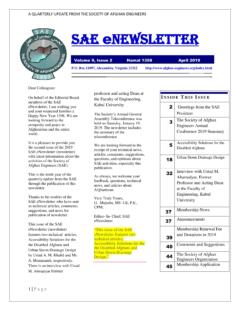
SAE Newsletter – April 2019, Volume 9, Issue 2, Hamal 1398
Dear Colleagues:
On behalf of the Editorial Board members of the SAE eNewsletter, I am wishing you and your respected families a Happy New Year 1398. We are looking forward to the prosperity and peace in Afghanistan and the entire world.
It is a pleasure to provide you the second issue of the 2019 SAE eNewsletter (newsletter) with latest information about the activities of the Society of Afghan Engineers (SAE).
This is the ninth year of the quarterly update from the SAE through the publication of this newsletter.
Thanks to the readers of the SAE eNewsletter who have sent us technical articles, comments, suggestions, and news for publication of newsletter.
This issue of the SAE eNewsletter (newsletter) features two technical articles; Accessibility Solutions for the Disabled Afghans and Urban Storm Drainage Design by Ustad A. M. Khalid and Mr. A. Mommandi, respectively. There is an interview with Ustad M. Ahmadyar former professor and acting Dean at the Faculty of Engineering, Kabul University.
The Society’s Annual General Assembly Teleconference was held on Saturday, January 19, 2019. The newsletter includes the summary of the teleconference.
We are looking forward to the receipt of your technical news, articles, comments, suggestions, questions, and opinions about SAE activities, especially this publication. As always, we welcome your feedback, questions, technical news, and articles about Afghanistan.
Very Truly Yours,
G. Mujtaba, MS- CE, P.E., CPM;
Editor- In- Chief, SAE eNewsletter
“This issue of the SAE eNewsletter features two technical articles; Accessibility Solutions for the Disabled Afghans and Urban Storm Drainage Design.”
Inside This Issue
- Greetings from the SAE President
- The Society of Afghan Engineers Annual Conference 2019 Summary
- Accessibility Solutions for the Disabled Afghans
- Urban Storm Drainage Design
- Interview with Ustad M. Ahamadyar, Former Professor and Acting Dean at the Faculty of Engineering, Kabul University
- Membership News
- Announcements
- Membership Renewal Fee and Donations in 2019
- Comments and Suggestions
- The Society of Afghan Engineers Organization
Greetings from the SAE President
Dear SAE Colleagues Salaam:
I wish everyone a happy New Year 1398.
The SAE’s new year 2019 started with the Annual Conference 2019 titled “Sustainable land Development” in Afghanistan. It was a unique and overall a successful professional conference. The gathering was well attended at capacity. The SAE members from different states of the USA, as well as local Afghan Community leaders and members of other Afghan Organizations, participated at this conference. A brief report of the conference will be provided separately in this issue of the newsletter.
On behalf SAE, I want to express my sincere gratitude to all members and the Afghan community leaders for attending and actively participating at this unique event. Also, many thanks to the conference presenters and panelist for dedicating their time; and sharing their expertise and knowledge with not only the attending audience, but also with our audience worldwide via live broadcast on Facebook. Video of each presentations is available on SAE website as well as on Facebook.
For the remaining of 2019, we are planning to have 2-3 seminars on different topics of interest. Announcement of each seminar will be made in advance for members’ participation.
At the end of the conference, while praising the value and high quality of each presentation, one request was made to move the conference to a warmer season to maximize participation by all SAE members. The suggestion was made to the Executive Committee for consideration. I am hoping to have the next Annual Conference in mid-2020.
The Society’s future activities are dependent on its membership participation and financial contribution of membership dues. Your membership fee payment will enable the organization to host valuable and beneficial gatherings of Afghan professionals. I am personally requesting members to pay their membership fee along with the attached membership renewal application form.
Also, the Society has several committees with vacancy, I call on all members to select a committee of their choices and become active with the day-to-day operation of the organization. I sincerely thank you for your willingness to participate in the SAE activities and be part of the efforts in the development of our beloved Afghanistan.
Sincerely,
Atiq Panjshir
President, Society of Afghan Engineers (SAE)
The Society of Afghan Engineers Annual Conference 2019 Summary
By: Atiq Panjshiri, SAE President
Overview
The objective of the 2019 Annual Conference was to provide a forum for members of the Society of Afghan Engineers (SAE) to share their knowledge and valuable experience in sustainable land development practices in the United States and to identify deficiencies in land development practices in Afghanistan. Our hope is that these presentations will be a useful resource for developing better, more sustainable land development policies and practices in Afghanistan.
The Society of Afghan Engineers is committed to advancing a longer-term partnership with the technical agencies of the Afghan government as well with the professional engineering community in Afghanistan. These presentations were divided into seven parts and are led by SAE members. A transcript of each presentation will be posted on the SAE website in short order. Currently, you can access the video presentations on the SAE website, Facebook page, and YouTube.
The following topics were presented at the “SAE Annual Conference 2019”, available for viewing here: https://www.afghanengineers.org/gallery/vidoes/
- Urban Development Policy: Dr. Gul Afghan Saleh (video 1)
- Establishment of Urban Development Authorities and Institutes: Eng. Ahmad Wali Shairzay (video 2)
- Sustainable Urban Transportation: Eng. Hadi Rakin P.E (video 3)
- Unregulated Development and Accessibility Challenges for the Disabled Afghans: Eng. Manan Khalid P.E. (video 4)
- Wastewater Treatment: Eng. Aziz Azimi, CEO/President Technologists Inc. (video 5)
- Infrastructure Construction: Eng. Jalal Masumi (video 6)
- Urban Storm Drainage Design: Eng. Amanullah Mommandi P.E. (video 7)
Sustainable Land Development in Afghanistan
Land Development is the process of converting land from one use to another, and this conversion process has taken place throughout the history of mankind. As populations increase, the need for land development increases to facilitate better and more convenient living conditions. As land development increases, the available land becomes scares and development of existing areas becomes more complex. Notably, roadways and transportation systems become more complex and commercial markets and residential areas become denser. On account of this growth, waste water treatment, waste disposal, water supply, drainage, environment issues, security and a host of other concerns are exacerbated.
Although land development may be beneficial for a short period in terms of economic growth, it can have severe future consequences for the environment and the social well-being of future generations if it is not managed properly. In order to be sustainable in the long term, land development policies must balance current economic opportunities with the needs of future generations and the environment. Any neglect in the land development process can have severe consequences for generations to come.
The Afghan government and the development community have a moral obligation to make sure land development is properly regulated and growth is geared towards sustainability.
The 2019 SAE Conference on “Sustainable Land Development” in Afghanistan tackles some of these challenges and proposes solutions to improving living conditions in Afghanistan. Each presentation, led by an experienced SAE professional, focused on a topic of interest related to land development. Although, this conference did not cover all aspects of land development due to time constraints, we believe it was an important first step in bringing experts together to address these issues. Our goal is to have similar gatherings of experts to discuss other aspects of land development that we did not cover in our 2019 Conference, in the hope that these presentations will be used and implemented as local authorities see fit in Afghanistan.
Unfortunately, in the last eighteen years the land development process in Afghanistan has not advanced through the normal process that most countries experience. The Afghan Government needs to implement standardized policies in a transparent legal process and enforce these policies equally, otherwise progress will not be noticeable in the long-term.
To facilitate adoption of a standardized process, the Afghan Government must create a governing commission comprised of relevant stakeholders. Similar to other countries, the commission will be in charge of the overall planning process.
An orderly land development process can only be successful with proper planning and enforcement of established regulations, guidelines and standards that are equally applied to every applicant. Lack of an orderly process can have negative effects leading to unruly urban sprawl that results in unequal living conditions and forces poorer individuals into slums or other areas with substandard living conditions. Also, disorderly development can have a major negative impact on the environment and sanitation.
Conclusion
The challenges that land development poses in Afghanistan’s major cities, while immense and costly, are not insurmountable. In order to address the negative economic and environmental impact that massive, unregulated land development poses, the Afghan government and interested stakeholders must act today to adopt both short-term and long-term solutions to address flooding, sanitation, pollution, congestion, and water access, among other issues. However, the success of these measures depends on an overarching land development planning process that is grounded in a culture of accountability, respect for legal norms, and equal application of the law.
Accessibility Solutions for The Disabled Afghans
By: Manan Khalid, P.E., LEED AP(BD+C)
Abstract
According to World Health Organization (WHO) one billion people—one in every seven of the world’s population lives with a physical, sensory, intellectual, or mental health impairment that affect their daily lives. People with disabilities are often without equal access to healthcare and rehabilitation, education, employment, and are marginalized or excluded from the socioeconomic, religious, and political lives of their communities. People with disabilities have also routinely been overlooked by global health and international development efforts.
In this arena, Afghanistan has had its share. Sadly, decades of bloody conflicts have multiplied the number of these unfortunate human beings. According to the Middle East Institute, the war, through its direct and indirect effects, has resulted in 1.5 million disabled Afghans. Other sources predict this number at more than 2 million people. The war has left these people with serious disabilities, some without limbs. These people continue to undergo hefty challenges: no access to public services, negative attitudes from society, unemployment and physical accessibility are just some of the hardships. It is disheartening to think that most of these people may not have had the possibility to enter a university or at least attend school, enter a public building, or be inside the glitzy towers and shopping centers that have gone up in our cities. Lack of regulations, planning, and commitment to remove physical barriers have denied this group access to such facilities.
To improve this situation, development, implementation and monitoring of regulations regarding disability needs should to be given a high priority in all policies of the government, private sector and civil society. With the above in mind, the goal here is not to propose standards, as they are universal and widely exist. However, it is to propose some very needed and accomplishable features, if implemented, will help our disabled compatriots with some form of accessibility.
General Information
A disability is defined as an intellectual, psychiatric, cognitive, neurological, sensory or physical impairment or their combination. These impairments are permanent or likely to be permanent, which result in substantially reduced capacity of the person for communication, social interaction, learning or mobility, and make them dependent on continuous support services. Originally, it was referred to as “handicap”. The word handicap originated in England during King Henry VII’s reign (15th-16th century). To make a living, the Disabled Veterans of War were forced to take to the streets with their “cap in hand,” begging for coins. King Henry made it legal for disabled people to beg, because he didn’t think they could hold down jobs. Therefore, disabled individuals therefore became known as “handicapped”. The correct term today is disability and calling them handicapped is no longer acceptable.
Physical, hearing, vision, intellectual, learning and independent living difficulties are the common types of disability. Physical difficulty constitutes 20% of the overall world’s disabled population and the number is on the rise due to chronic health conditions. According to WHO, two-thirds of the years lived with a disability in low- and middle-income countries are due to chronic diseases. It is ironic to know that only handful of countries in the world guarantee work rights for the disabled people. Afghanistan falls into a group where constitution does not include specific protection for disability, but there are laws that broadly guarantee work rights for such people.
Across the world, people with disabilities have poorer health outcomes, lower education achievements, less economic participation and higher rates of poverty than people without disabilities. This is partly because people with disabilities experience barriers in accessing services including health, education, employment, and transport as well as information. In the process, children have been impacted the most. United Nations (UN) Statistics indicate, that for every child killed in warfare, three are injured and acquire a permanent form of disability. According to UNESCO, 90% of children with disabilities in developing countries do not attend school. According to United Nations Development Program(UNDP), the global literacy rate is as low as 3 % for adults with disabilities and 1% for women with disabilities.
We must keep in mind, that disability is just one fact or aspect of the life of a disabled person. It is the other abilities that count. They can work and should benefit from the same services available to rest of society. They deserve opportunities just like everyone else and should have the right to full inclusion and integration into society. The late Professor Stephen Hawking once famously said: “Disability need not be an obstacle to success. I have had motor neuron disease for practically all my adult life. Yet, it has not prevented me from having a prominent career in astrophysics and a happy family life.” US president, Franklin Delano Roosevelt (FDR) was permanently paralyzed at age 39, which made him unable to walk without support. He went on to become Governor of New York and America’s longest serving President.
Afghan Statistics
According to Middle East Institute, during the decades of war following the Soviet invasion in 1979, an estimated 1.8 million Afghans were killed and 1.5 million disabled, which included more than 300,000 children. Ministry of Martyrs and Disabled (MMD) estimates up to 2 million disabled Afghans. Hundreds of thousands of these Afghans were disabled due to the direct and indirect effects of war. Landmines and other war machines, inadequate healthcare, malnutrition, preventable diseases such as polio or tuberculosis and birth complications are some of those causes. Psychologically, war trauma has affected Afghans tremendously. Based on a survey, 68% of Afghans suffer from depression, anxiety and psychosomatic problems. Psychosomatic problems are physical illnesses or other conditions caused or aggravated by a mental factor such as internal conflict or stress.
In Afghanistan and many other countries in the world, there is also a social stigma attached to disability. For example, some Afghans perceive blind people as incomplete human beings. In Afghanistan, over 400,000 people are blind and about 1.5 million are visually impaired.
As for jobs and services, Law of Rights and Privileges of Persons with Disabilities required to reserve 3% of jobs in the government and private sector to individuals with disabilities. Up Until 2016, only 0.17% (6% of the commitment) of government employees consisted of disabled persons. There was only one High School in Afghanistan for visually impaired and it was closed after the raid on American University of Afghanistan.
As mentioned previously, in Afghanistan and across the world, people with disabilities have poorer health outcomes, lower education achievements, less economic participation and higher rates of poverty than people without disabilities. This is partly because people with disabilities experience barriers in accessing services including health, education, employment, and transport as well as information. There are many ways that such barriers can be removed. The following are some of those means that are practical and achievable in Afghanistan.
New Construction
Moving forward, it is imperative not to design and build buildings and infrastructures that will require modification later to create accessibility. The best way forward is to adapt Universal Design. Architect Ron Mace, father of this concept, defined universal design as: ” Universal Design is the design of product and environments to be usable by all people, to the greatest extent possible, without the need for adaptation or specialized design.” In other word, making design accessible to everyone in the society.
Universal Design Specific Features
- Entrance to buildings: Entrances should be designed and built with no steps from the onset (Fig-1a). Such feature will make it possible for everyone to enter a building. In which case, no ramps or lifts will be required.
- Doors: Doors and Doorways shall be designed and built at least 32 inches (815mm) wide from the onset (Fig-1b).
- Door Handles: Lever handles shall be installed on all doors (Fig-1c). Round door handles shall not be used.
- Faucets: All faucets shall have single-liver controls that are easier to operate (Fig-2a). Such feature makes adjustment of water temperature and volume simple for disabled people and everyone else.
- Light switches and electrical receptacles: Switches and receptacles shall be installed at a height that is more reachable by those who may have trouble bending over or reaching up. Appropriate height and their maximum projection into the egress path are shown in Fig-3.
- Curb Cuts: Proper curb cuts at crossing points of all streets where sidewalk exists, or will be built, shall be provided. Dimensions shown in Fig-4b are universally acceptable for such cuts.
Existing Buildings
For existing buildings, practical and achievable solutions to remove barriers are as follows:
- Ramps: Despite being elaborate, massive and expensive, ramps are the most common and safest solution for removing barriers at entrance to buildings. These are surfaces with slopes greater than 1:20. For accessibility, ramps shall have a maximum slope of 1:12 and their cross slope shall not be steeper than 1:40. The clear width of a ramp run shall be 36 inches (915 mm) minimum and must have appropriate handrails (Fig-5). Ramps shall have landings at the bottom and top of each ramp run (Fig-6). Ramp run which is measured horizontally along a ramp, shall not be more than 30 feet (9 meters) long. Landing should also be provided at each change of direction and shall not have slope greater than 1:48. Landing width shall be equal to the width of the ramp run and their length should be a minimum of 60 inches(1525mm). Ramps can be built from many different materials. Concrete ramps are the most sound and ideal type of ramps. However, they are bulky and expensive. The most economical ramps are the modular aluminum ramps (Fig-7) that are readily available both from India and China. They are delivered in pieces with instructions and are assembled in the field. In US, they cost about 40% of the concrete ramps.
- Platform Lifts: Platform lifts have many types, configuration and purpose. They can be fixed or mobile and can be a replacement for costly ramps. They are made both for interior and exterior use. They can serve as vertical transport or can travel along an inclined rail and can be foldable to allow the necessary egress clearance of the staircase (Fig-8). Lifts can be added easily to existing buildings and without major and expensive alterations. Many varieties of lifts are readily available from China and India.
- Widening doors: This requirement can be achieved without importing or adding other features and structures. It is just about modifying the existing doors to make them wide enough for people with disabilities. The requirement is a clear opening width of 32 inches (815 mm) minimum (Fig-9). For swinging doors, the clear width shall be measured between the face of door and stop, with the door open at 90 degrees. If there are two doors in series, as is the case in buildings with vestibules, the distance between two such doors shall be 48 inches (1220 mm) minimum plus the width of any door swinging into the space (Fig-10).
- Door Hardware: This is the simplest modification of all. Simply install hardware that people with disability can easily operate. Any of the hardware shown in (Fig-11) are acceptable. Round door knobs are not acceptable and are not considered as accessible hardware.
- Curb cuts at sidewalks: Curb cut is a wedge cut in an elevated curb to allow smooth passage between the sidewalk and the street (Fig-12). They were originally designed to make public streets accessible to wheelchair users. Today, everyone benefits, whether they have a physical disability or not. If one has ever pushed a child’s stroller, carried heavy bags, had joint pain, walked with crutches or a cane, know that a curb cut would help.
- Toilets: An accessible toilet is another important necessity. In Afghanistan, having one such toilet in a building will be a huge accomplishment. The idea of a unisex toilet may not be acceptable culturally, but having a unisex toilet is better than having none. Following are the requirements of an accessible toilet (Fig-13).
- There must be at least a 60” (1525mm) diameter maneuvering space for a wheel chair in the room.
- Door to the toilet shall be at least 32″(815mm) wide.
- Toilet seat shall be 17″-19″(435mm-485mm) high
- A grab bar shall be located off the back wall 33”-36” (840mm-915mm) from the floor and shall be 36” in width.
- A second grab bar 42” (1070mm) in length shall be located at 33”-36” (840mm-915mm) from the floor on the sidewall.
- The bottom of mirror in the toilet shall start at 40” (1020mm) from the floor.
- Toilet tissue dispensers shall be at 15”-19” (380mm-485mm) from the floor.
- Comprehensive Accessibility: The following features are also required for full accessibility. In Afghanistan for now, items 1 to 6 could be a huge accomplishment and will remove the barriers that prevent the disabled population access to the necessary services. These features can slowly be added once those needed the most have been accomplished.
- Repositioning telephones
- Adding raised letter and Braille signage on elevator control buttons
- Installing flashing alarm lights
- Restriping a parking lot to create accessible parking spaces
- Installing a paper cup holder beside an inaccessible drinking fountain
- Removing high pile, low density carpeting
- Rearranging tables, chairs, or other furniture to create adequate maneuvering space
Conclusion and Recommendations
Afghanistan with its vast disabled population, needs to start implementing programs and regulations to remove barriers that have denied its disabled population access to services and goods. It is a challenge but can be accomplished with will and commitment. For new construction, universal design is the best option. Existing buildings could be challenging, as they may require some degree of alterations to accommodate features for removing barriers and making them accessible. However, it can be accomplished incrementally with accessible approach and entrance as the first priorities. Moving forward the following are recommended for implementation.
- Develop and implement policies and procedures ensuring that accessibility concerns are integrated in the design of new buildings and public spaces.
- Adopt and implement universal design for all new construction
- Develop and Implement a trigger for accessibility whenever there are significant alterations to existing buildings.
- Ensure that professionals and decision-makers involved in the design, construction, urban planning and transportation consider accessibility standards.
- Ensure that universities include accessibility in their curriculums of architecture, urban planning and engineering.
- Implement technical accessibility audits to encourage better consideration for accessibility issues by decision-makers and stakeholders
- Create a selection committee, responsible for developing selection criteria and selecting the projects with best and most accessible features.
- Develop a prize or rating system for the most inclusive architectural projects to encourage others to do so.
Reference Standards
- ICC, Accessible and Usable Building and Facilities (ICC A117.1), Washington DC, 2017.
- Hamraie, Aimi; Building Access: Universal Design and the Politics of Disability, University of Minnesota Press, MN, 2017
- Guidance on the 2010 Standards for Accessible Design, USDOJ, Washington DC, 2015
About the Author
Manan Khalid is a Civil Engineer with over 35 years of professional experience that includes service as Assistant Professor at the Faculty of Engineering of Kabul University and service in different engineering and administrative capacities in the kingdom of Saudi Arabia. Since coming to US, he has worked in the rehabilitation of bridges and tunnels with NYCDOT, construction mitigation and control with NYCDOT and the rehabilitation of low and high-rise buildings with the NYC Housing Authority. Currently, he serves as a Director of Architecture and Engineering at the NYC School Construction Authority.
He holds a BS degree in Civil Engineering from the Faculty of Engineering of Kabul University and a master’s degree in Hydrology from Roorkee University in India. He has attended post graduate studies in the rehabilitation of Infrastructures at NYU’s- Polytechnic School of Engineering, and in Leadership, at Baruch college in New York. He is a Registered Engineer in the State of New York and a LEED Accredited Professional in Building Design and Construction.
Urban Storm Drainage Design
BY Amanullah Mommandi, M.S., P.E.
Abstract
This article is a brief introduction of Urban Storm Drainage Design components and recommendations. The article further provides three recommendation for Kabul City Drainage Design. The implementation of these recommendations will tremendously reduce the current damages caused by every storm occurrence in Kabul City. The three recommendations mentioned in this article for Kabul City have already been implemented in the City of Denver Colorado USA with great success.
Introduction
There is an old and important proverb for Kabul. It says: “Kabul be zar bashad be barf ne.” This means that “Kabul City is better off without Gold but not without Snow.” This adage is a clear statement of how critical precipitation is for Kabul City. However, the unplanned and rapid development around the old Kabul City and its surrounding areas have created new challenges for the residence of Kabul City.
During every rainfall and snowfall, traffic comes to halt, pedestrian cannot move freely within the city, small businesses that use the sidewalks are completely shut down, and the standing water has damaged the building foundations, streets and utilities. These are just few of the problems that confront the public and businesses after every rainfall and snowfall in Kabul.
In the first part of this article, discussions have been made about urban storm drainage design guidelines for those readers that are not familiar with urban drainage design.
In the second part, three recommendations have been provided for the improvement of Kabul City’s drainage system. These recommendations, if adopted, will accomplish the following:
- Minimizes the impact of rainfall and snowfall on the daily life of the City residents.
- Reduces the damages to properties and infrastructure
- Improve public safety and people’s well-being.
- Minimizes the economic impact on small business owners.
Urban Storm Drainage Design
The force of gravity, which causes all waters flowing on the ground surface to seek the lowest level, creates natural drainage, and provides for the distribution of water, whether surface or otherwise. This natural drainage is a necessary to render the land fit for the use of people. Rivers are the best natural drainage system.
The following are the main items to consider in performing an urban storm drainage design:
- Policies and Principles
- Hydrologic Data Collection
- Planning
- Technical Criteria
- Floodplain Management
1. Policies and Principles
Policy
Adequate drainage for urban areas is necessary to preserve and promote the general health, welfare, and economic well-being of the region.
Principles
The following are the main principles:
– Drainage is a regional phenomenon that does not respect the boundaries between government jurisdictions or between properties;
– A storm drainage system is a subsystem of the total urban water resource system;
– Every urban area should have an initial (i.e., minor) and a major drainage system, whether it is planned and designed or not;
– Runoff routing is primarily a space allocation problem. The volume of water present at a given point in time in an urban region cannot be compressed or diminished;
– Planning and design of stormwater drainage systems should not be based on the premise that problems can be transferred from one location to another;
– An urban storm drainage strategy should be a multi-objective and multi-means effort;
– Design of the storm drainage system should consider the features and functions of the existing drainage system;
– In conjunction with new development and redevelopment, coordinated efforts should be made to minimize increases in, and reduce where possible, stormwater runoff volumes, flow rates, and pollutant loads to the maximum extent practicable;
– The stormwater management system should be designed beginning with the outlet or point of outflow from the project, considering downstream effects and the effects of offsite flows entering the system;
– Floodplains should be preserved whenever feasible and practicable;
– Reserve enough right-of-way for lateral movement of incised floodplains;
– Storage of runoff in detention and retention reservoirs can reduce the drainage conveyance capacity requirement immediately downstream; and
– The stormwater management system requires regular maintenance.
2. Hydrologic Data Collection
- Data collection program is an important step in a drainage program to get the facts;
- Storm runoff and flood damage data should have a uniform correlation;
- Rainfall-runoff data collection and analysis program should be established;
- Inventory of successful projects and useful findings can be used for future projects;
- Runoff magnitude records need to be compiled; and
- Floodplain data collection program should be conducted to delineate flood hazard areas along all waterways.
3. Planning
- Storm drainage is a part of the total urban environmental system; therefore, storm drainage planning and design should be compatible with comprehensive regional plans;
- Planning should consider a major drainage system necessary to manage the 100-year runoff;
- Outfall system planning should identify detention, water quality and conveyance practices within a watershed that ultimately discharges to a receiving stream; and
- Minor drainage system should be considered to transport the runoff from 2-year to 5-year storms.
4. Technical Criteria
- Every urban area has two separate and distinct drainage systems.
- Initial Drainage System
- Major Drainage System.
- In USA, most of the municipalities and transportation authority’s use the following design criteria:
- Initial Drainage System: 2- to 5-year floods
- Major Drainage System: 100-year flood
- Irrigation ditches should not be used for the collection and transport of neither initial nor major storm runoff.
5. Floodplain Management
- Comprehensive floodplain management reduces the vulnerability and danger of flood related damages;
- The dangers of flooding include threats to life, safety, public health, and mental well-being, as well as damage to properties and infrastructure and disruption of the economy; and
- The natural and effective uses of the floodplains has political, social, and economic values.
Many factors contribute to Kabul City’s frequent flooding. The following are few of the major ones:
– Population or urbanization;
– Lack of public awareness and improper trash collection;
– Inadequate storm drainage system;
– Lack of drainage laws and regulations;
– Inadequate maintenance due to limited resources; and
– Rapid development of buildings and roads, adding more impervious areas.
U.S. Corps of Engineers Afghanistan Engineers District, AED Design Requirements: Hydrology Studies (Provisional) Various Locations, Afghanistan, September 2009, Version 1.5 has developed Runoff Coefficient C and Rainfall Intensity curves for many cities of Afghanistan, including Kabul City.
Drainage Design
Rational Method. Rational Method is widely used around the world. Rational Method was introduced in 1889 and is still being used in most engineering offices in the United States and around the world. No other practical drainage design method has evolved to such a level of general acceptance by the practicing engineer.
Q=KCIA
Where:
– Q = Design discharge (cum/sec)
– K= 0.278 (dimensionless) for metric units
– C= Rational Method Coefficient (runoff/rainfall)
– I= Rainfall intensity mm/hr.
– A= Drainage area in km. square
Impact of development on storm water for Kabul:
Pre-developed runoff
C = 0.30 – Runoff coefficient (runoff/ rainfall) for farmed land, sand and gravel – (rolling 2% to 10%). Figure 1.
– 30% of rainfall produced flood
– 70% percent of rainfall stay on the ground surface or seep into the ground
Post-developed runoff
C= 0.90 – Runoff coefficient (runoff/ rainfall) for buildings and roofs. Figure 1
– 90% of rainfall produces flood
– 10% percent of rainfall is retained on the ground surface and /or infiltrate into the ground
Example: Ten-year storm for Kabul City
Hydrology: Rational Method.
The Rational Method Runoff Coefficient (C) in Fig 1 and Rainfall Intensity Curve in Fig 2 are developed by US Corps of Engineers in 2009. (Reference 3)
A: Predevelopment (Farmland)
C = 0.30. Runoff Coefficient for Farmland, Sand and Gravel. (Rolling 2% to 10%). Figure 1
TC: 20 minutes. TC is Time of Concentration. It is the time for runoff flow to travel from the hydraulically most remote location of the drainage basin to the outlet of the drainage basin. Calculated (overland flow time plus unpaved water course flow time)
I= 41 mm/hr. (Rainfall Intensity Curve for Kabul). Figure 2
A = 0.202 km2. Given
Q = 0.278 X 0.30 X 41 X 0.202 = 0.69 m3/ sec. (Pre-development condition, historic flow)
B: Developed condition (Commercial Buildings)
Q = KCIA,
K = 0.287 9 (conversion to metric system)
TC = 15 minutes (shorter time due to paved area)
I = 60 mm/hr. (Kabul Rainfall Intensity Curve). Figure 2
C = 0.90 (buildings and roofs). Figure 1.
Q = Peak flow in m3/sec
Q = 0.278 x 0.9 x 60 x 0.202 = 3.0 m3 / sec (Developed condition flow rate)
Developed flow / Historical flow = (3.0 / 0.69) = 4.4 times more flow after development.
The additional flow due to development must be retain on the property and slowly released at historical flow rate.
Recommendation # 1
Urgent: There is no drainage regulations in Afghanistan current Water Law published is Rasmee Jareda (Government Publication for announcing new rules and laws) on Sour 6, 1388. There is a need to amend Afghanistan Water Law to include drainage law to legally require landowners and developers of Kabul City to retain the extra volume of water generated by the impervious areas on their properties. The extra water shall be stored in constructed water quality detention ponds on their properties. The release from the pond shall be at pre-developed flow rates.
Amending the current water law to include drainage regulations will help reduce rainfall runoff from current 90 percent to 30 percent. There will be no cost to the City of Kabul for the stormwater volume reduction. The City government should lead and encourage the private and public sectors to retain excessive runoff on their property.
Long-term solution for Kabul and all cities within Afghanistan.
The following is the recommended addition to current language of Afghanistan Water Law:
Legal Principles
The owner of upstream property possesses a natural easement on land downstream for drainage of surface water flowing in its natural course. The upstream property owner should alter drainage conditions and make sure the water is not sent down in a manner or quantity that does more harm to the downstream land.
Historic flow rate is the runoff generated by a storm prior to the new development of the land. This pond will reduce the peak floodwater flowing downstream. This practice will minimize flood damages to downstream properties.
Recommendation # 2
Recommend that Kabul City change its current practice of open ditch storm drain system as shown in Figure 8 to close storm drain system as shown in Figure 5.
Open ditch storm drain system is not safe for pedestrian and traffic; attracts debris, trash and create health hazards; and needs more maintenance. Close storm drainage system is safe for pedestrian and traffic; prevents larger debris entering the storm drain system; and provides additional space for sidewalk and less maintenance.
Closing the top of the open ditch a show in Figure 8 with concrete slab to a closed storm drain system as shown in Figure 7 will provide additional space for sidewalk, prevent debris going into the storm drain system, improve safety for motorist and pedestrian, enhance safety and environment, prevent bad odor and mosquitos’ nests.
Recommendation # 3
Rainwater Harvesting is a process that in those regions where the rainfall season is short and follows by hot and long summer without rainfall. The locals collect rainfall water in ponds and containers for extended use for the summer months. In urban areas roof rain water collection is very common practice. In part of the U.S Rainwater collection from the building roofs were not allowed due to water rights rules.
Rainwater harvesting is not new. Archeological evidence points to rainwater harvesting in China and the Middle East dating back 4,000 to 6,000 years ago. In Afghanistan, rainwater harvesting has a long history in Farah, Nimrooz, Khost and other provinces. In Delaram along Kabul Herat Highway, there was a major stop for motorist to get water from a large covered rainwater storage.
For this approach, the author recommends establishing research initiative to investigate rainfall harvesting in government buildings and evaluate its success and potential barriers. Use the results of the study to conduct public training and to promote awareness.
This is a new and innovative approach for Kabul City residents to collect rainwater from the roof and they may resist its application. Even though as stated above in Khost, Farah, Nieroze and Badghes rainwater harvesting from surface runoff and snowmelt was common practice, but, not from the rooftops. Once the public recognize the economic and environmental impacts of rainwater harvesting on reduction of street flooding and irrigating the trees around their houses, they will be receptive to implementing this new idea.
The governor of Colorado, Mr. John Hickenlooper signed House Bill 1005, which allows a maximum of two rain barrels, with a combined capacity of 110 gallons at each household. The measure took effect on August 10, 2015.
The bill does not allow capturing more than 110 gallons runoff from the roofs. The additional water generated by the rainfall belongs to the downstream landowners. The owners of the houses located at the foothills of Kabul City can use harvested rainwater for trees, vegetable garden and cleaning. In Kabul City, retaining rainwater by the property owners at the foothills will minimize the flooding impacts on the properties located at the lower elevation.
Conclusion
Stormwater management is a challenging task all over the world. Flooding of the streets within urban areas happens all over the world. The author strongly recommends adopting and implementing the three mentioned recommendations for stormwater management for Kabul City and other cities of Afghanistan.
The implementation of these recommendations will minimize the negative impact of stormwater and snowmelt on properties, improve safety, water quality, and air quality within the city. The implementation of these recommendations will reduce stormwater negative impact on the streets and will allow small venders to conduct their business safely without interruption.
The author is willing to travel to Afghanistan to provide training, recommendations, review the drainage related guidelines and reports, and provide review comments.
References
- Denver Regional Council of Governments, “Urban Drainage and Flood Control District – Criteria Manual (USDCM).” Revised August 2018.
- Colorado Department of Transportation Drainage Design Manual Comment, 2004
- U.S. Corps of Engineers Afghanistan Engineers District, AED Design Requirements: Hydrology Studies (Provisional) Various Locations, Afghanistan, September 2009, Version 1.5
- Afghanistan Water Law. Islamic Republic of Afghanistan, Ministry of Justice, Rasmee Jareda (Government Publication announcing new regulations and laws), Sour 6, 1388
About the Author
Mr. Amanullah Mommandi M.S.; P.E. is the SAE Vice President and a Professional Engineer in the state of Colorado; U.S.A. He is currently the Director of Applied Research and Innovation Branch with Colorado Department of Transportation (CDOT).
Prior to migrating to USA. Mr. Mommandi served as President of Kunduz-Khanabad Water Resource Authority in Afghanistan. During that time, he also oversaw the Feasibility study of Wersaj Dam in Takhar Province, Khanabad Hydro Electric Power Plant and Ali Abad Irrigation Project in Kunduz, Afghanistan. The author has over 40 years of experience related to water resources, hydrology, and hydraulics and storm drainage design.
Mr. Mommandi is the co-author of many research projects related to water resource. His research projects reports can be downloaded from the following web link: https://www.codot.gov/programs/research
Interview with Mr. Mehrabuddin Ahmadyar, Former Professor and Acting Dean at the Faculty of Engineering, Kabul University
By: Abdul Wahed Hassani, Ph.D., P.E., M. ASCE
Professor Mehrabuddin “Dean” Ahmadyar was born in 1944 in the village of Honeysaidan in Logar Province, Afghanistan. He completed his elementary school in Honeysaidan and then his family moved to Kabul. He graduated from Afghan Institute of Technology (AIT) in 1965.
Professor Ahmadyar earned his B.S. degree in Civil Engineering from the Faculty of Engineering Kabul University in 1968 and M.S. degree in Civil Engineering from Purdue University, USA, in 1973. Immediately after graduation, Mr. Ahmadyar started his first career as an instructor at the Faculty of Engineering, Kabul University. From 1973 to 1975, Mr. Ahmadyear served as Professor, Assistant Dean and Acting Dean at the Faculty of Engineering, Kabul University.
Mr. Ahmadyar served in various projects at prestigious positions including his work as Construction Engineer, Project Manager, and Technical Advisor. He worked with Banai Construction Unit (BCU), Water and Power Company of Afghanistan (WAPECA), Zerwan Construction Company in South Tehran and a Spanish construction company (Caminos Y Puerto’s) in the port of Bander Shahpoor, Iran. In 1980, he returned back to Kabul University and continued teaching at the Faculty of Engineering. Finally, Mr. Ahmadyar immigrated to Omaha, Nebraska in 1982 with his family and accepted a job with Tibbs Construction Company as a Civil Engineer in the Construction of Storz Expressway.
It was a privilege that the author of this interview was one of his students at the Faculty of Engineering, Kabul University. I was Professor Ahmadyar’s student in the photogrammetry class. He is a very knowledgeable Professor, a true engineer, and a man of dignity. While Professor Ahmadyar was the Acting Dean of the Faculty of Engineering, some of the students asked him to help them with reinforced concrete course. Professor Ahmadyar kindly volunteered to teach reinforced concrete class during lunch hours for that semester. His teaching methodology and his knowledge of the subject course was very encouraging and unforgettable.
Mr. Ahmadyar is known for his dedication and love of his countrymen, honesty and professionalism. It is a pleasure to get the opportunity to interview a dear friend, and a highly respected former Professor of the Faculty of Engineering, Kabul University. For this issue of the Newsletter, the author requested Mr. Ahmadyar for an interview, which he gracefully accepted. I would like to thank Mr. Ahmadyar for accepting the invitation to have the interview for the publication of the SAE e-Newsletter. The following are the interview questions/discussions (Q), and Mr. Ahmadyar’s response (R):
(Q) Please briefly tell the readers about yourself, your children, your schooling, hobbies and current activities.
(R) Currently I am residing in Newark, California with my family and I have 9 children and 15 grandchildren. My elementary school was in Logar, secondary school was in Kabul, Tejarat High school (Institute of Trade and Commerce) and after ninth grade I transferred to Afghan Institute of Technology (AIT). After graduation from AIT in 1965, I started undergraduate studies at the Faculty of Engineering of Kabul University and received BS degree in Civil Engineering in 1968. Immediately after graduation I started my first career as an instructor in the Faculty of Engineering, Kabul University.
From 2005 to 2010, I was doing real-estate business and after retiring from that business I joined the volunteer team of Afghan Refugee Islamic Community of the Bay Area, a non-Profit Corporation and Masjid Abu-Bakr-e- Siddiq is part of this corporation. With the help of other Afghan Engineers, I planned and built a good size parking lot for Masjid Abu-Bakr-e- Siddiq. The following Afghan Engineers helped me with this project: Waheed Baqi, Najib Barati, Hamid Majroh, Zabihullah Zaka, Aminullah Mahmood, Dr. Saboor Rahim, and Najib Tarar. I am thankful to all of them for their professional engagement in this public project. After the successful completion of the project for my volunteering work, I received several awards from the City of Hayward and Alameda County and I am thankful for their considerations. Now most of the time I am busy with gardening in my own house and Masjid’s parking lot. Sometimes I take my grandchildren to the park near my house. Thanks God that I have a happy life.
(Q) When and how did you leave Afghanistan? Have you been involved in any activities in Afghanistan since you left the country?
(R) In the spring of 1980, I left Kabul with my friends for Pakistan and it was extremely difficult choice and all of us left our family in our beloved country. We didn’t know what will be our destiny and we were walking completely in the dark for a better future. My uncle knew the way to Pakistan and we walked with him for several days to Pakistan. We stayed in the camp in Peshawar with one of my relatives and after a week we moved to a hotel in Peshawar City and stayed there. After sometimes we found several friends and graduates of the Faculty of Engineering and each one of them were insisting to join their party and after some consideration, I voluntarily worked in the education and publication affairs of the Jamiat Islami Afghanistan in Peshawar. Frequently we were engaged with Mujahedeen and they shared their stories and experiences with us.
(Q) Please tell us about your assignments at the Faculty of Engineering, Kabul University. What made you take those assignments and what did you enjoy about them?
(R) After graduation from Kabul University, I started my first career as an instructor at the Faculty of Engineering at Kabul University. One of the first professors I worked closely with was Dr. Abdul Ghafoor Qaissauni, who was the Dean and professor of the Faculty of Engineering. May God bless his soul and grant him Janna. He was a very nice and wise person.
The United States Agency for International Development (USAID) had a contract with Kabul University to train their instructors and professors at the public universities in the U.S.A. and I was one of those instructors fortunate enough to attend Purdue University to receive my master’s degree in the field of Civil Engineering. After my graduation in 1973 from Purdue University, I returned to Kabul University and continued teaching there.
I was appointed as the Assistant Dean of the Faculty of Engineering of Kabul University in 1974. Mr. Sayed Wahid Zewari, the Dean of the College of Engineering at that time left for USA on a PhD program in 1975. During Professor Zewari’s leave I served as the Acting Dean of the Faculty of Engineering. I liked my work with the University very much and my best time was with my students and I liked them from my bottom of heart and I tried my best to be a good teacher for all.
(Q) You were a professor at Kabul University and you worked with various engineering agencies in Afghanistan, Iran, and USA. How would you rate your experience at these places?
(R) My first assignment was with the team of Nebraska at the Faculty of Engineering, Kabul University. Dr. R. E. Gibson a very good gentleman was the Chief of Party and I had a very close working relationship with him and his other team members. Sometimes I even was asking him for office materials and supplies that urgently needed for the Faculty of Engineering of Kabul University. May God bless his soul. He was a very kind and generous person.
In Iran my boss and the president of the company Mr. Javier Herrero Garcia was a very knowledgeable and nice person and my relationship with him was very friendly. When I returned to Afghanistan in one holiday two members of our company (one from Spain and another from Argentine) joined me, and they stayed in my house as my guests for one week and this shows the level of trust.
(Q) During your career services you have worked with many foreign companies in Afghanistan, Iran and USA. Please briefly discuss the types of work that you performed in Iran. Which building codes were used in the design and construction of the buildings?
(R) I worked as a Construction Engineer with Banai Construction Unit (BCU) and also as a Project Manager and Advisor on several construction projects, including Kabul Fire Station, Computer Center, Kabul Industrial Park, Rock Crushing, Processing plant, and more.
In the spring of 1976, I left BCU for military training in a special program by the Ministry of Defense and after graduation, I joined the USAID engineering team in Afghanistan. I worked on several construction projects for the Ministry of Education and Ministry of Rural Rehabilitation and Development.
In 1977, I traveled to Iran and started engineering work with Zerwan Construction Company that primarily focused on construction of high-rise buildings in South Tehran. Our company was a general contractor and the projects were subcontracted to several other companies and my job was to check if the works were done according to the approved plans and I was reporting any discrepancy to the Project Engineer. I didn’t use any code myself but I saw a Persian building code there. I moved on to work with an Iranian branch of an international Spanish construction company (Caminos Y Puerto’s) as a project Engineer in the port of Bander Shahpoor (Bander Khomeini). I worked with them for over a year in the construction activities of roadways and earthwork. Besides my engineering work I was their official translator too. I had to cut my contract short to return to Afghanistan, when the Soviet Union invaded Afghanistan. The government cancelled my passport.
(Q) Was the language of the building code in Persian or any other language?
(R) I didn’t use any Building code. There was a Persian Building code. More than two thousand foreign companies were working in Iran at that time from all over the world and my guess is that each company used their own country’s code like Afghanistan. In Afghanistan American trained Engineers were using American Building codes and Russian trained Engineers were using Russian Building codes.
(Q) During the building construction in Iran, which agency was in charge of the quality control and quality assurance inspection and testing activities?
(R) In Bander Shahpoor there was a Norwegian engineer employed by the Iran government. He was performing soil testing and other quality control activities in our company.
(Q) How did you like your work in Iran?
(R) The weather was very hot, I didn’t like the hot weather. My boss was very nice and knowledgeable Engineer and I was happy working with him.
(Q) Please tell us briefly about your experience of working with WAPECA, a prestigious organization in Afghanistan. What types of design and construction work were completed during your employment with the company?
(R) In 1978, I was employed by the Water and Power Engineering Company of Afghanistan (WAPECA), which was an engineering consulting firm of the Ministry of Water and Power. I was involved in the construction activities of Kamal Khan Dam, it is a Hydroelectric Water and Power Project and that project was a joint venture contract between WAPECA and a Swiss Company. Mr. Yaqub Rafiq was the Project Manager and Mr. Mujtaba and Dr. Haffizi were working as a Geotechnical Engineers in that project. Engineer Omar Jan , Engineer Abdullah Ainee, Engineer Eshaq, Engineer Hashim Rayeq, Engineer Assad Rahmat, Engineer Ziaullah Hashimi, almost a dozen engineers were working there in different aspects of the project. The work of this project started almost 50 years ago and it still continues. Most of the work has been done over and over, it is a costly project and now it is not safe area to work. My goal was to go to the site and do quality control. We established concrete and soil laboratories there in the 14th Story Building in Kabul. We were waiting for a proper and safe time to move the laboratory equipment to the site in Kamal Khan, which didn’t happen.
(Q) Banai Construction Unit (BCU) was one of the well-known construction company in Afghanistan at that time. Can you provide us a few examples of the projects that you were the principal designer or construction project manager?
(R) My time in BCU was short but I liked it very much and I supervised the construction activities of several projects, such as; Kabul Fire Station, Computer Center, Kabul Industrial Parks, and Rock Crushing and Screening Plant.
(Q) You worked with various construction companies in USA, Can you briefly tell us about the projects that you were involved?
(R) I worked with Tibbs Construction Company in Omaha Nebraska as a subcontractor of Peter Kiewit Construction Company in the construction of Storz Expressway. I was the Project Manager of the Calamus Reservoir Dam in Burwell, Nebraska in 1984 and several other projects.
(Q) I know that you gave up your job with Tibbs Construction Company, a reputable company in USA. What made you make that move?
(R) The weather of Omaha is not favorable for construction and more than 50% of the time the construction companies are down or doing their job with a lot of difficulty. My plan was to start my own contracting company here in the Bay Area, California. Unfortunately, I found out at that time that many construction companies were down and most of the attentions were toward computer and electronics. The civil engineers were going to change their field and going to colleges to study Computer and Electronics. It was not a good time for civil engineers and construction worker. After a couple of months, I found a job with Bechtel Engineering Company in the traffic analysis of the highway 87 in San Jose, California and that was boring and low pay job with a lot of traffic. I quit that job and started my own business. For a few years, I worked in my automotive business with my son. I sold that company in year 2000 and started real-estate business.
(Q) How would you compare your experience of working with public and private agencies? Which one is more challenging and why?
(R) Private business is the easiest way to become rich but it needs more work and energy. On the other hand public sectors jobs are relaxing jobs with more free time and reliable future. After leaving Bechtel Engineering Company, I started my own Automotive Business, although I was new in this business but I was making much more money than the Bechtel’s fixed salary.
(Q) You have an impressive resume, what was the key to your educational success and professional Engineering accomplishments?
(R) From childhood I had a great desire toward technical works and because of that I left Trade and Commerce School and enrolled at AIT. I don’t consider myself very successful. My goal was very high but because of the bad situation in our country I just survived.
(Q) What type of advice you offer for Afghan professionals living outside of their country who want to serve their motherland, but are unable to leave their current jobs and families?
(R) Fortunately, we are living in the advance information and technology age. It is very simple to transfer knowledge to any part of the world; Internet and Solar Power are the two magical ingredients that give us this capability to send and receive information through our telephones and computers. Now you can teach a subject from your bedroom thousands of miles away. One can get a degree or certificate without moving out of his/her village. With the 5G technology one can do even more things.
With little money one can build a classroom in a village, install a solar panel, and monitor a 5G phone and internet connection. Maybe, it looks a little hard now but wait for one more year. Right now, with YOUTUBE it is possible to send and receive information all over the world.
(Q) Thank you for taking the time to share your thoughts and experience with the readers of the newsletter. Congratulations for your outstanding accomplishments and your lifetime of experience and successes.
(R) I am thankful to you by giving me this opportunity to share my life story with my friends, colleagues, and other readers of the SAE eNewsletter. You are sharing a lot of important information with friends, students, and professional groups and organizations. You are successful in your career and I highly appreciate and am proud of your success and professional engineering activities.
Membership News
Achievements and Awards
The newsletter will inform their readers of winners of awards or any other successes of Afghan professionals and students, especially, their Society members. You can help the SAE eNewsletter editors by providing the news of the achievements, award winners, promotions, retirement, and any other success stories.
“Advise us of success stories or achievements of the Society members, any Afghan professionals, and Afghan students.”
Announcements
(1) The 2019 SAE Membership Renewal
Dear Members of the Society:
The Management of the Society of Afghan Engineers (SAE) would like to remind all members that 2019 membership renewal and Annual fee of $60 are due. Your membership fee collectively would enable us to pay for some basic needed services of the Society such as Website security monitoring, updating and maintenance. Also, your membership fee would provide SAE’s management the financial means to organize and host events and seminars on relevant technical topics. The membership renewal application is attached to the Newsletter and also can be downloaded from our website at www.afghanengineers.org
Please visit the SAE Face book when you get the opportunity. We appreciate your kind attention to the membership due request.
Sincerely,
Atiq Panjshiri, President
The Society of Afghan Engineers
(2) SAE eNewsletter Regional Representatives
The positions of the SAE eNewsletter Regional Representatives are open. Please let us know if you are interested to volunteer for one of these positions or if you want to nominate other qualified members to serve in these positions. The representatives will inform the newsletter Editorial Bard of any technical news in their regions and contact authors for their contributions in the activities of newsletter. For additional information please send an email to SAE eNewsletter Editorial Board: Ghulam Mujtaba, E-Mail: mujtabaghulam@bellsouth.net; A. Wahed Hassani, Email: awhassani@gmail.com; A. Manan Khalid, E-Mail: manank10@gmail.com; and Hafizullah Wardak, Email: hwardak@comcast.net
(3) The SAE Membership Renewal Updates
The following are the status of the membership renewal fee payments and donations to the Society of Afghan Engineers during Year 2019. The SAE management would like to thank all members for their financial support and other contributions to the Society activities.
Membership Renewal Fee and Donations in 2019
| Date | First Name | Last Name | Fee Paid $ | Donation $ | Total Payment $ | Remarks |
|---|---|---|---|---|---|---|
| 1/28/2019 | Najib | Poya | 60 | 200 | 260 | |
| 1/19/2019 | Atiq | Panjshiri | 60 | 40 | 100 | |
| 1/28/2019 | Ghulam | Mujtaba | 60 | 140 | 200 | |
| 1/28/2019 | Steve | Rossi | 60 | 60 | 120 | |
| 2/26/2018 | Abdul Nazeer | Babacarkhial | 180 | 70 | 0 | Paid $250 in 2018 for Years 2018-2020 |
| 1/19/2019 | Sohaila S. | Shekib | 60 | 0 | 60 | |
| 2/10/2019 | Sayed Aziz | Azimi | 60 | 0 | 60 | |
| 1/19/2019 | Sadeq A. | Ezzat | 60 | 0 | 60 | |
| 2/10/2019 | Saleh | Yafatali | 60 | 40 | 100 |
Comments and Suggestions
The Editorial Board of the SEA eNewsletter has received comments from the respected Society members and readers of the Newsletter related to the January 2019 issues of the newsletter and SAE Annual Conference 2019.
The Editor has responded to the comments and suggestions related to the newsletter by emails individually upon their receipt and would like to take this opportunity to thank all of you again for your comments, suggestions, and kind words. The comments and responses are included for information of all readers of the newsletter.
1. Comment from Mr. Malik Mortaza, former SAE President
Mr. Mortaza has thanked the Editor for sending him the SAE eNewsletter and has wished all a Happy and Prosperous New Year.
Response:
Dear Engineer Sahib Mortaza Salam:
You are welcome. We are also wishing you, your respected family, and relatives a happy and prosperous new year.
2. Comment from Dr. Sharif Hassainy, former Deputy Minister of Urban Development, Islamic Republic of Afghanistan
Dr. Sahib Hossainy has sent his email from Canada and has thanked the Editor for sending him the January issue of the newsletter. He has also thanked the Editorial Board for their efforts and volunteering work in the preparation of the SAE eNewsletter. In his email he had attached a few pictures of the Darul Aman building.
Response:
Dear Dr. Sahib Hossainy Walaikum Salam:
Thanks a lot for the time that you have taken to send us the beautiful and historical Darul Aman building pictures. The pictures show that a nice job has been done in the renovation of the building.
3. Comments from Mr. Amin Mahmood, President, AM Structural Design Inc., former Kabul University professor.
Mujtaba Khan, Salaam Alaikum,
I enjoyed reading the newsletter, especially the article about Kabul Polytechnic University and interview with Ustad Bahrami.
The article about Polytechnic brought me fond memories when I was a student at the Faculty of Engineering at Kabul University and there was a long strike by the university students in 1971, which lasted several months. I was among a few freshman students who continued attending classes during the strike, despite pressure and disruptions from other classmates and the university-student union. The strikes ended only after the university was shut down by the government.
The main dormitory at the university was closed due to the shut-down but those who continued attending classes were housed at Kabul Polytechnic Institute (KPI) dormitories.
Kabul University reopened in March of 1972 and our classmates before the strike found us one year ahead of them after the strike. East Pakistan became Bangladesh during that winter and those of us who jumped one year ahead of our other classmates were given the title of “Bangladeshis”. For the following four years we continued attending classes year-around with no breaks until graduation in December 1975 and we spent winters in the KPI dorms. Despite walking long distance to classes in the frigid winter from KPI to Faculty of Engineering and being showered by slush and splashing rainwater from cars on the road, our stay at KPI was the most memorable and we enjoyed it greatly. The huge cafeteria, the beautiful mosque and grand gymnasium/auditorium where we watched sport events and movies are among the good memories. The iron fence around the entire campus with controlled entry gates were ideal university environment for studying under a tree shade with no interruptions.
During my recent trips to Afghanistan, I have visited KPI and was really pleased to see the hustle and bustle of students in the campus and the enthusiasm among them for their future and the future of their country.
Speaking of Ustad Bahrami, I had the privilege of being his student in my second year at the college and later as his assistant during 1975, one semester before my graduation when I was hired as a teaching assistant at CE department. Upon graduation I worked with him as a new faculty member at the same department. His attitude towards us as students and towards me as his assistant was extremely friendly. I pray for his long and healthy life. I also thank the newsletter’s board for interviewing our senior colleagues while they are still among us.
Response:
Dear Ustad Mahmood Walaikum- Us-Salam:
Thanks for your comments about January 2019 issue of the SAE eNewsletter, especially, the article about Polytechnic University and Ustad Khalid’s interview with Ustad Baharami. The work of the last issue of the newsletter was the joint efforts of the following colleagues:
Authors- Mr. Najib Poya, Mr. Najibullah Aoudjan, and Mr. Noor Ahmad Sultani;
Editorial Board- Dr. A. W. Hassani, Ustad A. Manan Khalid, and Ustad Hafizullah Wardak.
President’s message and Information about January 2019 SAE Annual Meeting – Mr. Atiq Panshiri
Thanks for your kind words and sharing your experience with us while you were staying in Kabul Polytechnic Institute (KPI) dormitories. Kabul University is proud of their graduates like you who are role models for the younger generation. You have also mentioned about Ustad Bahrami. He is one of the highly respected professors of the Kabul University.
Once again, thanks for your comments and valuable technical articles that you have sent in the past to the SAE eNewsletter for publication.
4. Mr. Atiq Panjshiri, SAE President, has sent the following email to the meeting attendees related to the SAE Annual 2019 Conference. Mr. Hassan Sherdil, President of the Afghan Academy has sent his response to Mr. Panjshiri.
Dear Friends Salaam:
On behalf of the Society of Afghan Engineers (SAE), I want to thank you for attending the SAE’s Annual Conference 2019 on “Sustainable Land Development in Afghanistan” last Saturday, January 19, 2019 at Dunya Banquet Hall.
We hope that you found the conference informative and worthwhile. The primary goal of this conference was to bring together Afghan Engineering professionals together to discuss the challenging issues of massive “unregulated” development facing our beloved Afghanistan and to gather professional ideas as to how best manage a sustainable development for now and future generations.
We believe that our knowledgeable and experienced speakers and panelists provided in-depth insight, as well as, practical suggestions to share with the Afghanistan technical Ministries that could be utilized in the development efforts of Afghanistan.
Your presence and active participation in the panel’s discussions helped make this event a great success. We wish you all the best and hope that you continue to be engaged with the SAE in future events as well as becoming member of the Society. We count on your active support, if you are already a member, we hope to receive your renewed membership.
Response: Mr. Hassan Sherdil’s Email in response to Mr. Pajshiri’s email related to SAE 2019 Conference.
Salaam Panjshiri Saheb,
Although this was my first attendance of SAE conference I was amazed by the in depth knowledge and expertise on every subject matter. This is a great example on how we can apply our knowledge learned in so many years and make it feasible to conditions inside Afghanistan.
I applaud you, your colleagues and all participants for your precious contributions.
Regards,
Hassan Sherdil
President, Afghan Academy
The Society of Afghan Engineers Organization
SAE Executive Committee Members:
– President: Atiq Panjshiri
– Vice President: Amanullah Mohmmandi
– Treasurer: Mohammad Hashem Baluch
– Secretary: TBA
– Manager: TBA
SAE Board of Directors-Officers:
– Chairperson: Sohaila Sanie Shekib
– Vice-Chairman: Gul Afghan Saleh
– Executive Director: Abdul Nazeer Babacarkhial
Members SAE Board of Directors:
Farid Abass, Reza Afshar, Nazeer Babacarkhial, Rafaat Ludin, Gul Afghan Saleh, Mahmoud Samizay, Mohammad Saber Sarwary, Sohaila Sanie Shekib, and Hafizullah Wardak
SAE Past Presidents:
Ghulam Mujtaba, Abdul Hadi Rakin, M. Qasem Kadir, Abdul Hadi Rakin, Mohammed Hashim Rayek, Ahmad Wali Shairzay, Sohaila Sanie Shekib, and Malik Mortaza
SAE Chairpersons of Committees/Subcommittees:
Ghulam Mujtaba, Chairman – SAE eNewsletter Subcommittee
SAE Local Chapter Coordinators:
– A. Hamid Layan – Kabul, Afghanistan
– M. Qaseem Naimi – Toronto, Canada
– Najim Azadzoi – Massachusetts
– M. Qasem Kadir – Southern California
– A. Manan Khalid – New York and New Jersey
– Amanullah Mommandi – Colorado
– Atiq Panjshiri – Virginia and Washington DC
SAE eNewsletter Subcommittee:
– Subcommittee Chairman: Ghulam Mujtaba, M.S, CE, P.E.
– Members: A. Wahed Hassani, Ph.D.,P.E.; A. Manan Khalid, M.S., P.E., LEED AP; Hafizullah Wardak; Abdul Hamid Layan.
SAE eNewsletter Editorial Board:
– Editor–In–Chief: Ghulam Mujtaba, M.S, CE, P.E., CPM
– Editorial Board Members: A. Wahed Hassani, Ph.D.,P.E.; A. Manan Khalid, M.S., P.E., LEED AP
SAE eNewsletter Regional Representatives:
– Abdul Hamid Layan – Kabul
Subscribe/Unsubscribe:
The subscription to the SAE eNewsletter is free. If you are not receiving the SAE eNewsletter directly and would like to subscribe, please send a note to: mujtabaghulam@bellsouth.net with the subject “Subscribe: SAE eNewsletter”. To unsubscribe, send a note with the subject “Unsubscribe: SAE eNewsletter”.
Disclaimer:
The author, reporter, or agency of each publication, project, news, and products is included in this newsletter. Additional contact information of the authors and their agencies are available with the Editorial Board of the newsletter and may be provided upon request. The Editorial Board of the Society of Afghan Engineers, Executive Committee, Board of Directors, or any of its members are not liable for the accuracy or contents of the information. The reports and information are included as provided by the authors and agencies without any changes in the substance the documents. The information about the agency products or services is not the SAE endorsement.