SAE Newsletter – 2020-10 – Volume 10, Issue 4
Summarizes the critical peer review conducted by SAE experts on the “Housing Standards of the Islamic Republic of Afghanistan” and reflects on the history of the Afghan Institute of Technology.
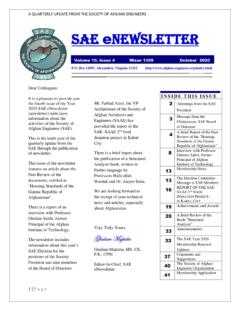
SAE Newsletter – October 2020, Volume 10, Issue 4, Mizan 1399
Dear Colleagues:
It is a pleasure to provide you the fourth issue of the Year 2020 SAE eNewsletter (newsletter) with latest information about the activities of the Society of Afghan Engineers (SAE).
This is the tenth year of the quarterly update from the SAE through the publication of newsletter.
This issue of the newsletter features an article about the Peer Review of the documents, entitled as “Housing Standards of the Islamic Republic of Afghanistan”. There is a report of an interview with Professor Ghulam Sakhi, former Principal of the Afghan Institute of Technology. The newsletter includes information about this year’s SAE Election for the positions of the Society President and nine members of the Board of Directors.
Mr. Farhad Azizi, the VP-Architecture of the Society of Afghan Architects and Engineers (SAAE) has provided the report of the SAE-SAAE 2nd food donation project in Kabul City. There is a brief report about the publication of a Structural Analysis book, written in Pashto language by Professors Hafizullah Wardak and Dr. Zarjon Baha. We are looking forward to the receipt of your technical news and articles, especially about Afghanistan.
Very Truly Yours,
Ghulam Mujtaba
Ghulam Mujtaba, MS- CE, P.E., CPM
Editor-In-Chief, SAE eNewsletter
Inside This Issue
- 2 Greetings from the SAE President
- 3 Message from the Chairperson, SAE Board of Directors
- 4 A Brief Report of the Peer Review of the “Housing Standards of the Islamic Republic of Afghanistan”
- 8 Interview with Professor Ghulam Sakhi, former Principal of Afghan Institute of Technology
- 13 Membership News
- 13 The Election Committee Message to SAE Members
- 16 Report of the SAE-SAAE 2nd Food Donation Project – In Kabul City
- 19 Achievements and Awards
- 20 A Brief Review of the Book “Structural Analysis”
- 33 Announcements
- 33 The SAE Year 2020 Membership Renewal Updates
- 37 Comments and Suggestions
- 40 The Society of Afghan Engineers Organization
Greetings from the SAE President
Dear SAE Colleagues Salaam:
I hope that you and your loved ones are staying safe. I implore everyone to continue taking this pandemic seriously and practice good social distancing and other protective measures while you are in direct contact with the public. Our hope is that together we will be able to contain and stop the spread of this virus.
Over the past three months, SAE’s Executive Committee, with the help of our independent Election Committee led by Eng. Abdul Nazeer Babacarkhail, was able to successfully conduct the election process for the next SAE President and members of the Board of Directors. We look forward to announcing the results as soon as the votes are tallied. The Election Committee may provide a preliminary report with a follow up soon thereafter.
To welcome the new Board Members and facilitate a smooth transition from the current leadership team to the newly elected leadership, we will be hosting the Annual General Assembly on Saturday December 19, 2020. More information will be shared with members as we get closer to that date.
In recent news, SAE was approached by Afghanistan’s Ministry of Urban Development and Land (MUDL) for assistance in providing a peer review of the building codes and standards drafted by a private company from Kenya. The Project was awarded to the Kenyan company through the World Bank Fund. The MUDL requested urgent peer review assistance with a short turnaround time, before the Kenyan company had finalized its submission. SAE quickly formed a Peer Review Committee of experienced and knowledgeable members under the leadership of Ustad Aminullah Mahmood. In less than ten days, the Peer Review Committee was able to review over 300 pages and officially submit their findings to the MUDL. Our hope is that SAE’s professional peer review was helpful in forming this building code manual for our homeland for generations to come.
I hope this peer review serves as the start for many future projects between SAE and Afghanistan’s relevant ministries. SAE is ready and willing to assist each agency of the Afghanistan when our assistance is needed. We look forward to continued collaboration between SAE and Afghanistan’s government.
I sincerely thank the Election Committee and the Peer Review Committee for their excellent volunteer work.
Sincerely,
Atiq Panjshiri, SAE President
Message from the Chairperson, SAE Board of Directors
Dear Members of the Society of Afghan Engineers and respected colleagues:
As the Chairperson of SAE since 2015, I am grateful to be surrounded by a wonderful Board of Directors, SAE executive committee members, and members of the SAE eNewsletter Subcommittee. I would like to express my sincere gratitude to all SAE members for volunteering their time to serve SAE.
The current pandemic has been a hardship on all of us. As a result, in the past months, we were unable to meet in group settings, yet, able to remotely communicate with each other.
I would like to thank Members of the Board of Directors who diligently worked with me in a team effort during my term as the SAE Chairperson. I further extend a special thank you to SAE President Mr. Atiq Panjshiri for his commitment through the years. Finally, let me also thank the numerous SAE Members who volunteered their time to achieve our valuable mission.
Currently, SAE is in the process of electing new Board of Directors and a President for the next three years as tenure of the current Directors and President is coming to a close. I sincerely thank the SAE Election Committee for their tireless work in organizing the upcoming elections.
SAE’s goal is to share its extensive knowledge and experience in the field of professional engineering and to take an active role in the reconstruction of Afghanistan. I believe by working as a team we will have a stronger voice in achieving SAE’s mission, vision, and goal to assist in the redevelopment of our beloved homeland.
Therefore, I invite all Afghan Professional engineers and architects to join this Professional Organization and lead SAE to meet the challenges ahead in order to accomplish its goal with their active involvement.
Finally, it is my honor to be part of this professional organization now and in the future. I look forward to working with all current and future members of SAE.
Very Truly Yours,
Sohaila Sanie Shekib
Chairperson, SAE Board of Directors
A Brief Report of the Peer Review of the “Housing Standards of the Islamic Republic of Afghanistan”
September 12, 2020
BY: A. Manan Khalid, P.E., LEED AP (BD+C)
Introduction
The Housing Standards for the Islamic Republic of Afghanistan were prepared by a Nairobi, Kenya based consulting firm. It was facilitated by the Ministry of Housing, Urban Development and Land (MUDL) and was funded through World Bank. The Standards are comprised of two volumes, with volume I on the Minimum Standards, and volume II containing Detailed Technical Standards.
The documents were prepared with the main objective of supporting the provision of the affordable, adequate and safe housing to the majority population of Afghanistan who currently live in inadequate housing. They are prepared with the aim of dealing with the following:
- overcrowding
- improving the living conditions in unplanned and informal settlements
- improving the quality of housing stock damaged by conflicts and lack of proper maintenance
- improving affordability
- improving resilience against natural and manmade disasters
- responding to geographic and climatic conditions of Afghanistan
- incorporating socio-cultural and historical issues
- modernization and improving standards of infrastructure through consideration of sustainability and universal accessibility
- improving quality of construction and
- improving adherence and enforcement of the existing standards and prevailing codes.
The objectives are broad and well-intended but like any such documents, require a thorough review to ensure their suitability for Afghanistan. Luckily, the Society of Afghan Engineers (SAE) was informed of these documents, which were soon to become the housing standards of our country. Accordingly, the SAE administration initiated communication with MUDL with the intension of reviewing them prior to their release. Contractual obligation of the consultant firm was due to expire on August 31, 2020.
Upon the receipt of a formal request from MUDL, the Society formed a Peer Review Committee of volunteer experts to review the developed Standards according to the areas of their expertise. Members of the Peer Review Committee and other volunteers individually reviewed the Standards and prepared their comments, suggested changes, and made recommendations for the betterment of the documents. Due to time constraints, the reviewers were not able to perform detailed reviews of all Sections of the Standards. They performed only brief and holistic reviews, the result of which were compiled in a 52-page report and was forwarded to MUDL on August 24, 2020.
The Summary of the holistic review by the committee indicates that the Developed Standards have many technical, formatting, style, and other deficiencies.
Summary Recommendations and Conclusion
A comprehensive review of these documents will be required to underline all needed edits and recommend necessary corrections. The two volumes need to be carefully reviewed and rewritten in a concise, easy to understand, using terms that are compatible with the industry and international standards. The rewritten version should be applicable and enforceable in Afghanistan and shall be fit for the cultural, economic and tribal structure of the country. As requested, and recommended, a thorough review will be required to make these standards fit for Afghanistan. Following are some of the recommendations that were included in the report.
- The Standards in their current form are too complex to understand even for experienced engineers. They need to be rewritten in easily understandable language with industry standard terminologies.
- Diagrams or illustrations shall be added for ease of interpretation and understanding.
- Considering that most workforce in Afghanistan are illiterate, the revised version of these standards should also be prepared in short video tutorials for homeowners and homebuilders for ease of implementation.
- Cultural and religious sensitivities must be considered when revising these standards. Flat roofs with privacy parapet walls are common in Afghanistan and will remain that way. Introducing pitched truss roofs may make engineering sense but are not practical in Afghanistan.
- End users should be given a chance to review and highlight sections/items that are not quantifiable or understandable, and documents be revised accordingly.
- Preparers should do their own peer review/proof reading to correct spelling and terminology mistakes and to revise items in order to make them easily understandable.
- The repeat and overlapped contents between the two volumes should be cleaned up.
- The “should be” and “shall be” items and those left to the discretion of the “Approving Authorities” shall be made specific to the extent possible. Standard will not be enforced, if left to the judgment of the approving authority which can be an individual decision maker.
- Formatting issues shall be reviewed and corrected.
- There are 26 pages related to Glossary of Terms in Vol. I. It should be shortened by removing the commonly understood or easily available dictionary terms. The definitions shall also be reviewed to ensure they are according to the industry and international standards.
- Use of units should be made consistent throughout the documents
In conclusion and as has been emphasized in the preliminary review report, and in order for these Standards to become of value to our beloved country, the following are recommended as the path forward:
- A detailed review of the documents revised based on the preliminary review report must be performed by the same or an expanded committee of volunteer experts.
- Due to personal and professional obligations, the detailed review shall be allocated at least six months from the date of a new request by the Ministry.
- For the detailed review, all codes referenced in these standards should be made available to the reviewers.
About the Author
Manan Khalid, P.E., LEED AP (BD+C)
Manan Khalid is a graduate of the Afghan Institute of Technology (AIT), holds a BS degree in Civil Engineering from the Faculty of Engineering of Kabul University and a Master Degree in Hydrology from Roorkee University in India. He has attended and completed postgraduate studies in the Rehabilitation of Infrastructures at NYU’s-Polytechnic School of Engineering, and in Leadership, at Baruch College in New York.
Manan Khalid has over 35 years of professional experience that includes service as Assistant Professor at the Faculty of Engineering of Kabul University, and almost a decade of service in different engineering and managerial capacities in the Kingdom of Saudi Arabia. Currently, he serves as Director of Architecture and Engineering at the NYC School Construction Authority and manages a portfolio of about a billion dollar worth of building projects.
He has served as a member of the Board of Directors of SAE for two terms in the past, is a founding member of the SAE’s eNewsletter, and has been serving as a member of its editorial board since inception in 2010.
Interview with Professor Ghulam Sakhi, former Professor at the Faculty of Engineering, Kabul University and former Principal of the Afghan Institute of Technology
By: Abdul Wahed Hassani, Ph.D., P.E., M. ASCE
Professor Ghulam Sakhi Khan was born in 1930 in the village of Kamari, Kabul, Afghanistan. He completed his elementary school in Bagrami, Kabul and middle and high school in Darul Mualimin (Teacher Training School). Professor Ghulam Sakhi earned his B.S. degree in mathematics and physics from the Faculty of Science, Kabul University and M.S. degree in math and physics from University of Wyoming, USA. He also attended University of Connecticut for two years of postgraduate studies.
After graduation from the Faculty of Science, Mr. Ghulam Sakhi started his first career as an instructor at the Afghan Institute of Technology (AIT), Kabul, Afghanistan. He subsequently served as Assistant Principal and then as a Principal of AIT, from 1965 to 1973. He also served as Assistant Director of Building Construction Department of the Ministry of Education and Professor at the Vocational Technical Education (VTE) Department of the Faculty of Engineering of Kabul University until 1986.
In 1986, Mr. Sakhi immigrated with his family to Peshawar, Pakistan. He joined the International Rescue Committee (IRC) and served as the Principal of Experimental School of Science and then served in the IRC Teacher Training and Textbook Development Department. At the end of 1990, Mr. Sakhi with his family immigrated to Maryland, USA. In 1992, he returned to Peshawar and served as Manager of the Construction Supervisor Training Program of the IRC.
It was a privilege that the author of this interview was student at AIT, while Professor Sakhi was the Principal. The author was fortunate to work with Professor Sakhi as a colleague at the Faculty of Engineering of Kabul University and then at IRC in Peshawar, Pakistan. He is a very knowledgeable professor and a man of dignity and respect.
Mr. Sakhi is known for his dedication and love of his countrymen, honesty and professionalism. It is a pleasure to get the opportunity to interview a dear friend, a highly respected former Principal of AIT, and Professor of the Faculty of Engineering, Kabul University. For this issue of the newsletter, the author requested Mr. Sakhi for an interview, which he graciously accepted.
I would like to thank Professor Sakhi for accepting the invitation to have the interview for the publication of the SAE eNewsletter. The following are the interview questions/discussions (Q), and Mr. Sakhi’s response (R):
(Q) Please briefly tell the readers about yourself, your children, your schooling, hobbies and current activities.
(R) I reside in Maryland, USA with my family and have 5 children and 17 grandchildren. All of them are doing good in schooling and most of my children have graduated from school and are working. I completed elementary school in Bagrami, Kabul and middle and high school in Darul Mualimin (Teacher Training School) and graduated in 1950. I received my B.S. degree in mathematics and physics from the Faculty of Science, Kabul University in 1955 and M.S. degree in math and physics from University of Wyoming, USA in 1960. From 1969 to 1971, I attended University of Connecticut, USA for two years of postgraduate studies. My hobbies consist of reading books such as “A Brief History of Time by Stephen Hawking”.
(Q) When and how did you leave Afghanistan? Have you been involved in any activities in Afghanistan since you left the country?
(R) I left Afghanistan in 1986 and the way I got out was by walking through the mountains for two days. It was hard for a long time cigarette smoker to walk through the mountains. I was a Pashto translator for the US army in Afghanistan.
(Q) You served for a few years as a Principal of AIT. Can you tell our readers about AIT, its special status as a high school and its affiliations with American Institutions?
(R) AIT was established with the assistant of USAID. Initially Wyoming University assisted AIT and then had association with Southern Illinois High School System. AIT used American Vocational School Curriculum with American Textbooks and English as medium of instruction. Dari and Pashto languages, Mathematics, Physics and Chemistry were also part of the curriculum. AIT had six different technical departments; namely Auto Mechanic, Building Construction, Civil Aviation, Civil Technology, Electrical Technology and Machin Shop. All the Departments were fully equipped with American Machinery, laboratory equipment, and supplies. Each Department had an American Advisor who actively took part in teaching also. AIT was one of the best schools in Afghanistan, educating high school level technicians in various fields of science and technology.
(Q) What was the medium of instruction at AIT?
(R) The medium of instruction was English. Later the mediums of instructions became Dari and Pashto the Afghanistan native languages.
(Q) Were the students comfortable using the English textbooks and hearing lectures in English?
(R) The students had no problems with English as their medium of instructions and they loved it.
(Q) During your career services with AIT, this school moved from its old building (presently used by Ministry of Higher Education) to a very modern, advanced, fancy building with the training workshop facilities, administration building, and testing laboratories that were meeting the American Standards. Can you tell us which agency sponsored the expenditure of this new building?
(R) AID helped providing supplies, books, materials, equipment, and machinery. If we needed anything, they would provide them for us.
(Q) Do you have contact with any of your AIT or Faculty of Engineering associates and colleagues?
(R) Yes, I still talk with many of them to this day. My friends and students are living all around the world such as Afghanistan and Australia. They are still in contact with me. In fact former teachers and student of AIT are very active and occasionally get together to share their memories. Following is a picture of my sweet memories’ of 2011 reunion of AIT students and faculty in California, where I was the keynote speaker of that gathering.
(Note: Image descriptions: Front row from right: Najibullah Sayami, SatarAtiqi, Jack Irvine, Amon Osmani. Back row from right: Ghafar Zalal, Gul Beekzad, Hasim Shaghasi, Said Samad Najibi, Ghulam Sakhi khan, Taymuree Sahib, Nazir Noorzay, Majid Hafez, Hamayun Niazmand, Iqbal Haider)
(Q) Please tell us briefly about your experience of working with the Construction Department of the Ministry of Education in Afghanistan?
(R) During the time I served at the Construction Department of Ministry of Education, USAID provided some financial support to sponsor construction of about 30 elementary schools in different parts of the Country. USAID also sponsored repair of some existing school buildings throughout the Country.
(Q) You have worked with AIT, VTE, and the Construction Department of the Ministry of Education in Afghanistan. In my opinion there is need for capacity building and training of construction, maintenance, and pipeline industry professionals in Afghanistan. A few examples of the necessary training development and certification programs may include; carpentry, electrical, electronic systems technician, heavy equipment operations, highway/heavy construction, heating, ventilation, and air conditioning, masonry, plumbing, and welding. Please tell us about the availability or need for the development or the improvement of training programs in the craft areas.
(R) The construction and rehabilitation of Afghanistan will take many years, in order to achieve this goal; we need much more well-educated technicians to be trained in the various fields you mentioned. Training could be done through formal education as well as utilization of advanced information technology. Internet and computers are easily available and our manpower from this country can help. I love to take part in those types of programs but now I am too old for these types of training activities.
(Q) You were involved in educational programs of Afghan Refugees in Peshawar, Pakistan. Can you tell us of your level of involvement and the effectiveness of those programs?
(R) I worked as a principal of the science high school of IRC. I was also involved in rewriting the math and since textbooks for Afghan high schools and also taught math as well. I took part in establishing a construction supervisor program. It consisted of 9-month and 18-month training programs in the field of construction.
(Q) How did you like your professional work in Peshawar, Pakistan?
(R) I liked working in Pakistan because it was useful for the Afghan refugees and the future reconstruction and rehabilitation of Afghanistan.
(Q) How do you describe your teaching career and how did your students think of you as a teacher?
(R) I loved teaching and I was trained for it. It was a big passion of mine to teach. I respected the students and they respected me. As far as I know, I still receive appreciation calls from them.
(Q) How many times have you returned to Afghanistan and how do you describe your personal experience and observations of Afghanistan?
(R) I went back to Afghanistan two times just to visit relatives. As far as I know Afghanistan needs more educated people and more education in the various fields of technology. So, they can build schools, roads and dams. I like Afghanistan because it is a wonderful country and has wonderful people. I always try to help Afghanistan as much as I can.
(Q) How would you compare your experience of working with public and private agencies? Which one is more challenging and why?
(R) My experience of working with private agencies was more successful than public sector. Private agencies are more challenging because you have to find the way to get involved in something and it is not sponsored by the government.
(Q) You have been a professor and a successful administrator; please provide us a few examples of challenges at the times of your services?
(R) During the communist era we had a hard time teaching because they discontinued the student enrollments in our college. Also, a lot of professors were being put into jail, so I had to be cautious while talking and teaching.
(Q) You have an impressive resume, what was the key to your educational success and professional accomplishments?
(R) I would study a lot and work hard to get towards my goals. I would also not waste my time with what I do and tell the truth to everybody.
(Q) What type of advice you offer for Afghan professionals living outside of their country who wants to serve their motherland, but are unable to leave their current jobs and families?
(R) Afghanistan is a wonderful country. They should work hard to make the country successful. It is every Afghan’s responsibility to fulfill their duty. The Afghan professionals in USA can provide the training and advise utilizing the modern technology and easily available internet system.
Thank you for taking the time to share your thoughts and experience with the readers of the newsletter. I congratulate you for your outstanding accomplishments and your lifetime experiences and successes.
Membership News
The 2020 SAE Election
This year the SAE Election Committee will conduct the election process for the positions of the Board of Directors and the President of the Society. The Election Committee has sent the following message by email to the SAE members regarding the election.
The Election Committee Message to SAE Members – September 18, 2020
Society of Afghan Engineers 2020 Election
Election Committee:
* Mr. Nazeer Babacarkhial- Chairman
* Mr. Hafiz Wardak -Member
* Mr. Fayeq Fasihi- Member
ELECTION COMMITTEE REPORT:
The Society of Afghan Engineers (SAE) triennial election is currently in progress for the years 2021 to 2023. The Election Committee is dedicated to conducting an honest and transparent election process. We assure the SAE members that their votes will remain confidential.
There are nine available positions on the Board of Directors (BOD) and one for President. All the candidates are highly respected and professional members of SAE and the Afghan community. Becoming elected on the BOD is particularly important in that it impacts the future of SAE and its role in helping our homeland of Afghanistan. Those not elected are highly encouraged to stay involved and participate in SAE events.
Initially there were fourteen candidates in the running for the nine positions on the BOD and one candidate for that of the President. However, on September 3rd, 2020 one candidate withdrew his nomination and thus, there are now thirteen candidates remaining for the BOD positions.
On August 1st, 2020, the Election Committee sent out ballots for voting to all SAE members with the deadline for submission on September 15th, 2020. We received ballots from 87% of the eligible voters from SAE and are currently verifying the votes. This brings us to the fifth stage of the election process, as shown by the Election Timeline attached. Barring any unforeseen circumstances, the SAE election results will be announced on October 15th, 2020. Starting January 1st, 2021, the newly elected president and board of directors will begin their two-year term in office.
On behalf of myself and the Election Committee for SAE, we thank you for submitting your votes in a timely manner and allowing us to conclude the election on schedule. We look forward to the continued growth and future endeavors of SAE and its members.
Best of luck to all the candidates!
Nazeer Babacarkhial, PE
Chairman, Election Committee
Election Committee Guideline – 2020 SAE Election
| Activity | Deadline | Status |
|---|---|---|
| Distribution of Election notices | 6/15/20 | complete |
| Nominee acceptance & Bio to E Committee | 08/10/20 | complete |
| Membership Verification | 8/20/2020 | complete |
| Distribution of voting ballots to active SAE members | 9/1/2020 | complete |
| Voting closer midnight EST | 9/15/2020 | |
| Ballot tabulation & count | ||
| Announcement of election result | 10/15/2020 |
Note:
A. Each Nominee and voting member must satisfy eligibility requirements per SAE “Bylaws”.
1) Per the decision of SAE Board of Directors in a meeting on August 4, 2020 all those who have paid 2020 membership fee are eligible to vote.
2) SAE Bylaws Section 3-4 Membership requirements: (1) Any person who submits such an application, approved by the President, and pays the required Membership fee shall automatically become a Member of the Society in the appropriate classification. Membership approval shall be effective upon the President’s notification of the applicant.
3) Section (3): Only Regular Members may hold elected positions as President, Vice President, and members of the Board of Directors.
4) Section (7): In order to exercise voting privileges, a Member must be on the active Membership list at least six months prior to the voting date and have informed the Society of his/her updated address and other contact information.”
5) Section 8-3: Retired Society Members residing in Afghanistan are exempt from payment of the annual Membership fees.
6) Item 7 of the operating manual: The applicants residing in Afghanistan are exempt from payment of the application fee and annual renewal fee. The continuation of the Society membership requires the submittal of the annual renewal form shown in Appendix E.
B. SAE president, Mr. Panjshiri, to provide active members list to the election committee.
Report of the SAE-SAAE 2nd Food Donation Project – In Kabul City
June 29, 2020
BY: Farhad Azizi; SAAE VP-Architecture
At this time when the spread of coronavirus and the ensuing restrictions on movements in Afghanistan’s most populated city, Kabul, have had a serious adverse economic effect, most hard hit are the poor and unskilled workers who depended on daily income for survival. Cognizant of this situation, a joint food distribution project was implemented in Kabul during the third and fourth week of June 2020, funded by the US-based Society of Afghan Engineers (SAE) and implemented by the Afghanistan based Society of Afghan Architects and Engineers (SAAE).
This project which targeted the most affected families of the current coronavirus related quarantine in the City, valued at over AFs. 434,655.00 (four hundred thirty-four thousand six hundred fifty-five Afghanis), equivalent to US $5,637.50 (five thousand six hundred thirty-seven and five tenths US Dollars).
The SAE donation (US $5,700.00) was collected in June 2020 for the needy families during the Covid-19 quarantine and was transferred to Mr. Farhad Azizi through Western Union. After subtracting the $12.5 of miscellaneous expenses, only US $50 will remains with Mr. Farhad Azizi that needs to be paid for SAE. The total amount of US$ 5,637.50 was utilized to implement a very effective project of food items distribution, which covered 117 needy families.
To start the project, SAAE held a meeting of its Executive Council and available members of Board of Directors, During the meeting a team under the leadership of SAAE Executive Deputy, Engineer Dalia Akbarmir was appointed and delegated to plan and implement the project. The team consisted of the following:
- Engineer Ms. Dalia Akbarmir; SAAE Executive Deputy,
- Architect Mr. Farhad Azizi; SAAE VP-Architecture,
- Engr. Mr. Zekria Habibi; SAAE member of Board of Directors,
- Mr. Zahid Haqjo; SAAE Secretary.
The team came up with a plan to provide tickets in order to avoid rush due to Covid-19 pandemic and purchase food items for distribution to 117 families.
Through this effort, each family was provided with a package that consisted of one bag of wheat flour (50 Kg per bag), one bag of high quality rice (10 Kg per bag), one bag of high quality beans (3.5 Kg per bag), one bag of sugar (3.5 kg per bag) and one container cooking oil (5 Lit. per container).
The project planning and implementation consisted of the following main steps to ascertain that crowding is prevented, transparency is assured, and the recipients of food packages are subjected to minimum effort:
- Team recognized a supply market at a best central location of the city, negotiated for low prices and good quality food items, and made the purchase,
- 400 sheets were printed with SAE and SAAE logos and were attached to the wheat flour and rice bags that were purchased and were located at the store (the distribution point),
- 117 paper tokens were printed with the same logos as those attached to the food bags. These papers contained the address and telephone numbers of the food store, a list of the contents of food package to be received and each was signed by Nawandish Sahib and stamped by official SAAE stamp,
- These paper tokens were distributed by team members to targeted recipients at different locations of the City,
- Each recipient would submit his/her paper token to the food market (distribution point) to receive their food package.
- The team regularly monitored the distribution process at the distribution point to ascertain proper delivery of the food packages!
We should thank the SAE for allocating the fund for this effort as well as recognize the efforts of the five-member team who, despite the restrictions imposed and the risks involved, due to the presence of coronavirus, they made sincere efforts to plan and implement this very meaningful food donation project.
About the Author:
Mr. Farhad Azizi is the VP-Architecture of the Afghanistan-based Society of Afghan Architects and Engineers (SAAE) and has been a member of the SAAE since 2009. In addition to, being a life member of the SAAE, he has also served in different positions at Technologists, Inc. – a US-based leading corporation in the construction sector of Afghanistan since 2008. Currently, he is functioning as the Design Director of Technologists, Inc. in its Afghanistan Operations.
His focus on community collaboration has led him to a number of volunteer opportunities and community leadership roles. Mr. Azizi’s dedication and commitment toward serving the community is one of the upmost priorities in his career.
Achievements and Awards
The newsletter will inform their readers of winners of awards or any other successes of Afghan professionals and students, especially, their Society members. You can help the SAE eNewsletter editors by providing the news of the achievements, award winners, promotions, retirement, and any other success stories.
“Advise us of success stories or achievements of the Society members, any Afghan professionals, and Afghan students.”
Achievements
Congratulations to Professor Hafizullah Wardak and Dr. Zarjon Baha, SAE members and the authors of the Structural Analysis book, written in Pashto language. The book has been published and distributed to the universities and major libraries of Afghanistan. The Editor of the SAE eNewsletter asked Professor Hafizullah Wardak to provide us the summary of his published book for information of all readers of the SAE newsletter. He graciously accepted the Editor’s request and provided us the following book review.
A Brief Review of the Book “Structural Analysis”
By: Hafizullah Wardak
Structural Analysis is the title of a new book, written in Pashto language by Hafizullah Wardak and Dr. Zarjon Baha that was recently published and released in Afghanistan. The book is being distributed to Universities and major libraries across the Islamic Republic of Afghanistan.
It took the authors five years to complete the book. The first three years were relatively easy laying the foundation of the book material, but the last two years involved extensive work, almost ten hours daily, with seven days a week effort. I was fortunate that my dear friend Professor Zarjon Baha, former Dean of the Faculty of Engineering of Kabul University and current professor at Purdue University, partnered with me as a co-Author. We both worked tirelessly making this book a reality, for our dear Afghan civil engineering students in universities and practicing engineers across Afghanistan.
The original outline included several more chapters with various topics and sections, but due to Coronavirus sending a shock wave across the globe, I got concerned and worried that this effort, Allah forbid, may not reach fruition. In April of this year, after discussion with the co-author Zarjon Baha we made the book ready and released it on May 29, 2020, which is the Pashto International Day. We thought this will be our special small gift to the celebration of the that day. We will add few more sections and topics, inshallah, when a second revision and print become available.
Dr. Baha and I discussed how and what Pashto style, dialect, and vocabulary to use and consider it in writing this book. After a lengthy and serious thought, we decided to write it in a simple Pashto language that we speak on the daily basis at our homes. Since both of us were born in Wardag province, it was easier to use our baseline home spoken dialect and language style in writing.
Once we decided to publish this book for the Afghan engineering students, we were required to obtain acceptance from the Ministry of Higher Education of the Islamic Republic of Afghanistan, a university President, Dean of a college of engineering, and head of the civil engineering department. For this, we reached out to “Afghanic-textbook” in Germany to assist us with the publication and distribution process. We are grateful to Dr. Yahya Wardak of “Afghanic-textbook” for helping us with completing the process, including its publication and distribution to Universities, libraries in the Islamic Republic of Afghanistan and several international libraries and Afghan Centers.
This book is covering fundamentals of structural analysis. The book can be covered in one or two biannual semesters of an academic curriculum of civil engineering at the university level. The book could also be used as a reference guide by civil engineers in practice.
The Structural Analysis book is written in Pashto, a native language of Afghanistan, with an easy and simple daily spoken style, that can be used in all universities across Afghanistan and practicing engineers in the country. There are some terms where Pashto equivalent word was not found or developed by the authors in those cases the English words are used.
I am working on a PowerPoint presentation in Farsi/Dari language that the content of this book can be used for engineering students where Dari language is used. A dear friend who is professor in Europe, has promised that he will assist in online presentation using his developed online software tools. More information will be available when this phase-lectures in online initiate.
The book is divided into two volumes, nine chapters and an appendix with total of 848 pages. To make reading more appealing, pleasant, and less boring; color pictures and color figures are used, and each page is less crowded to avoid unnecessary verbiage.
Let me walk the readers through each chapter of the Structural Analysis book and show samples of few pictures, figures, and tabulated data from the book.
The first volume covers analysis of statically determinate structures in five chapters. It covers Forces, Reactions, Shear and Bending Moment Diagrams, Truss Structures, Deflections, and Influence Lines. The second volume is statically indeterminate analysis with four chapters covering Slope deflection, Moment Distribution, Matrix method of Structural Analysis, and Dynamic Analysis of Structures.
The introduction in the first chapter covers general concepts with pictures and figures of various types of structures. The introduction consists of 24 sections where Live Loads and Dead Loads acting on structures including earthquake, wind and general analysis methods are covered. Common dead loads in building, and general codes are shown in tables.
The first chapter covers Reactions and Types of Forces in 13 sections and several subsections. Solved examples for determining reactions and practice problems are part of this chapter.
Chapter 2 is about Shear and Bending Moment. This chapter has 18 sections and few subsections. Solved example problems and practice problems are included.
The third chapter covers truss types, methods of joints and sections analysis in 11 sections including solved examples and practice problems.
Chapter 4 is about Deflection calculations, where various methods (Integration, Virtual Work, Moment Area, Conjugate Beam, Castigliano Methods) are used to find Deflection amounts with numerous solved examples. This chapter has 38 sections and several subsections with plentiful solved examples and practice problems.
The fifth chapter covers Influence Line, where the concept of Influence Line is discussed and solved examples with practice problems in detail are presented in 20 sections.
Chapter six starts with statically indeterminate structures analysis in Volume II. This chapter covers slope deflection method for the analysis of statically indeterminate structures in 20 sections with several solved examples for both beam and frame type structures, and practice problems.
Chapter seven covers moment Distribution in 24 sections with solved example problems and practice problems.
Chapter 8 covers Matrix Method of Structural Analysis in 26 sections. An introductory matrix algebra and solving structures using matrix method are presented. There are numerous solved examples and practice problems.
Chapter nine covers Fundamentals of Structural Dynamic Analysis in 9 sections and several subsections. General dynamic equations of single and multi-degree elastic system with damping and without damping are discussed. Examples of how to determine displacement as a function of time, and frequency calculation with discussion on numerical integration are included. Types of external dynamic loads, shear walls, impact of earthquake on buildings, and analysis of buildings for earthquake loading with a detail example are part of this section.
An appendix showing shear and moment diagrams of various loading types, and typical engineering formulas and solid structural shapes, etc. are included.
A good news to share is, we are in the process of trying to get permission from a publishing company for translating a well-known and highly respected book of Mechanics of Materials that could be used by civil as well as mechanical engineers into Pashto language. This book has been used as textbook in many of the great universities here in USA. We hope that will be another small contribution that we can make for educating our dear Afghan engineering students in our beloved Afghanistan. If the book is complete as planned, we will have a review on that and share it with you all. Since the permission release process for translation takes more than a year, we are thinking of another civil engineering structure textbook to translate after the one we are waiting for the draft of the contract to receive.
Note: Currently the book is not available for sale, anyone interested in obtaining a copy of the book please send email to hwardak@comcast.net. The author may provide you online access when available.
Brief Biography of Hafizullah Wardak:
Mr. Hafizullah (Hafiz) Wardak is the former professor at Kabul University, and Technical Fellow (retired) at the Boeing Aerospace Company. Mr. Wardak worked with Boeing Company for over 32 years performing structural analysis. In addition to regular technical work, he has taught Structural Integrity, an off-hour structure class, to other Boeing engineers for over 20 years. He has also worked with Sargent & Lundy- Chicago, Illinois on the structural analysis of several nuclear power plants for over six years as member of the Structural Specialist Organization. In Afghanistan, he worked at the Civil Engineering Department, Faculty of Engineering of Kabul University, as professor of the civil engineering department, and deputy-chairman of the Afghan Seismological Center for six years. He is graduate of Habibia High school in Kabul, received BS in Civil engineering from the University of Hawaii Honolulu, MS in structural engineering from Case Western Reserve University, Cleveland Ohio, and completed all courses for PhD in Fracture Mechanics at the University of Alabama Huntsville.
Brief Academic Background of Zarjon Baha
- Born in Yousafkhail Wardag and attended Takya elementary school.
- Went to Darul-Mu-Alimine for six years and then received his Bachelor Degree in Engineering from Faculty of Engineering at Kabul University.
- Received his Master’s Degree from Purdue University and a Ph.D. Degree from North Carolina State University in Civil Engineering.
- Worked total of 20 years as a Teacher, Department Head, and the Dean at the Faculty of Engineering, including his time to get his degrees in the USA.
- Has been working as a Professor of Construction Management at Purdue University from 1982 until this date.
- Blessed with three children and is living with his life partner of 64 years, Fatima, in West Lafayette, Indiana.
Announcements
(1) The 2020 SAE Membership Renewal
Dear Members of the Society:
The Management of the Society of Afghan Engineers (SAE) would like to remind all members that 2020 membership renewal and Annual fee of $60 are due. Your membership fee collectively would enable us to pay for some basic needed services of the Society such as Website security monitoring, updating, and maintenance. Also, your membership fee would provide SAE’s management, the financial means to organize and host events and seminars on relevant technical topics. The membership renewal application is attached to the Newsletter and also can be downloaded from our website at www.afghanengineers.org. Please visit the SAE Facebook when you get the opportunity. We appreciate your kind attention to the membership due request.
Sincerely,
Atiq Panjshiri, President
The Society of Afghan Engineers
(2) SAE eNewsletter Regional Representatives
The positions of the SAE eNewsletter Regional Representatives are open. Please let us know if you are interested to volunteer for one of these positions or if you want to nominate other qualified members to serve in these positions. The representatives will inform the newsletter Editorial Board of any technical news in their regions and contact authors for their contributions in the activities of newsletter. For additional information please send an email to SAE eNewsletter Editorial Board: Ghulam Mujtaba; A. Wahed Hassani; A. Manan Khalid; and Hafizullah Wardak.
(3) The SAE Year 2020 Membership Renewal Updates
The following are the status of the membership renewal fee payments and donations to the Society of Afghan Engineers during Year 2020. The SAE management would like to thank all members for their financial support and other contributions to the Society activities.
THE YEAR 2020 MEMBERSHIP RENEWAL FEE AND DONATIONS Paid in Earlier Years
| Date | First Name | Last Name | Fee Paid $ | Donation $ | Total Payment in 2020 $ | Remarks |
|---|---|---|---|---|---|---|
| 2/26/2018 | Abdul Nazeer | Babacarkhial | 180 | 70 | 0 | Paid $250 in 2018 for Years 2018-2020 |
| 8/4/2018 | Saleh | Keshawarz | 180 | 0 | Paid $180 in 2018 for Years 2018-2020 |
MEMBERSHIP RENEWAL FEE AND DONATIONS IN Year 2020
| Date | First Name | Last Name | Fee Paid $ | Donation $ | Total Payment in 2020 $ | Remarks |
|---|---|---|---|---|---|---|
| 1/07/2020 | Atiq | Panjshiri | 60 | 60 | ||
| 2/07/2020 | Ghulam | Mujtaba | 60 | 140 | 200 | |
| 2/07/2020 | Amanullah | Mommandi | 60 | 40 | 100 | |
| 12/26/2019 | Abdul Manan | Khalid | 60 | 40 | 100 | |
| 12/26/2019 | Gul Afghan | Saleh | 60 | 40 | 100 | |
| 2/29/2020 | Hafizullah | Wardak | 120 | 120 | Paid $120 for 2020 & 2021 | |
| 3/03/2020 | Hashim | Rayek | 60 | 0 | 60 | |
| 3/03/2020 | Abdullah | Noorzad | 60 | 0 | 60 | |
| 3/03/2020 | Shapooor | Hamid | 60 | 0 | 60 | |
| 3/03/2020 | Najim | Azadzoi | 60 | 0 | 60 | |
| 03/05/2020 | Sohaila | Shekib | 60 | 60 | 120 | |
| 3/05/2020 | Nadir | Sidiqi | 60 | 60 | 120 | |
| 03/05/2020 | Yar Mohammad | Ebadi | 60 | 0 | 60 | |
| 03/06/2020 | Bahaudin | Mujtaba | 60 | 40 | 100 | |
| 03/21/2020 | Reza M. | Afshar | 60 | 40 | 100 | |
| 3/23/2020 | Zarjon | Baha | 180 | 20 | 200 | Paid $180 for 2020-2022 |
| 3/23/2020 | Hashem | Baluch | 120 | Paid $120 for 2020 & 2021 | ||
| 4/28/2020 | Steve | Rossi | 60 | 60 | 120 | |
| 4/28/2020 | Zia | Yamayee | 60 | 200 | 260 | |
| 3/23/2020 | Abdul Wahed | Hassani | 60 | 60 | ||
| 5/19/2020 | Jalal | Masumi | 60 | 40 | 100 | |
| 5/28/2020 | Aziz | Ghani | 60 | 0 | 60 | |
| 5/31/2020 | Rafat | Ludin | 120 | 30 | 150 | for 2019 & 2020 |
| 6/17/2020 | Sabir M. | Sarwari | 180 | 0 | 180 | for 2018-2020 |
| 7/1/2020 | Ahmad Wali | Shirzay | 240 | 10 | 250 | for 2017-2020 |
| 7/13/2020 | Najib M. | Paya | 60 | 200 | 260 | |
| 7/17/2020 | Nader | Noori | 60 | 0 | 60 | |
| 7/16/2020 | Amin | Mahmood | 60 | 40 | 100 | |
| 7/19/2020 | Zabiullah | Zaca | 60 | 40 | 100 | |
| 7/23/2020 | Hamid | Naderi | 60 | 0 | 60 | |
| 7/21/2020 | Moheb | Arghand | 60 | 0 | 60 | |
| 7/24/2020 | Sayed | Hashemyan | 60 | 0 | 60 | |
| 7/10/2020 | Hadi | Rakin | 120 | 0 | 120 | for 2019 & 2020 |
| 7/23/2020 | Najib M. | Kazimi | 60 | 0 | 60 | |
| 7/2/2020 | Abdul Saboor | Rahim | 120 | 0 | 120 | for 2019 & 2020 |
| 7/24/2020 | Matin | Sayed | 60 | 0 | 60 | |
| 7/20/2020 | Said Sharif | Hossainy | 60 | 20 | 80 | |
| 8/5/2020 | Wahid | Naim | 60 | 0 | 60 | |
| 8/5/2020 | Bashir | Kazimee | 60 | 0 | 60 | |
| 8/5/2020 | Masood | Sattari | 60 | 0 | 60 | |
| 8/5/2020 | Mahmood | Samizay | 120 | 0 | 120 | for 2019 & 2020 |
| 8/5/2020 | Omar | Poya | 60 | 0 | 60 | |
| 7/24/2020 | Yar M. | Mohabbat | 60 | 0 | 60 | |
| 7/24/2020 | Timor | Sekander | 60 | 0 | 60 | |
| 5/31/2020 | Yusuf | Afrooz | 60 | 0 | 60 | |
| 9/11/2020 | Ghulam M. | Feda | 60 | 0 | 60 |
Comments and Suggestions
The Editorial Board of the SAE eNewsletter has received comments and suggestions from the respected Society members and readers of the Newsletter after the distribution of the July 2020 issue of the newsletter. The Editor has responded to the readers’ comments and suggestions individually by emails upon their receipt; and would like to take this opportunity to thank them again for their comments, suggestions, and kind words.
1. Comment from Dr. Said Sharif Hossainy
Dear Ustad Mohtaram Eng. Saheb G. Mujtaba, Editor-In-Chief SAE eNewsletter
Asallam-o-Alaikom,
I acknowledge receiving your email, regarding the third quarterly issue of the 2020 SAE eNewsletter. May God protect you and all your family members and entire people of the world from this COVID-19 pandemic. Thank you for your kind efforts and volunteering. I wish you good health, prosperity and happiness.
Best Regards
Dr. Said Sharif HOSSAINY
Editor’s Response:
Dear Dr. Sahib Hosssainy Walaikum Salam;
Thanks for the acknowledgment of the receipt of the the July 2020 issue of the SAE eNewsletter and your kind words. Your contributions in the activities of the publication of the newsletter by sending us your articles, suggestion, and valuable comments are greatly appreciated. We are also wishing for safety of all of us as well as our countrymen and the entire people of the world from coronavirus infection disease.
Best regards,
Ghulam Mujtaba
2. Comment from Ustad Hasan Nouri, President, Fluvialtech Inc.
Mujtaba Saheb:
Thank you for what you are doing. You make me feel very proud.
Regards,
Editor’s Response:
Dear Ustad Nouri Salam
Thanks for acknowledgment of the receipt of the SAE eNewsletter and your kind words. We are also proud of your accomplishments as the President, Fluvialtech Inc
Best regards,
Ghulam Mujtaba
3. Comment from Malik Mortaza, Past SAE President
Mujtaba Sahib Salaam:
Thank you for sharing the Newsletter with us and appreciate your hard work and dedication to the SAEs efforts. Stay safe from the pandemic.
Malik Mortaza
Editor’s Response:
Dear Engineer Sahib Mortaza Salam:
Hoping that this finds you and yours respected family in good health and spirit. We are fine. Thank for your kind words regarding SAE eNewsletter. We are trying to maintain the structure that you and other colleagues originally designed and built its foundation. The Society members appreciate your efforts and hard work in its establishment.
Best regards,
Ghulam Mujtaba
The Society of Afghan Engineers Organization
SAE Executive Committee Members:
President: Atiq Panjshiri
Vice President: Amanullah Mommandi
Treasurer: Mohammad Hashem Baluch
SAE Board of Directors-Officers:
Chairperson: Sohaila Sanie Shekib
Vice-Chairman: Gul Afghan Saleh
Executive Director: Abdul Nazeer Babacarkhial
Members SAE Board of Directors:
Farid Abass, Reza Afshar, Nazeer Babacarkhial, Rafaat Ludin, Gul Afghan Saleh, Mahmoud Samizay, Mohammad Saber Sarwary, Sohaila Sanie Shekib, and Hafizullah Wardak
SAE Past Presidents:
Ghulam Mujtaba, Abdul Hadi Rakin, M. Qasem Kadir, Mohammed Hashim Rayek, Ahmad Wali Shairzay, Sohaila Sanie Shekib, and Malik Mortaza
SAE Chairpersons of Committees/Subcommittees:
Ghulam Mujtaba, Chairman – SAE eNewsletter Subcommittee
SAE Local Chapter Coordinators:
A. Hamid Layan – Kabul, Afghanistan; M. Qaseem Naimi – Toronto, Canada; Najim Azadzoi – Massachusetts; M. Qasem Kadir – Southern California; A. Manan Khalid – New York and New Jersey; Amanullah Mommandi – Colorado; Atiq Panjshiri – Virginia and Washington DC
SAE eNewsletter Subcommittee:
Subcommittee Chairman: Ghulam Mujtaba, M.S, CE, P.E.
Members: A. Wahed Hassani, Ph.D., P.E.; A. Manan Khalid, M.S., P.E., LEED AP; Hafizullah Wardak; Abdul Hamid Layan.
SAE eNewsletter Editorial Board:
Editor-In-Chief: Ghulam Mujtaba, M.S, CE, P.E., CPM
Editorial Board Members: A. Wahed Hassani, Ph.D., P.E.; A. Manan Khalid, M.S., P.E., LEED AP
SAE eNewsletter Regional Representatives:
Abdul Hamid Layan – Kabul
Subscribe/Unsubscribe:
The subscription to the SAE eNewsletter is free. If you are not receiving the SAE eNewsletter directly and would like to subscribe, please send a note to: mujtabaghulam@bellsouth.net with the subject “Subscribe: SAE eNewsletter”. To unsubscribe, send a note with the subject “Unsubscribe: SAE eNewsletter”.
Disclaimer:
The author, reporter, or agency of each publication, project, news, and products is included in this newsletter. Additional contact information of the authors and their agencies are available with the Editorial Board of the newsletter and may be provided upon request. The Editorial Board of the Society of Afghan Engineers, Executive Committee, Board of Directors, or any of its members are not liable for the accuracy or contents of the information. The reports and information are included as provided by the authors and agencies without any changes in the substance of the documents. The information about the agency products or services is not the SAE endorsement.