SAE Newsletter – 2021-01 – Volume 11, Issue 1
Inaugurates the 2021-2023 SAE leadership term with an exploration of European architectural history and the official results of the comprehensive 2020 society elections.
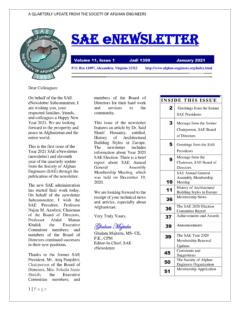
SAE Newsletter – January 2021, Volume 11, Issue 1, Jadi 1399
A QUARTERLY UPDATE FROM THE SOCIETY OF AFGHAN ENGINEERS
Dear Colleagues:
On behalf of the the SAE eNewsletter Subcommittee, I am wishing you, your respected families, friends, and colleagues a Happy New Year 2021. We are looking forward to the prosperity and peace in Afghanistan and the entire world.
This is the first issue of the Year 2021 SAE eNewsletter (newsletter) and eleventh year of the quarterly update from the Society of Afghan Engineers (SAE) through the publication of the newsletter. The new SAE administration has started their work today. On behalf of the newsletter Subcommittee; I wish the SAE President, Professor Najim M. Azadzoi; Chairman of the Board of Directors, Professor Abdul Manan Khalid; the Executive Committee members; and members of the Board of Directors continued successes in their new positions.
Thanks to the former SAE President, Mr. Atiq Panjshiri; Chairperson of the Board of Directors, Mrs. Sohaila Sanie Shekib; the Executive Committee members; and members of the Board of Directors for their hard work and services to the community.
This issue of the newsletter features an article by Dr. Said Sharif Hossainy, entitled, History of Architectural Building Styles in Europe. The newsletter includes information about Year 2020 SAE Election. There is a brief report about SAE Annual General Assembly Membership Meeting, which was held on December 19, 2020.
We are looking forward to the receipt of your technical news and articles, especially about Afghanistan.
Very Truly Yours,
Ghulam Mujtaba
Ghulam Mujtaba, MS- CE, P.E., CPM
Editor-In-Chief, SAE eNewsletter
Inside this issue
- Greetings from the former SAE Presidents
- Message from the former Chairperson, SAE Board of Directors
- Greetings from the SAE Presidents
- Message from the Chairman, SAE Board of Directors
- SAE Annual General Assembly Membership Meeting
- History of Architectural Building Styles in Europe
- Membership News
- The SAE 2020 Election Committee Report
- Achievements and Awards
- Announcements
- The SAE Year 2020 Membership Renewal Updates
- Comments and Suggestions
- The Society of Afghan Engineers Organization
Greetings from Mr. Atiq Panjshiri, the SAE former President
Dear SAE Colleagues Salaam:
I wish everyone a happy, healthy, and prosperous New Year 2021. I hope the new year brings a safer and heathier year for you and your family, and soon the fear of COVID-19 will be over, and things get back to normal soon.
Today, December 31, 2020, will be my last message as President of the Society of Afghan Engineers (SAE). It has been an honor and privilege of mine to serve as the President of this Society for the past six years. I have had the privilege and honor of working together with a group of extraordinary professionals both at the Board of Directors as well as the Executive Committee. I express my sincere gratitude for their support over the last six years.
On Saturday, December 19, 2020, the Society held its Annual General Membership meeting that was well attended by membership. The meeting was held via Zoom Video Conference and started at 2pm (EST) with opening remarks by the President and Chairperson of the Board, followed by a financial report of the Society and Committees reports. The meeting was a great opportunity for the new President, Chairman of the Board and the rest of SAE’s newly elected leadership to get acquainted with the membership and set forth a brief program agenda for the years ahead. The meeting was constructive and engaging. Members provided their constructive comments and shared ideas on future of the Society.
I extend my sincere congratulations to SAE’s new President, Mr. Najim Azadzoi, the Executive Committee, the new Chairman of the Board of Directors, Mr. Manan Khalid, and Board members. The new SAE leadership has many decades of combined professional and management experience. I have no doubt under their guidance and leadership, the Society will be able to achieve tremendous successes as they move forward. I wish them the best and many more successful years for the Society and our beloved Afghanistan, as I officially hand them the SAE leadership seat on January 1, 2021.
I sincerely thank everyone of you for the support that you provided to the Society over the past six years.
Sincerely,
Atiq Panjshiri, the SAE former President
Message from Mrs. Sohaila Sanie Shekib, the former Chairperson, SAE Board of Directors
December 19, 2020
Mrs. Sohaila Sanie Shekib, former Chairperson, SAE Board of Directors presented the SAE Annual Board of Directors’ report during the SAE Annual General Assembly Membership Meeting, which, was held on December 19, 2020. The following was her presentations during the meeting:
Dear Distinguished SAE members:
Salaam.
In the name of Allah, the Compassionate and Merciful, on behalf of the Board of Directors and myself, I welcome everyone to the SAE 2020 Annual General Membership Meeting.
I pray that everyone is in good health and staying safe during these difficult times. The year 2020, primarily due to the coronavirus pandemic, was challenging in many ways for both, the entire world and each of us. However, hope exists, thanks to Allah, and a vaccine is now available for distribution to control the spread of the worldwide pandemic. I further pray the upcoming year of 2021 be one of peace and even greater hope. I wish you and your family a happy and healthy New Year.
I thank the members of the Board of Directors who worked diligently alongside me during the past six years of my two terms as the chairperson. Together, we were able to fulfil the many tasks assigned to the Board of Directors, and certainly, it would have been difficult for me to carry out my responsibilities without their support. At this time, I would like to take a moment to name each member individually to thank them for their commitment and dedication during the past years.
Mr. Amanullah Mohmandi, Mr. Salah Keshawarz, Mr. Hafizullah Wardak, Mr. Najum Azadzoi, Mr. Rafaat Ludin, Mr. Saber Sarwary, Mr. Wahid Enayet, Mr. Nazeer Babacarkhial, Mr. Mahmoud Samizay, Mr. Reza Afshar, Mr. Gul Afghan Saleh and Mr. Farid Abbas, thank you all very much!!!
A special thanks to the President of the SAE, Mr. Atiq Panjshiri, and the SAE Executive Committee for their dedication towards the SAE’s goals and objectives. Finally, I would like to thank the many SAE members who volunteered their time to assist the Executive Committee in achieving the SAE’s mission.
In 2020, elections were held for the positions of the SAE president and nine members of the Board of Directors. The SAE Election Committee, under the leadership of Mr. Babacarkhial, conducted a remarkably successful election process to elect the new leadership of the SAE for the next three years. I would like to thank the Election Committee members; Mr. Babacarkhial Sahib, Ustad Wardak Sahib and Engineer Sahib Fayeq Fasihi, for their dedication and tireless work in planning and conducting a professional and successful election.
As a result of this election, we have a newly elected President and nine members of the Board of Directors who are ready to serve SAE for the next 3 years, beginning on January 1, 2021.
I would like to congratulate and welcome newly elected SAE President, Mr. Najim Azadzoi, members of the Board of Directors elect, and the SAE Chairman of the Board of Directors elect, Mr. Manan Khalid. I wish each of them success in this honorable mission. I believe their experience, knowledge, and commitment in so many ways will be an asset to SAE. I also believe, with the support and active involvement of the other SAE members, this new team will succeed in meeting SAE’s noble goals for the benefit of our homeland country Afghanistan.
The SAE eNewsletter Subcommittee’s tireless work and efforts, led by Ustad Mujtaba Khan, enables SAE to remain connected to the world and communicating its goal and objectives. We must all thank Ustad Mujtaba Khan and his team for volunteering their time in order to ensure the timely distribution of the Newsletter to our friends, colleagues, and other members worldwide.
Sadly, SAE lost two of its very active, devoted, and honorable members. In 2018 we lost Ashraf Jan Roshan and in 2020 we lost Mohammad Quasem Jan Kadir. Peace be with them and I pray to Allah for their comfort in Jannatul-Bareen. SAE will forever be grateful for their service and positive contributions.
The year 2020 presented new challenges never seen during SAE’s existence or throughout the world. Due to restrictions in place for the prevention of the spread of the coronavirus, the Board of Directors conducted their regular quarterly meetings, and special meetings based on request from the Executive Committee at other times, via teleconference.
As Chairperson of the SAE Board of Directors, I would like to take this opportunity to congratulate Mr. Atiq Jan Panjshiri and his team for a successful fund-raising effort to assist needy families during this difficult times in Afghanistan as well as their achievement on timely completion of a peer review of the building codes & standards for the Ministry of Urban Development.
In closing, it has been my honor to serve as Chairperson of the SAE Board of Directors for the past six years. During this time, and with the help of countless persons, I provided much needed assistance to my homeland. I have worked with respected colleagues and made lifelong friendships along the way.
Thank You!!!
Very Truly Yours,
Sohaila Sanie Shekib
Chairperson, SAE Board of Directors
Greetings from Mr. Najim M. Azadzoi, AIA, the SAE President
Respected Members of the Society of Afghan Engineers:
May you have a happy, healthy and prosperous Year 2021.
I am honored to be elected the President of the Society of Afghan Engineers (SAE) for the term 2021-2023. I respectfully accepted this responsibility and hoping that I have the strength, endurance, your support, and guidance to perform my duties in the best interest of the Society, under its Bylaws; and to serve as best as I can in the rebuilding of our fatherland, Afghanistan.
In early 1990s, I joined a small group of Afghan Engineers and Architects gathered in Virginia and decided to lay down the foundation of an organization, now known as the “Society of Afghan Engineers”. Afghanistan had seen a decade of war and turmoil in the 1980s, and I left the country in December of 1981. As the situation settled down at the end of 1989, I was thinking of returning to the country or to participate in the rebuilding of the country.
In the early days of the SAE establishment, there were only a handful of Afghan engineers and architects. Among us were a dozen Afghan engineers and architects who are currently members of the SAE. Our thanks and appreciation go to the dedication and efforts made by these members. SAE was registered as a Non-profit organization with the Commonwealth of VA in 1993.
By the Spring of 1996, the Society received an invitation from the Government of Afghanistan for help. I was fortunate to accompany Mr. Malik Murtaza, the President of the Society at the time, in a fact-finding mission to Kabul in May of 1996. We were to assess the situation in the field. We found almost half of the city demolished; roads, electrical power lines, water supply system, transportation network, and the basic infrastructure were destroyed. The City was depopulated. There was no source of financial support and the International Communities had abandoned Afghanistan. The scale and magnitude of the problem were beyond the capacity of any government. We returned with reports, slides, photos, and some videos and once again started meetings, presentations, and lectures in California, Boston, New York, and in Virginia, trying to let the International World hear the voices of the Afghan people for help.
After September 11, 2001, the situation changed, and the Society of Afghan Engineers once again began its activities and prepared itself to participate in the rebuilding process underway. I sent a handwritten letter on behalf of the Society to the leadership of the new Interim government in Kabul proposing an International conference on “Rebuilding of Afghanistan”. The response was positive, and the Society prepared itself for the conference in Kabul. Over 200 scholars, university representatives, engineers, architects, and planners from around the world registered for this conference and participated. The Ministry of Urban Planning and the Kabul Municipality with support from Japan International Cooperation Agency (JICA) joined the Society in coordinating this 4-day conference in September 2002. Between 2004 to 2010 several SAE members volunteered to support various governmental agencies and universities providing professional services in different capacities. We remember the loss of three members of the SAE; Juma Mohammad Mohammadi, Ahmad Rateb Olumi, and Farhad Ahad whose plane crashed in the Indian Ocean while on an assignment in Pakistan. After 2010 until now, the Society remained a much smaller group and provided volunteer technical and educational support for various Afghan authorities and universities.
Current Status of the Society: Membership in the Society has reached its lowest in the last 10 years. SAE’s participation and activities in the rebuilding of the country diminished dramatically. Despite numerous attempts by the Society leadership and individual members to reach out to the authorities in the country offering their volunteer help and support, no tangible assignment was awarded to the Society. However, the Society with its own efforts and limited resources responded positively to any request by the authorities in Kabul and reached out to Universities in Kabul and Herat voluntarily.
The Society maintained its reputation as a professional, non-profit and non-governmental organization for the past 27 years. SAE updated its Bylaws as needed and followed the rules and regulations as stated in the Bylaws. Elections took place every three years and new Board of Directors and Executive Committees were selected. The 2020 successful election is an example of a good practice of a professional organization and I thank you all for putting your trust to elect me as the new President of the Society.
The Way Forward: Our fatherland is once again facing new challenges. The International Communities have pledged reduced economic aid with attached conditions for the next four years. The security situation in the country is grim and not favorable.
I am pleased to announce that the Society has assembled a new team of Executive Committee and a Board of Directors to face these challenges. I suggest that the Society shall adopt a more aggressive and serious strategy in response to these challenges and obstacles.
There is a new generation of Afghan Engineers, architects, and planners in the country. Most have completed their education in Afghanistan, and some in the neighboring countries. A handful of these engineers and architects have received their higher degrees from the US and other European and Eastern Asian countries. There are more universities and technical Institutes than ever before.
Membership in the Society must be increased. Members who left the Society shall be encouraged to return and take part in the challenges ahead of us. SAE financial resources shall be increased by the members and I will propose to increase the annual membership fee. We also aim to seek non-conditional financial contributions and grants from the International and national sources. Communication among the members of the Society shall be uncensored and transparent. I will focus on and strengthen the Communication and Public Relation Committee in order to promote the Society’s organizational, technical, marketing and educational activities. The SAE Website shall be updated regularly to ensure that all information is posted on time. The SAE Electronic-Newsletter Subcommittee which has done an excellent job in the past ten years will be elevated to an Online Publication Committee with resources to advance Internet Technology. The Technical Affairs Committee will be reviewed and reorganized, and I propose to revise and add the Subcommittees of Architecture and Urban Planning, Civil Engineering, Mining and Industries, Energy, and Education. Each Subcommittee will be responsible for the tasks that will be assigned to that Committee.
Nominations for the positions of SAE Executive Committee: I am delighted to announce that I have nominated the following members for the positions of the SAE Executive Committees and Chairpersons of the some of the SAE Committees and Subcommittees as required by the Bylaws of the Society:
- Mr. Hamayon Ibrahim for the position of the SAE Vice President. Mr. Hamayon is an active member of the SAE and he is a graduate of the Faculty of Engineering. He has over 30 years of experience as an architect in Afghanistan and in Virginia.
- Professor Hafizullah Wardak for the position of the SAE Secretary. Mr. Wardak was a board member of SAE and he was professor of the civil engineering department at the Faculty of Engineering of Kabul University. Mr. Wardak worked with Boeing Aerospace Company for 30 years as Technical Fellow in structures.
- Dr. Mahmoud Samizay for the position of SAE Treasurer. Dr. Mahmoud Samizay has been actively involved in the Society as a member of the Board of Directors in the past term and in post-conflict reconstruction of Afghanistan in the last 15 years.
Nominations for the positions of Chairpersons of Committees/Subcommittees:
- Mr. Wali Shairzay for Chairperson of the Capacity Building and Academic Development Subcommittee. Mr. Shairzay received his BS in Civil Engineering from Kabul University in 1970 and his master’s degree from the America University of Beirut in 1973. He served as President and Board Member of the Society in the past and has over 40 years of experience in Afghanistan and in the USA.
- Professor Bashir Kazimee for the Chairperson of the Architecture and City Planning Subcommittees. Mr. Kazimee is a professor emeritus at the School of Design and Construction at Washington State University. He has earned his degrees from MIT and Kabul University and is a distinguished scholar.
- Mr. Rafaat Ludin for the Chairperson of the SAE/AGA Liaison Subcommittee. Mr. Ludin was a Board member of the Society in the past term. He has a bachelor’s degree in electrical engineering from Germany and a Master’s degree in Business Administration from University of California in Irvine. He is an entrepreneur and expert business developer.
Qualifications and credential of the above nominees will be presented in the upcoming meeting of the Board of Directors for review and approval.
In the first three months beginning January 2021, I propose to reestablish the SAE Liaison Office with a Part-Time local SAE employee with salary in Kabul. The SAE local representative in Kabul will report to the Society members weekly and will be a bridge of continuous contact.
Within the first six months, I propose to establish the very first Society of Afghan Engineers Research and Innovation Center (SAERIC) in the Faculty of Engineering at Kabul University. The Research Center will be used by all members of the Society in collaboration with the Faculty of Engineering staff and students. Research projects will include all sectors of the Engineering field. Initial financial support will be provided by donations and contributions by the members of the Society and the Center will be self-reliant in the future after its inaugural year.
With help and support of the SAE Liaison Office and the SAE Research and Innovation Center, we shall be able to establish the very first Institute of Afghan Architects in the country.
We will reach out to American Universities with Afghan connections and staff and students, Professional Institutes, and other Afghan Professional Communities to collaborate in professional activities of the Society. We will also reach out donors and International Communities involved in the rebuilding of Afghanistan for financial support.
With today’s technology and the use of Internet, SAE can connect with its counterparts in the country virtually.
With Regards,
Najim M. Azadzoi, AIA
SAE President
Message from Mr. Abdul Manan Khalid, the Chairman, SAE Board of Directors
Dear readers of the SAE eNewsletter,
As we are leaving 2020 behind, it’s certainly safe to say, it wasn’t the year we expected it to be. With a pandemic and so many other challenges, the year in rearview now, was packed with a wallop. Difficult times often inspire adaptation and even growth. For some that might have been the case, but for others, it might have been full of sorrow and disappointments. You may know colleagues who may have been infected with the merciless virus, and others, who have lost their loved ones, their jobs, their businesses, and are dealing with the aftereffects and aftershocks.
It is 2021 now, and I would like to be optimistic and want to hope that my message next year at this time, will be about all the wonderful things that may have happened during this year. With that optimism, I wish you, your families, the resilient people of Afghanistan a very happy and prosperous new year ahead.
With the start of this year, SAE’s new administration and new board of directors is starting their three-year term. As we all know, our beloved country needs a lot of help, and there is still a huge vacuum in the technical field. The availability of tremendous capacity and expertise in every technical field among Afghans, especially here in the US, should be harnessed and used to help the cause of our people. The new board, in collaboration with the executive committee of the Society will seek all means to harness this available resource in order to fulfill the mission of the Society and to pursue its vision in the best way possible.
I would like to use this opportunity to thank the previous executive committee and the board of directors for their tireless efforts in passing on the torch well and alive to the new administration. Also, I would like to congratulate and welcome the new president and the new board of directors and look forward to full cooperation and fruitful three years ahead.
This time of the year is full of joy and happiness. Everyone is looking forward to a bright and different year where the devastating pandemic will go away, and our lives will return to some sort of normality. So, my message to you at the beginning of this year is one of hope and anticipation of better things to come in 2021. I wish each one of you the happiest of days ahead to go along with love, courage and peace that you all deserve.
Stay safe and be well.
Sincerely
Abdul Manan Khalid
Chairman, SAE Board of Directors
The Society of Afghan Engineers (SAE) Annual General Assembly Membership Meeting
December 19, 2020
The Society of Afghan Engineers (SAE) Annual General Assembly Membership Meeting was held Via ZOOM VIDEO from 2:00 PM – 4:30 PM (EST) on Saturday December 19, 2020. The meeting Agenda included the following items:
Agenda
- 02:00 – 03:00 PM Introduction and Annual Report of SAE Activities – Mr. Atiq Panjshiri, SAE President
- Board of Directors Annual Report – Mrs. Sohaila Shekib, SAE Chairwoman of the Board of Directors
- Financial Report – Mr. Atiq Panjshiri
- SAE Newsletter Subcommittee Report – Mr. Ghulam Mujtaba, Subcommittee Chairman
- SAE Election 2020 – Mr. Nazeer Babacarkhail
- 03:00 – 03:15 PM The SAE Chairman Elect of the Board of Directors – Mr. Manan Khalid
- 03:15 – 03:30 PM The SAE President Elect – Najim Azadzoi
- 03:30 – 04:25 PM Open Discussions – Q & A – Coordinator, Mr. Nazeer Babacarkhial
- 04:25 – 04: 30 PM CLOSING REMARKS – Mr. Atiq Panjshiri, President SAE
- Adjournment
History of Architectural Building Styles in Europe
By Dr. Said Sharif Hossainy
Introduction:
The effects and historical footprint of the Europe architecture are visible across major cities such as Rome, Paris, Prague, Vienna, Florence, London, Aachen and Cologne in Germany, etc. The influence of the ancient Europe architectural style is even seen and witnessed across the globe today. In this paper a brief and condensed introduction to the history of the Europe architectural style is being presented. Few years ago in Kabul I was given a task to write general information about the European architecture for the use of young Afghan engineers and architects, but due to my busy schedule at that time I could not complete the task. Now I am very pleased to be able finishing that task with this paper which provides information about history of European architecture. Hoping that the architectural students and other followers of the fine arts of architecture in Afghanistan find it useful.
The style of architecture is very widespread in Europe, which includes buildings such as churches, palaces and various governmental and non-governmental buildings. In order to have a general perspective of the history of European architecture, I will briefly describe most of the major historical periods of European architecture, including utilization and legacy of the style of the European architecture, in parts of North America.
I would like to dedicate this collection of information to young Afghan architects and engineers and others enthusiasts individual who are interested in the beautiful European art of architecture, and its comparison with the style of Islamic architecture. It will undoubtedly be useful as a basic guide.
This article provides a few examples of the European style of building architecture.
1. Ancient Greece and Roman architectural styles:
This Classical architectural style has its roots in the ancient Greece civilization and Roman Empire. The beginning of proportion in the building is one of the features of this period, scale and proportion impact the aesthetic quality of a building. “Proportion is a central principle of architectural theory and an important connection between mathematics and art. It is the visual effect of the relationships of the various objects and spaces that make up a structure to one another and to the whole.” In this period, “Doric” and “Ionic” columns entered as building, such as the Acropolis in ancient Greece and the open amphitheater, the ancient agora in the heart of Athens. These date back to the 4th, 5th and 6th centuries BC, as the years 430 and 460 BC are called the Golden Age of Athens. (Figure 1).
Figure 1 – Temple of Hephaestus in Athens dates to 449 BC – Use of architectural style Doric columns
In ancient Rome, the amphitheater next to another building was a special interest of the Romans and was inspired by the semicircular stadiums of ancient Greece. A prominent example is the Coliseum amphitheater, which was built around 70-72 AD in elliptical shape building with a capacity of more than fifty thousand spectators. A place for animals and the necessary equipment and tools was built underground in the theater stage. In this amazing building, the Romans used all three types of ancient columns, such as Doric order, Ionic order and Corinthian order to decorate the exterior of the building and provide high aesthetic effect to its façade. This magnificent building was used for hosting, entertainment programs, bloody gladiatorial contests, gladiatorial fights against wild animals, and for the execution of convicts. (Figure 2).
Figure 2 – Colosseum amphitheater in Rome, Italy, 70-72 AD
2. Early Christian Byzantine architectural styles:
This style has its roots in the Byzantine Empire, and during the reconstruction of the ancient Byzantine City by Constantine. A church of the Byzantine Empire was built and the city was named, Constantinople. When Ottoman Sultan Mehmed II captured (May 29, 1453) this city, the city was renamed to Istanbul as it is today. Hagia Sophia a relic of the Eastern Roman Empire and a masterpiece of Byzantine architecture was rebuilt in 532 AD and reopened in 537 AD.
Mosaic is a special Byzantine art that has its roots in Sumerian civilization. The best example is the mosaics on the interior walls, which depict scenes of creation, and is the most prominent example at the Hagia Sophia in Istanbul. Currently, it is now mosque and a museum of historical artifacts in the Republic of Turkey. (Figure 3).
Figure 3 – Hagia Sophia Mosque and Museum, Byzantine Architecture in Istanbul – Turkey, Designers Isidore of Miletus and Anthemius of Tralles – completion date, 537-1453
3. Carolingian or Pre Romanesque architectural style:
This style belongs to the northern part of Europe, which appeared in France and Germany in the late 8th and early 9th centuries. This style of architectural is strongly influenced by the Roman style. The cathedral of Aachen in Germany is the most prominent example of this style which was built by the order of Emperor Charlemagne, where he was buried in 814. (Figure 4).
Figure 4 – City Cathedral, Romansque architecture, Aachen, Germany architect Odo of Metz – 796
4. Romanesque architectural style:
This style of architecture is related to medieval Europe, which began in the 10th century AD and continued until the 12th century to the advent of the Gothic style. Romanesque style incorporates elements of ancient Roman and Byzantine architecture with features such as semicircular arche, and huge columns. It has large towers and thick walls. In Germany, one of the most famous Romanesque buildings is the Speyer Cathedral. The Cathedral of Durham in England is part of the Romanesque period too. (Figure 5).
Figure 5 – Speyer Cathedra Basilica in city Speyer, Germany, Opend 1106
5. Gothic architectural style:
This style of architecture became popular in Europe at the end of the Middle Ages. This style, which in fact inherits the Romanesque style, was born in France. The Church of St. Denis in Paris is the first Gothic church and dates to 1140. Gothic architecture has gone through three evolutionary periods: 1- Early Gothic, 2- Middle Gothic, 3- Late Gothic, that means, it lasted from the 12th to the 16th century.
Sensible features of this style are pointed arches, and ribbed roofs. In addition to large churches, this style of architecture was used in the construction of monasteries, palaces, castles and municipal buildings in Europe. One of the most exciting examples of the Gothic style is the Cologne Cathedral in Germany. With its giant tower at 157 meters, it is the second tallest church in Germany and the third largest in the world. The tomb of the three kings are also located there. There are also prominent examples of this style in the cities of Milan – Italy, Barcelona – Spain, and Viana – Austria. (Figure 6 & Figure 7)
Figure 6 – Cathedral in Cologne, Germany, architecs, Master Gerhard, Ernst Friedrich Zwirner, Arnold wolff – 1322
Figure 7 – Cathedral in Milan, Italy, It is the largest church in Italy, architects: Donato Bramante, Giovanni Antonio Amadeo, and more – costruction begain in 1386 and completed, 1965
6. Italian Renaissance architectural style and Renaissance beyond Italy:
Renaissance was a revival of the cultural elements of ancient Rome and Greece, the beginning of a period of scientific, cultural and artistic development in Europe, and the revival of art under the influence of classical models in the 14th-16th centuries. In fact, the Renaissance meant a return to the classical traditions of Roman and Greek art, and they wanted to revive those elements. The word Renaissance refers to the French in the 16th century, they were used.
The Renaissance originated in Florence, Italy, in the fourteenth century, and finally in the fifteenth century this revolution conquered all northern Europe, including Russia, and this publication continued for two centuries and ended in England.
St. Peter’s Basilica is one of the most famous and the largest church in the world, and is located in Vatican City, Italy. Altogether, this amazing building is a combination of Renaissance and Baroque architecture. Its magnificent dome represents the golden age of the Renaissance style (Dome of St. Peter in the Vatican, Rome – Italy). Construction of this monument began in 1506 and lasted until 1626. Well-known Architects such as Donato Bramante, Raphael and Michelangelo created and completed this amazing building with unparalleled architectural genius and special attention as they took over after their predecessor’s death. It must be acknowledged that the use of ancient Greek and Roman columns reflects the direct influence of the classical style on this monument. (Figure 8)
Figure 8 – Dome of St. Peter in the Vatican, Rome (Bramante, Raphael, Michelangelo), Italy
7. Baroque architectural style:
Baroque architecture began in Italy in the early 17th century and soon covered much of Europe until the mid-eighteenth century. The Gesù Church, built between 1568 and 1584, is one of the finest examples of Roman Baroque architecture. In France, the Baroque style merged with the classical style and with the introduction of many theatrical decorations, a new architectural phenomenon emerged, The Palace Versailles near Paris, was built during the heydays of monarchy in France as a symbol of absolute monarchy. This is a clear example of French Baroque classicism. In Russia, Peter the Great built the Palace of St. Petersburg in this style in 1830.
The Baroque style, like the Gothic style, has three stages: the initial stage, the advanced stage, and the evolved stage. Examples of Baroque architecture are found throughout Europe. (Figures 9 and 10)
Figure 9 – Church of the Gesù, Rome, Italy. (The first Baroque view) Architect – Giacomo Barozzi da Vignola
Figure 10 – Palace of Versailles near Paris, France. André Le Nôtre and Louis Le Vau – Architects 1669
8. Rococo architectural style:
Rococo was not exactly an architectural style. It was a form of energized Baroque executed with light by number of French, Italian and German artist. The Rococo style emerged in France in the late 1790s, the last period of Baroque architecture. It spread to other parts of Europe, especially Italy, Germany, Austria, Central Europe and Tsarist Russia. Architects created beautiful buildings in the Rococo style with precise decorations with curved lines or spirals, which is the characteristic of this period. The examples of this beautiful architectural style are presented in Figures 11 and 12.
Figure 11 – Catherine Palace is a in Saint Petersburg – Russia Chief architect Brtholomeo Rastrelli Strting in 1743
Figure 12 – Church of the Weiss in Steingaden, Germany. Architect Dominikus Zimmermann, 1754
9. Neoclassic architectural style and Neoclassicism in the USA:
Between 1730 and 1914, architects inspired by the Renaissance style of architecture and classical architecture, moved away from the Baroque and Rococo styles because the growing middle-class architects in Europe showed dislike to those styles. Ancient Greek and Roman civilization that were considered the symbols of equality and democracy, became interested in the ideas of Andre Palladio, the architect of the period of Renaissance and created new buildings in Britain, the United States, and Europe that took advantage of many details of the ancient Greek and Roman architecture.
In the late 1700s and early 1800s, especially the newly formed United States, neoclassical ideals were used to build large government buildings and a collection of smaller private homes. Prominent examples of such era are the US Congress building by architect, Benjamin Henry Latrobe, and the American White House, by Irish born architect, James Hoban. These clearly show the use of details of neoclassical architectural style. (Figures 13 and 14)
Figure 13 – The Capitol Building, Washington, D.C. by of the architects Benjamin Henry Latrobe and others
Figure 14 – The White House in Washington, D.C. by Irish born architect, James Hoban
10. Art nouveau architectural style:
The New Art movement has its roots in England and between 1890 and 1914 this style in France called Art Nouveau was first formed in the design of fabrics and graphics and later in architecture, interior design and furniture in countries such as Spain, Austria, Brussels-Belgium, Italy and expanded in to Russia. In fact architects of this style benefited from using glass, metal and other material in the building. The façade of art Nouveau, buildings often have sculptural elements, curved and curved shapes, idol-like and decorative surfaces. One of the pioneers of this style is the famous Spanish architect Anthony Gaudi who created many buildings in the center of the Barcelona, Casa Batllo is considered one of his masterpieces.
Also in Brussels, Belgium, beautiful houses were designed by architect Gustave Strauven between 1901 and 1903, who is also known as one of the leading architects of the modern art style. See an example of his work below.
In Eastern Europe, the work of the architect Mikhail Osipovich Eisenstien in line with the Art Nouveau style in Riga, the capital of Latvia, should not be ignored. the beautiful apartments on Albert Street were, designed by architect Mikhail Osipovich Eisenstein. (Figures 15, 16, and 17)
Figure 15 – Casa Battlo Redesigned in 1904 by architect Antoni Gaudi in Barcelona, Spain
Figure 16 – Apartments on Albert Street by architect Mikhail Osipovich Eisenstein in 1901 in Riga, Latvia
Figure 17 – The Maison Saint Cyr square Ambiorix 11, Brussels, Belgium, Architect Gustave Strauven – 1901-1903
11. Art Neo Gothic architectural style or Gothic Revival
In the second half of the nineteenth century, with the efforts and pursuit of the pioneers of this style, the English architects Augustus Pugin and Ruskin flourished, and it can be clearly said that Augustus Pogin is the creative neo-Gothic style.
This popular style of architecture is also known as the medieval Gothic revival. In Europe, a clear example of this style is the British Parliament building in London (1840-1860). In the nineteenth century, this movement had a major impact on European and American architecture. It should be noted that the characteristic of this style of interior decoration and interior design was the many decorations.
This style is inspired by Gothic cathedrals and other medieval architecture for high-rise buildings. The Chicago Tribune skyscraper, built in Chicago, USA in 1924, is a good example of Neo-Gothic architecture in the United States. The motives of the Neo-Gothic style of architecture can be clearly seen at the top of the tower. (Figure 18)
Figure 18 – Chicago Tribune Tower, architects: Raymond Hood, John Mead Howells, J. Andre Fouilhoux, John Vinci, Edward J. Burling – USA, 1924
12. Art Deco architectural style:
Art Deco (Decorative Art) using patterns and inspiration from the architecture of ancient Egypt, in emerged in France between in 1925 and 1937 emerged in France as a decorative art, and later it was followed in other European countries and the United States.
It can be said that the United States is the second most important platform for the development of this expensive style, and it flourished in that country. Curved or zigzag design and vertical lines were very effective in this architectural art. One example of a prominent outstanding example of American Art Deco architecture is the Fox Theater in Detroit, Michigan with- Interior Decorations by Eve Leo. (Figure 19 and 20)
Figure 19 – Interior’s view of Fox Theatre in Detroit Michigan, architect Charles Howard Crane, 1928
Figure 20 – Interior’s view of Fox Theatre in Detroit Michigan, architect Charles Howard Crane, 1928
13. Modernist architectural style:
The modern art style began in Europe in the early twentieth century and its popularity spread after World War II and continued for three decades as a prominent and pioneering architectural style. It brought about dramatic changes in the art of architecture that continues to this day.
Leaders, masters, and pioneers of this style include Walter Gropis, Ludwig Mies Van Der Rohe, and Lu Corbusier, but Walter Gropis founded the Bauhaus School of Art in 1919 in the ancient land and, historical and cultural city of Weimar-Germany. It is located almost in the center of this ancient land and operated until 1933 and for a short time Mies was also the director of this school of art. This school of art taught the students in such a way that in the field of design, the needs were considered separately and their designs in accordance with the requirements of the industrial community. Students were also advised to avoid the luxuries of building facades and not to follow predecessors, although they use very little decoration. This school of art has been called the German Bauhaus-Universitat since 1996. (Figure 21)
Figure 21 – Fagus Factory in Alfeld, Germany one of the earliest works and the finest masterpiece of modern architectural style of Walter Gropius, 1911
A number of Bauhaus architects who moved to Chicago established a new Bauhaus University in that city and continued to teach young students. Accordingly Ludwig Miss Van Der Rohe after immigrating to the United States in 1937 and settling in Chicago, he was elected president of the New Bauhaus. Later it was renamed as the Illinois Institute of Technology, in 1956, the modernist professor and architect designed the new building of the Illinois Institute of Technology in Chicago. (Figure 22)
Figure 22 – Institute of Technology in Illinoi Chicago, USA. Architect, Ludwig Mies Van Der Rohe, 1956
As mentioned earlier, Le Corbusier, French-Swiss architect (origenaly he was from swiss) is one of the pioneers of modern architecture, and many theorists agree that his work has made a significant contribution to the modern movement. In my opinion, the insight into his works of art obliges us to express such as fact. One of the best examples of his work is presented in Figure 23.
Figure 23 – Notre- Dame du Haut, Roman Catholic chapel in Ronchamp, France – Architect Le Corbusier, 1955
It is important to mention that, one the pioneers of the modern architectural style is the great American architect Frank Lloyd Wright. The Waterfall House (Figure 24) is one of his most enduring artistic creations during 1936-1939 and is a unique and modern example that quickly and became widely spoken all over the world. Majority agree that Wright was a large-scale artist. He was a creative, skilled theorist, master writer, and mastermind. He taught many students and played a valuable role in the twentieth-century architectural movement. The Guggenheim Museum, New York is a well-known and latest work by Frank Lloyd Wright.
Figure 24 – Waterfall in Pennsylvania – USA- Architect, Frank Lloyd Wright, 1936-1939
Another example of the modern architectural style is the Sydney Opera House in Australia that should not be forgotten. It was designed by Danish engineer and architect Jorn Utzon and was built in 1973. (Figure 25)
Figure 25 – Opera House in Sydney- Australia, Eng. Arch. Jorn Utzon, 1973
14. Postmodernism architectural style
Postmodern style is in fact a new style of architecture movement that emerged in the 1960s as a struggle against the lack of diversity of modern architecture. It has evolved from the combination of different styles and periods of history and the modernism movement. This diverse mindset emerged in the late 1960s and early 1970s. Leading postmodernist theorists and architects travel the world indefinitely and do not follow a single path, in other words, they are not satisfied with the aesthetics of uniform modernism.
Leading figures and theorists of the postmodernist style of architecture are Robert Venturi, Denise Scott Brown and Philip Johnson, specially the work of Venturi and Johnson made it flourish. The first postmodern building was the house that Robert Venturi designed for his mother in the 1950s, and one of Robert Venturi’s creations in Europe is completing the Sainsbury Wing Gallery, in London.
We should not forget the outstanding design of the Guggenheim Museum in Bilbao Spain by the Canadian-American engineer Frank Gerry. This building represents the magnificent architecture and stunning design and is one of the most pioneering architecture of the twentieth century. (Figure 26, 27 and 28)
Figure 26 – House in Philadelphia, USA, Architect Robert Venturi, 1950
Figure 27 – Sainsbury Wing, The National Gallery in London, England, American Architect, 1991
Figure 28 – Guggenheim Museum in Bilbao, Spain, Architect Frank Gehry (Canadian American), 1997
15. Neo-Modernism and Parametricism Architectural Style
Neo-modernism is seen as the successor to modern and postmodern architecture. Nature has always been an inspiration to designers and architects, and neo-modernis something new in architecture. The technology that computers bring with them, rooted in computer-aided design, has given architects the tools to analyze and simulate the intricacies of nature.
Central City complex was deposited for operation in the year 2004, in City of Surrey in Canada. Using shark-shaped fish as floor plan, since the floor plan has been designed in the form of a shark, the ceiling of the complex is mimics shark ribs, is a prime example of simulating natural creatures in the art of architecture. See my article in April 2020 issue of the SAE eNewsletter.
The term neo-modern was first used in 1982, Neo-moderns are no longer idealists who aspired to change society, but rather play with forms for beauty, or in other words, neo-modern architects do not have the concerns of modern architects, and their work does not seek some kind of connection with social goals, nor does it seek to solve the problem with which modern architects were involved, rather, their concern is architecture for the sake of architecture itself.
One of the pioneers of this style is Zaha Hadid, an Iraqi-British architect, and Zaha Hadid’s architecture can be seen as an attempt to bridge the gap between early modernism and the digital age. Parametricism is a new phenomenon in line with neo-modernism and one of the leading theorists of parametricism is Patrick Schumacher, who introduced it in the 2010s.
Examples of parametric architecture by the engineer Zaha Hadid are buildings such as the Galaxy Soho office complex in Beijing, and the Heydar Aliyev Center in Baku, Azerbaijan. and (Dongdaemun Design Plaza (DDP), designed by Zaha Hadid and Samo in Seoul, South Korea. Undoubtedly, in all the three designs, they have shown extraordinary creativity.
In connection with this style of neo-modern architecture, I still need to introduce the artistic creativity of Moshe Safdie, a Canadian who built Marina Bay Sands Resort in Singapore and is the same as Stonehenge and was inspired by it and is undoubtedly rooted in it. In addition architect, Moshe Sefdi has other creative works in Canada and abroad. (Figures 29, 30 and 31)
Figure 29 – Galaxy Soho office complex buildings in Beijing, China, architect Zaha Hadid (Iraqi – English), 2010
Figure 30 – Heydar Aliyev Centre, Baku, Azerbaijan, architect Zaha Hadid, 2012
Figure 31 – Marina Bay Sands Resort in Singapore, Canadien architect Moshe Safdie, 2011
CONCLUSION:
Some historians have argued that the history of architecture is almost as old and complex as human history itself. It is said that the exact origin of the architecture dates to the Neolithic period, approximately 10,000 BC, Just when people gave up living, caves, and decided to build a shelter and started working in this direction.
The architecture we are talking about today is usually evaluated in terms of visuals. One of its interesting aspects is its ability to reflect the spirit of the time. Just looking at the buildings built in various places at different times helps us to understand our architectural developments and past. Today’s architects and designers use great architectural eras such as those of the Greek and Roman empires as inspiration. These courses also challenge designers to continue designing efficient, safe and stable buildings that are comfortable, elegant and modern for everyday use.
I am sure young architects, engineers and, others enthusiasts individual who are interested, can use the coherent information of this article as a basic guide as a strategic plan for extensive research.
Author’s Biography
Said Sharif Hossainy, Eng. Arch. PhD.
Former deputy minister, Ministry of Urban Development (MoUD)
Senior advisor to the Minister (MoUDH)
Canadian Architectural Registration No: 2280
Member board of Directors of the Society of Afghan Engineers (SAE)
Member of the Society of Afghan Architects &Engineers (SAAE) ID No: 0018
Member in the Roster of CANADEM No: 2808 – CANADEM is an Ottawa based non-profit, government related organization, originally designed as Canada’s national roster of civilian experts.
Received an award from the Speaker of the House of Parliament, January 12, 2016 (22-10- 1394 HS)
Membership News
The 2020 SAE Election
The SAE Election Committee conducted the election process in the Year 2020 and has provided the following report regarding the results of the election.
Election Committee:
* Mr. Nazeer Babacarkhial, Chairman
* Mr. Hafiz Wardak, Member
* Mr. Fayeq Fasihi, Member
The SAE 2020 Election Committee Report
Dec 26, 2020
In year 2020, the SAE Election Committee performed the election process for the positions of the President and Board of Directors of the Society. The Committee has made efforts to conduct a fair, transparent, and on time election process in accordance with the established schedule and Bylaws. In October 2020 issue of the SAE eNewsletter, the detailed Committee’s progress report was published.
According to the SAE Bylaws, only the active members, retired members, and members residing in Afghanistan are eligible to vote. The 47 active members voted in the 2020 election. As a result, the SAE President and nine members of the Board of Directors were elected.
Mr. Najim M. Azadzoi has been elected by the Society members as the President of the Society. Dr. Abdul Wahed Hasssani, Dr. Sharif Hossainy, Mr. A. Manan Khalid, Mr. Jalal Masumi, Mr. Amanullah Mommandi, Mr. A. Hadi Rakin, Dr. Gul Afghan Saleh, Mr. Masood Sattari, and Mr. Zabi Zaca have been elected as members of the SAE Board of Directors. The Elected Board Members have elected Mr. A. Manan Khalid as the Chairman of the Board of Directors.
The elected members will serve in their elected positions for three years, from January 1, 2021 to December 31, 2023.
The Election Committee congratulates the elected members and wish them continued successes. Last, the Election Committee wishes happy holidays to all members and a prosperous new year for our beloved country, Afghanistan.
With warmth Regards,
Nazeer Babacarkhial, PE
The Election Committee Chairman
Achievements and Awards
The newsletter will inform their readers of winners of awards or any other successes of Afghan professionals and students, especially, their Society members. You can help the SAE eNewsletter editors by providing the news of the achievements, award winners, promotions, retirement, and any other success stories.
“Advise us of success stories or achievements of the Society members, any Afghan professionals, and Afghan students.”
Achievements
Monthly Magazine of BioNatural Healing College (BNHC).
Congratulations to Professor Nadir Sidiqi and his team members for the publication of the monthly magazine of BioNatural Healing College (BNHC). The SAE eNewslettter Editor requested Professor Sidiqi to write a brief description about the monthly magazine. He graciously accepted the Editor’s request and submitted the following article about the BNHC E-Magazine:
BNHC E-MAGAZINE
It is a pleasure to share with the Society of Afghan Engineers (SAE) colleagues in their SAE e-Newsletter about the monthly magazine of BioNatural Healing College (BNHC). The topics in this BNHC E-Magazine is focused on nutrition and holistic health, which is crucially important in the improvement of the health of every person who is concerned about his or her health. BNHC has the privilege to have begun, since April 1, 2019, and continue publishing on a monthly basis. For free access to the BNHC E-Magazine, please refer to the BNHC website and click on publication at www.bionaturalhealingcollege.org
Best regards,
Nadir Sidiqi, Dr. Nadir Sidiqi Ph.D.
President/ Dean of Academics, Editor-In-Chief
BioNatural Healing College (BNHC)
The New Parliament Complex of the Islamic Republic of Afghanistan
Congratulations to Dr. Sharif Hossainy the author of “The New Parliament Complex of the Islamic Republic of Afghanistan”, written in Dari and English languages. The book has been sent for publication. Dr. Sharif Hossainy mentioned that he will submit a brief summary of the book to the Editor of the SAE eNewsletter, whenever it is published.
Announcements
(1) The 2021 SAE Membership Renewal
Dear Members of the Society:
The Management of the Society of Afghan Engineers (SAE) would like to remind all members that 2021 membership renewal and Annual fee of $60 are due. Your membership fee collectively would enable us to pay for some basic needed services of the Society such as Website security monitoring, updating, and maintenance. Also, your membership fee would provide SAE’s management, the financial means to organize and host events and seminars on relevant technical topics. Please visit the SAE Face book when you get the opportunity. We appreciate your kind attention to the membership due request.
Sincerely,
Najim M. Azadzoi, AIA, President
The Society of Afghan Engineers
(2) SAE eNewsletter Regional Representatives
The positions of the SAE eNewsletter Regional Representatives are open. Please let us know if you are interested to volunteer for one of these positions or if you want to nominate other qualified members to serve in these positions. The representatives will inform the newsletter Editorial Board of any technical news in their regions and contact authors for their contributions in the activities of newsletter.
(3) The SAE Year 2020 Membership Renewal Updates
The following are the status of the membership renewal fee payments and donations to the Society of Afghan Engineers during Year 2020. The SAE management would like to thank all members for their financial support and other contributions to the Society activities.
THE YEAR 2020 MEMBERSHIP RENEWAL FEE AND DONATIONS Paid in Earlier Years
| Date | First Name | Last Name | Fee Paid $ | Donation $ | Total Payment in 2020 $ | Remarks |
|---|---|---|---|---|---|---|
| 2/26/2018 | Abdul Nazeer | Babacarkhial | 180 | 70 | 0 | Paid $250 in 2018 for Years 2018-2020 |
| 8/4/2018 | Saleh | Keshawarz | 180 | 0 | Paid $180 in 2018 for Years 2018-2020 |
MEMBERSHIP RENEWAL FEE AND DONATIONS IN Year 2020
| Date | First Name | Last Name | Fee Paid $ | Donation $ | Total Payment in 2020 $ | Remarks |
|---|---|---|---|---|---|---|
| 1/07/2020 | Atiq | Panjshiri | 60 | 60 | ||
| 2/07/2020 | Ghulam | Mujtaba | 60 | 140 | 200 | |
| 2/07/2020 | Amanullah | Mommandi | 60 | 40 | 100 | |
| 12/26/2019 | Abdul Manan | Khalid | 60 | 40 | 100 | |
| 12/26/2019 | Gul Afghan | Saleh | 60 | 40 | 100 | |
| 2/29/2020 | Hafizullah | Wardak | 120 | 120 | Paid for 2020 & 2021 | |
| 3/03/2020 | Hashim | Rayek | 60 | 0 | 60 | |
| 3/03/2020 | Abdullah | Noorzad | 60 | 0 | 60 | |
| 3/03/2020 | Shapooor | Hamid | 60 | 0 | 60 | |
| 3/03/2020 | Najim | Azadzoi | 60 | 0 | 60 | |
| 03/05/2020 | Sohaila | Shekib | 60 | 60 | 120 | |
| 03/05/2020 | Nadir | Sidiqi | 60 | 60 | 120 | |
| 03/05/2020 | Yar Mohammad | Ebadi | 60 | 0 | 60 | |
| 03/06/2020 | Bahaudin | Mujtaba | 60 | 40 | 100 | |
| 03/21/2020 | Reza M. | Afshar | 60 | 40 | 100 | |
| 3/23/2020 | Zarjon | Baha | 180 | 20 | 200 | Paid for 2020-2022 |
| 3/23/2020 | Hashem | Baluch | 120 | 120 | Paid for 2020 & 2021 | |
| 4/28/2020 | Steve | Rossi | 60 | 60 | 120 | |
| 4/28/2020 | Zia | Yamayee | 60 | 200 | 260 | |
| 3/23/2020 | Abdul Wahed | Hassani | 60 | 60 | ||
| 5/19/2020 | Jalal | Masumi | 60 | 40 | 100 | |
| 5/28/2020 | Aziz | Ghani | 60 | 0 | 60 | |
| 5/31/2020 | Rafat | Ludin | 120 | 30 | 150 | for 2019 & 2020 |
| 6/17/2020 | Sabir M. | Sarwari | 180 | 0 | 180 | for 2018-2020 |
| 7/1/2020 | Ahmad Wali | Shirzay | 240 | 10 | 250 | for 2017-2020 |
| 7/13/2020 | Najib M. | Paya | 60 | 200 | 260 | |
| 7/17/2020 | Nader | Noori | 60 | 0 | 60 | |
| 7/16/2020 | Amin | Mahmood | 60 | 40 | 100 | |
| 7/19/2020 | Zabiullah | Zaca | 60 | 40 | 100 | |
| 7/23/2020 | Hamid | Naderi | 60 | 0 | 60 | |
| 7/21/2020 | Moheb | Arghand | 60 | 0 | 60 | |
| 7/24/2020 | Sayed | Hashemyan | 60 | 0 | 60 | |
| 7/10/2020 | Hadi | Rakin | 120 | 0 | 120 | for 2019 & 2020 |
| 7/23/2020 | Najib M. | Kazimi | 60 | 0 | 60 | |
| 7/2/2020 | Abdul Saboor | Rahim | 120 | 0 | 120 | for 2019 & 2020 |
| 7/24/2020 | Matin | Sayed | 60 | 0 | 60 | |
| 7/20/2020 | Said Sharif | Hossainy | 60 | 20 | 80 | |
| 7/24/2020 | Yar M. | Mohabbat | 60 | 0 | 60 | |
| 7/24/2020 | Timor | Sekander | 60 | 0 | 60 | |
| 5/31/2020 | Yusuf | Afrooz | 60 | 0 | 60 | |
| 9/11/2020 | Ghulam M. | Feda | 60 | 0 | 60 | |
| Total | 4,660 |
A Memorial Statement from the Society of Afghan Engineers
َإِنَّا َلِلِ َّه ِ وَإِنَّا إِلَيْهِ رَاجِ عُون
We surely belong to Allah and to Him we shall return.
ِِوَٱۡلإ ِكإرَام ِِٱلإجَلَـٰل ذُو َِرَب ِك ُِوَجإ ه ِٰوَيَبإقَى .فَان عَلَيإہَا ِمَنإ ِ لُِك
All that is on earth will perish, but face of your Lord will abide forever, full of Majesty, Bounty and Honor
On October 11, 2020, the Society of Afghan Engineers (SAE) lost one of its devoted leaders, Mohammad Quasem Kadir, the former Chairman of the Board of Directors and former President of the Society. Marhoum and Maghfour Mohammad Quasem Kadir was a loyal member, supporter, a voice, and friend to SAE and above all a great enthusiast of providing technical assistance helping Afghanistan. With great sorrow and deep sadness, we learned that Marhoum Mohammad Quasem Kadir after a long battle with JC Virus (John Cunningham Virus) and Liver Cirrhosis departed from this world at 5:45 PM in his home in Riverside California. May Allah SWT forgive him, and elevate his status among the guided people, look after the family that he left behind, comfort him in his final resting place, and may Allah lighten that place for him.
Marhoum Mohammad Quasem Kadir devoted considerable amount of his time and efforts to the cause of Society ever since he joined the Society of Afghan Engineers in 1995. The Society is grateful for the leadership, hard work, and above all for being a role model for modesty, patience, kindness, and good humor that Marhoum M.Q. Kadir provided as President, Chairman of the Board of Directors, and as Master of Ceremony chairing many of the Society’s annual conferences.
The Society joins Marhoum Kadir’s family, relatives, colleagues, and friends in honoring his life and our thoughts are with his family during these difficult times. We wish him Jannatul Ferdous and his family Sabre Jameel and Ajre Azeem.
Marhoum M. Q. Kadir was born in 1958 in Murad Khani, Kabul – Afghanistan. He graduated from Habibia High School in 1978 and entered the Faculty of Engineering at Kabul University in 1979. Unfortunately, like all other Afghans, his life and education were interrupted by the war in Afghanistan. After one year at Kabul University, he fled to Pakistan in 1980 and then to Germany, where he pursued his engineering education at Aachen University and obtained his Bachelor of Science Degree in Electrical Engineering. In 1991, he immigrated to the United States and in 1992 got married with his wife Faiqa Kadir, a graduate of Kabul University, Faculty of Medicine. He pursued his graduate studies and earned a master’s degree in Computer Sciences and Information Technology from DeVry University in Southern California.
In 1997, he joined DeVry University as the manager of the Information Technology (IT) laboratories and was promoted to the IT leadership 2 years later and climbed up the leadership ranks to the Director of IT, Dean of IT, and Regional Director of IT within the IT Organization. He was presented with several awards for outstanding achievements including the President’s Excellence award for achievements in 2001, 2002 and 2003; and the PRIDE (Professional Recognition of Integrity, Dedication and Excellence) award in 2005, which is the most prestigious award at DeVry University.
While in DeVry University, he also enrolled in an MBA program at Keller Graduate School of Management but because of his illness and ultimate departure from this world he could not complete the program. Marhoum M.Q. Kadir passionately believed in using his abilities and knowledge to give back to the community and worked tirelessly to achieve his goal through education and knowledge transfer to students, engineers, relatives, friends, and the general community at DeVry University, Society of Afghan Engineers, and by personal interactions.
Marhoum Mohammad Quasem Kadir passed away peacefully on Sunday, October 11, 2020, at his home in Riverside, California at age 62. He was a beloved husband, father, and an accomplished professor and Director of Information Technology at DeVry University. He was buried at Pomona cemetery in Southern California on October 15, and a Fatiha (memorial service) was held on the same day through Zoom. Several members of the Society participated and delivered eulogies during the Fatiha.
In addition to his wife Faiqa Jaan Kadir, Marhoum Mohammad Quasem Kadir is survived by his two lovely daughters Sadaf Jaan Kadir, student at UC Riverside, and Susan Jaan Kadir, student at UCLA. his four dear brothers; Asadullah Kadir and Ata Mohammad Kadir living in Australia, and Mohammad Aqa Kadir and Mohammad Hashim Kadir living in Southern California; and three dear sisters. May Allah SWT bless Mohammad Quasem Kadir’s soul in Jannah and give his family and friends Sabre Jameel and protect them from all harms. Alhukmo Lillah!
Comments and Suggestions
The Editorial Board of the SAE eNewsletter has received comments and suggestions from the respected Society members and readers of the Newsletter after the distribution of the October 2020 issue of the newsletter.
1. Comment from Dr. Said Sharif Hossainy
Dear Ustad Mohtaram Eng. Sahib G.Mujtaba, Editor-In-Chief SAE eNewsletter Asallam-o-Alaikom,
I wish you good health and happiness. Thank you for sending me the fourth quarterly issue of the 2020 SAE eNewsletter. I also pray that; dear Afghans and all humanity will be saved from evil COVID-19 pandemic. I thank you by sending this comment that was the result of your suggestion that, the author, Professor Wardak, announced the publication and distribution of the book “Structural Analysis” to universities and major libraries of Afghanistan, in the SAE eNewsletter. I sincerely congratulate the publication and distribution of this valuable Work for the esteemed authors, Professor Hafizullah Wardak and Professor Zerjon Baha, and I am extremely grateful for their great scientific services in helping the younger generations, the prosperity and the rise of beloved Afghanistan. I have also written a commentary (تقریظ) before to honor this precious work. I also pray that, the peace process in Doha, Qatar, will be successful so that, dear Afghans will have peace.
Editor’s Response:
Dear Dr. Sahib Hosssainy Walaikum Salam;
Thanks for the acknowledgment of the receipt of the October 2020 issue of the SAE eNewsletter and your kind words. Thanks for your email and comments about Ustad Hafizulah Wardak’s book review article. Your past contributions in the publication activities of the SAE eNewsletter are greatly appreciated. We are also wishing for peace in Afghanistan and safety of the entire people of the world from coronavirus infection disease.
2. Comment from Engineer Walid Howaida
Dear respected Ustad,
Thanks a lot for sharing the SAE eNewsletter with me.
Respectfully, Your Student, Walid Howaida
Editor’s Response:
Dear Engineer Sahib Howaida Salam:
It is a pleasure to know that you are healthy and safe from coronavirus pandemic. Thanks for letting us know that you have received the October 2020 issue of the SAE eNewsletter. I am wishing for your safety and safety of your respected family.
3. Comment from Engineer Abdullah Qadir
Dear Brother,
Wish you long life with good health. Thanks for sharing such useful information.
Editor’s Response:
Dear Br. Engineer Sahib Qadir Salam:
It is a pleasure to read your email and to know that you and your respected family are safe and healthy. Thanks for the acknowledgment of the receipt of the October 2020 issue of the SAE eNewsletter and your comment about it. We are also wishing for your safety from coronavirus and your healthy life.
4. Comment from Professor Saleh Keshawarz
Dear Ustad Mujtaba Khan salaam,
I thank you and admire your (you and the Subcommittee) hard work and perseverance in preparing the SAE eNewsletter on consistent basis for so many years. Of particular interest in Achievement section of the Newsletter, was the highlights of the Structural Analysis book by my respected professors, Ustad Hafiz Wardak and Dr. Zarjaan Baha. Congratulations to both and indeed it is a great achievement. Reading the summary by Ustad Hafiz took me back many years to our beloved Faculty of Engineering when he was teaching us about influence line, slope deflection, moment distribution, and other topics. I am sure with publishing this book, another generation of Afghan engineers will benefit from their hard work. It is like that old story in our elementary school books were the old Baghbaan was saying: Others planted trees so that we can eat the fruit, and now it is our turn to plant trees so that the future generations benefit from the trees. And that is what Ustad Hafiz and Dr. Baha have done. Great work.
Editor’s Response:
Dear Dr. Sahib Keshawarz Walaikum Salam:
It is a great pleasure to read your email, especially, your valuable comments about SAE eNewsletter, especially, the highlights of newly published Structural Analysis book. The 10- year publications of the newsletter have been the results of the joint efforts of the Newsletter Subcommittee and contributions of authors like yourself. I have copied the Newsletter Subcommittee members as well as Ustad Hafiz Wardak and Dr. Sahib Baha to read your comments. I am sure that they will be very pleased to read such comments from a Professor and Chair of Department of Civil, Environmental, and Biomedical Engineering of the University of Hartford.
Professor Dr. Baha’s Response:
Keshawarz Sahib: Us-salamu-alaikum
It has been long time that we have not seen each other, and I hope things will change to see old friends. It gives me an enormous pleasure to learn about our faculty graduates that shine throughout the world. We all should be proud of it and hope they will play an important role in Building Afghanistan. I know that you have done so much for Afghanistan through cooperation with Herat University for many years. May Allah reward you for your efforts and make Barakah in your health, family, and your profession. Thank you for your gracious comments about the book which has been recently published in Afghanistan for the use of the university students throughout the country.
Professor Hafiz Wardak’s Response:
Dear Saleh Jan Salaam
Thank you for your kind comments. Yes, those were the good old days a glorious period of the Faculty of Engineering of Kabul university that we all should be proud of it. Students of that period were highly qualified, eager to learn and most important well behaved and had special high character and manner. It was those students that made Faculty of Engineering a distinguished Faculty. Thank you for your comments. The book is now available online we will appreciate any comments if you find time and thumb through it.
The Society of Afghan Engineers Organization
-
SAE Executive Committee Members:
- President: Najim Azadzoi
- Vice President: TBA
- Treasurer: TBA
- Secretary: TBA
- Manager: TBA
-
SAE Board of Directors-Officers:
- Chairperson: A. Manan Khalid, M.S., P.E., LEED AP
- Vice-Chairman: TBA
- Executive Director: TBA
-
Members SAE Board of Directors: Wahed Hasssani, Sharif Hossainy, Manan Khalid, Jalal Masumi, Amanullah Mommandi, Hadi Rakin, Gul Afghan Saleh, Masood Sattari, and Zabi Zaca
-
SAE Past Presidents: Atiq Panjshiri, Ghulam Mujtaba, Abdul Hadi Rakin, M. Quasem Kadir, Mohammed Hashim Rayek, Ahmad Wali Shairzay, Sohaila Sanie Shekib, and Malik Mortaza
-
SAE Local Chapter Coordinators:
- A. Hamid Layan – Kabul, Afghanistan
- M. Qaseem Naimi – Toronto, Canada
- Najim Azadzoi – Massachusetts
- Amanullah Mommandi – Colorado
- Atiq Panjshiri – Virginia and Washington DC
- A. Manan Khalid – New York and New Jersey
-
SAE eNewsletter Subcommittee:
- Chairman: Ghulam Mujtaba, M.S, CE, P.E.
- Members: A. Wahed Hassani, Ph.D., P.E.; A. Manan Khalid, M.S., P.E., LEED AP; Hafizullah Wardak; Abdul Hamid Layan
-
SAE eNewsletter Editorial Board:
- Editor-In-Chief: Ghulam Mujtaba, M.S, CE, P.E., CPM
- Members: A. Wahed Hassani, Ph.D., P.E.; A. Manan Khalid, M.S., P.E., LEED AP; Hafizullah Wardak
-
Subscribe/Unsubscribe: The subscription to the SAE eNewsletter is free. To subscribe, email mujtabaghulam@bellsouth.net with the subject “Subscribe: SAE eNewsletter”. To unsubscribe, use subject “Unsubscribe: SAE eNewsletter”.
-
Disclaimer: The author, reporter, or agency of each publication, project, news, and products is included in this newsletter. The Editorial Board, Executive Committee, or Board of Directors are not liable for the accuracy of contents. Information is provided by authors without changes in substance. Agency products or services are not a SAE endorsement.