SAE Newsletter – 2021-10 – Volume 11, Issue 4
Examines the vital role of information and communication technologies (ICTs) in e-learning while detailing SAE’s rapid humanitarian fundraising response for displaced Afghan families.
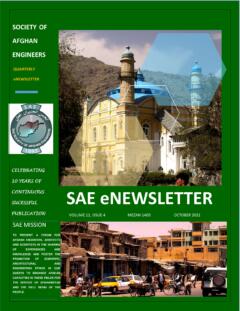
SAE Newsletter – October 2021, Volume 11, Issue 4, Mezan 1400
SAE Mission
To present a forum for Afghan engineers, architects and scientists in the sharing of experiences and knowledge and foster the promotion of scientific, architectural and engineering ethics in our quests to enhance Afghan capacities in these fields for the service of Afghanistan and the well being of the people.
Contents
- Editor’s Note
- Message From the President of SAE
- Message from the Chairman of the SAE Board of Directors
- SAE Fundraising for Displaced Families in Afghanistan
- In Memory of the Late Architect Abdullah Breshna
- Resignation of the SAE Representative in Kabul
- The Progress of Information & Communication Technologies (ICTs) and Electronic Learning in Afghanistan by Dr. Bahawodin Baha
- Report From Kabul, Afghanistan
- Membership News
- Achievements and Awards
- Announcements – (SAE 2021 General Assembly Meeting)
- Comments and Suggestions
- The Society of Afghan Engineers Organization
Note From the Editor-in-Chief, SAE eNewsletter
A Successful Team
Success is the goal of every team. A successful team has distinct ingredients. An attempt is made here to clarify these ingredients. But first we must understand the definition of a team. The dictionary defines: “A team is a group of individuals working together to achieve their goal”.
Consider several individuals working together on a project to build a bridge across a river, a flock of birds flying together to find new pasture, and a pack of wolves hunting together for food. In each case, each one work for a common goal. To achieve their goal, they are staying together as a team.
For the individuals working as a team building the bridge is their goal. In the case of birds, flying together as a team with a goal to reach a greener pasture for food, water and raising their future generation. The pack of wolves work together as a team with a goal to catch and kill a prey so they can feed themselves and their off springs.
There is a commonality within the above three examples – everyone is working for a goal, a common purpose, to achieve their goal they are working as a team . If each one doesn’t work for a common goal, it will not be a teamwork, the members in each team will fragment into groups. A group is not a team, where self-interest and greed will dominate no one will work for a common goal.
When there are several teams to accomplish a common goal an important element that bond them is trust and understanding each role and responsibilities. Having a goal, trust & understanding the many interrelationships that exist between the teams are important ingredient for a successful team . To succeed as a team, members must trust each other and the organization. If there is no trust among the members, the results will be failure.
This bring us to what is the goal of the Society of Afghan Engineers (SAE)? The goal of SAE as defined in section 2.2 of the Bylaws “To present a forum for Afghan engineers, architects and scientists in the sharing of experiences and knowledge and foster the promotion of scientific, architectural and engineering ethics in our quest to enhance Afghan capacities in these fields for the service of Afghanistan and the wellbeing of the people.” And the section 2.3 of the Bylaws state: “The vision of the Society shall be to participate in the development of Afghanistan,”
Difficult and complex tasks can be solved, and difficult goals can be achieved if individuals work together as a team and trust each other. One person cannot achieve and solve all tasks by himself. Each member’s support, participation, and guidance are needed to achieve a common goal.
The SAE is comprised of several teams each contributing to the above common purpose and common goal. To accomplish the above goal the various teams, need to trust each other and work together for the common goal. Members of the team should help each other, personal interest should stay away, each member should strive to achieve the team objective. Team members have different qualities, and they can benefit, gain and learn from each other. By their combined effort, team members complement each other skills, they generate synergy, they maximize strength and minimize their weaknesses.
Each team member must know the goal and work toward achieving that goal. There should exist an atmosphere of co-operation, interdependence, teamwork, and trust. Even if they are called various committee or subcommittee members, they all are members of the one SAE team, and they should work for the same goal as defined above.
Team members should avoid political games, blame games, instead cohesion and common vision should be emphasized. Forming a team or a sub team is easy but difficult to focus and bind them to a common goal and common purpose. Their bond is trusting each other. Members must learn to trust each other. We see governments where trust does not exist among their fellow employees, distrust results chaos, disarray and dysfunctionality that leads to failure of the system.
Open communication should be encouraged, and transparency must be always kept among the team members. The common goal must be clearly understood and conveyed to each member. Communication must be crystal clear and to the point, so everyone understands their role and responsibility. For example, members of a committee should understand their role in the committee as well their responsibilities related to their role. Conflicts among individual are the results of confusion and misunderstanding. When members do not understand their role and responsibilities then confusion takes over. The role within the team become fuzzy and execution of teamwork for achieving a common goal disappear. Members must learn how to listen to each other, input of each member, even if small should be valued and respected. When one participates in questions and show respect to the other who is speaking this action builds bond between members.
Members must seek guidance how to perform effectively. Left unguided they plow their own ways, based on greed, and mostly in the wrong direction where self-interest takes over. The trust and goals are lost.
When individual team members know their role, they trust each other, they direct and contribute their resources, knowledge, and skills toward achieving the common goal of the team then that team will be a successful team. Each one of us should work and make SAE a successful team.
With Best Regards
Hafizullah Wardak
Editor- in- Chief SAE eNewslettter and
Chairman – SAE eNewsletter Subcommittee
Message From the President of SAE
During the third quarter of 2021; the Society has made significant strides in achieving its goals set forth during the first and second quarters of 2021. However, these successes were challenged by a number of unexpected events and obstacles. These unexpected factors played significant roles in the slowness and to some extend delay of our planned projects.
While an agreement was finally reached between the Society and the department of Architecture at the Faculty of Engineering in Kabul University for the use and distribution of the Ashraf Roshan Scholarship Fund, the surge of coronavirus once again prevailed in Afghanistan. Schools and most government offices closed in July. Later, and when restriction of Covid-19 was lifted, schools were closed again due to a summer vacation. Similarly, when the Society reached an agreement with the University of Herat to launch the planned Renewable Energy Pilot Project, the security situation was deteriorated in Herat in late July and the University closed its doors for an undetermined period. Similarly, other projects planned and developed by the Society such as agreements between the Society and the Ministry of Urban Development and Land, National Water Affair Regulation Authority, and the Afghan National Standardization Authority were all placed on hold due to worsening security situation and Covid-19.
Despite these obstacles, we were able to completed a successful Fundraising to help the displaced families in Afghanistan. Membership in the Society kept growing, the review and update of Bylaws of the Society is in progress. The Society Website is finally upgraded to a new version of Word Press and it is being updated. A Joint-Venture agreement was signed between SAE and the Afghans Education for Better Tomorrow (AEBT) to promote Online Education in Afghanistan. The Board of Directors approved the SAE 2021 General Assembly Meeting to take place Virtual via Zoom on October 16, 2021. Details of the Agenda of the meeting will soon be published.
As you all know, August 15, 2021 is a historical day in Afghanistan. The Society will remain committed to serve the people of Afghanistan and to participate in the development of Afghanistan under the guidance of its Bylaws.
With Regards,
Najim M. Azadzoi, SAE President
Message From the Chairman, SAE Board of Directors
Dear Readers of the SAE ENewsletter,
Since February 2020, life has been anything but normal in the world. It has been all about COVID and the havoc it brought on the people and communities. It was a total disruption and will leave scars on parts of our lives forever. In Afghanistan though, there has been close to no worry and change. People went about their daily lives as usual, and COVID seemed a joke and unreal. Considering everything that has been happening, COVID may not have been a big deal for Afghanistan after all.
COVID or not, our beloved country has been going through very hard times. Through it, Afghans have learned to be resilient and strong, and with faith, these days will pass too. To serve our impoverished people, little it maybe, SAE has continued to operate according to its mission. The executive committee has been busy with their agenda, and the Board has been holding meetings, more than ever, to prepare for the little service that maybe delivered someday. In line with that, following are some of the major items that came to the Board. They were discussed in detail and decisions rendered.
- Joint Venture proposal between the Society of Afghan Engineers and the Afghan Education for Better Tomorrow (AEBT)
- Memorandum of Understanding and Modification to Ashraf Roshan’s Scholarship Fund
- The overhaul and maintenance of the Society’s Website
- Review and approval of Ustad Hafizullah Wardak as the Editor In-Chief of the eNewsletter and as the Chairperson of its Subcommittee
- Review and approval of the date and venue of the Annual General Assembly Meeting
- Review of the Bylaws: The appointed Task Force has been diligently working to edit and revise the Bylaws. Once all finished and done and approved by the Board, a draft of the new version will be shared with the members.
- Emergency fundraising for the displaced. A special emergency meeting was held to put this in motion.
Thinking positive and having hope is the only way forward. As it has been said, “Good time comes after bad time-like a beautiful day arises after a dark night”, we will remain hopeful and will pray for our country and our people.
Stay safe and be well.
Sincerely,
Abdul Manan Khalid, P.E., LEED (BD+C)
Chairman, SAE Board of Directors
SAE 2021 Fundraising for Displaced Families in Afghanistan
Decades of war and neglect has created hardship for millions of people in our beloved and war-torn country. With the current developments in Afghanistan, that situation has been amplified. Many families have left their homes in search of safety and in the hope of finding help in larger cities, especially Kabul, Kandahar, Helmand and Herat. We have been heartbroken seeing crying babies and people living in makeshift tents in parks and other open spaces on televisions. As sons and daughters of that country, it is hard to see that and not do something to help.
Seeing all that, the Society of Afghan Engineers (SAE) with the mission of enhancing the professional capacities in the field of architecture and engineering, and vision of helping and participating in the development of Afghanistan, jumped into action to do whatever else that could be done. It started a fundraising campaign on August 12, 2021 and by August 28, has raised a total of $6,257 from its members, their acquaintances, and friends and families.
While we sincerely thank everyone who contributed, we would like to assure them that these funds will be used thoughtfully and effectively. Considering the situation on the ground, and with the winter on the way, these funds will be sent to Afghanistan at an appropriate time in order to be used efficiently and only to the needy families.
On behalf of the Society of Afghan Engineers, we sincerely appreciate contributions made by all members and their friends and families. We understand many of you may have contributed to this cause through other means and channels which is commendable. Below is a list of those who took part in this fundraising:
| No. | Donated as of 8/20/21 | Amount ($) | Comments |
|---|---|---|---|
| 1 | Philip Durgin | 200.00 | Facebook Donation |
| 2 | Jim Olchefsky | 500.00 | Facebook Donation |
| 3 | Ian Whitney | 50.00 | Facebook Donation |
| 4 | Najim Azadzoi | 500.00 | Facebook Donation |
| 5 | Ahmad Wali Shairzay | 80.00 | Facebook Donation |
| 6 | Amina Bahrami | 700.00 | Facebook Donation |
| 7 | Melanie Nunn | 10.00 | Facebook Donation |
| 8 | Seven Tran | 10.00 | Facebook Donation |
| 9 | Wahab Nassery | 65.00 | Facebook Donation |
| 10 | Gul Afghan Saleh | 60.00 | Facebook Donation |
| 11 | Alexandra Carvalho | 100.00 | Facebook Donation |
| 12 | Wazin Muzhgan | 22.00 | Facebook Donation |
| 13 | Bill N Cathy Haight | 100.00 | Facebook Donation |
| 14 | Mehrzay Mohammad Jan | 75.00 | Facebook Donation |
| 15 | Ghulam Mujtaba | 300.00 | Facebook Donation |
| 16 | Manan Khalid | 300.00 | Facebook Donation |
| 17 | Ashraf Azadzoi | 100.00 | Facebook Donation |
| 18 | Bashir Kazimee | 75.00 | Facebook Donation |
| 19 | Abraham Baha | 250.00 | Facebook Donation |
| 20 | Hafiz Wardak | 200.00 | Facebook Donation |
| 21 | Mohammad Noorzay | 75.00 | Facebook Donation |
| 22 | Marzia Hessami | 10.00 | Facebook Donation |
| 23 | Zabi Zaca | 200.00 | Facebook Donation |
| 24 | Hamayon Ibrahim | 100.00 | Facebook Donation |
| 25 | Amin Mahmood | 200.00 | Check Payment |
| 26 | Mahmoud Samizay | 75.00 | Facebook Donation |
| 27 | Nadir Sidiqi | 200.00 | Check Payment |
| 28 | Atiq Panjshiri | 200.00 | Facebook Donation |
| 29 | Mang Tia | 200.00 | Facebook Donation |
| 30 | Amanullah Mommandi | 200.00 | Facebook Donation |
| 31 | Jalal Masumi | 200.00 | GoMeFund Donation |
| 32 | Gul Afghan Saleh | 100.00 | GoMeFund Donation |
| 33 | Abdul Hassani | 300.00 | Check Payment |
| 34 | Nader Noori | 500.00 | Check Payment |
| 35 | Bahaudin G. Mujtaba, Dr. Leslie Tworgoer, and Dr. Ravi Chinta | 1,000.00 | Check Payment |
| TOTAL | 7,257.00 |
Fundraising Goal: $5,000 Raised: $7,257
SAE Executive decided to establish a committee consisting of dedicated members of the Society to properly plan, manage, and oversee the distribution of the fund to qualified and eligible families in Afghanistan. The Committee Members are:
- Amanullah Mommandi, SAE Board Member
- Gul Afghan Saleh, SAE Board Member
- Hadi Rakin, SAE Board Member
- Amin Mahmood, SAE Student Committee, Chairperson
- Hafizaullah Wardak, SAE Editor-in-Chief
- Hamayon Ibrahim, SAE Vice President
- Mahmoud Samizay, SAE Treasurer
- Rafaat Ludin, SAE/Afghan Government Agencies Liaison Chairperson
- Masood Sattari, SAE Board Member
- Habib Rahman Rahmat, former SAE Representative in Afghanistan.
It is intended that the Fundraising Committee will commence its work soon and finalize its plan before the end of September and the funds to be distributed to qualified recipients in Afghanistan before the start of the winter.
Sincerely yours,
Najim Azadzoi, SAE President.
In Memory of Late Architect Abdullah Breshna
Architect Abdullah Breshna went to school in Berlin where he trained to become an architect and then worked with Egon Eiermann. In the early 1960s he returned to Afghanistan under King Zahir Shah and made significant contributions to the modern development of Kabul. But when the Soviet army occupied the country in 1980, Abdullah Breshna fled Afghanistan and settle in Germany.
Professor Bashir Kazimee, SAE Chairperson of Architecture and Urban Planning Subcommittee recalls Architect Abdullah Breshna as a forerunner of the modern architecture design in Afghanistan. Kazimee says: “I remember him very well as a teacher when I was in my junior architectural design class at the Faculty of Engineering at Kabul University in 1971, where he taught us architectural design for one semester. I found him to be the most dedicated and inspiring design teacher at that time.”
Abdulla Breshna’s father, late Abdul Ghafur Breshna, studied under the artist Max Liebermann in Berlin in the 1920s, and he married there. Abdul Ghafoor Breshna (April 1907 – January 4, 1974), was an Afghan painter, music composer, poet, and film director. He is regarded as one of the country’s most talented artists. He also composed the former national anthem of Afghanistan that was used during the 1970s.
Professor Kazimee continues: “Coming from an artistic family himself, Abdullah Breshna had an amazing artistic talent with hand drawings and sketch techniques, that fascinated every client and designer alike. Kazimee adds; his stylish residential and commercial architecture cannot be missed throughout the panorama of modern Kabul urban subdivisions. His emphasize on the details of architecture with charming horizontal and vertical concrete liners, sleek cantilever projections, wide balconies and large widow openings represented the luxurious glamour of his time. His style of architecture, at the least, inspired the next generations of the architects and design professionals who followed his design genre in the country. He served as the president of the Afghan Construction Unit in Kabul, which was a public/private construction company and built many successful governmental and private buildings in the country. He was also running a private architectural and engineering consulting firm by the name of “Abad” in Kabul.
Abdullah Breshna worked as an architect and town planner after he moved to Germany. He also served as President and CEO of and architectural firm, Zahra Breshna Consulting in Berlin Germany, ran by his daughter, Zahra Breshna. Zahra has Membership of Architectural Association in Berlin-Germany, since 2000.
The generation of Afghan architects and engineers who were trained and grew up in Afghanistan in the 1960s, 70s and 80s, very well remember him as a leading figure in the areas of architecture and planning.
Professor Hafizullah Wardak, SAE Editor-in-Chief, who taught structural courses at the Faculty of Engineering in Kabul University in the 1970s and 80s shares his memories working with Abdullah Breshna. “I participated in several official meetings with the Late Architect Abdullah Breshna. I found him a true patriotic Afghan, that he loved Afghanistan and wanted to provide as much as possible in the area of his expertise to the country. Which I think he did. One occasion I was part of a meeting that was held to discuss the cracks developed in the cantilevered roof of Ghazi Stadium where the President of the Country, President Daud, was scheduled to to be there for student parade. Architect Abdullah Breshna showed his sincere concern for the safety and well being of the President and also for the entire Afghan nation. I was touched by his thoughts and concern. The second time there was another technical issue related to several buildings that the Afghan government was considering to purchase. Again, I witnessed his deep love for the country. In another occasion, days after the Communist Coup, I had my daughter to a Pediatrician in Shari Naw Kabul, and he had his daughter brought there too, may be the one shown in the above picture, for medical visit to the same doctor. We chatted and expressed our opinion about the new government and some personal thoughts in the waiting area. That was the last time I saw him. He was a very sincere, family loving, and cared deeply in his heart about Afghanistan especially in the area of Architecture and overall construction.
On behalf of the Society of Afghan Engineers, we send our sincere condolences to his family, and may Allah (SWT) shower his soul with his eternal blessings and bountiful mercy.
Najim Azadzoi, SAE President.
Resignation of SAE Representative in Kabul, Afghanistan
With regret we were informed that Mr. Habib Rahman Rahmat Mayar, SAE Representative in Kabul, Afghanistan, resigned from his post. His resignation was accepted as of August 31, 2021. His resignation was due to his new job assignment offered to him in July 2021 and his commitment as the new Director of Badakhshan Energy Company where he will be stationed outside of Kabul mostly in Northern provinces and Badakhsah. Mr. Rahman was kind to offer his continuous voluntary cooperation with the Society with limited presence in Kabul. The Society appreciates his commitment to continue to work and help the SAE on a voluntary basis.
Mr. Rahman was chosen from among a total of eight (8) candidates for the position by a SAE screening committee in May 2021. During his four months service with SAE, he served diligently and established professional contacts with various Government departments, Engineering organizations, and Educational Institutes and provided valuable reports, documents, and responded to numerous inquiries by members of the Society with valuable information.
Habib Rahman Rahmat Mayar graduated from the Electrical Department of the Faculty of Engineering, Kabul University in 1984. He graduated from Afghanistan Institute of Technology (AIT) in 1978.
With Regards,
Najim Azadzoi, SAE President.
Technical Paper: The Progress of Information & Communication Technologies (ICTs) and Electronic Learning in Afghanistan
Dr. Bahawodin Baha
University of Brighton, UK.
b.baha@brighton.ac.uk
Abstract
This paper presents the results of an overview about the rapid development of computer science and ICT related educational programmes in Afghanistan. The main reasons behind such success have been highlighted. The application of ICT tools in various sectors, specifically at education sector and electronic learning have been briefly examined in this paper. The challenges for deploying digital leaning systems in Afghanistan are highlighted and recommendations are made how to take advantage of the e-learning and modern communication tools with the main aim to transfer knowledge and skills to Afghanistan.
Recommendations have been made to integrate ICT within mainstream education and to improve and develop the education of other science, engineering, and technology subjects within the Afghan universities, which will be crucial for future development in the country.
1. Introduction
The dramatic progress in engineering technologies during the 1980s and 1990s brought prosperity and better economic conditions to the society and thus, the development in technologies has made a huge contribution to improve the standard of life across the world. Examples of such technologies are computer technology, IT, digital communications and information and communication technology (ICT). Higher education in the above subjects across the world has played an important role to develop these technologies. However, the people of Afghanistan have regrettably not benefited from these golden opportunities because of wars and instabilities in the country. Higher education institutions in Afghanistan have been devastated because of decades of wars, neglect, and instabilities. Improving the education system, specifically in subjects related to science and technologies, is crucial for the future development in the country. Afghanistan had a reasonable education system in the region [1] and amongst the education institutions; specific attention had been made to improve the overall education system specifically in subjects related to science and engineering [2] – [3]. Regrettably, the progress that was achieved in 1970’s has been reversed because of the decades of wars and instabilities.
Limited progress has been achieved since the establishment of new government over two decades. For instance, the number of students has increased, some new institutions have been established and effort has been made to upgrade the experience and qualifications of existing academics in such institutions. However, the overall quality of higher education has not been improved significantly, the exception being that the computer science and information technology (IT) sector has experienced substantial progress and expansion in the country.
The following three main issues will be discussed in this paper:
a. History
b. The reasons behind the accomplishment and the successful expansion of computer science and IT courses compared to traditional engineering and science and engineering courses.
c. The application of ICTs and digital learning
d. Furthermore, the effects of partnerships between universities in Afghanistan with universities in the developed world will be investigated and reported as such partnerships have contributed to the areas of computer science and IT.
2. History of computer science and IT courses at higher education institutions in Afghanistan
The Afghan previous government has realised the importance of ICT and hence converted the ministry of communications to the ministry of communications and IT. Short-term training in ICT tools has been provided for junior and mid-level managers at many governmental and non-governmental organisations for the past six or seven years in order to overcome the shortage of ICT professionals in the immediate future. However, such training programmes have not been organised in a uniform and cohesive way to alleviate the long-term gap of the ICT professionals in the country. Regrettably, the progress has been limited despite of huge amount of investment by the international community in ICT related projects. However, the first national conference which was organised by the ministry of communications and United National development Program (UNDP) was held in Kabul in 2006 [4].
It is unfortunate that the previous Afghan government has not considered integrating ICT within the mainstream education system in the country. ICT can provide unique opportunity for both academics and students to have access to a rich library of information, free of charge via the internet.
An integrated approach is needed by the previous Afghan government and international community to introduce computers and internet access into the learning environment in Afghanistan, such introduction will have a major effect on education system. As the learning resources such as fully stacked libraries and fully equipped computer laboratories are rare in the country, careful planning is required to prioritize the introduction of ICT into the mainstream education including higher education.
While the world has changed dramatically in the past few decades and will continue to do so with an accelerating pace, the learning environment, i.e. the classroom has not changed but it will change in the near future. The education system in Afghanistan must follow its international counterparts by international norms into the education system. ICT can play a major role to achieve such objectives.
The first undergraduate programme on computer science was started at Kabul University (KU) in 1997 [5] and since the establishment of the new government in Afghanistan in 2002 many other computer science and IT courses have been introduced at universities in the country. Many computer centers have been created at Kabul University and other higher education institutions in Kabul and other major cities. Though, the there is little or no collaboration between the various computer centres and their sponsors.
The list of public universities offering computer science and IT courses are as follows:
a. In the Capital
– Kabul University (KU)
– Information and Communication Technology Institute (ICTI)
– Kabul Polytechnic University (KPU)
– University of Education
b. Provincial Universities
– Balkh University (BU) in the north of the country
– Nangarhar University (NU) in the east of the country
– Kandahar (KU) and Sheikh Zahid Universities located in Khost (SZKU), in the southeast and southern Afghanistan
– and Herat University (HU) in western Afghanistan.
There are many private institutions which offer IT courses beside the above public universities in Afghanistan.
3. Reasons for success
To the author’s knowledge, the following factors are the main reasons for the success of computer science and IT courses in Afghanistan.
3.1. New Technologies such as computers and wireless communications
Computer technology and mobile telephones have recently been introduced to the country and most youngsters in the country are fascinated by these technologies and try to incorporate it into their daily life. Computer science and IT courses are popular courses after medicine and engineering and attract talented candidates at universities across the country. Some students, who are unable to get admission to public universities, learn computer and ICT skills at private institutions, which increase their chances of finding well paid jobs at the government or non-governmental organisations. The establishment of communication and internet companies and other development in electronic communication has a major effect by promoting ICT in the country. According to the latest information from ministry of communications and IT, the number of companies which provide communications and IT services are more than thirty-three.
3.2. Better employment opportunities
The international organisations working in Afghanistan usually hire a workforce that is computer literate; as a result, candidates with computer skills will have major advantages over other candidates applying for same positions at various UN agencies and other non-governmental organizations (NGO’s). The jobs at international organisations are more rewarding compared to the jobs at the Afghan government or local companies.
3.3. Donors’ willingness to invest in the labs
Mysteriously, it has been very easy to persuade the donors to invest in computers and ICT equipment compared to equipment for traditional engineering and science subjects and thus, many new computer laboratories can be found at most higher education institutions. However, the lack of coherent IT policies and their applications specifically in sharing the learning resources such as textbooks, libraries, and IT equipment amongst the Afghan universities are clear. The Afghan government ought to address this issue.
3.4. Young and enthusiastic academics
Most of the experienced and qualified academics at higher education institutions in Afghanistan have either fled the country, retired or have been victims of the wars in the country. Those who stayed behind were isolated from the rest of the world and some of them have been involved in politics and regrettably politics was mixed with the education, which had a devastating effect on the whole education system in the country.
One of the major advantages of the computer science department at Kabul University is that most of the academics are young, enthusiastic and some of them may have some international experience too. Consequently, most of the academics are willing to enhance their knowledge and adapt new academic practices within. The constructive attitude of such academics had a positive effect and greatly improved the quality of education that they provide compared to the traditional science and engineering courses which has a long history within the universities in Afghanistan.
4. The progress of Electronic Learning (E-Learning) in Afghanistan
Despite of the success to establish many computer science and IT courses in Afghanistan, the real applications of ICT tools in other sectors have not been rather limited. One of the very important applications of ICT tools that experienced exponential growth around the world is electronic learning (e-learning) and remote teaching specially after the COVID-19 crises in early 2020, which has been investigated in the section.
The concept of e-learning is advancements in computer and communication technologies over the last three decades have enabled the educators to provide electronic learning knowns as e-Learning which has been utilized by many universities, colleges, schools, and recently other organizations world-wide. Higher education around world has experienced incredible number of technical innovations and changes over the last two decades. One of those changes is the integration of Information and Communication Technologies (ICTs) in education through an educational tool which is called Learning Management System (LMS) that is employed by educationalists for planning, implementation, and assessment purposes, which will be briefly discussed in the next section.
4.1. Learning Management Systems (LMS)
For any institution to embark on e-Learning for their students, they must have a Learning Management System (LMS) which may cost the institutions relatively huge sums of money. An LMS provides the backbone on which the workflow of education runs. An LMS can be adopted for various purposes including sharing notes, introducing assignments, lecture slides and post grades and the students can submit their course work and essays electronically through these platforms.
The main features of an LMS are as follows:
– Provide a platform for sharing lecture notes and slides, teaching plan and assignments, and recorded lectures.
– LMS provide close collaboration between learners and instructors.
– Create an educational workflow that makes sense for different environments including blended learning
– Mobile users will be able to access teaching materials from anywhere.
There are over hundred software companies which develop LMS systems every year. Examples of the popular LMS systems which most universities in the developed world employ are Blackboard, Canvas, Moodle, and many other clouds based LMS systems. However, large sums of money will be needed to deploy such systems, which will be discussed in the next part section of this document.
4.2. Cost of LMS systems
The LMS companies which provide services to the schools, colleges and universities charge huge sums of money on annual basis. For instance, University of Brighton in the UK where the author has been working is charged over £90000 annually by Blackboard Inc for the services which they provide. In addition, the university also make payment in the region of £100000 to another company which provide Turnitin facilities. Furthermore, there are many software packages which are integrated with LMS to provide enormous IT services and therefore, each institution is required to make further huge investment which will enable their students, academics, and administration staff to have access to better ICT services and e-learning facilities.
4.3. Remote teaching
In remote teaching, face to face interactions is usually replaced with online lectures/seminars or alternative activities directed through Learning Management Systems (LMS), the system that was discussed earlier in this document. The administrators register all the students in various courses through LMS systems and the academics provide their lectures notes and other materials via LMS which will enable their students to access the teaching materials from anywhere.
Communication tools such as MS-Teams, Zoom or SKPYE are required for delivering lectures remotely. Microsoft provide an attractive license agreement for their product including MS-Teams to the universities. Therefore, most institutions are using MS-Teams for their remote teaching and meetings. Another advantage of MS-Teams is the strong security features of this tool.
4.4. E-Learning and Afghanistan
E-learning is a new concept, and many people are unfamiliar with this terminology in Afghanistan. The main challenges for launching e-Learning in Afghanistan are as follows:
(i) The lack of proper IT infrastructure within the educational institutions.
(ii) The lack of reliable high speed internet access and communication networks.
(iii) The lack of suitably IT literate and experienced academics, admin staff and technicians.
(iv) Intermittent electricity supply as pylons and electricity towers are blown up from time to time.
(v) The lack of strong commitment by academics in the institutions.
(vi) All students may not have access to suitable devices to access online teaching materials.
(vii) The Ministry of Higher education (MoHE) developed a system called HELMS for the whole country; however, the author has not tested the system but has received many complains.
5. Conclusions
The relative progress of courses related to computer science and IT at the Universities in Afghanistan and the reasons behind such progress has been highlighted in this paper. Despite of the success of the successful establishment of computer science and ICT courses, the applications of ICT tools in office automation and specifically in e-learning has been rather limited or non-existent. Hence the following recommendations are made about the establishment of proper e-learning systems at schools and universities in the country.
- ICT policies should be developed at the government and institutional levels; sound national policies are based upon government priorities and goals, which are associated with the present circumstances in Afghanistan. Policy strategies or approaches to achieving goals may differ, especially regarding supporting ICT usage and research in higher education Institutions in Afghanistan.
The development of national policies that can positively impact on ICT adoption and expansion in the following areas is highly recommended:
a. Promote access to IT skills and education for all;
b. Improved network infrastructure in urban and rural areas;
c. Encourage technological research and development.
Positive ICT policies and investments are clearly beneficial to higher education institutions, even though ICTs have not replaced classroom face to face Teaching and learning. Undoubtedly, ICTs can provide greater access for different target learners, and can become vehicles for enriched pedagogical experiences, particularly for distance educators and learners separated by time and space. However, to embark on e-learning there are many challenges including the following which the authorities must address before launching such new initiatives:
- The necessary ICT training should be provided for the academics, technicians and administrators at the education and higher education institutions in the country. The training will be more productive and effective provided academics are committed and willing to learn and change their attitude towards adapting the new practices. Otherwise, any significant progress to address this issue seems a distant possibility.
- To make huge investment in IT infrastructure at universities.
- The deployment of large skill Learning Management systems (LMS) systems such as Blackboard, Canvas seems impractical and less cost effective at present. Therefore, the authorities ought to consider cost effective solutions. The author will be happy to share his experience and recommendations to make some progress.
- There are many other issues, such as lack of suitable fast internet access, qualified and experience academics and technicians and IT equipment.
It is hoped that the Afghan government will learn lessons from such successes and extend the experience to improve science, engineering, and technology courses at the educational institutions in the country. Nevertheless, further work is required to extend the benefits of this positive development to other subjects and make full use of ICT in other sectors.
References
- Samady, R. S.,” Education and Afghan Society in the Twentieth Century,“ United Nations Educational Scientific and Cultural Organisation (UNESCO), November 2001.
- Baha, B., “Engineering Education in Afghanistan,” Proceedings of the 2003 WFEO/ASEE e- Conference. June 2003.
- Baha, B, Z, Baha (2008) Technical Vocational and Engineering Education in Afghanistan, American Society of Engineering Education (ASEE) Conference, Philadelphia, USA, June 2008.
- Ministry of Communications, “First National ICT Conference Afghanistan 2006 “, April 2006.
- Ministry of Higher Education, “International Conference on Information Technology for Higher Education in Afghanistan,“ June 2008.
Author of The Technical Paper
Dr Bahawodin Baha, (BSc – Afghanistan, MSc and PhD- UK)
Dr. Bahawodin Baha is a principal lecturer at the University of Brighton in England since 1989 where he has been teaching and performing research in electronic engineering. He published many papers on electronics at international conferences and well-known international journals. He has recently been conducting research in machine learning, Internet of Things (IoT), high frequency semiconductor devices and wireless communication systems.
Besides his teaching and research at University of Brighton, he has been assisting Higher Education in Afghanistan since 2005 through various projects on improving higher education. He has trained some talented Afghan lecturers for Kabul Polytechnic University (KPU) at University of Brighton. He also took sabbatical leave for two years and worked as a technical advisor at the Ministry of Communication and Information Technology (MICT) in Afghanistan. During his work, his activities were very closely associated with the Ministry of Higher Education (MoHE) and Kabul based universities. He has published papers about improving engineering education in Afghanistan at international conferences in Europe and north America. In addition, Dr. Baha has recently been promoting digital learning and remote teaching at universities in Afghanistan. He also developed a website in support of higher education in Afghanistan.
He was a visiting scholar at Virginia Polytechnic, Institute and Sate University (VPI) in the USA in 1991 – 1992 where he worked with well-known electronic professionals who are working at Intel, Texas Instruments and etc.
Report From Kabul, Afghanistan
A Report From Afghanistan, July 2021
By: Habib Rahman Rahmat Mayar
Mr. Habib Rahman Rahmat Mayar was SAE representative in Kabul prior to his resignation on July, 2021. He had informal meetings with several Afghan engineers in Kabul, Badakhshan, Mazar-i-Sharif and Herat provinces. The purpose of the meetings was to understand their thoughts on current engineering issues in Afghanistan.
During meetings, the following items were discussed:
1. Jointly working on possible pilot projects for solar powered water lifting and other potential Renewable Energy Systems. Rivers in Afghanistan currently can irrigate 100,000 hectares of new lands with the new system. The engineering team will complete a detailed report for publication in the eNewsletter in the future.
2. A team of engineers are currently working on the preparation and development of design manuals for electrical-irrigation system that is presently needed in Afghanistan.
3. It will be beneficial to Afghan engineers if online remote training workshops, courses like those done for Herat University can be offered to Afghan engineers.
The team of engineers identified the following issues that may require further discussion and study:
1- Technical problems:
a) Transformers are complicated components, some transformers are overloaded, power supply networks are worn out in some districts (cables, bases, insulators, brackets, etc.)
b) Lack of equipment and electrical appliances and failure to complete some projects in border districts such as Sheghnan & Maimi.
c) Repairing and extending the distribution networks and branches, as well as replacing wooden and semi-concrete bases with standard concrete bases and replacing worn-out position cables with new and standard cables.
2- Financial problems: Lack of implementation of financial needs of electricity management in districts at the appointed time.
3- Commercial and Business problems: Lack of clear policy for the sale of electricity, the existence of previous government offices, the presence of complicated and analog meters in the networks, which causes high losses and lack of business staff in the districts.
4- Problems of human resources (HR): Lack of regular plan to improve the capacity and capability of employees in the center and districts.
5- Start of the remaining works of Tajikistan 35 kV network to Maimi.
6- Visiting Sheghnan 6 and Sheghnan 2 semi-finished projects.
7- Lack of a clear regional cooperation policy and strategy for the easily passage of technical personnel for the purpose of monthly repairing equipment on the Afghanistan-Tajikistan border. Removal of any restrictions.
8- Poor communication (internet and telecommunications) between the districts and the center.
9- Lack of guards (for offices and sub-stations) in districts.
10- The need for walkie-talkie telecommunications in the districts and the center.
11- Improving high voltage networks, including transformer stations, and replacing all types of ceramic insulators with polymer type.
12- Construction of Tamp weir (dam catchment) in the sea flow path due to fluctuations in the monsoon sea flow in MHP challenges the energy production process in four seasons.
Membership News
SAE New Members 2021
SAE is pleased to announce that many professional engineers and architects in the United States, Canada and Afghanistan have shown their interests becoming SAE team members since January 2021. SAE has received most of new members’ membership applications and fees as required by the SAE bylaw. We welcome everybody and looking forward working together in future projects by providing professional services to Afghan Government and agencies. We welcome our newest high qualify members and look forward to their contribution to the purpose and mission of the Society of Afghan Engineers as set forth in the bylaw of the society.
Society of Afghan Engineers (SAE) Membership Fees-2021 USD (Active Members)
| No | Last Name | First Name | 2021 Membership | Donation | Total | Email Address |
|---|---|---|---|---|---|---|
| 1 | Afrooz | Yusuf | myafrroz@gmail.com | |||
| 2 | Afshar | Reza M. | 60 | 40 | 100 | afghanrelief@aol.com |
| 3 | Arghand | Moheb | 0 | 0 | 0 | mohebargand@yahoo.com |
| 4 | Azadzoi | Najim | 60 | 140 | 200 | azadarch@aol.com |
| 5 | Babacarkhial | Abdul Nazeer | 0 | 0 | 0 | engineernaz@aol.com |
| 6 | Baha | Zarjan | 120 | 0 | 120 | bahaz@purdue.edu |
| 7 | Baluch | Hashem | 60 | 0 | 60 | baluch56@yahoo.com |
| 8 | Ebadi | Yar M. | 60 | 40 | 100 | yebadi@ksu.edu |
| 9 | Ghani | Aziz | 60 | 140 | 200 | agdesignstudio@gmail.com |
| 10 | Hamid | Shapoor | 0 | 0 | 0 | Shapoor_Hamid@URSCorp.com |
| 11 | Hashemyan | Sayed | 0 | 0 | 0 | hedayat@comcast.net |
| 12 | Hassani | Abdul Waheed | 60 | 0 | 60 | awhassani@gmail.com |
| 13 | Hossainy | Said Sharif | 60 | 40 | 100 | sharifhossainy@hotmail.com |
| 14 | Ibrahim | M. Hamayon | 60 | 0 | 60 | hamayonibrahim@ccl-eng.com |
| 15 | Kazimee | Bashir | 60 | 40 | 100 | bkazimee@wsu.edu |
| 16 | Kazimi | Najib M. | 0 | 0 | 0 | Najibkazimi07@gmail.com |
| 17 | Keshawarz | Saleh | 120 | 120 | keshawarz@hartford.edu | |
| 18 | Khalid | Manan | 60 | 40 | 100 | manank10@gmail.com |
| 19 | Ludin | Rafat | 60 | 90 | 150 | rludin@comcast.net |
| 20 | Mahmood | Amin | 60 | 40 | 100 | amahmood@amstructural.com |
| 21 | Masumi | Jalal | 60 | 40 | 100 | jalal.masumi@gmail.com |
| 22 | Mohabbat | Yar M. | 0 | 0 | 0 | ymohabbat@yahoo.com |
| 23 | Mommandi | Amanullah | 60 | 0 | 60 | mommandia@gmail.com |
| 24 | Mujtaba | Ghulam | 60 | 140 | 200 | mujtabaghulam@bellsouth.net |
| 25 | Mujtaba | Bahaudin | 60 | 40 | 100 | mujtaba@nova.edu |
| 26 | Naderi | Hamid | 0 | 0 | 0 | hnaderi24@gmail.com |
| 27 | Naim | Wahid | 0 | 0 | 0 | naimw@hotmail.com |
| 28 | Noori | Nader | 0 | 0 | 0 | mnoori916@yahoo.com |
| 29 | Noorzad | Abdullah | 60 | 0 | 60 | anoorzad@noorzadconsulting.com |
| 30 | Panjshiri | Atiq | 60 | 0 | 60 | atiqpanjshiri@yahoo.com |
| 31 | Paya | Najib M. | 60 | 200 | 260 | mnpoya@yahoo.com |
| 32 | Poya | Omar | 0 | 0 | 0 | opoya84@hotmail.com |
| 33 | Rahim | Abdul Saboor | 0 | 0 | 0 | asrengineering@sbcglobal.net |
| 34 | Rakin | Hadi | 0 | 0 | 0 | hadi@verizon.net |
| 35 | Rayek | Hashim | 0 | 0 | 0 | rayekfamily@gmail.com |
| 36 | Rossi | Steve | 0 | 0 | 0 | srossi@scrossi.com |
| 37 | Saleh | Gul Afghan | 60 | 40 | 100 | gulsaleh@gmail.com |
| 38 | Samizay | Mahmoud | 60 | 40 | 100 | sae.samizay@yahoo.com |
| 39 | Sarwari | Sabir M. | 0 | 0 | 0 | ssarwary@redwoodcity.org |
| 40 | Sattari | Masood | 0 | 0 | 0 | masood@svestimatingservices.com |
| 41 | Sayed | Matin | 0 | 0 | 0 | matinsayed24@gmail.com |
| 42 | Sekander | Timor | 0 | 0 | 0 | abautowholesale@yahoo.com |
| 43 | Shekib | Sohaila | 0 | 0 | 0 | sohaila@saniecg.com |
| 44 | Shirzay | Ahmad Wali | 0 | 0 | 0 | ahwshairzay@gmail.com |
| 45 | Sidiqi | Nadir | 0 | 0 | 0 | nadirsidiqi@yahoo.com |
| 46 | Wardak | Hafizullah | 60 | 0 | 60 | hwardak@comcast.com |
| 47 | Yamayee | Zia | 60 | 200 | 260 | yamayee@up.edu |
| 48 | Zaca | Zabiullah | 60 | 40 | 100 | zabihulla@comcast.net |
| Subtotal | $1,680 | $1,350 | $3,030 |
2021 New Members
| No | Last Name | First Name | Membership | Donation | Total | Email Address |
|---|---|---|---|---|---|---|
| 1 | Abdullah | Ehsan | 60 | 0 | 60 | ehsan.abdullah2@gmail.com |
| 2 | Afghan | Fazel Ahmad | 60 | 0 | 60 | afghanfazel37@hotmail.com |
| 3 | Atayee | Tamim | 60 | 0 | 60 | tatayee@rivertec.com |
| 4 | Baidariwal | Fazal | 0 | 0 | baidariwal@yahoo.com | |
| 5 | Goethert | Reinhard | 0 | 0 | 0 | rkg@mit.edu |
| 6 | Levrat | Fred | 0 | 0 | 0 | fredlevrat@gmail.com |
| 7 | Mehrzai | Jan | 60 | 0 | 60 | jmehrzai@yahoo.com |
| 8 | Miller | Hamida | 60 | 0 | 60 | hamidamillerteam@gmail.com |
| 9 | Naimi | Qaseem | 60 | 40 | 100 | mqnaimi@yahoo.com |
| 10 | Omarzad | Mustafa | 60 | 0 | 60 | mu_omarzad@yahoo.com |
| 11 | Qadir | Abdullah | 0 | 0 | 0 | abdullah.qadir@gmail.com |
| 12 | Roshan | Tooba | 60 | 0 | 60 | ararchgroup@aol.com |
| 13 | Taraky | Yar Mohammad | 60 | 40 | 100 | yarart@hotmail.com |
| 14 | Abdul Qayum | Abdul Rauf | 60 | 0 | 60 | abdulrauf22@hotmail.com |
| 15 | Zahori | Sayed | 0 | 0 | szahori@redwoodcity.org | |
| 16 | Farooqi | Najib M. | 60 | 140 | 200 | Najibfar@aol.com |
| 17 | Durnai | Ahmad Shah | 0 | 0 | 0 | asdk@sympatico.ca |
| 18 | Wardak | Hassan Wazma | 0 | 0 | 0 | wazma786@aol.com |
| Subtotal | 660 | 220 | 880 | |||
| Grand Total | $2,340 | $1,570 | $3,910 |
SAE New Members (Residing in Afghanistan and Turkey)
| No | Name | Residence | Email Address |
|---|---|---|---|
| 1 | Zhakfar Zabihullah | Afghanistan | z.zhakfar2015@gmail.com |
| 2 | Kamran Matiullah | Afghanistan | matiullahkamran@gmail.com |
| 3 | Momand Mohammad Ishaq | Afghanistan | ishaq_moh@yahoo.com |
| 4 | Momand Mohammad Fazil | Afghanistan | Fazil.uccc@gmail.com |
| 5 | Zahid Hasibullah | Afghanistan | Hasib.zahid315@gmail.com |
| 6 | Saberi Safi | Afghanistan | safi.saberi97@gmail.com |
| 7 | Asim Arif | Afghanistan | arif.asim2018@gmail.com |
| 8 | Naimi Kazim | Afghanistan | kazim.naimi2016@gmail.com |
| 9 | Hmadard Sahar | Afghanistan | Engsaharmahmood1@gmail.com |
| 10 | Howaida Ahmad Walid | Afghanistan | walidhowaida@gmail.com |
| 11 | Maihan Regina | Afghanistan | reginamaihan@gmail.com |
| 12 | Alizoi Mohammad Azim | Afghanistan | mazimalozai@gmail.com |
| 13 | Hussaini Muzhda Sahadat | Turkey | muzhda.sahadat@gmail.com |
| 14 | Sattari Mashhood | Turkey | zaheer.sattari@gmail.com |
| 15 | Qadery Qadria Shewa | Afghanistan | qadriashq2021@gmail.com |
| 16 | Nazarian Tayebeh | Afghanistan | tnazarian@yahoo.com |
Achievements and Awards
Afghan American Chamber of Commerce (AACC) Recognized by SAE
Afghan American Chamber of Commerce (AACC)
September 13, 2021
Dear Mr. Jeffrey Grieco:
On behalf of the Society of Afghan Engineers (SAE), I would like to express my sincerest gratitude for your relentless efforts towards promoting the exchange of information and stimulating US-Afghanistan business and investment.
Many AACC members and affiliates in the business community were adversely affected by the velocity and magnitude of events unfolding during the unsettling events which proceeded last month’s US withdrawal in Afghanistan. Not only did years of planning, investments and enterprise operations grind to a sudden halt, many businesses feared for the safety of their loved ones and employees. The timeliness and thoroughness of the information you assembled and disseminated to AACC members during this period of chaos, including available assistance programs and respective procedures, brought a sense of calm and focus. The SAE commends your leadership and looks forward to your continued service to the Afghan-American business and SAE community.
Sincerely,
Mohammad Jan Mehrzai
Chairperson for SAE Corporation Committee
Announcements
The 2021 SAE General Assembly Virtual Meeting
Saturday, October 16, 2021
via Zoom
1:00 PM – 3:00 PM Eastern Time (Washington); 10:00 AM – 12 PM Pacific Time (California)
9:30 PM – 11:30 PM (Kabul Time)
Tentative Agenda
| Time | Presentation/Topic | Presenter |
|---|---|---|
| 12:00 – 1:05 | A recitation of the Holy Quran & Duwa | To Be Determined |
| 12:05 – 12:10 | Welcome Remarks | Najim Azadzoi, President |
| 12:10 – 12:15 | Keynote Speaker | Prof. Zarjon Baha, Ph.D., Purdue University |
| 12:15 – 12:30 | Guest Speaker: Status of Afghan Economy & Refugees | Jeffery Grieco, President, AACC |
| 12:30 – 12:35 | A message from the SAE Board of Directors | Manan Khalid, Chairman |
| 12:35 – 12:40 | SAE Financial Report Updates | Mahmoud Samizay, SAE Treasurer |
| 12:40 – 12:50 | Some Reflection and Hope | Prof. Reinhard Goethert of MIT |
| 12:50 – 12:55 | How can SAE help Afghanistan Realistically | Nader Noori, US Bureau of Reclamation |
| 12:55 – 1:05 | Review of SAE 3-year Strategic Plan | Rafaat Ludin, Chairperson |
| 1:05 – 1:10 | The Future of Architecture and Urban Planning | Prof. Bashir Kazimee |
| 1:10 – 1:15 | Online Education for Women in Afghanistan | Mohammad Feda, President, AEBT |
| 1:15 – 1:20 | Online Education and Training for Afghan students | Amin Mahmood, Chairperson |
| 1:20 – 1:25 | Future of SAE Publications and Newsletter | Hafizullah Wardak; Editor-in-Chief |
| 1:25 – 1:30 | SAE Members’ Owned Businesses role | Jan Mohammad Mehrzai |
| 1:30 – 2:00 | Open discussion, Question & Answers | All Members |
The Society of Afghan Engineers Organization
The purpose of the Society of Afghan Engineers is to accomplish the activities described in the mission and vision statements of SAE. The Society is formed by the free will of a group of Afghan Architects and Engineers and is operated on a nonprofit basis. The Society engages in charitable activities and as a result of this, the Society of Afghan Engineers is exempted from Federal Income Tax under Section 501 (c)(3) of the United States Internal Revenue Code. The Society is not an agency of any government nor is the Society a political organization. Therefore, it is not devoted to carrying on any political propaganda.
Executive Committee
- President: Najim Azadzoi
- Vice President: Hamayon Ibrahim
- Treasurer: Mahmoud Samizay
Board of Directors
- Chairman of the Board: Manan Khalid
- Vice Chairman of the Board: Jalal Masumi
- Executive Director of the Board: Gul Afghan Saleh
- Board Members: Abdul Wahid Hassani, Shrif Hussaini, Amanullah Mohmmandi, Hadi Rakin, Masood Satari, Zabi Zaca
Local Chapter Coordinators
- Toronto, Canada: M. Qaseem Naimi
- Colorado: Amanullah Mommandi
- Massachusetts: M. Najim Azadzoi
- N. California: M. Najib Poya
- New York/New Jersey: A. Manan Khalid
- Virginia/Washington DC: Atiq Panjshiri
- Kabul, Afghanistan: A Hamid Layan
SAE Committees and Subcommittees Chairpersons
- Corporation Committee: Jan Mohammad Mehrzai
- SAE Electronic Newsletter Subcommittee Editor-in-Chief: Hafizullah Wardak
- Architectural Subcommittee: Prof Bashir Kazimee, AIA
- Building Code Subcommittee: Najim Azadzoi, AIA
- SAE/AGA Liaison Subcommittee: Rafaat Ludin
- City Planning Subcommittee: Najim Azadzoi, AIA
- Website Development and Maintenance: Najim Azadzoi, AIA
- Student Subcommittee: Amin Mahmood
- Capacity Building and Academic Development: Wali Shairzay
Kabul Polytechnic University International Journal of Engineering and Technology
Congratulations to the Press Department of Kabul Polytechnic University for publication of International Journal of Engineering and Technology. Assistant Professor, Dr. Ahmad Jawad Niazi is serving as the Editor-In-Chief. There are needs for editorial and technical related expert reviewers of the articles.
Reviewer Criteria:
– Must have published articles as first author or correspondent author in peer-reviewed journals in the past five years.
– Minimum education of master’s degree or equivalent in engineering and technology disciplines.
Interested reviewers can contact:
Assist. Prof. A.J. Niazi, PhD.
Cell: +93-781-151-152
Email: ijet@kpu.edu.af / dr.ajniazi@gmail.com
Comments and Suggestions
The Editorial Board of the SAE eNewsletter welcomes comments and suggestions from the respected Society members and readers of the Newsletter. Your comments and responses will be included for information of all readers of the SAE eNewsletter.