SAE Newsletter – 2022-01 – Volume 12, Issue 1
Discusses the overarching impact of municipal government engineering, details a joint venture with Planate Management Group, and updates the community on emergency housing and fundraising distributions.
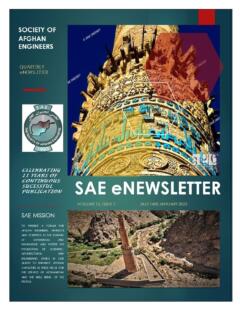
SAE Newsletter – January 2022, Volume 12, Issue 1, Jadi 1400
A Quarterly Update From The Society of Afghan Engineers
6265 Franconia Road Alexandria, VA 22310
http://www.afghan-engineers.org/index.html
Contents
- Editor’s Note
- Message From the President of SAE
- Message from the Chairman of the SAE Board of Directors
- SAE Fundraising for Needy Families in Afghanistan
- SAE Representative in Kabul Afghanistan
- Joint Venture with Planate Management Group
- Municipal Government and Engineering by M. S Sarwary
- A Healing Word From The BioNatural Healing College
- The 2021 General Assembly Meeting
- Membership News
- Achievements and Awards
- Comments and Suggestions
- Job Opportunities at Planate Management
- The Society of Afghan Engineers Organization
Note From the Editor-in-Chief, SAE eNewsletter
Education – Key to Progress, Wellbeing, and Stability, of a Nation
Greetings, happy new year, and welcome to the first issue of the SAE eNewsletter of the year 2022. Our hope is that you had a pleasant, safe, and healthy 2021. On this first day of the year 2022, I would like to share with you an important topic in the following few paragraphs.
The news sources around the world, had ample debates and coverage of education during the past year. It is timely to remind readers of the SAE eNewsletter the significance and importance of education and its impact on the wellbeing of a nation.
From the Islamic point of view, based on the two main sources the Quran and Sunnah, education and knowledge are vitally important and highly emphasized for human being. Obtaining knowledge and education and providing access of it to all is accentuated in Islam. With education and knowledge, one can fulfil obligation and duties to Allah (SWT) and humanity nobly.
Education, in general and in today’s terminology, guides and propel citizens of a nation to prosperity, progress, peace, stability, and wellbeing. It leads the populous to establish a well-balanced functioning society, and it becomes a leading force for creating operational infrastructure that are essential for a healthy and balanced society. The role of higher education institutions is so vital for the survival of a nation that they can be considered and categorized as a critical infrastructure.
Years ago, I was enrolled at an “English as a Second Language (ESL)” class at the University of Hawaii. The ESL professor, asked the class: why is the United States of America (USA) the most powerful nation in the world? Few students responded it has a strong military force, few other said it has more money, several other responses along the same line were mentioned. The professor said the correct answer is, USA has the world best higher educational institutions. He named MIT, Case Institute of Technology (CIT), Caltech, Stanford, Yale, U Penn, Harvard, NYU, and several other higher educational institutions across the country. These institutions have produced a vastly educated populations that led to the creation of a highly advanced and functional infrastructure and made this country the most powerful nation on earth.
We witness India, it provides and export technical workforce, especially scientist, engineers, and technologist to the entire world. India’s leaders valued and recognized that key to progress and wellbeing is education, thus promoted its youths to attend the best universities of USA and Europe, at the same time built and strengthened its own educational institutions, and infrastructure.
China, another example, decades ago it started sending a large number of youths, each year to attend the best schools in USA and Europe. At the same time supported and built their own higher education institutions and infrastructure. We witness the results of their action today.
Singapore, a small nation, with highly educated populations, and well trained and dedicated leadership, have risen to become the best global economies with exemplary developed infrastructure. The quality of life and overall lifestyle of its citizen has reached an impressive level.
In general, a nation with highly educated populace has the most functional and needed infrastructure. I am using the word infrastructure by the definition of dictionary, it covers the basic physical and organizational structures and facilities needed for the operation of a social and economic of society, systems, and services that a country needs to function properly and normally.
A nation with well-planned and maintained infrastructures has the best healthcare system such are hospitals, qualified doctors, well maintained transportation systems, water supply facilities and their management, energy sources, waste disposal system, well maintained educational systems, excellent communication system, services including law enforcement, emergency services, etc. Most important these nations continuously improve and update their existing educational system.
Nations where higher education or education in general does not get priority, they end up with less educated residents. Lack of proper education holds them back on establishing and building infrastructure, job creations, and overall economic growth, developments, stability, and survival of the nation become a challenge. The leaders struggle to allocate budget to build infrastructure, create jobs and employment for citizen. They cannot improve it’s citizen quality of life and end up with infrastructure that is nonfunctional or non-existent.
Without educated cadre of professionals, a sustained and balanced growth of well-functioning infrastructure will not come to existence. It is the professionals in various fields that can plan, operate, and execute, for example transport of people and goods, provide clean drinking water, safe disposal of community waste products, create and develop energy sources and build and sustain medical hospitals and provide health services to the community. Yes, indeed education can also bring peace and prosperity to the world. Let us join hands and make the Society of Afghan Engineers a champion and supporter of education at every level in Afghanistan.
As we step into year 2022 and leave the year 2021 behind, let us raise our hands in Dua to Allah (swt) to bring peace, safety, prosperity, stability, and happiness to everyone in our beloved Afghanistan. We want to see functional infrastructures coming to existence soon there. With the publication of this issue, I would like to extend “happy new year” greetings to each one of you and your respected families. Have a safe, healthy, and happy 2022.
With Best Regard,
Hafizullah Wardak
Editor-in-Chief SAE eNewsletter and Chairman – SAE eNewsletter Subcommittee
hwardak@comcast.net
(Editor-in-Chief Note: I attended a school for four years with the above similar condition from 1st to 4th grade in a village of Wardak province)
Message From the President of SAE
NO. 5, January 2022
As the year 2021 is behind us, the Society of Afghan Engineers starts the year 2022 with much hope and prospect for peace, prosperity and development in our beloved homeland, Afghanistan. Since our last reports from SAE three months ago, I can assure you that all members of the Society worked as hard as ever toward our common goal of achieving our objectives as prescribed in our Bylaws and to participate in the development of Afghanistan.
The Annual Report of the Society was submitted to the Commonwealth of Virginia, State Corporation Commission, and acknowledgement was received confirming the SAE tax ID, Filing Number, and Work Order Number. Also, the Society’s new mailing address and new Officers, Board of Directors and Agent names updated as of October 20, 2021. Also, confirmation received from IRS that the Society of Afghan Engineers was determined to exempt from federal tax under the Internal Revenue Code (IRC) Section 501 (c) (3). Donors can deduct contributions they make to the SAE under IRC Section 170.
SAE is also qualified to receive tax deduction bequests, devises, transfers or gifts under section 2055, 2106 or 2522. SAE was determined to be classified as a public charity under the IRC Section listed above. SAE Bank account information updated and the new SAE bank is Truits in lieu of former BB&T.
SAE Fundraising to help and support the displaced families in Afghanistan was closed on November 30, 2021 and I am pleased to report that we successfully raised $9,100.80. A team consisting of volunteered SAE members and donors will jointly decide on the nature and distribution of the fund to qualified people before the start of the winter.
On July 16 SAE announced the Annual General Assembly meeting for 2021. As per SAE Bylaws, Section 9, Article 9-1, the Society shall hold an annual face-to-face general Membership assembly meeting, video, or teleconference for the transaction of its business. The Board of Directors held a meeting on 06/24/2021 and unanimously agreed upon convening a face-to-face Annual General Assembly Meeting in the month of October in one of the central states. Accordingly, as per this Executive Action No. 4 and as per the requirements of the Bylaws article 9-1 & 2 noted above, Due to Covid-19 restrictions it was decided to have the General Assembly meeting virtual via Zoom on Saturday October 16, 2021, at 1:00 pm EST. The meeting lasted for two hours and around 62 SAE members participated in this meeting.
SAE membership continued to increase and I am pleased to announce that Mr. Ed Corcoran from Denver, Colorado, Professor. Mehdi Sabet from United Arab Emirates, and Ms. Sahar Mahmood from Kabul Polytechnic University joined the Society.
SAE signed a Memorandum of Understanding (MOU) with Planate Management Group of Alexandria, Virginia on November 8, 2021. Planate Management Group is a Service-Disabled Veteran-Owned Small Business (SDVOSB) headquartered in Alexandria, Virginia, and Orlando, Florida with technical support center in South East Asia and East Africa that provides program management and facilities engineering services worldwide. Planate is a small business provider of planning, design, infrastructure management, technical consulting, engineering, and construction management services in support of the US Department of Defense along with other US federal agencies all over the world. Under this MOU, both parities agreed to work together to identify Afghan engineers, in the USA, Canada, Afghanistan and globally to serve as professional workforce to support PMG’s work in various parts of the world.
On October 29, 2021 SAE drafted a letter which was discussed and reviewed by the Board of Directors’ meeting and the letter was emailed to Mr. Peter Duffy, USAID Mission Director for Afghanistan in Doha, Qatar. The letter was emailed by Mr. Jeff Grieco, AACA President.
On November 13, 2021, SAE conducted a Zoom meeting at 1:00 pm EST to discuss the proposed Emergency Housing Project designed by Mr. Amin Mahmood, SAE Student Subcommittee Chairperson. The meeting was chaired by Mr. Mahmood and lasted for two hours. Around 20 members attended this meeting and members of the Society who took part in the discussion during this meeting were: Prof. Bashir Kazimee, Prof. Reinhard Goethert of MIT, Prof. Mehdi Sabet from Dubai, UAE; Dr. Yar Tarakay from Canada, Hamayon Ibrahim, Dr. Mahmoud Samizay, and Najim Azadzoi. Mr. Amin Mahmood presented plans and drawing showing the use of steel shipment containers for Emergency Housing project.
On December 4, 2021, SAE conducted it third Zoom meeting at 12:00 pm EST and it lasted for two and half hours. There were four subjects included in the agenda of this meeting: 1) Review of Emergency Housing Project for Displaced Families in Afghanistan; 2) Update Reports on SAE Renewable Energy Pilot Project in Herat, 3) Low-Cost Housing options for Afghanistan, and 4) SAE Fundraising and hiring a SAE representative in Kabul, Afghanistan. Around twenty-five people participated in this meeting from US, Canada, United Arab Emirates, and Afghanistan.
Efforts are underway to establish contacts with our colleagues at universities and professional entities in Afghanistan and to follow up with plans and programs SAE initiated at the beginning of the year 2021.
With Regards,
Najim M. Azadzoi, SAE President
Message From the Chairman, SAE Board of Directors
Dear readers of the SAE eNewsletter,
During the previous quarter, SAE continued to operate according to its mission and to further its vision. The executive committee has been busy with its agenda, and the Board of Directors has been holding meetings to work on issues that may be of help and interest to our impoverished country and people someday. In line with that, following are some of the major items that were brought to the Board. They were discussed in detail and decisions rendered.
- The Society’s General Assembly Meeting was held on October 16. During that meeting, issues were raised, and proposal made by the participants. To attend to those issues and proposals, a Special Meeting of the Board of Directors was held on 12/09/2021. Those proposed items were discussed in detail and specific Board Members were voluntarily assigned to research them further and present their findings in a future meeting.
- To open discussions with USAID, a letter was drafted by the Executive Committee. After a candid discussion in the Board, the decision to send the letter was deferred to the President.
- Sending a delegation to Kabul for talks with the new government and to establish a path for future cooperation was discussed. Due to unfavorable condition on the ground, this issue was also postponed to a later date.
- Review of the edits and revisions to Bylaws has been a major topic of discussion in many of the Board meetings. Sections 1 through 4 were discussed previously and changes were ratified by the Board in the previous meetings. Section 3-3.3 of the Bylaws related to membership and the right to vote was always a continuous item. Considering the issues with membership and past elections, this section was fully revised. It may require a couple of more meetings to review and ratify the rest of the changes to the Bylaws.
This time of the year is festive and full of joy and happiness on the western hemisphere. However, for our people and our country, it will be grim and full of anxiety. Most are not certain of how to make it through the winter. Resources are scarce and money is hard to find. Collections and fundraising sounds good, but it takes time and distribution has been a challenge on the ground. I urge that we start helping the needy in our own circle of acquaintances individually. With that, I wish you and your respectful families a very happy, healthy, and prosperous year ahead.
Stay safe and be well.
Sincerely,
Abdul Manan Khalid, P.E., LEED (BD+C)
Chairman, SAE Board of Directors
SAE 2021 Fundraising for the Needy Families in Afghanistan
Decades of war and neglect has created hardship for millions of people in our beloved and war-torn country. With the current developments in Afghanistan, that situation has been amplified. Many families have left their homes in search of safety and in the hope of finding help in larger cities, especially Kabul, Kandahar, Helmand and Herat. We have been heartbroken seeing crying babies and people living in makeshift tents in parks and other open spaces on televisions. As sons and daughters of that country, it is hard to see that and not do something to help.
Seeing all that, the Society of Afghan Engineers (SAE) with the mission of enhancing the professional capacities in the field of architecture and engineering, and vision of helping and participating in the development of Afghanistan, jumped into action to do whatever else that could be done. It started a fundraising campaign on August 12, 2021 and by December 08, has raised a total of $9,100.80 from its members, their acquaintances, and friends and families.
While we sincerely thank everyone who contributed, we would like to assure them that these funds will be used thoughtfully and effectively. Considering the situation on the ground, and with the winter on the way, these funds will be sent to Afghanistan at an appropriate time in order to be used efficiently and only to the needy families.
On behalf of the Society of Afghan Engineers, we sincerely appreciate contributions made by all members and their friends and families. We understand many of you may have contributed to this cause through other means and channels which is commendable. Below is a list of those who took part in this fundraising:
| No. | DONATED AS OF 12/09/21 | AMOUNT ($) | COMMENTS |
|---|---|---|---|
| 1 | Philip Durgin | $ 200.00 | Facebook Donation |
| 2 | Jim Olchefsky | $ 500.00 | Facebook Donation |
| 3 | Ian Whitney | $ 50.00 | Facebook Donation |
| 4 | Najim Azadzoi | $ 500.00 | Facebook Donation |
| 5 | Ahmad Wali Shairzay | $ 80.00 | Facebook Donation |
| 6 | Amina Bahrami | $ 700.00 | Facebook Donation |
| 7 | Melanie Nunn | $ 10.00 | Facebook Donation |
| 8 | Seven Tran | $ 10.00 | Facebook Donation |
| 9 | Wahab Nassery | $ 65.00 | Facebook Donation |
| 10 | Gul Afghan Saleh | $ 60.00 | Facebook Donation |
| 11 | Alexandra Carvalho | $ 100.00 | Facebook Donation |
| 12 | Wazin Muzhgan | $ 22.00 | Facebook Donation |
| 13 | Bill N Cathy Haight | $ 100.00 | Facebook Donation |
| 14 | Mehrzay Mohammad Jan | $ 75.00 | Facebook Donation |
| 15 | Ghulam Mujtaba | $ 300.00 | Facebook Donation |
| 16 | Manan Khalid | $ 300.00 | Facebook Donation |
| 17 | Ashraf Azadzoi | $ 100.00 | Facebook Donation |
| 18 | Bashir Kazimee | $ 75.00 | Facebook Donation |
| 19 | Abraham Baha | $ 250.00 | Facebook Donation |
| 20 | Hafiz Wardak | $ 200.00 | Facebook Donation |
| 21 | Mohammad Noorzay | $ 75.00 | Facebook Donation |
| 22 | Marzia Hessami | $ 10.00 | Facebook Donation |
| 23 | Zabi Zaca | $ 200.00 | Facebook Donation |
| 24 | Hamayon Ibrahim | $ 100.00 | Facebook Donation |
| 25 | Amin Mahmood | $ 200.00 | Check Payment |
| 26 | Mahmoud Samizay | $ 75.00 | Facebook Donation |
| 27 | Nadir Sidiqi | $ 200.00 | Check Payment |
| 28 | Atiq Panjshiri | $ 200.00 | Facebook Donation |
| 29 | Mang Tia | $ 200.00 | Facebook Donation |
| 30 | Amanullah Mommandi | $ 200.00 | Facebook Donation |
| 31 | Jalal Masumi | $ 195.20 | GoMeFund Donation |
| 32 | Gul Afghan Saleh | $ 97.60 | GoMeFund Donation |
| 33 | Abdul Hassani | $ 300.00 | Check Payment |
| 34 | Nader Noori | $ 500.00 | Check Payment |
| 35 | Bahaudin G. Mujtaba, Dr. Leslie Tworgoer, and Dr. Ravi Chinta | $ 1,000.00 | Check Payment |
| 36 | Tooba Rooshan | $ 500.00 | Check Payment |
| 37 | Allen Nassery | $ 100.00 | Check Payment |
| 38 | Zarjon Baha | $ 100.00 | Check Payment |
| 39 | Mehdi Sabet | $ 440.00 | Wire Transfer |
| 40 | Rafi Samizay | $ 100.00 | Check Payment |
| 41 | Wazma Wardak Hassan | $ 500.00 | Venmo |
| 42 | Yusuf Afrooz | $ 111.00 | To be noted. |
| TOTAL | $ 9,100.80 |
SAE Executive decided to establish a committee consisting of dedicated members of the Society to properly plan, manage, and oversee the distribution of the fund to qualified and eligible families in Afghanistan. The Committee Members are:
- Amanullah Mommandi, SAE Board Member
- Gul Afghan Saleh, SAE Board Member
- Hadi Rakin, SAE Board Member
- Amin Mahmood, SAE Student Committee, Chairperson
- Hafizullah Wardak, SAE Editor-in-Chief
- Hamayon Ibrahim, SAE Vice President
- Mahmoud Samizay, SAE Treasurer
- Rafaat Ludin, SAE/Afghan Government Agencies Liaison Chairperson
- Masood Sattari, SAE Board Member
- Habib Rahman Rahmat, former SAE Representative in Afghanistan
It is intended that the Fundraising Committee will commence its work soon and finalize its plan before the end of September and the funds to be distributed to qualified recipients in Afghanistan before the start of the winter.
Sincerely yours,
Najim Azadzoi, SAE President.
SAE Representative in Kabul, Afghanistan
SAE Executive Action No. 12, SAE REPRESENTATIVE IN KABUL, AFGHANISTAN
December 15, 2021
I am pleased to announce that the Society of Afghan Engineers successfully completed the selection of hiring a Representative in Kabul, Afghanistan.
We received a total of six (6) applications for the position. A screening committee was formed to review the eight applicants’ CVs and qualifications. The screening committee consisted of the following SAE members:
- Professor Bashir Kazimee (Chairman of the Committee)
- Prof. Zarjon Baha, PhD
- Professor Hafiz Wardak
- Mr. Rafaat Ludin
- Najm Azadzoi.
After careful reviews of the applicants’ resumes and qualifications statements, a short list of three individuals was submitted for final consideration. We found Mr. Walid Howaida’s background, experience, education and qualification match closely to the terms of reference and job description of the SAE Representative in Afghanistan.
Terms of service: 3 months, January, February, and March 2022 subject to extension.
Biography of Walid Howaida
Ahmad Walid Howaida, graduated from Civil Engineering Department of the Engineering Faculty of Kabul University in February 1982 and after graduation was employed by the Kabul University as a lecturer, immediately. He taught there till October 1993 with a few years gap because of compulsory military service and closing of engineering faculty by the regime for political reasons.
In October 1993 he left the job because of security issues and joined an Afghan NGO (Cooperation Center for Afghanistan-CCA) till October 1999 as North Regional Manager.
In October 1999 he received a scholarship in management in the UK and after completion of his studies applied for asylum and stayed there till 2006.
In March 2006 he returned to Afghanistan and started working with the ministry of Rural Rehabilitation and Development (MRRD) under UNDP contract as Senior Institutional Advisor till August 2007.
In August 2007 he was employed by the Afghanistan Independent Human Rights Commission as Senior Technical Adviser and worked with them till March 2008.
In March 2008 he was employed as Director of Operation, Maintenance & Reconstruction of the Presidential Palace of Afghanistan till November 2010.
In December 2010 he was employed by an international Canadian company (SNC-Lavalin) as Deputy Team Leader for Survey and Design of 111 small and medium dams till March 2014.
In February 2015 under a short-term UNDP contract, worked with the Governor of Paktika province as Senior Monitoring and Evaluation Adviser till June 2015.
In June 2015 was employed by the ministry of finance as Director of Coordination, Monitoring and Implementation of Development projects of the ministry of finance till February 2016.
From February 2016 started working with the Afghanistan High Security Printing House as Senior Technical Adviser till collapse of Kabul by Taliban in August 2021.
Joint Venture with Planate Management Group
SAE EXECUTIVE REPORT No. 17, December 15, 2021
A JOINT VENTURE AGREEMENT WITH PLANATE MANAGEMENT GROUP (PGM)
A JOINT VENTURE AGREEMENT (JVA) was signed between the Society of Afghan Engineers (SAE) and The Planate Management Group for the purpose a mutual collaboration to identify Afghan engineers in USA, Canada, Afghanistan and globally to serve as professional workforce to support PMG’s works in various parts of the world.
General Terms of Agreement:
The Parties will collaborate with each other to identify the needs for engineering professionals and qualify the needs to enable identification of most suitable Afghan engineers to meet PMG’s demands. SAE will identify suitable engineers from within the USA and Canada as well as in Afghanistan and globally, who meet the requirements of PMG and after the first level of screening will refer them to PMG for further vetting and potential hire. The Parties understand that there are no direct and stipulated financial obligations for any party in this collaboration but understand that Goodwill shall be shown through voluntary contribution towards the work delivered by SAE to PMG.
Planate Management Group (PMG) is a Service-Disabled Veteran-Owned Small Business (SDVOSB) headquartered in Alexandria, Virginia, and Orlando, Florida USA with a technical support center in South East Asia and East Africa, that provides program management and facilities engineering services worldwide. Planate is a small business provider of planning, design, infrastructure management, technical consulting, engineering, and construction management services in support of the US Department of Defense (DOD) and its Service (Army, Air Force, Navy, Marine Corps) missions, along with other US federal agencies, all over the world.
For details of this JVA, please refer to the original JVA agreement signed between the two parties on November 9, 2021.
Yours,
Najim Azadzoi, AIA, SAE President
Technical Paper: Municipal Government and Engineering
By Mohammed Saber Sarwary P.E.
Introduction
When considering the role government plays in our lives, we tend to focus on the federal and state levels of government. However, our municipal government has a greater impact on our day-to-day lives. A municipality is defined as a city or town that has corporate status and a local government. It is formed around population centers which correspond to geographic designations created by the United States Census Bureau. Municipalities vary in size from millions of residents to only a few thousand and have their own respective governments.
There are certain legal powers that are not within the jurisdiction of the Federal government and are therefore divided between the State and local governments. Most Americans regularly meet their city governments using parks, schools, and libraries. They also use the services provided by the city’s fire, police, public works, and community development departments. Those mentioned above are part of the local government’s jurisdiction and their responsibility to manage. Each municipality has its own written constitution, codes and ordinances, and these documents are often far more elaborate than their Federal counterparts. Given the vital role the city government plays in our daily lives, the goal of this paper is to best explain the importance of engineering within the framework of this establishment.
City Government
As shown in the table below, the powers of city government are distributed among three separate branches: legislative, executive, and judicial.
Table 1: Local vs Federal/State Government Branches
| Branch of Government | Federal- or State-Level Example | City- or Town-Level Example |
|---|---|---|
| Legislative Branch | Congress/State Legislature | City Council |
| Judicial Branch | Supreme Court/District Court | City Attorney |
| Executive Branch | President/ Governor | City Manager |
Together, the three branches form a legal government that is required by law, necessity, and custom to provide governance to a community. The legislative branch is the municipality’s governing body, which makes the rules through adoption of ordinances, policies, and procedures that are then implemented by the executive branch. For a city, the legislative governing body is the city council. In general, mayors and other city council members are directly elected by the people. Often, municipal government is organized under two principal forms of government: the mayor-council or the council-manager systems.
From the two, the Council–Manager system, is most widely implemented in the United States.
Council-Manager Municipal Government
The city council members are elected by the citizens of the city and the mayor is chosen from amongst the council on a rotating basis. The council oversees general administration for the city, creating policies, and setting budgets for the organization.
The City council appoints a City Manager to carry out day-to-day administrative operations.
A. City Manager
The City Manager is responsible for implementing all of the city council’s policy decisions. They provide leadership and direction to department heads and other staff, while working with council to develop action plans to support the city’s mission, values, and priorities.
The City Manager appoints and manages the city’s department heads such as Chief of Police, Fire Chief, Public Works Services Director, Human Resources Director, Parks & Recreation Director, Finance Director, and Community Development Services Director.
B. Community Development Services
The community development services department has three major divisions:
Planning – Building – Engineering
i. Planning Division
The Planning Division provides vision and guidance for the long-range development of the city. This division develops and maintains the city’s general plan, conducts special studies, and monitors population and housing growth.
ii. Building Division
Building division enforces the city building code, issues building permits, conducts building inspections, and enforces zoning ordinances.
iii. Engineering Division
For most cities, the city’s Charter Act requires the city to have a registered civil engineer as the City Engineer. The City Engineer has the power to appoint as many assistants and other employees as permitted by the city’s budget in order to effectively manage and conduct the city’s Engineering Division.
C. City Engineer
The City Engineer is responsible for all engineering and construction within the city’s jurisdiction. Many of these services affect the citizen’s health, well-being and general convenience. The work undertaken by the city engineer includes the design, construction and maintenance of roadways and bridges including curb/gutter and sidewalk, storm drain/flood control system and sea defense works, sanitary sewers and sewage disposal works, domestic and recycled water mains and water distribution works, public buildings, public parks, sports playing fields, parking structures, etc.
The City Engineer is essentially a technical officer. Their job normally entails a considerable amount of out-door work, and they come into contact with all divisions of the community. The City Engineer is generally fortunate to see a job through from inception to completion. The work designed by the City Engineer is almost invariably subject to approval by a committee of the local authority and often by the City Council.
There are a wide variety of duties the City Engineer and Engineering Division are responsible for.
Duties of City’s Engineering Division
Following is a brief summary of Engineering Division duties:
- Establish design criteria and engineering standards for the City.
- Establish and implement master plans for domestic and recycled water distribution, sanitary sewer collection, storm water/flood control collection, roadway, curb/gutter and sidewalk for the City.
- Review all building permit applications for compliance with City Standards for water and sanitary sewers, drainage, flood control, and necessary State and Local Permits.
- Review variety of plans for erosion control, parking lots/garages, storm water runoff, and storage, flood hazard zones, utilities, entrance/egress access, pavement, finished floor elevations, ordinance compliance, driveways, grading, traffic and pavement marking plans, and traffic impact studies for all submittals to Planning and Zoning Commission, Wetlands Commission.
- Administer the City’s Flood Insurance Program. Review cost of renovations for compliance in regulated areas. Protect floodways from encroachment.
- Advise the City Council on all petitions for public improvements, including street acceptances and design, street abandonment, sidewalks, utility conduits and vaults/chambers, and proposed driveway construction agreements.
- Provide Special Committee Reports to the City Council which involve preparation of legal descriptions for layouts, abandonment, and established grades for City-accepted streets.
- Provide line and grade for curb and sidewalk installation within City-accepted right-of-ways. Reference all monuments prior to destruction by planned new construction, and replace as necessary.
- Maintain permanent records of and provide information relative to City property including: maps, field data, vertical and horizontal control, street layouts, utility records, established grades, buildings, bridges, parks, landfill and hazardous waste area.
- Provide engineering services to other municipal departments including support to the City Attorney’s Office with legal records, easements, property descriptions, right-of-way line surveys, act as expert witness, and provide depositions in claims and court disputes.
- Provide consultation, recommendations and record map information to the general public.
- Review for regulation compliance and approve, as applicable, all maps prior to the public’s filing of such in the City Clerk’s Office. Update City records with new subdivision map and revisions.
- Assist with GIS Policy and Technical revision as needed.
- Manage and coordinate technical effort with outside consulting engineers who are under agreement with the city for engineering services related to public capital improvement projects. Insuring that consultants and contractors involved conform to approved plans and City Engineering Standards.
- Field investigation of complaints and requests involving storm water, traffic, parking and traffic calming studies.
- Responsible for developing project scope, Request for Proposals (RFPs), cost estimates, budget preparation, obtain grant funding, and managing projects.
- Administering and managing traffic signal/Intelligent Transportation System and roadway improvement projects.
- Modernize the traffic signal and its surveillance system with state of the art technology, to improve the safety and efficiency of vehicular and pedestrian movement in the City.
- Administer and manage Local Bridge Program such as application for grants, consultant selection/interview and design, contractor bids, construction and inspection.
- Develop traffic signal operation Guidelines.
- Responsible for all aspects of traffic engineering functions including but not limited to; traffic control signal system and timing updates, signs and pavement markings, on-street parking, on-street Handicapped parking and school safety zone programs.
- Provide technical support to all City Project managers involved in the Department of Transportation (DOT) and Federal financial related projects. Manages the City, State and Federal government grants for the projects.
- Direct project management and administration of large scale infrastructure from planning through construction.
- Assist various departments with technical oversight and review for various projects throughout the City.
- City Administrator of the Storm Water Management. Enforcing City ordinance for drainage requirements for new construction and substantial improvements within the City.
Redwood City, California
The City of Redwood City was incorporated on May 11, 1867. Redwood City is a Charter City and operates under the ‘council-manager’ form of government, meaning that the City Council appoints the City Manager, who is then responsible for the day-to-day operations of the City. The seven-member City Council is the governing body elected directly by the residents of Redwood City.
As the legislative branch of the local government, the City Council makes final decisions on all major city matters and sets city-wide priorities and policies. The City Council directs the City Manager to implement these priorities and policies. The City Council adopts ordinances and resolutions necessary for efficient governmental operations, approves the budget, and acts as a board of appeals. The City Council appoints the City Manager and City Attorney, as well as the members of the City’s advisory boards, commissions, and committees.
A. Budget & Fund Sources
City governments throughout the United States collect revenue from a variety of sources including taxes (mostly from property tax and sales tax), user charges, license fees, and various other sources.
Funding for capital projects typically derives from many sources, with the Utility Users’ Tax (UUT) the primary revenue source utilized for capital improvement projects (The City collects a voter-approved Utilities User Tax (UUT) on gas, electricity, cable and telecommunications services). Most other funding sources are restricted to certain purposes and, in some cases, must be spent within a prescribed period. Dedicated revenue sources include park impact and park in-lieu fee funds, water capital projects and sewer capital project funds that comes from the enterprise fund, transportation grants, traffic mitigation fees fund and Gas Tax revenues.
B. Redwood City Engineering
Redwood City’s Engineering division consists of three main teams which are Infrastructure, Subdivision/Permit and Transportation Planning/Traffic Engineering teams. Each team has a supervising civil engineer as the team leader with several senior, associate, and assistant civil engineers including inspectors and engineering technicians reporting to them.
The Engineering Division plans, designs, and manages the rehabilitation and enhancement of the city’s infrastructure and public facilities. Some of the areas covered are as follows:
- 155 miles of roadway
- 8 miles of levees
- 567 miles of pipelines (water and sewer)
- 64 pump stations
- 12 water tanks with a 21-million-gallon storage capacity
- Over 13 miles of creeks, drainage ditches, and canals
The Infrastructure team is responsible to develop and implement water supply system masterplans for the water distribution system that includes reservoirs/tanks, pump stations, and pipelines. The storm drainage/flood control collection system is responsible to develop and implement storm collection system/sea protection system that includes pipes, storm drain pump stations, creeks, channels, and levees. The sanitary sewer collection system is responsible for developing and implementing the sanitary sewer masterplan for the sanitary sewer collection system that includes pump stations, pipelines, etc.
The Subdivision/Permit team is responsible for all private engineering work within the city and works with the Planning and Building division to make sure all engineering work within the city complies with the city, state and federal codes and regulations.
The Transportation/Traffic Engineering team is responsible to develop and implement transportation master plans for roads, bridges, highway overpasses, as well as supporting local and regional transportation networks. They are also responsible for parking facilities for motorized and non-motorized vehicles.
Conclusion
A city government is successful once it is able to generate its own revenue from the services it provides to its citizens. In addition, an established constitution and set of ordinances is needed to properly manage the city. Once both the funding and laws are in place, then collaboration amongst different departments can occur to ensure organized and well managed infrastructure, projects, and services are delivered to the people of the city.
Biography of Engineer Mohammad Saber Sarwary
Mohammad Saber Sarwary is a registered professional civil engineer and serves as the current City Engineer and Engineering Division Manager at the City of Redwood City in California. He graduated from Kabul University in 1980 with a Bachelor of Science Degree in Civil Engineering and continued his studies receiving a Post Graduate Diploma in Soil Mechanics & Foundation Engineering from the Indian Institute of Technology (IIT) in New Delhi, India. In addition to his professional work, Mohammad has served two terms on the Board of Directors for the Society of Afghan Engineers (SAE) and hopes to continue with the efforts to serve the Afghan community locally and abroad. Mohammad currently resides in the Bay Area with his wife and three children.
A Healing Word From The BioNatural Healing College
The health of humanity has faced many challenges in the past two years. Mask mandates, global vaccination programs, community lockdowns, health and socially complex issues caused by COVID-19 have increased uncertainty and anxiety. Looking ahead, BioNatural immunity has emerged as an important factor for a healthy body and human society as a whole.
Indeed, food, nutrition, and healing are front-and-center in the media and on the minds of everyone around the world. Our bodies are blessed with an immune system to protect themselves against pathogens (harmful bacteria, viruses, fungi, etc.), that cause disease. A healthy diet and a healthy lifestyle is the natural remedy to boost the immune system. On behalf of BioNatual Healing College (BNHC Online), we wish you all a productive, cooperative, creative and collaborative 2022. Almighty Allah blesses you all and our beloved native country Afghanistan.
Best regards,
Dr. Nadir Sidiqi Ph.D.
President/Dean of Academics
BioNatural Healing College (BNHC)
http://www.bionaturalhealingcollege.org
dr.sidiqi@bionaturalhealingcollege.org
The 2021 General Assembly Meeting
Saturday, October 16, 2021
Virtual via Zoom
Overview of the Assembly
- Welcome Remarks, Najim Azadzoi, AIA, President
- Keynote Speaker: Prof. Zarjon Baha PhD., Purdue University
- Guest Speaker: Jeffery Grieco, AACC President
- Message of the Board of Directors: Manan Khalid
- SAE Financial Report: Dr. Mahmoud Samizay, Treasuerer
- Some Reflection and Hope: Prof. Reinhard Goathert of MIT
- How can the Society help Afghanistan realistically: Nader Noori
- SAE 3-year Strategic Plan reviewed: Rafaat Ludin
- The Future of Architecture & Urban Planning in Afghanistan, Prof. Bashir Kazimee
- Online Education for Women in Afghanistan: Eng. Mohd. Feda AEBT President
- Online Education of Afghan Students: Prof. Amin Mahmood
- SAE Future Publication and Newsletter: Prof. Hafizullah Wardak
- SAE Businesses and Companies roles in Afghanistan: Jan M. Mehrzai
- Open Discussion and Questions & Answers
SAE President, Najim Azadzoi, Welcoming Remarks
Honorable Chairman Manan Khalid, Respected Members of the Board of Directors, Respected Chairpersons of the Society’s Committees and Subcommittees, Esteemed Members of the Society of Afghan Engineers, and dear Colleagues, Friends and guests.
I welcome you to the SAE 2021 Annual General Assembly Meeting.
The SAE Annual General Assembly is the Society’s tradition, and it is required by the Bylaws of the Society to take place once a year. Section-9 of the Bylaws calls for an Annual face-to-face General Membership assembly meeting, or via video or teleconference for the transaction of the Society’s business.
Plans and Programs laid out at the beginning of the year 2021 were challenged by a number of obstacles and unexpected events. The surge of Coronavirus from one side and the deterioration of the Security situation on the other hand played a role in the delay of the Society’s projects in Afghanistan. Agreements made between the Society and the Kabul University Faculty of Engineering and Architecture department, Herat University, Ministry of Urban Planning, National Water Affairs Regulation Authority, and Afghan National Standardization Authority and several other Universities and professional communities in Afghanistan are all currently on hold.
Despite these obstacles, the Society has made significant progress in several areas, including a successful fundraiser, Bylaw reviews, and signing Memorandums of Understanding with partner organizations.
Keynote Speaker: Prof. Zarjon Baha
Assalamu-alaikum, Dear Friends of Afghanistan:
When our President, Najim Azadzoi, asked me to be a keynote speaker, I felt privileged to be addressing such a distinguished group at our annual General Assembly.
For more than forty years Afghanistan has faced political instability and very difficult times, but our work shall not be influenced by those events because we have no control over them. Our mission should always remain the same: to help rebuild Afghanistan and improve the quality of life for every Afghan. For example, if we help to adapt a proper Building Code for the country, that can provide safe buildings for everyone. Similarly, if we can teach via the internet and deliver conferences, this will help improve education and professionalism in the country. Our projects must not be influenced by the politics of the country.
Guest Speaker: Mr. Jeff Grieco, President, Afghan American Chambers of Commerce
Status of Afghan Economy and Donor Relations
Multiple factors contributed to the collapse of Afghanistan’s Constitutional Islamic Republic, including the Trump Admin agreement with the Taliban, the Biden Administration withdrawal, and the “Afghan Corruption Matrix.”
Coming next is a perfect storm of calamities: a humanitarian crisis with 18 million nearing acute malnutrition, sustained drought, COVID-19 impacts, and the freeze of Afghan assets. The U.S. government response includes over $1.2 billion for humanitarian response, implemented through UN agencies.
We need now from the U.S. and international community to not disengage from the Afghan people, to find secure funding platforms, and to prioritize bilateral assistance focused on women’s economic empowerment.
SAE Financial Report Updates
Mahmoud Samizay, SAE Treasurer
The only income source of the Society of Afghan Engineers’ is the annual membership of $60.0.
Treasury Report
| Item | Amount |
|---|---|
| Balance As of January 6, 2021 | $19,041.00 |
| Membership Fees + Donation (Active Members) | 3,410.0 |
| New members (21) | 1,120.0 |
| Subtotal Income | $23,571.00 |
| Expenses: | |
| Post Box | 75.0 |
| Website | 13.0 |
| Kabul Representative | 628.0 |
| Miscellaneous | 160.0 |
| Subtotal Expenses | 876.0 |
| SAE Bank Account Balance as of Dec 2021 | $22,695.00 |
Annual Report: Afghan Government Agencies Sub-Committee (AGAS)
Prepared by: Rafaat Ludin, BSEE MBA – Chairperson of AGAS
During the current year, AGAS worked with the President and the Board to identify and appoint a liaison officer for Afghanistan, Eng. Habib Urrahman Rahmat.
AGAS engaged with several entities including Kabul University, the Ministry of Urban Development and Land (MUDL), the National Water Affairs Regulation Authority (NWARA), and the Afghanistan National Standards Authority (ANSA). MoUs were drafted for these collaborations, though many remain unsigned due to the government collapse.
SAE – Goal setting for Architecture/Urban Design Committee
Prof. Bashir Kazimee, AIA
The committee mission aims to improve, educate, and sustain the practice of architecture and urban design in Afghanistan. Key objectives include guidance on curriculum development, establishing an “Applied Research and Design Innovation Center,” and encouraging professional licensing for architects.
Online Education for Women in Afghanistan
Eng. Ghulam Feda, AEBT President
AEBT proposes to promote girls’ secondary education (grades 7-12) in Afghanistan via a tele-education model. The goal is to provide quality instruction from female teachers transmitting from remote locations, fostering a learning environment where students and teachers can have meaningful interactions.
Emergency Housing for Displaced Families in Afghanistan
Amin Mahmood, SAE Student Subcommittee Chairperson
As professional engineers and architects, we need to be creative in solving the problem of homelessness. One such shelter could be made from shipping containers which are abundant in Afghanistan. A typical twenty feet long container can be purchased for $700 to $1,000. Cutting a door and a window and adding insulation can make a shipping container a sturdy shelter.
Future of SAE Electronic Newsletter and Publications
Hafizullah Wardak, SAE Editor-in-Chief
The SAE eNewsletter is released every quarter. Future goals include transitioning to more website-based distribution while maintaining email attachments for those in Afghanistan with limited access. We aim to establish more contact with engineering colleges and libraries inside Afghanistan.
SAE Members’ Owned Businesses and Companies
Mohammad Jan Mehrzai, SAE Corporation Committee Chairperson
The committee is focused on bringing member businesses together to provide guidance and address challenges facing rebuilding efforts. We aim to organize a searchable database of members and create a match-making forum to tie members to professional opportunities.
Membership News
SAE is pleased to welcome several new members.
Mehdi S. Sabet, AIA, NCARB
Professor Sabet attained his BFA and Environmental Design from Parsons School of Design and his Master’s in Architecture from Virginia Tech. He is an associate professor of design at Zayed University.
Ed Corcoran, PhD
Edward Corcoran has over 50 years’ experience with national security issues. He serves as a Senior Fellow at GlobalSecurity.org and is a board member of Afghan Education for a Better Tomorrow.
Abraham Baha, Principal
Principal at Geotechnical Solutions in Irvine, California. Former President of Banai Construction Co. in Afghanistan.
Sahar Mahmood, Urban Planner
Graduate of Kabul Polytechnic University, Urban Planning Department. Former intern at the Ministry of Urban Development and Housing.
Wazma Wardak Hassan
CEO and President of Afghan Americans of New York. B.S. in Electrical Engineering from Wichita State University.
Mushtaq Abdulrahimzai
B.S. in Civil Engineering from Shaikh Zayed University and MBA from Bakhtar University. PMP certified with experience on the Kajaki Dam and various solar projects.
Achievements and Awards
Wazma Wardak Hassan Recognized by US Senator Charles E Schumer
Mrs. Wazma Wardak Hassan, founder of Afghan American of New York (AANY), has been recognized by U.S. Senator Charles Schumer for her work helping Afghan refugees with resettlement in New York. SAE congratulates her for her dedication.
Comments and Suggestions
Habib Rahmat (Oct 1, 2021): SAE serves most efficiently for oppressed Afghans at this crucial juncture of time.
Amanullah Mommandi (Oct 1, 2021): I read the whole eNewsletter today. I really enjoyed it a lot… It is a good reflection of SAE activities and provides a unique technical bond among the Afghans technical professionals.
Nadir Sidiqi (Oct 1, 2021): Congratulations on 10-year SAE e-Newsletter celebration. I really learn and enjoy your beautiful Editor’s Note “A Successful Team”…
Job Opportunities at Planate Management Group
The following positions are available at Planate Management Group:
* Program Analyst (Palo Alto, CA)
* Structural Inspector (Marshall Islands)
* Master Electrician (Marshall Islands)
* Facility Maintenance Coordinator (Maryland)
* Registered Architect (Orlando)
* Junior Mechanical Engineer (Orlando)
* Lead Electrical Engineer (Orlando)
* Various Positions (San Salvador, El Salvador; Camp Lejeune, NC)
For more information, contact Daisy Villena, SHRM-PMQ at daisy.villena@planate.com.
The Society of Afghan Engineers Organization
- President: Najim Azadzoi
- Vice President: Hamayon Ibrahim
- Treasurer: Mahmoud Samizay
- Chairman of the Board: A. Manan Khalid, P.E.
- Vice-Chairman: Jalal Masumi
- Executive Director: Gul Afghan Saleh
- Editor-in-Chief: Hafizullah Wardak
Regional Coordinators:
* A. Hamid Layan – Kabul, Afghanistan
* M. Qaseem Naimi – Toronto, Canada
* Najim Azadzoi – Massachusetts
* Mohammad Najib Poya – Northern California
* A. Manan Khalid – New York and New Jersey
* Amanullah Mommandi – Colorado
* Atiq Panjshiri – Virginia and Washington DC