SAE Newsletter – 2022-04 – Volume 12, Issue 2
Continues the critical assessment of Kabul City’s groundwater aquifer storage recovery and launches preparations for the international Bamiyan student housing design competition.
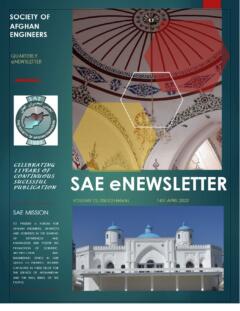
SAE Newsletter – April 2022, Volume 12, Issue 2, Hamal 1401
Contents
- Editor’s Note
- Message From the President of SAE
- Message from the Chairman of the SAE Board of Directors
- SAE Executive Report No. 18, March 8, 2022
- SAE Executive Report No. 19, March 23, 2022
- SAE Fundraising Distribution in Afghanistan
- SAE Representative – News from Kabul Afghanistan
- SAE-Architecture and Urban Design Subcommittee Proposed Activities in 2022
- Kabul City Groundwater Aquifer Storage and Recovery by Amanullah Mommandi
- News From Kabul University
- Membership News
- Achievements and Awards
- Comments and Suggestions
- Job Opportunities at Planate Management
- The Society of Afghan Engineers Organization
Note From the Editor-in-Chief, SAE eNewsletter
Role of Engineer in Building a Nation
Engineer—builder of a nation, inventor of technologies, creator of economic prosperity and stability of a society.
Engineer and Scientist are the two professionals that have strived since the early days of humanity seeking ways for improving living conditions, protecting lives, and taking care of the planet earth. Engineer uses knowledge of science, mathematics, and working experience; it is a demanding and rewarding profession, that brings stability to a nation by improving living condition of people. Engineer works tirelessly for discovering solutions to complex problems, finding ways for creating new products and services, building modern infrastructure and industries of the future. Engineer and Scientist work together, both are essential partners for building a healthy society.
Building a nation to achieve prosperity and stability are not easy undertakings; however, they are not possible without engineer. It is true that a nation cannot be built without the collective efforts of young and old, skilled, and unskilled. But engineer plays an indispensable and valuable role in building a stable nation, leading it to self-sufficiency, and political & economic stability.
Our world is dynamically changing, problems are evolving, at the forefront are engineers who are creating products and services that alleviate problems. Engineers create new technologies to provide clean water, adequate sanitation, access to electricity, air pollution control, transporting people from one point to another point of the planet earth safely and affordably. Building housing, and laboratory in space, producing medicine and other products in space free of gravity, design and build weather satellite that provide accurate weather and natural disaster forecasting information. Making travel possible to other stars looking for life in other planets, and further exploration of space, and deep seas.
In medical discipline, engineers design devices such as pacemakers, brain implants, camera and tools that can reach heart, opens blocked arteries placing a mesh so blood can flow normally. Engineer in period of crisis, design machines that accelerate and accurately produce large doses of vaccine such as that for Covid. Finding ways to create and produce masks and distribute them quickly to the residents.
Afghanistan has been facing economic challenges for the past several decades. Engineers can bring relief to the economic condition of Afghanistan, by un-earthing/extracting the hidden wealth, the various minerals, that Allah has bestowed on this nation, but lie underground and un-touched.
The vast mineral wealth of Afghanistan has been known for centuries, abundance of precious stones, and other minerals exist in various part of the country. Current estimates are that there is substantial deposit of, copper, gold, oil, natural gas, uranium, coal, iron ore, lithium, chromium, talc, gypsum, marble, gold, lapis lazuli, emerald, rubies, and many other precious stones and rare earth minerals.
Over the past 40 years various countries, and organization have estimated the value of Afghanistan mineral deposits to be worth between 1 trillion to 4 trillion dollars ($4 x 10¹²). That is where the role of engineers becomes vital to bring this hidden wealth to surface and usage.
- Copper: (Aynak mine -Logar Province): copper deposit of Aynak, is estimated over $1000 billion dollars ($1.2 x 10¹²). Historically, copper was first used for coins in around 8000 BC. Copper was important to early humans and continues to be a material of choice for a variety of domestic, industrial, and high-technology applications. It has high corrosion resistance; conducts heat and electricity efficiently and it can be drawn into wire. An average car contains 1.5 km of copper wire and the total amount of copper ranges up to 45 kg in a vehicle. Chile and Peru have emerged as the world’s productive copper states.
- Iron Ore: (Hajigag Mine): it is estimated at ($1 x 10¹²). To produce steel, iron ore is needed, 98% of iron ore is used for making steel. Currently Australia and Brazil dominate the world market for iron ore.
- Lithium (called the white gold): Lithium of Afghanistan is estimated to be the world largest reserve deposit. Lithium is used in making batteries, the deposit could be worth one trillion dollars (+$1 x 10¹²). The demand for Lithium, and revenue can be many times more as the world transitions to clean energy. More than 50% of lithium mined is used in batteries (laptops, digital cameras, and electric vehicles). Countries having Lithium mines are Australia, Argentina, Bolivia, and Chile.
The oil boom is transitioning to clean energy, the era of clean energy is here and will dominate the globe soon, with use in automobiles, air transport and heating source at the forefront.
Assuming revenue from all other mineral deposits in Afghanistan $1 x 10¹² that need to get unearth, these untapped minerals are estimated to be worth over four trillion dollars ($4 x 10¹²). These 4 trillion dollars can provide income of 30 billion ($30 x 109) per year to Afghanistan for 133 years.
Afghanistan will not be a poor country but one among the rich nations. This type of revenue can shift Afghanistan unstable economy to a stable one. But all this depends on dedicated engineering manpower and expertise. Afghanistan could move from failure to a successful self-sufficient and a peaceful nation.
How to bring to surface the hidden wealth, that Allah has given to the Afghan nation? The answer is dedicated Afghan engineers. These dedicated Afghan engineers should build factories to process the mineral deposits in the country that will create well-paying jobs to citizens and then sell the processed products to the world market. The country must realize the role of engineering and the importance and value of science and pay attention to engineers and scientists. Wish you and your family a happy, & healthy New Year 1401. Allah bring peace and prosperity to Afghanistan and the entire world.
Note: data numbers are taken from various sources in wide world web.
With Best Regard
Hafizullah Wardak
Editor-in-Chief SAE eNewsletter and Chairman – SAE eNewsletter Subcommittee
hwardak@comcast.net
Message From the President of SAE
No. 6, April 2022
Members of the Society of Afghan Engineers:
“May you have a happy, healthy and prosperous Year 1401 HS.”
The Society of Afghan Engineers (SAE) has been involved in the rebuilding of Afghanistan since its establishment in 1993. Members of the Society have reached out to their colleagues and counterparts in various Afghan agencies in the past 29 years of its service.
Back in 1996, the Society received an invitation from the Government of Afghanistan calling for help. The Society formed a team, including myself, and traveled to Kabul on a three-week fact-finding mission in the month of May, 1996.
During the Taliban rule between the years of 1996 to 2001, the Society made a few attempts to reach out to our colleagues, but no tangible venture of the Society is recorded in those years.
After September 11, 2001, the SAE participated in the rebuilding process. During all these years, the Society maintained its non-political and non-governmental status in accordance with the By-Laws of the Society. The Society is committed to remain non-aligned during any dealings with all government agencies and organizations. We will pursue and respect the “mission” and the “vision” of the Society as they are stated in the Society’s By-Laws. The SAE has a reputation as a professional, non-profit and non-governmental organization.
Current Status:
Beyond the challenges of how to formulate the Society’s policies towards the situation in Afghanistan, the Society may want to articulate and shape its activities and approach appropriate to the situation. Many members have expressed interests in reaching out to our colleagues to minimize humanitarian suffering and continue support for the Afghan professional societies, particularly women and the young educated ones.
Currently, the SAE Architecture Subcommittee is organizing and planning an International Low-Cost Housing design competition and is communicating with several Universities in Afghanistan through an SAE representative in Kabul. A fundraising launched by the SAE and successfully distributed cash funds to qualified displaced families in Kabul and in Kandahar. Similarly, efforts are underway by other SAE Committees and Subcommittees to renew and re-visit agreements and Memoranda of Understandings prepared to be signed with various government agencies in the past and to be completed.
The Way Forward:
With the help and support of the SAE/AGA Liaison Subcommittee and the SAE Representative in Afghanistan, we shall be able to re-establish our contacts with universities and professional communities in Afghanistan. We will reach out to American Universities, Professional Institutes, and other International Professional Communities to collaborate in professional activities of the Society. We will also reach out to donors and international funding agencies such as the USAID, World Bank, and the Asian Development Bank involved in the rebuilding of Afghanistan for financial support.
With today’s technology and the use of the Internet, SAE can connect with our colleagues and counterparts in Afghanistan virtually.
With Regards,
Najim M. Azadzoi, AIA
SAE President
Message From the Chairman, SAE Board of Directors
Dear readers of the SAE eNewsletter,
By the time you read this message, it will be spring. After the cold and dark days of winter, the spring season brings new life and fresh hope to the world. Using that motto, we at the SAE look forward to such hopes and the possibilities to be able to help our country and our people. The recent news from the government of the United States is hopefully paving the way for our direct contact and collaboration with the new administration in Kabul. It is time to plan a strategy for establishing contact, and maybe, to send a delegation when the time is right.
As for the Board of Directors, during the past three months, holding monthly meetings have continued. As a result, a goal for the completion of the revisions to the Society’s Bylaws and Manual has been established. There have been concerns that this task is taking longer than expected time. To clarify that, it is the thorough review and revisions due the needs of time and new realities that is taking the time. The goal is to produce a complete and comprehensive document. After all, it is the charter of the organization. With this in mind, it has to be revised thoughtfully, and should be given the due time it requires.
The sole mission of the Society is to be able to help our beloved country. No doubt, that it has been going through very hard times, but we should never lose hope for a better future. Let’s change criticism to positive feedback and helping hands. Let’s be excited and look forward to a better tomorrow. I believe in what a popular motivational speaker once said: “When there is hope in the future, there is power in the present, and since hope is the foundational quality of all change, there is considerable reason to be excited.”
Happy New Year!
Stay safe and be well.
Sincerely,
Abdul Manan Khalid, P.E., LEED (BD+C)
Chairman, SAE Board of Directors
SAE Executive Report No. 18, March 8, 2022
Nomination for the Position of Chairperson of the Water Resource Subcommittee
Mr. Hadi Rakin, P.E.
Mr. Rakin has been a licensed professional civil engineer since 1989, with active licenses in the Commonwealth of Virginia and the State of Maryland. Mr. Rakin is an active member of the American Society of Civil Engineers for more than 30 years and a member of the American Society of Highway Engineers for more than 25 years. He has over 40 years of experience in the study, planning, analysis, design, management and construction, program management of high profile and mega projects and programs with multi-billion-dollar budgets both in the United States and in Afghanistan.
On behalf of the Society, I thank Mr. Rakin for accepting my nomination for the position of Water Resource Subcommittee. The Water Resource Subcommittee of the Society of Afghan Engineers would ensure coordination between various Afghan Government agencies and the Society addressing water law, drainage basin studies, water availability, and conducting feasibility studies for land development, irrigation systems, reservoirs, dams, power plants, and flood control projects. We are looking for Mr. Rakin’s valuable contribution to the Society and to the rebuilding of our beloved homeland, Afghanistan.
Nomination of Mr. Rakin as the Chairperson of the Water Resource Subcommittee will be submitted to the Board of Directors for approval.
With Regard,
Najim Azadzoi,
SAE President
SAE Executive Report No. 19, March 23, 2022
Nomination for the Position of Chairperson of the SAE Membership Committee
Ms. Donya Amiri, P.E., T.E.
Donya Q. Amiri is the Founder and CEO of AIM Engineering Consultants, Inc. Ms. Amiri holds a Master of Science degree in Transportation Engineering, a Bachelor of Science in Civil Engineering, and a Bachelor of Science in Business Management all from San Jose State University. She is licensed as a Professional Civil Engineer (PE) and as a Professional Traffic Engineer (TE) in the State of California.
Information about AIM can be found on the company’s website at www.aimeci.com.
SAE Membership Committee
The Membership Committee is responsible for inviting qualified personnel to join the Society and maintains their updated contact information. The Committee works closely with both the Finance and Communication Committees to request and receive annual membership renewal invoices and membership fees. The Committee prepares the membership Directory, entitled as, “The Directory of the Society of Afghan Engineers”, and provides it to the Communication Committee for both web-based and hard copy publications. The Directory will include the profession and contact information of the Society members. It may include architectural, engineering, and other advertisements.
Nomination of Ms. Amiri as the Chairperson of the Membership Committee will be submitted to the Board of Directors for approval.
With Regard,
Najim Azadzoi,
SAE President
SAE Fundraising Distribution to the Needy Families in Afghanistan
Through the Fundraising efforts that was reported in the January issue of the eNewsletter, SAE collected total of 10,100 dollars. On January 6, 2022, the Task Force along with SAE President and Chairperson of the Board had a zoom meeting and discussed the collected fund’s distribution process. As a result, it was concluded that the proceeds of the fund raising should solely be used for the immediate benefit of the displaced and needy families, utilizing the free service available through the following two humanitarian organizations:
- Afghan Relief, managed by Mr. Reza Afshar (SAE member), to distribute $6,100.00 worth of staples and supplies to the needy families in Kabul.
- Selab Charity Foundation, managed by Haji Said Mohamad Selab, to distribute $4,000.00 worth of staples and supplies to the needy families in Kandahar.
Accordingly, the two organizations distributed the funds, a summary of the distribution in Kabul and Kandahar is provided below:
Afghan Relief, managed by Mr. Reza Afshar ($6,100.00)
The supply packages were distributed to 135 needy families in Kabul on February 4, 2022. Dr. Sahib Mosawi, Afghan Relief’s Kabul Representative along with Mr. Howaida, SAE ‘s Kabul Representatives were present during the distribution process. Each package included one sack of flour, one bottle of 5-liter cooking oil and one large warm winter blanket.
Selab Charity Foundation, Managed by Haji Sayed Ahmad Selab ($4,000.00)
The supply packages were distributed to ninety-five (95) needy families living in tents in the city of Kandahar. Eighty-four (84) families received the donation package, and eleven (11) families got funds to purchase medicine for the needy and sick family members.
- Each package in Kandahar City contained 20 kg Rice, 50 kg flour, a 10-liter bottle of cooking oil.
- Each package outside of the Kandahar City, contained 20 kg rice, 50 kg flour, a 10-liter bottle of cooking oil, 4.5 kg tea, 5 kg soap, and 20 kg sugar.
- Twenty-two (24) families living in tents in Kandahar City got large tarp to cover their leaky roofs.
The month of Ramazan, is starting in a few days. It is the month of giving. Most people give their zakat in this month. I highly recommend SAE embark on a second Fund Rising for the needy families. If you watch some of the videos by Mr. Selab, the living conditions of your compatriots will break your heart and make you cry.
Mr. Selab Sahib highly recommended that SAE sponsor a Bakery (Nanwayee) in Kandahar to provide five (5) bread per needy family. The regular price for bread is eighteen (18) Afghanis and the owner is willing to give it to SAE sponsored family for sixteen (16) Afghanis. Five breads will cost ninety (90) Afghanis per family which is around a dollar per family.
We would like to thank the donors, and also extend our sincere appreciations to Engineer Sahib Reza Afshar, President of Afghan Relief, and Haji Sahib Sayed Ahmad Selab, President of Selab Charity Foundation, Dr. Sahib Mosawi, Afghan Relief Kabul Representative and Engineer Sahib Walid Howaida, SAE Kabul representative for their unconditional support and service in distributing the funds.
Best regards,
Amanullah Mommandi, P.E.
SAE Board Member and the Fundraising Distribution Committee Coordinator
News From Afghanistan
A Brief Report from Kabul
By SAE Representative, Mr. Walid Howaida
Report No. 1
Date: February 2022
Requested by: SAE Architecture Subcommittee
Inquiry/Task: Information about the existing situation and condition of the caves around the Bamyan big statue and the government plan for the resettlements of the families who are currently living in the caves, to some residential projects.
Findings:
Based on the plan I had a 4-day journey to Bamyan city from 8-11 February 2022. I met the Bamyan official as well as visited some families who are living in the cave and the report information submit as follows:
- Firstly, I met Mr. Sarhadi the Bamyan governor on 9 February and shared SAE’s idea for resettlement of the existing families who are living in the caves around the Bamyan big Statue. The Bamyan governor said, still there is no clear plan from the government side because the senior officials are busy with political and security issues and thanked SAE for their concerns and promised to provide facilities when SAE has any useful plan for resettlement of the mentioned families.
- Secondly, I met Mr. Frootan, the Bamyan province Mayor. He welcomed the SAE idea and repeated the same thing what the governor said, still there is no plan from the governor side for resettlement of the families who are living in the caves.
- Thirdly, I met Mr. Saifurahman Mohammadi, director of the Information & Culture directorate of Bamyan province. He provided us with some information about the plan of the former government. He said that still there is no any special program or plan for resettlement of the mentioned families, but previously an NGO, Islamic Relief, has built about 20 small houses at the Azhdaha valley in the governmental land and since they built those houses, some people occupied the empty caves to benefit from the Islamic Relief project, but it was happened once. During a survey in the last regime around 250 families used to live in the caves and some of them moved to the houses which were built by the Afghan and senior officials that remained in his position from the former regime senior officials! He also said that there is no special project and plan for resettlement of the families who are living in the caves, but shared some information about two residential projects that were designed, approved by the former government and implemented, partially. He added that the two approved residential projects are Gunbadak and Tapa-i-jalal. In Gunbadak project 1000 residential houses were considered and around 500 of them were distributed to the eligible families and around 500 blank land remained. In Tapa-i-Jalal project 700 residential houses were considered and around 500 of them were distributed and around 200 blank land remained. These projects are standard and all facilities for residential projects like school, clinic, park, drinking water network, sanitation issues, etc. were considered.
- Finally, I met Eng. Kazim Razaee, acting director of Urban Development, Housing and land directorate of Bamyan province. He was the only qualified residential project which was shared with Azadzoi sahib. Eng. Kazim Razaee shared the available information and documents as a master plan of Bamyan city as well as detailed drawings of the Gunbadak project. Some more were given some land from the government side to build houses and still 135 families are living there.
Report No. 2
Date: 20 January 2022
Requested by: SAE Editor-in-Chief, Ustad Hafizullah Wardak
Inquiry/Task: What is the impact of the latest snow/rain on the living condition of residents in Kabul and across the country.
Findings:
The impact of the latest snow/rain on living conditions of residents in Kabul and across the country. Afghans have a very famous proverb that “Kabul can be without Gold, but not without Snow”.
The latest rainfall and snowfall have negatively impacted the living condition of people in Kabul and other cities because most families don’t have enough fuel to heat their houses. Also due to cold weather more cold-related diseases are spread, but in the rural area the impact is positive.
The recent snow/rain will help and also it is expected to increase crop production and also it will impact groundwater level but it cannot be significant because the process of recharge is very slow and over usage of groundwater is very high. The recent snow/rain has increased the discharge of the rivers, but it is not a good sign because less water stores will remain in the higher altitude due to climate change.
The past rain and snow used to create floods in Kabul city created difficulties for residents and still it is a problem but for a short duration. Big cities, such as Kabul had air pollution problem and this latest snow/rain going to alleviate this problem and help clean the air, but again due to heavy smoke due to consumption of wood, coal, and diesel, the air pollution increases immediately after raining.
The last snow/rain is expected to be a normal year with good production, but still it will depend on the condition of precipitation in February and March. And finally, traffic congestion due to flooding still exists because of no proper drainage in the city.
SAE-Architecture and Urban Design Subcommittee Proposed Activities in 2022
Consistent with our mission: to improve, educate, and sustain the practice of the architecture and design in our country, this year we are planning to launch an “International low-income Housing Design Competition,” hosted by SAE, Architecture/ Urban Design sub-committee. Among the participant universities will be various architecture and urban planning programs in Afghanistan, in partnership/collaboration with few invited foreign universities. The education goal is to encourage collaboration, interchange and learning between the participant Afghan/foreign universities. The assigned team “International Housing Competition,” for this task is diligently working on the followings:
- Scope of the competition – the document will define the design program components such as: the scope and goals of the competition, detail space and site program, timelines, submission requirements, eligibility, evaluation criteria, student composition, jury, and awards. The housing design team had several meetings on the preparation of the document, and currently the final draft is prepared and is ready to be released.
- Participant universities – Invitation letter is prepared to be sent to the selected Afghan/foreign universities, architecture and urban design programs to participate in the housing design competition. Possible Afghan universities will be: the Kabul University, Kabul Polytechnic, Herat University, Kandahar University, Shaikh Zayed University in Khost, Paktia and Nangarhar Universities. Among the foreign universities, we are considering to invite MIT, Harvard University, Washington State University, and Hartford University, other interested institutions may be added later to the list.
- Funding and expenses – Fundraising possibly among SAE members and other donor organizations will be held to help the Afghan students with costs related to the design production, equipment, materials, and other related expenses. Prizes and website development costs will be decided accordingly when funding becomes available. A fundraising flyer/poster is prepared to be circulated among the possible donors for the purpose soon.
- Timelines – We are targeting to advertise, launch the website, and submit the housing competition program to the selected universities by June 15, 2022 – submission and review of the final projects is expected to be made in December 15, 2022 – selection of the winners and awards announcement is expected to be done on January 15, 2023.
- Website for the competition – We need to develop a website and data bank to exhibit the competition materials and related information to the competitors for the easy access. Also, the site will help the jurors to view the final submissions for evaluation. Depending on the budget availability we will soon be looking at the options to develop the website.
Keeping in mind that at this point the competition is only an educational design project, however, we are hoping that the outcome of the design competition will become a catalyst for helping the communities in the Afghan cities with their acute housing problems.
Prof. Bashir Kazimee, Chairperson, SAE Architecture and Urban Planning Subcommittee
April 2022 Issue – Technical Paper: Kabul City Groundwater Aquifer Storage and Recovery
By Amanullah Mommandi, M.S., P.E.
(Part One of Four)
Abstract
This article is the continuation of the article published in April 2020 issue of the SAE eNewsletter. Rapid population growth and other factors have led to reduced groundwater supply for Kabul city residential and commercial use. In this article, the author proposes the implementation of Aquifer Storage and Recovery (ASR) programs and the construction of new dams to augment ASR programs to provide adequate water to recharge Kabul city groundwater aquifers.
Introduction
Kabul, the capital of Afghanistan is the fifth fastest-growing city in the world. Its population in 2017 was estimated at five million and is expected to increase to about eight million by 2050. Rapid population growth and expected temperature rises due to climate change mean the area will need six times more water by 2050, according to the US Geological Survey.
Development of a modern water supply system for Kabul was initiated at the end of 1920s when King Ghazi Amanullah Khan invited a British engineer to bring water from Paghman River to Kabul residences. The project consisted of four components. The first component was the construction of a water intake structure on Paghman River in Paghman to withdraw surface water. The second component was the installation of a five-inch conveyance pipeline from Paghman to Deh Afghanan, with a length of twenty-six kilometers. The third component was the construction of a storage facility at Deh Afghanan. The fourth component was the construction of a water distribution network from the storage facility to Kabul.
Municipal consumers were supplied water through service connections and public standpipes. A historical water supply method of Kabul has been the water vendor, or Saquau, who delivered water in goatskin bags from public standpipes. After the 1920s, future drinking water projects, which are outlined in Kabul City Master Plans listed below, used deep wells to draw drinking water from Kabul groundwater aquifers.
- 1974: Second Kabul City Master Plan
- 1978: Third Kabul City Master Plan
- 2011: Fourth Kabul City Master Plan (current)
The second major development in supplying water to Kabul started with Allaudin well-field that was constructed between 1954 and 1965 under a bilateral agreement between Japan and Afghanistan. The third major project was the Afshar Groundwater utilization funded by Federal German Republic.
There have been two planning studies on Kabul City conducted recently. One is the “Consultancy Services for Preparation of Development Plan for Kabul, Afghanistan,” supported by the World Bank and conducted by Intercontinental Consultants and Technocrats Pvt. Ltd. (ICT Study), from 2007 to 2008. Another one is the “Kabul Metropolitan Area Urban Development Master Plan” (KMAUD Master Plan), supported by Japan International Corporation Agency (JICA) and conducted from 2008 to 2009. The ICT Study was aiming to identify development projects for Kabul City, while the KMAUD Master Plan was to formulate a regional development plan focusing on harmonized development of the Deh Sabz New City and the existing Kabul City.
The objective of this masterplan is to establish the city masterplan of the Kabul Municipality Area by conducting supplemental analysis and planning works by fully utilizing the results of the ICT Study and the KMAUD Master Plan. This master plan aims to replace the Third Kabul City Master Plan which is the last master plan of Kabul City approved in 1978. Thirty-two million cubic meters of water is used from Kabul’s underground water reserves every year while the capacity of the city’s water is twenty-nine million cubic meters in a year.
There are currently over 200,000 wells in Kabul, the drop in ground water level is “a crisis” for residents. Meanwhile, in the Asia Foundation’s recent Survey of the Afghan People, it revealed that there are rising concerns over water shortages in Kabul province. The Asia Foundation meanwhile said recently that more needs to be done, including policy solutions that promote water use efficiency at the consumer level through recycling, wastewater management, water treatment, the harvesting of surface water, and the monitoring of groundwater extraction methods at the ministry level.
Kabul City Groundwater Aquifers
Today, the main source of municipal water for commercial and residential customers in Kabul are groundwater aquifers, which flow in the direction of surface-water drainage. Kabul’s groundwater aquifers are under increased stress from various sources which is putting a great strain on future water supply for the city. One cause is the surge in population in Kabul city which has led to a higher demand for drinking water. Another cause of strain on future water supply is the recent droughts that have hindered the ability of Kabul, Paghman and Logar rivers to recharge the aquifers through seepage.
There are two other major factors that affect Kabul groundwater resources. One is an increase in commercial water usage. The second is that the private sector has increasingly been allowed to drill their own wells and access groundwater resources in Kabul and surrounding areas.
Afghanistan Geological Survey (AGS), with technical assistance from the U.S. Geological Survey, established a water-level monitoring network in the Kabul Basin, and, in 2004 Water levels were monitored in sixty-nine wells in the Kabul Basin, starting in July 2004 and continuing through March 2007. Static water levels have seasonal fluctuations from 0.5 to 3 meters. As a result of increased demand and reduction in ground recharge, there has been a five to ten-meter drop in groundwater levels since 1980, and according to a 2013 USGS report, the rate of groundwater level is decreasing 1.5 meters per year on average. In one monitoring well a decline of thirty meters has been observed. As expected, many shallow wells have dried up completely.
Groundwater levels were monitored in seventy-one wells in the Kabul Basin, Afghanistan, starting as early as July 2004 and continuing to the present (2013). The monitoring network is made up exclusively of existing production wells; Seventy wells are in unconsolidated sediments, and one well is in bedrock. Water levels were measured periodically, monthly, in sixty-four wells. The water level of the well located on the grounds of the Afghanistan Geological Survey building were measured more frequently. This report provides a 10-year compilation of groundwater levels in the Kabul Basin prepared in cooperation with the Afghanistan Geological Survey. Depths to water below land surface range from a minimum of 1.47 meters (m) in the Shamali subbasin to a maximum of 73.34 m in the Central Kabul subbasin. The Logar subbasin had the smallest range in depth to water below land surface (1.5 to 2.4 m), whereas the Central Kabul subbasin had the largest range (2.64 to 73.34 m).
Water levels were monitored in sixty-nine wells in the Kabul Basin, Afghanistan, starting in July 2004 and continuing through March 2007. Well depths in the study area ranged from 4.9 to 160 meters. Water levels below land surface ranged from less than 1.5 to 68 meters, while static water levels ranged from 1.5 to 40 meters. Seasonal water-level fluctuations from September 2005 through May 2006 ranged from less than 1 to 8 meters. Water level trends during the study period showed both increases and decreases. Drawdowns due to pumping ranged from 5 to 25 meters.
To summarize, today, the water seepage from Paghman, Kabul, and Logar Rivers; and current precipitation are not adequate to recharge the Kabul groundwater aquifers.
Future Aquifer Storage and Recovery Programs
The mechanical recharging of the Kabul City ground water aquifers was recommended 45 years ago in 1975. In 2017, the author attended the American Water Resource Association Annual Conference in Sacramento California where there were many excellent presentations related to water resources. Two presentations related to Aquifer Storage and Recovery (ASR) programs were of special interest to the author due to their urgent and immediate applicability to Kabul City and other cities in Afghanistan.
One promising example of artificial recharge of aquifers comes from the city of Yakima located in the state of Washington. Yakima uses an ASR program that stores spring runoff from nearby streams in underground storage. There are over four hundred similarly operating ASR wells across the United States.
The Water and Soil Survey Authority, within Ministry of Irrigation and Agriculture and later within Ministry of Water and Power and currently Ministry of Water and Energy in cooperation with USGS have installed stream gauge stations all over the country since sixties including stream gage station on Paghman River, Kabul River and Logar River.
The function of stream gage is to monitor the flow depth in the stream 24-hour and year-round. The technical staff, hydrologist in Hydrology Department converted the water depth into flow rate using rating curves for each site. These water measurement gages had automatic recorder housed inside a structure. To calibrate the data, the hydrology department’s staff would go to the main rivers gage sites during the spring flood season and manually collect the stream flow data using the cableways and current meters. The stream flow data is extremely important for decision makers to build dams across the stream. The flow rate will control the size of the dam.
Due to space limitation, the article has been divided into four parts. In the second part of the article the contribution of Shah-Wa Arus Dam across Shaker Dara River, north of the city and Shatoot Dam on Kabul River, northwest of the city will be discussed. Shatoot and Shah-Wa-Arus dams are currently under construction.
Biography of Engineer Amanullah Mommandi
Mr. Mommandi graduated from the College of Engineering at Kabul University with a bachelor’s degree in Civil Engineering in 1968. Subsequently, he joined the Water and Soil Survey Authority in the Ministry of Agriculture and Irrigation where he served as a water resource engineer until 1973. Mr. Mommandi pursued graduate studies in Water Resource and Hydraulics at Colorado State University located in Fort Collins, Colorado, USA where he obtained his master’s degree in 1975.
Mr. Mommandi then returned to Afghanistan and started working for the Ministry of Water and Power (MPW) as General Director of Planning, General Director of Technical Monitoring, and Inspection, and finally as the President of Kunduz Khanabad Water Resource Authority.
After immigrating to the United States, Mr. Mommandi briefly worked in the private sector as a consultant before joining the Colorado Department of Transportation (CDOT). Mr. Mommandi’s career at CDOT spanned over 35 years before his retirement in 2019. At CDOT, he served as the Hydraulic Program Manager and later as the Director of the Applied Research and Innovation Branch. Mr. Mommandi co-authored many publications related to water resource and transportation.
In 2012 Mr. Mommandi presented on various water resource hydraulics and transportation applications at the Ministry of Public Works and at the College of Engineering at Kabul University. Mr. Mommandi accompanied Minister Aoudjan and others to inspect the highway from Kabul to Khenjan including the Salang Tunnel. He also Joined Mr. Aoudjan and his delegation to Inspect Eisenhour-Johnson Memorial Tunnel along I-70 west of Denver, Colorado, USA. The author facilitated the signing of Technical Memorandum between Afghanistan Minister of Public Works and CDOT.
Mr. Mommandi joined the Society of Afghan Engineers (SAE) in the early nineties, chaired the SAE Colorado Chapter and served two terms as member of SAE Board of Directors and Vice President. He is currently SAE Board member.
News From Kabul University
Zuhal Noori, Urban Planning student at the Faculty of Engineering, Kabul University
“An Email”
March 1st 2022
Kabul University Engineering Faculty.
Greetings and best regards, Azadzoi Sahib.
I am Zuhal Noori, a student of the third year, department of urban design and planning, faculty of engineering, Kabul university. I contacted you and sought professional help in my projects. I was introduced to Mr. Hamayon Ibrahim, an architect and active civil engineer practicing in the USA. Mr. Ibrahim sent me some real project plans with some details and photos of the project after the construction. I sincerely appreciate SAE helping me. Once again, thanks to the SAE, specifically Mr. Ibrahim and for his time and intellectual advice.
Respectfully,
On behalf of the Society of Afghan Engineers, I congratulate Zuhal and wish her for a successful completion of her project.
Najim Azadzoi, SAE President.
Membership News
SAE is pleased to announce that many professional engineers and architects in the United States, Canada and Afghanistan have shown their interests becoming SAE team members since January 2021. SAE has received most of new members’ membership applications and fees as required by the SAE bylaw. We welcome everybody and looking forward working together in future projects by providing professional services to Afghan Government and agencies. We publish new members’ names and their short biography in each SAE quarterly eNewsletter as provided the information. We welcome our newest high qualify members and look forward to their contribution to the purpose and mission of the Society of Afghan Engineers as set forth in the bylaw of the society.
SAE New Members March, 2022
DONYA Q. AMIRI, P.E.
Donya Q. Amiri is the Founder and CEO of AIM Engineering Consultants, Inc. Ms. Amiri holds a Master of Science degree in Transportation Engineering, a Bachelor of Science in Civil Engineering, and finally a Bachelor of Science in Business Management all from San Jose State University. She is licensed as a Professional Civil Engineer (PE) and as a Professional Traffic Engineer (TE) in the State of California. With more than 15 years of engineering experience working for local Bay Area governments, Ms. Amiri has led several cities’ Civil Engineering, Transportation, Traffic Engineering, and Land Development groups while managing a wide array of high profile and complex policies, programs, and projects. She is recognized for her passion, enthusiasm, and dedication to building safe, innovative and equitable infrastructure while accommodating the evolving needs of the community.
ZABIHULLAH SARFARAZ
16 years of experience in Construction Project Management and Implementation. Experience includes public work inspection / Plan review, construction QA/QC, managing construction projects, managing, and directing contractors, and working in hazardous environments. Also have experience of AutoCAD, QCS, Signature Scene 6, Blue Beam and Microsoft Office Suite.
SAE Membership Fees-2022 USD
| No | Last Name | First Name | 2022 Membership | 2022 Donation | 2022 Total | 2023 Membership | 2023 Donation | 2023 Total |
|---|---|---|---|---|---|---|---|---|
| 1 | Rossi | Steve | 60 | 440 | 500 | 60 | 200 | 260 |
| 2 | Roshan | Tooba | 60 | 440 | 500 | 0 | ||
| 3 | Yamayee | Zia | 60 | 200 | 260 | 0 | ||
| 4 | Azadzoi | Najim | 60 | 140 | 200 | 0 | ||
| 5 | Mujtaba | Ghulam | 60 | 140 | 200 | 0 | ||
| 6 | Masumi | Jalal | 60 | 130 | 190 | 60 | 0 | 60 |
| 7 | Baha | Zarjan | 60 | 60 | 120 | 0 | ||
| 8 | Kazimee | Bashir | 60 | 40 | 100 | 0 | ||
| 9 | Mommandi | Amanullah | 60 | 40 | 100 | 0 | ||
| 10 | Samizay | Mahmoud | 60 | 40 | 100 | 0 | ||
| 11 | Atayee | Tamim | 60 | 40 | 100 | 0 | ||
| 12 | Corcoran | Edward | 60 | 32.75 | 92.75 | 0 | ||
| 13 | Baluch | Hashem | 60 | 0 | 60 | 60 | 0 | 60 |
| 14 | Hassani | Abdul Waheed | 60 | 0 | 60 | 0 | ||
| 15 | Khalid | Manan | 60 | 0 | 60 | 0 | ||
| 16 | Mahmood | Amin | 60 | 0 | 60 | 0 | ||
| 17 | Panjshiri | Atiq | 60 | 0 | 60 | 0 | ||
| 18 | Rakin | Hadi | 60 | 0 | 60 | 0 | ||
| 19 | Sidiqi | Nadir | 60 | 0 | 60 | 0 | ||
| 20 | Wardak | Hafizullah | 60 | 0 | 60 | 60 | 0 | 60 |
| 21 | Wardak | Hassan Wazma | 60 | 0 | 60 | 0 | ||
| 22 | Abdulrahimzai | Mushtaq | 60 | 0 | 60 | 0 | ||
| 23 | Keshawarz | Saleh | 60 | 60 | 0 | |||
| 24 | Sabet | Mehdi | 0 | 0 | 0 | 0 |
SAE New Members (2021)
| No | 2021 New Members | Membership | Donation | Total |
|---|---|---|---|---|
| 1 | Abdullah Ehsan | 60 | 60 | |
| 2 | Afghan Fazel Ahmad | 60 | 60 | |
| 3 | Atayee Tamim | 60 | 60 | |
| 4 | Baidariwal Fazal | 0 | 0 | |
| 5 | Goethert Reinhard | 0 | 0 | |
| 6 | Levrat Fred | 0 | 0 | |
| 7 | Mehrzai Jan | 60 | 60 | |
| 8 | Miller Hamida | 60 | 60 | |
| 9 | Naimi Qaseem | 60 | 40 | 100 |
| 10 | Omarzad Mustafa | 60 | 60 | |
| 11 | Qadir Abdullah | 0 | 0 | |
| 12 | Roshan Tooba | 60 | 60 | |
| 13 | Taraky Yar Mohammad | 60 | 40 | 100 |
| 14 | Abdul Qayum Abdul Rauf | 60 | 0 | 60 |
| 15 | Zahori Sayed | 0 | ||
| 16 | Farooqi Najib M. | 60 | 140 | 200 |
| 17 | Durnai Ahmad Shah | 0 | ||
| 18 | Wardak Hassan Wazma | 120 | 120 | |
| 19 | Baha Abraham | 60 | 60 | 120 |
| 20 | Corcoran Edward | 60 | 0 | 60 |
| 21 | Sabet Mehdi | 60 | 0 | 60 |
Achievements and Awards
Semira Mursal Azadzoi, Mechanical Engineer
Semira Mursal Azadzoi is a Mechanical Engineer graduated from the University of Massachusetts, Lowell, Massachusetts. She invented the “ADDITIVE MANUFACTURING TECHNOLOGY (AMT) LOW SIGNAL DIVIDER” and was granted a patent by the Commissioner of Patents and Trademarks of the United States of America on August 10, 2021. She has also received a Certificate of Achievement in recognition of her achievement in completing the requirement of “SIX SIGMA SPECIALIST QUALIFICATION” on June 16, 2017.
On behalf of the Society of Afghan Engineers, we congratulate Semira’s success and professional achievement in the area of Electro-Mechanical Engineering.
SAE Editorial Board
Comments and Suggestions
The Editorial Board of the SAE eNewsletter welcomes comments and suggestions from the respected Society members and readers of the Newsletter. Your comments and responses will be included for information of all readers of the SAE eNewsletter.
I would like to extend my sincere thanks to Mr. Mohammed Saber Sarwary (P.E.), for his Technical Paper (Municipal Government and Engineering) published in the January 2022 issue of the SAE eNewsletter. I received several phone calls from the readers stating they liked and appreciated the technical paper. The Editorial Board of SAE eNewsletter, appreciate your effort for sharing your technical experience and expertise with the readers of the SAE eNewsletter. Thank you again.
Hafizullah Wardak
Editor-in-Chief of SAE eNewsletter
01-01-2022 Comments on January 2022 Newsletter
From: Baha, Zarjon
Thank you for sending us the new edition of the SAE Newsletter which includes a comprehensive coverage of SAE activities and other interesting materials for us all. I will consider this as a great New Year gift for us. Thank you and the rest of the SAE leadership for your hard work and accomplishments.
Mirwais Sediqmal
Thanks dears. We wish the same to you. Regards, Mirwais Sediqmal, M.Sc., Vice Chancellor & Assistant Professor, Laghman University.
Habib Rahmat
Dear Wardak saheb and colleagues around the world. First of all I heartily congratulate the new year 2022 for all of you in the hope of having peaceful and stable Afghanistan. Afghan People are suffering from economic problems in addition to COVID-19 and its newly emerged forms, poverty and health harsh conditions as well as high prices of food and non-food items. SAE had play very positive role up to date for supporting Afghans Engineers, but still 99% of them are jobless and still waiting for green light from the international community especially SAE. but no tangible results are seen. I hope in this new years SAE could assist the huge number of the Afghan Engineers inside Afghanistan through supporting the Energy and other developing projects that are planned during the past government.
Dr. Said Sharif Hossainy
Dear Ustad Mohtaram Eng., Hafizullah Wardak Editor-In-Chief SAE eNewsletter and Chairman of the Editorial subcommittee. Asallam-o-Alaikom, I acknowledge receiving your email, regarding the first quarterly issue of the 2022 SAE eNewsletter. Thank you for your kind efforts and volunteering. Happy New Year, I wish you good health, prosperity and happiness.
Bahawodin Baha
Muhtram Ustad salaam, Happy New Year to you and your family, I hope you will have a wonderful year ahead. I am grateful for sharing the SAE eNewsletter which I have found very interesting, specially after reading your article about Education. By your permission, I immediately copied that article and share it with my friends via the Facebook.
Bahaudin Mujtaba
Salam Kaka jaan Dr. Wardak Sahib, Happy New Year to you and family. I wish you all good health and happiness. Great articles from so many experts, especially your focus on the importance of education for everyone in Afghanistan. I like your ESL class story. Thanks for making these articles and content available…it takes a lot of work to be an editor.
Nadir Sidiqi
Muhtaram Eng. Sahib Wardak: Assalam Alyaikum. I hope you and your respected family are in the best health InShaAllah. Alhammdullulha, my respected mother, and I returned back home to Los Angeles on December 28 from Umrah trip. Thank you very much for your Duaa, kind message including sending me the beautiful and very informative first edition SAE e-Newsletter 2022.
Engineering Job Opportunities With Planate
The following positions are available at Planate Management Group:
– Electrical Engineer (Palo Alto, CA)
– Low Voltage Electrician (Palo Alto, CA)
– Planner & Estimator (San Francisco, CA)
– Engineers (Washington DC)
– Space Planner (Washington DC)
– Specification Writer (Washington DC)
– Field Engineer (Silverdale, WA)
– Contract Administrator (Silverdale, WA)
– Construction Manager (Albuquerque, NM)
– Quality Assurance Representative (Albuquerque, NM)
– Construction Manager (Pittsburgh, PA)
For more information and if interested in the above positions please contact Planate Management Group:
Mapet D. Santos, Recruitment Manager
daisy.villena@planate.com
The Society of Afghan Engineers Organization
SAE Executive Committee Members:
– President: Najim Azadzoi
– Vice President: Hamayon Ibrahim
– Treasurer: Mahmoud Samizay
– Secretary: TBA
– Manager: TBA
SAE Board of Directors-Officers:
– Chairman: A. Manan Khalid, M.S., P.E., LEED AP
– Vice-Chairman: Jalal Masumi
– Executive Director: Gul Afghan Saleh
Members SAE Board of Directors:
Wahed Hassani, Sharif Hossainy, Manan Khalid, Jalal Masumi, Amanullah Mommandi, Hadi Rakin, Gul Afghan Saleh, Masood Sattari, and Zabi Zaca.
SAE Past Presidents:
Atiq Panjshiri, Ghulam Mujtaba, Abdul Hadi Rakin, M. Quasem Kadir, Mohammed Hashim Rayek, Ahmad Wali Shairzay, Sohaila Sanie Shekib, and Malik Mortaza.
SAE Chairpersons of Committees/Subcommittees:
– Hafizullah Wardak, Chairman – SAE eNewsletter Subcommittee
– Wali Shairzay, Chairperson – Capacity Building and Academic Development Subcommittee
– Bashir Kazimee, Chairperson – Architecture and City Planning Subcommittees
– Rafaat Ludin, Chairperson – SAE/AGA Liaison Subcommittee
– Amin Mahmood, P.E., Chairperson – SAE Student Subcommittee
– Mohammad Jan Mehrzai, Chairperson – SAE Corporation Committee
SAE Local Chapter Coordinators:
– A. Hamid Layan – Kabul, Afghanistan
– M. Qaseem Naimi – Toronto, Canada
– Najim Azadzoi – Massachusetts
– Mohammad Najib Poya – Northern California
– TBA – Southern California
– A. Manan Khalid – New York and New Jersey
– Amanullah Mommandi – Colorado
– Atiq Panjshiri – Virginia and Washington DC
SAE eNewsletter Subcommittee:
– Subcommittee Chairman: Hafizullah Wardak
– Members: A. Wahed Hassani, Ph.D., P.E.; A. Manan Khalid, M.S., P.E., LEED AP; Abdul Hamid Layan.
SAE eNewsletter Editorial Board:
– Editor-In-Chief: Hafizullah Wardak
– Editorial Board Members: A. Wahed Hassani, Ph.D., P.E.; A. Manan Khalid, M.S., P.E., LEED AP; and Hafizullah Wardak.
SAE eNewsletter Regional Representatives:
– Abdul Hamid Layan – Kabul
Disclaimer: The author, reporter, or agency of each publication, project, news, and products is included in this newsletter. Additional contact information of the authors and their agencies are available with the Editorial Board of the newsletter and may be provided upon request. The Editorial Board of the Society of Afghan Engineers, Executive Committee, Board of Directors, or any of its members are not liable for the accuracy or contents of the information. The reports and information are included as provided by the authors and agencies without any changes in the substance of the documents. The information about the agency products or services is not the SAE endorsement.