SAE Newsletter – 2022-07 – Volume 12, Issue 3
Formally introduces the Bamiyan International Student Design Competition to rehouse cave dwellers and evaluates further infrastructural solutions to mitigate Kabul’s ongoing water crisis.
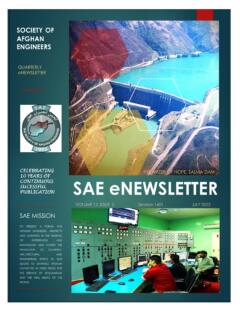
SAE Newsletter – July 2022, Volume 12, Issue 3, Seratan 1401
Society of Afghan Engineers Quarterly eNewsletter
Celebrating 10 Years of Continuous Successful Publication
SAE Mission
To present a forum for Afghan engineers, architects and scientists in the sharing of experiences and knowledge and foster the promotion of scientific, architectural and engineering ethics in our quests to enhance Afghan capacities in these fields for the service of Afghanistan and the well being of the people.
The Water of Hope, Salma Dam
Contents
- Editor’s Note
- Message From the President of SAE
- Message from the Chairman of the SAE Board of Directors
- SAE Executive Report No. 13, April 21, 2022
- SAE Executive Report No. 15, May 20, 2022
- SAE Executive Report No. 16
- Building For Peace: Rehousing the Cave Dwellers of Bamiyan
- Kabul City Groundwater Aquifer Storage and Recovery (part 2)
- Kabul Urbanization History, Planning and Informal Settlement
- Famous World Architects
- Membership News
- Comments and Suggestions
- The 2022 SAE Membership Renewal
- Job Opportunities at Planate Management
- The Society of Afghan Engineers Organization
Note From the Editor-in-Chief, SAE eNewsletter
Technology and Wellbeing of a Nation
I am heartbroken adding this sad news at the start of my editorial note. It is a time of grief and sadness, knowing the tragic losses and destruction in our beloved home country of Afghanistan due to recent earthquake in Paktika and Khost Provinces. The tragic news has been heartbreaking. Our prayers are for those affected during this terrible time, Jenatul-Ferdous to those who lost their lives, and Sabre Jameel to the survivors. More than thousand residents have lost their lives and several thousand houses have been demolished.
The Society of Afghan Engineers (SAE) have always stood by our beloved country in such time of calamity, it is extending help and support again during this terrible time. SAE leadership has instructed it’s representative (Mr Walid Howaida) in Kabul to visit the affected areas, assess the situation and distribute the allocated fund to the needy in those two provinces.
I wish each one of you and your respected family a happy, joyous, healthy, and prosperous upcoming Eid-el-Adha.
Use of technology drives economic growth, it generates opportunities/well-paying jobs, reduces poverty, transforms a society, and leads a nation to prosperity. Economic growth does not occur instantly, it is a process that requires a workable strategy, and that takes time.
A workable strategy is the use of modern technology. Technology can be copied and/or imported from nations who are the early starter of it, but the receiving nation must have infrastructure of knowledge, and technical capacity – there should be existence of scientific knowledge to absorb and assimilate the imported technology so it can succeed. In general, economic growth creates jobs that leads to the development of a society.
Economic developments are a continuous process and takes time, where traditional technology is transformed by using knowledge of science and modern engineering.
Economic Growth Leads Nation to Prosperity
- Agricultural Production
- Increase agricultural production to suffice 100% internal need.
- Manage and preserve water, and land use.
- Build dams.
- Build canals to irrigate.
-
Land Development: Use machinery instead of ox driven plowing.
-
Technology
- Develop Technical Infrastructure.
- Import/copy modern technology.
-
Use and absorb foreign technology.
-
Industrial Development
- Build & maintain tools internally.
- Build factories for processing local mines:
- Steel factory.
- Lithium processing plant.
- Copper processing plant.
- Build other small processing plants.
If we look at countries where technology was transferred or copied from the early starter nations, it took them several decades to absorb foreign technology for reaching the stage of self-sufficiency. First, they adopted the technology for their own need, and later brought innovations and industrialized their nation. Technology is not just machinery and equipment. There are more to it, such as supporting technical know-how, skills and overall knowledge that supplement technology. Equipment and machine-based technology needs maintenance, and repairs. Afghanistan needs to adopt science, engineering, and modern technology, and it must follow similar process to achieve sustainable economic growth that can lead to prosperity.
Poverty can’t be removed by giving cash money or loaves of bread at the bakery to the poor, so they will stop being poor. Poverty is more than just a lack of money, poverty can be reduced by providing poor households health care, educational resources, and access to financial system to exit poverty. This in return transpire groups of entrepreneurs, that further leads to economic growth. We see no/or slow economic growth in Afghanistan, and there is a decline of human development that have further contributed to the economic decline. A large group of professionals are selling vegetable, fruits, and fast food, etc. on four-wheeler carts in the bazar or looking for simple labor work.
The first area that Afghanistan must import foreign technology is to increase agriculture productivity it needs to serve 100 % of the country demand. Food supply is paramount to the survival, thus making agriculture priority. The population of Afghanistan is on the increase, ways and means must be found to increase agricultural productivity. Use of Technology is the way to feed the growing population. The vast scientific knowledge that has been developed by the developed nations can be imported and implemented.
The development of modern farming tools such as plough, tractor, planter, harvester, etc. to replace old simple tools such oxen or animal driven tools have become possible with science and technology. This has made farming easier, less labor, and faster.
Traditional Way vs Technology Based
– Traditional: Plowing field for crop with oxen; cleaning of local Karez for water (Village of Mohammad Quli, Jaghatoo Wardak Province).
– Technology Based: Salma Dam, Kamal Khan Dam, water gushing out from a Dam, making field ready for planting crop with machinery.
To improve agricultural productivity, management of water, irrigation and efficient land use is required. Water preservation, building dams, and canals and land development must move at faster pace. Afghanistan main source of water is rivers, where dams need to get build, so water can be stored and made available when it is needed. Even a drop of water should not get wasted.
The traditional technology now must transform into modern technology that is based on scientific and engineering knowledge, where the quality and quantity of production can increase. Since a large sector of the population is involved in agriculture, increase in agricultural productivity will become a catalyst for further growth. Once the nation become self-sufficient from its own agricultural products it then can move to industrialization phase.
The second area that Afghanistan must import technology and use it is to bring to surface the hidden wealth, that Allah has given to the Afghan nation, build factories to process the mineral deposits in the country that will create well-paying jobs to citizens and then sell the processed products to the world market. The country must realize the role of engineering and the importance and value of technology and pay attention to engineers, scientists, and technologists. The mines are well known such as Haji-Gack iron ore mine, Aynak copper mine, Lithium mines and several more. This way the country can move to industrialization.
Traditional Way of Mining vs Technology Based Mining & Processing
– Traditional: Local Method of Mine Extraction, transport & tool making.
– Technology Based: Iron ore mine extraction & transport to steel factory; factory processing.
With Best Regard,
Hafizullah Wardak
Editor-in-Chief SAE eNewsletter and Chairman – SAE eNewsletter Subcommittee
Message From the President of SAE
July 2022
Members of the Society of Afghan Engineers:
“May you have a happy 4th of July and a happy and prosperous upcoming Eid-el-Adha.”
As we entered the summer of 2022, it is almost a year since regime changed in Afghanistan which resulted in the closure of some universities for a while and the unfortunate departure of some faculties and students. With the good news of reopening of the universities, the Society of Afghan Engineers developed some positive initiatives to reach out our colleagues in universities in Afghanistan.
I am pleased to report that the Society of Afghan Engineers’ Architecture Subcommittee completed the schedule and program of a very important international students design competition, aimed to re-house the current cave dwellers of Bamiyan, located in Central Afghanistan. Consistent with the mission of the Society, the aim is to improve education and the practice of architecture and design in our beloved country, Afghanistan. Architecture and urban planning design schools and departments in various Afghanistan’s universities including Kabul University, Polytechnic University, Herat, Paktia, Khost, Kandahar and Nangarhar Universities will be invited to participate in this competition. A number of selected US universities like MIT, Harvard, Washington State, and Hartford universities will also be invited to enter to this competition. The first three winners will be selected by a jury and cash prices will be given to the winners. Also, the Society intends to support Afghan students financially by providing material and equipment to design the project and compete.
The Society of Afghan Engineers’ General Annual Assembly Meeting is one of the major events of the Society each year. Last year, the General Assembly took place virtual on October 16, 2022 and it was a successful one. Over 60 members and colleagues from around the world attended the meeting and there were 13 presenters including the Keynote Speaker and the Guest Speaker. This year’s SAE General Assembly Meeting is decided to take place virtual via zoom on Saturday, September 7, 2022. A task force team consisting of three qualified members of the Society will be selected to prepare the agenda and schedule of this year’s General Assembly.
I am also please to announce the approval and appointments of two new Chairpersons of the Society’s Membership Committee, Ms. Donya Amiri, and the Water Resource Subcommittee, Mr. Hadi Rakin. I once again congratulate both of them and look forward to their contribution to the Society’s effort in the respected areas.
The Society’s Website is under construction. A task force consisting of five (5) qualified members of the Society was selected on April 21, 2022. The task force team met virtual via zoom numerous times to design the new SAE Website. A contract was signed with GoDaddy.com within the Society’s budget and we are expecting that the new website will soon be launched. Once again, thanks to all members of the team working on the new website and particularly to Ms. Donya Amiri leading the team and working so hard to organize the meetings a compiling all the new information for the new website.
Communications and discussions are underway with Eng. Feda of the Afghan Education for Better Tomorrow (AEBT) to re-open the SAE joint effort began in May 2021 for a Feasibility Study of a Renewable Energy pilot project in Herat University. Meetings have taken place between AEBT and the Herat University new head of Engineering department and the Society of Afghan Engineers is invited to join the discussion. We are re-evaluating our position and I am in the process of forming a task force team consisting of the members of the Society previously involved and took part in the discussions and meetings concerning the Renewable Pilot project in Herat University.
Currently, we are focusing more on establishing communications with Afghan and American Universities, Professional Institutes, and other International Professional Communities to collaborate in professional activities in Afghanistan. We are also carefully evaluating options to establish contacts with US government agencies involved in helping and supporting development and humanitarian programs and activities in Afghanistan.
With Regards,
Najim M. Azadzoi, AIA
SAE President
Message From the Chairman, SAE Board of Directors
Dear readers of the SAE eNewsletter,
For this issue of the eNewsletter, in lieu of the usual reporting of the activities of the Board of Directors, I would like to provide you with a little history of Engineering and Architecture. It was due to my own curiosity and also, that discussion of whether egg was first or the chicken. In reality, it does not matter, as both disciplines are complimentary to each other. Those of you that are graduates of the Faculty of Engineering know that parallel with different disciplines of engineering, there was that good department of architecture.
To start with, let’s look into the origin of these vital disciplines. Etymological research indicates that the word “Architect” comes from the Latin word of “architectus“ which comes from the Greek word of “architéktōn”. “Architéktōn” is composed of two parts: “archi” which means “master” and “tekton” that means “builder”. As for Engineering and Engineer, there are many different etymologies. It most probably came from the Latin word of “ingeniare” which means to “devise.” At their origin in ancient times, there was no distinction. Those known as architects also did the engineering, and those known as engineers equally performed as architects. It has been said that “The first engineers were irrigators, architects and military engineers…”.
We think of an engineer as someone who designs some structure or machine, or who directs the construction of it. We also know those who operate or maintain structures and machines as engineers. In practice, ancient engineers were inventors, and the inventors were also classified as engineers. Accordingly, in ancient times, the innovators and designers were lumped together and were all known as “engineers.”
The profession kick started with the kings who ruled early cities, and desired houses larger and more comfortable than the huts of stone and clay. So, they called the professionals of those days known as architects to build them palaces. The architects did both the planning and the engineering. Next came the polytheistic priests who insisted that gods will be offended if they were not housed as splendidly as the kings. For that, architects planned and built temples, containing statues of the gods and other works of art. To protect the wealth of the gods and the kings, military engineers were born. They built walls and dug water filled ditches (also known as moats) around the cities.
Irrigators were also engineers who laid out the canal systems, on which the early river valley civilization was based. This in turn enabled the population to grow food and to herd animals.
These professionals simply used material that were strong and abundantly available. Prior to the invention of mortar, walls were simply made of stones. Those made with small stones stood up to weather, but could not stand up to enemies. Then came the idea of very large stones that were trimmed to fit roughly together. Safety came with the shear weight of these stones. The term “cyclopean walls”, still in use, was coined then.
Engineers laid the foundation of technology, and thereby that of civilization. Despite that, early history does not tell much about them. The earlier historical records were made by priests praising their gods and poets flattering the powerful and the kings. Technology in their mind was a mundane matter. Looking back at the progress, and the technological wonders of the twenty first century, there cannot be any denial of their importance and their unique role in the robust civilization of our times.
Go engineers go… Go architects go!
Stay safe and be well.
Sincerely,
Abdul Manan Khalid, P.E., LEED (BD+C)
Chairman, SAE Board of Directors
SAE Executive Action No. 17: SAE Contribution to Victims of July 2022 Earthquake in Paktika and Paktia, Afghanistan
The Society of Afghan Engineers transferred $10,000 from Society’s Bank account via Western Union to SAE representative, Mr. Walid Howaida, in Kabul on June 28, 2022. The purpose of this transaction is to help and to provide assistance to the victims of the July earthquake in Paktika and Paktia provinces of Afghanistan. The amount of $10,000 will need to be replenished from the donations and contributions to be made by the Society members and friends.
Mr. Walid Howaida, SAE representative in Afghanistan will travel to areas affected by the earthquake and will survey and document areas most affected and will identify qualified victims and the type of assistance needed to be distributed to the earthquake victim. A full report with videos and photos will be submitted to the Society for the records.
Any amount collected over $10,000 will also be used and distributed to the earthquake victims.
Yours,
Najim Azadzoi, SAE President
SAE Executive Action No. 13: SAE 2021 New Website
April 21, 2022
Per Executive request on 03/31/2022, the Board of Directors approved the design and construction of a new Website for the Society. I am pleased to announce that the SAE Executive Committee assigned a Task Force comprised of the individuals listed below to review the current SAE Website and propose a new design:
1. Ms. Donya Amiri, Team Leader
2. Mr. Rafaat Ludin
3. Mr. Jalal Masumi
4. Mr. Mahmoud Samizay, and
5. Mr. Hamayoun Ibrahim
Progress
The Task Force team met on Saturday, April 16, 2022, and shared their thoughts and ideas and explored options to proceed. A second meeting will be scheduled soon to discuss the design of the new SAE Website.
On behalf of the SAE, I sincerely appreciate those who participated in the meeting. We understand many of our SAE members and colleagues may have ideas about the website and please feel free to contact Ms. Donya Amiri and share your thoughts and ideas.
With Regards,
Najim M Azadzoi, SAE President.
SAE Executive Action No. 15: SAE General Assembly Meeting, 2022
May 20, 2022
In a meeting of the SAE Board of Directors on 5/5/2022, it was decided that the upcoming SAE General Assembly Meeting to be convened virtually on September 17, 2022.
As per SAE Bylaws, Section 9, Article 9-1, the Society shall hold an annual face-to-face general Membership assembly meeting, video, or teleconference for the transaction of its business in a place fixed by the Board of Directors. The meeting shall be held in the month of July or August, unless changed with the approval of the Board of Directors. Article 9-2 states that “All Members shall be notified by e-mail or other types of written notices about the agenda, date, time and place of annual meeting at least 90-days prior to the date of the scheduled meeting.
Yours,
Najim Azadzoi,
SAE President
SAE Executive Action No. 16: International Students Design Competition
Rehousing the Cave Dwellers in Bamiyan, Afghanistan.
Consistent with our mission: to improve, educate, and sustain the practice of the architecture and design in our country, this year we are planning to launch an “International Student Design Competition to rehouse the displaced families who occupy the caves at the historically known cliffs of Bayan where the remains of the Statues of famous Buddha are located,” hosted by SAE, Architecture/ Urban Design sub-committee. Among the participant universities will be various architecture and urban planning programs in Afghanistan, in partnership/collaboration with few invited foreign universities. The education goals are to encourage collaboration, interchange and learning between the participant Afghan/foreign universities. The assigned team, “International Housing Competition Team,” for this task is diligently working on the following.
-
Scope of the competition – The international housing design team had several meetings during past months on the preparation of the document, and currently the final draft is prepared and is ready to be released. The document defines the design program components such as: the scope and goals of the competition, detailed space and site programs, timelines, submission requirements, eligibility, evaluation criteria, jury composition, and awards.
-
Participant universities – Invitation letters are prepared to be sent to the selected Afghan/foreign universities, architecture, and urban design programs to participate in the housing design competition. Possible Afghan universities will be: the Kabul University, Kabul Polytechnic, Herat University, Kandahar University, Paktia, Khost and Nangarhar universities. Among the foreign universities, currently we are considering inviting MIT, Harvard University, Washington State University, and Hartford University. Other interested qualified institutions may be added to the list with the approval of the team.
-
Funding and expenses – Fundraising possibly among SAE members and other donor organizations will be held to help the Afghan students with costs related to the design production, equipment, materials, and other related expenses. Prizes will be decided accordingly when funding becomes available. A fundraising flyer/poster is prepared to be circulated among the possible donors for this purpose soon.
-
Timelines – We are targeting to advertise, and release the housing competition program to the selected universities by June 2022 – Registration will be open to universities between July 15 and September 30th, 2022. Competition submission deadline will be on December 15, 2022, and selection of the winners, Jury reviews/ announcement of the winners will be held on January 15-30, 2023.
-
Website for the competition – The SAE website which is already approved by the board of directors is near completion. The site will exhibit the competition materials, a data bank, and related information to the competitors for easy access. Also, the site will aid the jurors to access the final project submissions for their evaluation.
Keeping in mind that at this point the competition is aimed to improve the quality of design education in Afghan universities – however, we are hoping that the outcome of the student design competition to rehouse the displaced families of Bamiyan, will become a catalyst for helping the communities in the Afghan cities with their acute housing problems.
Yours,
Najim Azadzoi, SAE President
Bashir Kazimee, SAE Architecture Subcommittee Chairperson
Building For Peace: Re-housing the Cave Dwellers of Bamiyan
An International Students Design Competition
Context
The Society of Afghan Engineers (SAE), Architecture and Planning Division host an International Student Design Competition to provide sustainable housing and infrastructure for the war displaced families of Bamiyan, who occupy the caves at the historically known cliffs of Bamiyan where the remains of the Statues of famous Buddha are located. The sandstone cliffs of Bamiyan are most famous for the giant 6th century Buddha statues carved out of the rock, which were destroyed in 2001. Historically, these caves on the side of the cliff were dug out by monks and used for meditation and retreat. Since the 1990s, about 150 native families (1000 people) sought refuge in these caves for safety and protection. There is ample evidence that these historic sites are transforming significantly to accommodate the growing family meek living space needs. There is a growing fear that the cliffs at the important world heritage site will become structurally unstable and will be lost altogether due to misuse.
“The caves are our historical heritage,” says Ghulam Ali Wahdat, the governor of Bamiyan. “They must be preserved and open for tourists to come and visit.” The longer the caves are occupied by families, the more damage is done to the site, as families install front doors and windows, build makeshift extensions, and rig up satellite dishes and solar panels.
1. The Purpose
The design challenge will propose a viable and affordable housing solution for the low-income displaced families of cave dwellers at Bamiyan City. The Competition proposal must adhere to two interrelated critical components, the development of a sustainable small and manageable community with its related infrastructure and the affordable housing zone.
The re-settlement of these approximately 150 displaced families would have a noticeable impact on the living condition of Bamiyan residents. This housing proposal will inevitably need to be supported and funded by outside sources for land acquisition, infrastructure development and housing construction. The achievement of this goal will have far-reaching environmental, social and economic benefits for the Bamiyan city.
2. Product and Process
- Community: The proposals should consider the competing interests of the environment in the city of Bamiyan; its land use planning, environmental impact, contextual appropriateness, compatibility with the existing infrastructure, and employment opportunities, in order to invigorate the socio-economic and cultural qualities of the residents. Considerations should be given to the provisions of basic infrastructure and its long-term maintenance, and potential tourism benefits to contribute to the city economy. Construction of necessary infrastructure and municipal services such as water, sewer, paved roads/ walkways, schools, health facilities, mosque and community center and etc., can be formulated in gradual manner and time periods of 5-, 10-, or 15- year intervals as suitable to the availability of funds. The competition proposal envisions the residents’ collective efforts through a self-help approach, availability of microfinance schemes, participation of NGO’s and social institutions is expected to help in the implementation process.
- Housing: must adhere to the traditional practices and cultural norms of privacy of family and neighborhood. The housing units should consider flexibility and incremental growth to absorb the changing needs of the families’ structures. It should be noted, Afghan families tend to retain multi-generation members such as children, parents, and gran-parents, close relatives in some instances, in one household. Several options should be proposed for different family sizes. (A typical family size ranges between 3 – 6 people per household). Employing traditional and sustainable strategies for climate control, use of renewable energy, rainwater retention, natural cross ventilation, proper solar orientation, shading strategy, and natural daylight in the residential units are good practice considerations and sustainable approach for this project.
3. The Site
The proposed Competition site attached is located on the north side of the Bamiyan valley along the Charikar – Band-e Amir highway. It is located 5.5km east of the Buddhas and 4km from the City Center. It is a south-facing site with a slight slope of 10-20%. An 18m right of way is planned around the periphery of the site with two entries from the high way. All internal roads and circulation system will be part of the competition design. Total area of the site is approx. 4 hectare. Future expansion for more low-income housing can take place to the north and west of the site.
Bamiyan City has two distinct topographical characteristics: The lower valley areas and the upper north cliff.
– The lower riverine valley area is the historic area where the old bazaar is located with some existing indigenous houses, and where the lush green farming fields lies.
– The upper area above the north cliff, is where the airport is located. Through time the administrative sector, commercial zone, and residential buildings gradually expanded. The official Master Plan shows the city centre and most of the urban growth proposed in this area.
The 150 families relocation of the current cave dwellers to the new site requires sustainable land value assessment in the context of the current private agricultural zone. The design competition proposals should have a clear description of the site accompanied with a real or idealized site drawing/map. The site drawing, at minimum, should show the existing boundaries and main features of the site. The competitors are encouraged to refer to the Bamiyan’s master plan maps and aerial photos that can be helpful for the site location information details.
4. Submission Requirements
The competition goal is to encourage collaboration and exchange of ideas between foreign and Afghan university students (male and female). Therefore, it is intended required that the final submission should be a collaborative partnership between foreign and Afghan institutions.
- Project brief: one-page text and graphics for distribution.
- Presentation boards: should illustrate, A: immediate strategy, B: long term development.
- Community site plan: A textual description of the concepts and strategies, sketch/plan stressing relationships to the surrounding sites. Housing group plan showing relationships between units, interior and exterior spaces, etc. A site section.
- Housing: typical unit plans, sections and elevations, 3-D views, and other physical features.
- YouTube video (audio/video) in power-point format of the competition to be viewed by the jury for evaluation.
5. Eligibility
The Competition invites architecture, urban planning, and engineering students from selected institutions in Afghanistan and the USA to apply their collaborative efforts and innovative talents in developing achievable housing solutions which to help and integrate the current cave dwellers population (approx. 150 families) into the fabric of the community and to fully include them in all social, cultural, and productive activities.
6. Deadlines
Registration should be completed electronically through website.
– Competition Registration Deadline Date: July 15-September 30th, 2022
– Competition Submission Deadline date: December 15, 2022
– Jury reviews/ announcement of the winners: January 15-30, 2023
7. Evaluation Criteria
The competition evaluation will be based on the thoroughness, achievability and outcome quality of work, including but not limited to:
– Sensitivity and respects to tradition’s privacy needs, family structure, community, and others in design solutions, implementation and construction.
– Supports self-sufficiency and employment, economic growth and improve living quality of Bamiyan residents.
– Minimize dependency on the outside support (agency and materials).
– Considers ways and means of active, and meaningful process of participation by the villagers and dwellers in building achievable peace.
8. Awards
The final winners will receive:
– First Prize US $ 2500.00
– Second Prize US $ 1500.00
– Third Prize US $ 1000.00
– And, at the discretion of the jury there will be Honorable Mentions. All project submissions will be recognized with an acknowledgement certificate of participation after each phase.
9. Jury
- Selected SAE representative(s)
- Selected Development/NGO representative(s)
- Selected local Bamiyan resident representative(s)
- Selected University representative(s)
- Selected Professional representative(s)
10. Exhibitions
The Finalists are invited to present their projects online on YouTube and the physical place will be TBD.
– Poster/panel exhibition, location TBD.
– Online digital presentation on YouTube (audio/video).
Technical Paper: Kabul City Groundwater Aquifer Storage and Recovery
By Amanullah Mommandi, M.S., P.E.
(Part Two of Four)
Abstract
This article is the continuation of the articles published in April 2020, and April 2022 issues of the SAE eNewsletter. Rapid population growth, excessive pumping of ground water for commercial use, and the reduction of groundwater aquifer recharge due to droughts and other factors have led to drastic reduction of groundwater table for Kabul City.
In the first part of this article, published in April 2022, the author has discussed the planning history of Kabul City and the implementation of Aquifer Storage and Recovery (ASR) programs to provide adequate water to Kabul City water users. In a simplistic term the ASR program is to inject water into aquifer when there is adequate surface water available and then extracting it back when needed.
The Author recommends using the two dams that are currently under construction and proposes the construction of four new dams to provide direct drinking water as well as to support the ASR Program for Kabul City’s municipal water need. Following is a short segment of Tolo News related to Kabul groundwater for the readers information.
A Tolo News reporter in her Bazar Program of December 11, 2019, asked the Ministry of Energy and Water’s Head of the Groundwater Department questions related to Kabul City groundwater issues and concerns.
Minster of Energy and Water’s Groundwater Department representative stated the following:
– Kabul City with current population of five million need 150 million cubic meters of water per year based on the consumption of eighty liter per person in 24-hours.
– It is estimated that 95- 100 million cubic meter of water is pumped out of the Kabul Groundwater Basin by the city and private sector per year.
– Recharge capacity from rain, snow, Paghman River, Kabul River, and Logar River is about sixty million cubic meter per year.
– The deficit is about 35-40 million cubic meter water per year. This deficit contributes to the drawdown of the groundwater about 3-5 meter per year in Khair Khana, but unnoticed in Bagrami area.
The city must investigate new sources to augment the current deficit as well as future demands. The author has identified the current and future sources for Kabul City drinking water as well as for the implementation of the ASR program implementation.
Following are the main sources of water for current and future development need of Kabul City:
– Qargha Dam (existing)
– Shah-wa-Arus Dam on Shaker Dara River (under construction)
– Shatoot Dam on Kabul River above Reshkhoor on Kabul River (under construction)
– Sangi Naweshta Diversion Dam on Logar Liver at Sangi Naweshta (new)
– Tangi Gharu Dam on Kabul River at the mouth of Tangi Gharu on Kabul River (new)
– Sayyad / Tagab Gorge Dam on Panjshir River (new)
– Ghoorband Dam on Ghoorband River upstream from Jabil Siraj
Due to the eNewsletter space limitation, the author will be discussing the Shah-wa-Arus and Shatoot Dams providing direct drinking water as well as water for ASR Program. The importance of other dams will be discussed in the coming issues of SAE eNewsletter.
Followings are the two dams that are currently under constructions. Both dams will play key role in providing drinking water directly to Kabul City residents as well as to future ASR Program.
1. The Shah-wa-Arus Hydropower Dam
The Shah-wa-Arus dam is currently under construction across the Shakardara River North of Kabul. This dam is a 75-meter-high concrete gravity dam. After the completion of the dam, it will produce 1,200 MW Hydroelectric Power, irrigate 2,700 hectares of land and it will provide five million cubic meter of drinking water annually for 100,000 residents of Kabul. This dam will also serve as flood control and recreation. The total estimated cost of the project is 48 million US dollars. The dam will also provide adequate water to support Kabul City Aquifer Storage and Recovery (ASR) Program.
2. Shatoot Dam in Tangi Saidan
The Shatoot Dam is currently under construction and located south-west of Kabul City at Tanghi Saidan across Kabul River. The estimated cost of the dam will be about $236 million dollars and will take about three years to complete. Once completed, the dam will hold 146 million cubic meters of potable water for two million people in Kabul as well irrigation water for the farmland.
This project is a joint project between various ministries. The Ministry of Energy and Water will be responsible for the construction of the dam, The Urban Development and Land Ministry will start the construction of the water supply network simultaneously.
This announcement of the construction of this dam comes after the National Disaster Management Authority (ANDMA) recently warned that underground water reserves in Kabul will dry up within the next 10 years amid increasing demand and the overuse of water in city. This dam will provide adequate water to support Kabul City Aquifer Storage and Recovery (ASR) Program.
Kabul Urbanization: History, Planning and Propagation of Informal Settlements
Prof. Bashir Kazimee, AIA
Professor Emeritus, Washington State University
Introduction
It is widely believed that in coming decades the Afghan-built environment will transform into predominantly urban economies as the trends of urbanization move forward. Therefore, the central role of the Afghan cities will be crucial in fostering prosperity and social progress for its citizens. There is much evidence that well-planned cities vested in efficient social and environmental infrastructure are the drivers of the economic activities and increased entrepreneurial wealth that have led to their remarkable growth in many parts of the world. In a globalizing world, the role of the cities is even more critical to foster economic and cultural prospects for the world’s population. Therefore cities have the potential for innovative and dynamic transformation to increase efficiency and economic productivity, at the same time promote higher forms of cultural expression.
Kabul, the capital city of Afghanistan, had noticeable urban growth in the last two decades, which puts it among the fastest growing cities in the world. Its urban population growth is surpassing the globally recognized premier cities in the region, such as Karachi. Delhi, Tehran, and Bangkok, marking 5.5 million as of 2021. It is projected, that by the year 2030, the population of the city will increase to 7 million inhabitants, which is a much larger share of the country’s projected urban population. It is remarkable that this figure will represent 41% of the total urban population of the country as a whole.
What is significant is that the speed of urbanization in the city of Kabul has produced a distinctive urban environment, which is marked by vast scale of uncontrolled urban development and a haphazard concentration of urban population. We are witnessing extreme polarization in the distribution of the socio-economic resources, provision of urban facilities and services in the city; where the richer segment of population benefit the most, while increasing masses of poor population struggle for shelter, jobs, and security. Rural-urban migration has been the dominant urban force with informal and slum settlements that provide the only reality of shelter for the majority of the urban poor in the city.
Urbanization Overview: History of Planning and Proliferation of Informal Settlements
Located in the western plateaus of Hindo-Kush mountains at 1,780 meters above sea level, geographically, Kabul is considered to have the highest elevation of any capital city in the world. Being located on the major network of ancient trade routes, connecting India and China to the Persia and beyond to the west, the city was favored by many rulers and sultans to establish their administrative headquarters in the city. In the year 1502 AD, Zahiruddin Mohammad, later known as Babur Shah the Mughal emperor, established Kabul as his capital. Babur Shah was very fond of Kabul and commissioned several public construction projects including public buildings and beautiful gardens. Other Mughal princes like Shahjahan and Aurangzeb built structures and mosques in the city. While ruling in India, they favored Kabul’s suited climate and attractive surroundings for their summer capital.
In the rein of King Ahmad Shah, founder of modern Afghanistan, 1747; Kabul maintained its strategic importance while he ruled Khurasan from Kandahar, the capital of his administration. Later, Timur-Shah, his crowned son, moved the capital from Kandahar to Kabul in 1775, recognizing its centrality and being located at the crossroad of major trade routes. Being the capital of the Kingdom, during this period, Kabul grew in population and prosperity. Many commercial bazaars and Series were the hub of the city life. The cross-regional trade exchange, as well as strong commerce within the city, improved the livelihood of the inhabitants.
It was in the later part of the 19th century that the implementation of a modern city planning scheme was sanctioned by the rulers outside the Old City boundaries. During the rule of Amir Abdur Rahman, the new city expanded to the northwest and he commissioned the building of several opulent palaces and mansions, including the Arg. (the citadel), Baghi-Bala, and Chilsotoon palaces. During his time, for the first time, a public water supply system was built for the city. The water was diverted from an upstream Kabul River, channeled by an underground tunnel system for the use of the city inhabitants. Later, during the reign of his son King Habibullah (1901-1919), a modern piped water supply system was introduced for the city.
Informal Settlements
The period of reconstruction program initiated by the Government of the Islamic Republic of Afghanistan in 2001, marked high hopes for peace and economic opportunities, it also attracted the return of vast numbers of Afghan refugees from the neighboring countries of Pakistan and Iran. It is estimated that about 5.7 million refugees have returned home since the beginning of the new government in 2002 and the majority of the migrant returnees chose to live in the informal areas of Kabul. This number triggered the rapid growth of urban areas in Kabul. Price of urban land in the city climbed rapidly and affordability of shelter of any magnitude for the lower economic sector became a dream. Land grabbing by the powerful, that had halted during previous adminstrations became trendy again. Privatization and unregulated growth, created enormous urbanization pressure on the city.
According to a study by USAID the informal settlements in Kabul is identified those areas that are in violation of the Kabul master plan, built on lands that are acquired informally. These sites are classified into four types (1) settlements on the privately owned land, (2) settlements built on the public land, (3) settlements by the land grabber, and (4) settlements without legal status.
Steps to Improve the Informal Settlements
The following planning policies and regularity tools can mitigate the provision of affordable housing and helps towards the effective implementation of the master plans.
- Tenure security: Legalization of land and properties in the informal areas are legitimate steps to improve housing and living conditions. Ownership of shelter and access to city infrastructure and services are considered one of the primary development goals of Afghanistan National Development Strategies “ANDS”.
- Improve infrastructure and services: Construction of necessary infrastructure and municipal services such as water, sewer, paved roads, schools, health facilities and etc., can be formulated in gradual manner.
- Affordable financing: provide micro-financing schemes and loans over long period of time, secured by land and property values to help people improve their shelter needs.
- Self-help and participatory method: The tradition of user participation in planning and building process is now widely appreciated across the developing world and this method is used in many societies to improve the availability of shelter for low-income communities.
- Site and service: Supply the beneficiaries with a small parcel of land and minimum infrastructure, with the intention to mobilize their “sweat-equity” and self-help energies to construct their own houses.
- Community participation: Encourage community participation at the outset of upgrading process. Include representatives from the informal areas, so their voices are heard and their needs are given a priority in the planning process.
The goals of upgrading the informal housing in the urban planning process shouldn’t be mistaken for the approval of unlawful expansion and propagation of these settlements in future. The primary purpose of upgrading is to bring these areas under the lawful and orderly municipal planning framework so that they can be administered and integrated lawfully under the city’s jurisdictions.
Famous World Architects
By Dr. Said Sharif Hossainy
Introduction
This article provides information about intellectuals, who have taken unbreakable steps in the long path of architectural art for more than two thousand years, by presenting the lasting images and innovations of these great men in the history of architectural art.
Marcus Vitruvius Pollio
Marcus Vitruvius Pollio (born 70-80 BC) was a Roman writer, architect and engineer who worked in the first century BC. He was also an artillery officer and several specialists were working under his command. He believed that all buildings should be built in perfect proportion with the necessary strength, comfort, and beauty so that there are no obstacles to their use. He is also known as the father of architecture.
Leonardo da Vinci
Leonardo da Vinci (1452-1519) was born in the city of Vinci near the city of Florence, Italy. He is a multitalented figure, mathematician, engineer, architect and painter, lived in the heyday of the Renaissance. Da Vinci is best known for his paintings of “Mona Lisa” and the “Last Supper”. He spent the rest of his life in the Vatican City, Italy. He assisted one of the famous architects of the time, Bramante, in designing the St. Peter’s building in the Vatican.
Michelangelo
Michelangelo (1475-1564) was an Italian sculptor, painter, architect and poet of the Renaissance flourishing period. He believed that understanding the human body was essential to successful architectural design. One of his most extravagant building designs was the world-famous Dome of St. Peter in the Vatican City.
Raphael
Raphael (1483-1520) was an Italian painter and architect. He worked with well-known architects such as Donato Bramante and Michelangelo in the creation of the historic monument of St. Peter’s Church (Dome of St. Peter located in the Vatican, Rome – Italy).
Sinan Agha
Architect Sinan or Sinan Agha (1488/1490-1588) was the chief Turkish (Ottoman Empire) architect and engineer. He culminated the classical architecture of the Ottoman Empire with his genius talent. One of the most beautiful mosques is the Selimiye Complex in Edirne, designed by Sinan Agha.
Membership News
SAE is pleased to announce that many professional engineers and architects in the United States, Canada and Afghanistan have shown their interests becoming SAE team members since January 2021.
SAE Membership Fees – 2022 (USD)
| No | Last Name | First Name | 2021 Total | 2022 Membership | 2022 Donation | 2022 Total |
|---|---|---|---|---|---|---|
| 1 | Rossi | Steve | 260 | 60 | 440 | 500 |
| 2 | Roshan | Tooba | 60 | 60 | 440 | 500 |
| 3 | Yamayee | Zia | 260 | 60 | 200 | 260 |
| 4 | Azadzoi | Najim | 200 | 60 | 140 | 200 |
| 5 | Mujtaba | Ghulam | 200 | 60 | 140 | 200 |
| 6 | Masumi | Jalal | 100 | 60 | 130 | 190 |
| 7 | Corcoran | Edward | 60 | 60 | 92.75 | 152.75 |
| 8 | Afshar | Reza M. | 100 | 60 | 90 | 150 |
| 9 | Baha | Zarjan | 120 | 60 | 60 | 120 |
| 10 | Kazimee | Bashir | 100 | 60 | 40 | 100 |
| 11 | Mommandi | Amanullah | 60 | 60 | 40 | 100 |
| 12 | Samizay | Mahmoud | 100 | 60 | 40 | 100 |
| 13 | Atayee | Tamim | 60 | 60 | 40 | 100 |
| 14 | Hossainy | Said Sharif | 100 | 60 | 40 | 100 |
| 15 | Mujtaba | Bahaudin | 100 | 60 | 40 | 100 |
| 16 | Saleh | Gul Afghan | 100 | 60 | 40 | 100 |
| 17 | Zaca | Zabiullah | 100 | 60 | 40 | 100 |
| 18 | Amiri | Donya | 0 | 60 | 40 | 100 |
| 19 | Baluch | Hashem | 60 | 60 | 0 | 60 |
| 20 | Hassani | Abdul Waheed | 60 | 60 | 0 | 60 |
| 21 | Khalid | Manan | 100 | 60 | 0 | 60 |
| 22 | Mahmood | Amin | 100 | 60 | 0 | 60 |
| 23 | Panjshiri | Atiq | 60 | 60 | 0 | 60 |
| 24 | Rakin | Hadi | 60 | 60 | 0 | 60 |
| 25 | Sidiqi | Nadir | 60 | 60 | 0 | 60 |
| 26 | Wardak | Hafizullah | 60 | 60 | 0 | 60 |
| 27 | Wardak | Hassan Wazma | 60 | 60 | 0 | 60 |
| 28 | Abdulrahimzai | Mushtaq | 0 | 60 | 0 | 60 |
| 29 | Keshawarz | Saleh | 60 | 60 | 0 | 60 |
| 30 | Sabet | Mehdi | 60 | 60 | 0 | 60 |
| 31 | Ibrahim | M. Hamayon | 60 | 60 | 0 | 60 |
| 32 | Ahmady | Ahmad Jawid | 0 | 60 | 0 | 60 |
| 33 | Sarfraz | Zabiullah | 0 | 60 | 0 | 60 |
| 34 | Samizay | Rafi | 0 | 60 | 0 | 60 |
Comments and Suggestions
From Dr. Said Sharif Hossainy
Dear Ustad Mohtaram Eng. Hafizullah Wardak Editor-In-Chief SAE eNewsletter and Chairman of the Editorial subcommittee. Asallam-o- Alaikom, I wish you and your respected family a happy New Year (1401) and happy Ramazan. I hope you will have a wonderful year ahead. Thank you for your kind efforts and volunteering.
From Dr. Zarjon Baha
Dear Wardak sahib: Assalamu-alaikum. Thank you very much for sending me another new year, 1401 HS, gift. I would like to express my gratitude to the leadership of our society for making every effort to help Afghanistan. Regarding the newsletter, the editorial was outstanding to makes us feel good that Afghanistan has tremendous resources that could be explored in the future. The article by Mommandi sahib was another great contribution to address Kabul city survival in the drinking water issue in the future.
From Dr. Nadir Sidiqi
Muhtaram Eng. Sahib Wardak: Assalam Alyaikum. I hope this message reaches you and your respected family are well during this blessed month of Ramadan InShaAllah. Thank you for the hard work of your, SAE Editorial Board and for sharing the SAE eNewsletter in April edition 2022. I learn and enjoy your Editor’s note, as well as other SAE, respected colleagues for their valuable information.
From Dr. Bahawodin Baha
Dear ustad Wardak salaamona. I was delighted to receive the recent issue of SAE eNewsletter, many thanks for sharing this well-prepared document. I really enjoyed reading the whole document, especially the Editor’s Note and another excellent paper about Kabul City Groundwater Aquifer Storage and Recovery. Members of SAE and other professional Afghans can help the Afghan government to create institutions to improve the standard of technical education and research activities in Afghanistan.
The 2022 SAE Membership Renewal
Dear Members of the Society:
The Management of the Society of Afghan Engineers (SAE) would like to remind all members that 2022 membership renewal and Annual fee of $60 are due. Your membership fee collectively would enable us to pay for some basic needed services of the Society such as Website security monitoring, updating, and maintenance. Also, your membership fee would provide SAE’s management, the financial means to organize and host events and seminars on relevant technical topics.
Job Opportunities at Planate Management
The following positions are available at Planate Management Group:
– Electrical Engineer (Palo Alto, CA)
– Low Voltage Electrician (Palo Alto, CA)
– Planner & Estimator (San Francisco, CA)
– Engineers (Washington DC)
– Space Planner (Washington DC)
– Specification Writer (Washington DC)
– Field Engineer (Silverdale, WA)
– Contract Administrator (Silverdale, WA)
– Construction Manager (Albuquerque, NM)
– Quality Assurance Representative (Albuquerque, NM)
– Construction Manager (Pittsburgh, PA)
The Society of Afghan Engineers Organization
- SAE Executive Committee Members:
- President: Najim Azadzoi
- Vice President: Hamayon Ibrahim
-
Treasurer: Mahmoud Samizay
-
SAE Board of Directors Officers:
- Chairman: A. Manan Khalid, M.S., P.E., LEED AP
- Vice-Chairman: Jalal Masumi
-
Executive Director: Gul Afghan Saleh
-
Members SAE Board of Directors:
-
Wahed Hassani, Sharif Hossainy, Manan Khalid, Jalal Masumi, Amanullah Mommandi, Hadi Rakin, Gul Afghan Saleh, Masood Sattari, and Zabi Zaca.
-
SAE Chairpersons of Committees/Subcommittees:
- Hafizullah Wardak, Chairman – SAE eNewsletter Subcommittee
- Wali Shairzay, Chairperson of the Capacity Building and Academic Development Subcommittee
- Bashir Kazimee, Chairperson of the Architecture and City Planning Subcommittees
- Rafaat Ludin, Chairperson of the SAE/AGA Liaison Subcommittee
- Amin Mahmood, P.E., Chairperson of the SAE Student Subcommittee
- Mohammad Jan Mehrzai, Chairperson of SAE Corporation Committee
- Donya Amiri, Chairperson of the SAE Membership Committee
- Hadi Rakin, Chairperson of the Water Resource Subcommittee