SAE Newsletter – 2022-10 – Volume 12, Issue 4
Mobilizes community support following the tragic Paktika and Khost earthquakes, detailing emergency fundraising operations and shelter designs to assist affected regions.
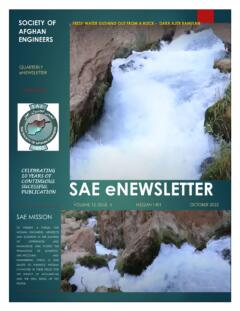
SAE Newsletter – October 2022, Volume 12, Issue 4, Meezan 1401
Fresh Water Gushing Out From a Rock – Dara Ajer Bamiyan
Society of Afghan Engineers Quarterly eNewsletter
Celebrating 10 Years of Continuous Successful Publication SAE eNewsletter
SAE Mission
To present a forum for Afghan engineers, architects and scientists in the sharing of experiences and knowledge and foster the promotion of scientific, architectural and engineering ethics in our quests to enhance Afghan capacities in these fields for the service of Afghanistan and the well being of the people.
SAE eNewsletter
P.O Box 151584 Alexandria, VA 22315 USA
http://www.afghan-engineers.org/index.html
Contents
- Editor’s Note
- Message From the President of SAE
- Message from the Chairman of the SAE Board of Directors
- SAE Executive Report No. 20, September 15, 2022
- SAE Executive Report No. 21, September 16, 2022
- SAE Executive Report No. 16
- Update on Bamiyan Housing Competition
- Fund Raised for Earthquake of Paktiaka and Khost
- Report From SAE Representative in Kabul
- Famous World Architects
- Hafizullah Wardak Recognized Who’s Who Worldwide
- Engineer of the Month
- Membership News
- Feeding, Fueling, Healing
- Comments and Suggestions
- The 2022 SAE Membership Renewal
- Job Opportunities at Planate Management
Note From the Editor-in-Chief, SAE eNewsletter
Earthquake can happen at any time; no matter where it occurs, it creates a disastrous impact on living beings, and it disseminates news of death and destruction. On June 22, 2022, around 1 am when the residents were in sleep, a 15 km deep earthquake measuring 6.2 occurred, in Paktika and Khost provinces of eastern Afghanistan. It destroyed several thousand homes, injured more than 6000 people, and caused more than one thousand deaths. The earthquake caused more damage and destruction in the two Woleswali (district) of Bermel and Gayan of Paktika. These two scenic districts are mountainous regions and difficult to reach by road. There are no adequate medical or major economic infrastructure or local economy in existence that could provide aid to the residents. The closest shopping and bazar available are about a 5 hours’ drive to Sharana, and Khost. The only product available is Jelghosa (pine nuts), which some of the residents collect and sell.
Seeing pictures of the destruction and stories of survivors are heartbreaking, families have lost members and animals lying buried under rubbles for days. This is a region where family members have a strong connection and live together in one compound and closed quarters. People live in old mud houses in the foothills. In general homes in these localities and most of Afghanistan are constructed from mud-clay material, and not designed for earthquake.
A college student only survivor: A medical student, named Khanzela, who is studying in Khost province, received a call to go home. He did not know who in his family has survived, when he reached his home after 7 hours of drive, all he could find of his family were 19 graves at a cemetery. Nineteen (19) members of his family including his wife, his two children, his father, mother, brothers, and sisters with their children, perished in this earthquake. In the rubbles of his home Khanzela finds his son’s hat seen in the picture. Now, he is worried about his study, his economic situation, and his future.
Khanzela is walking through the rubbles of his home, where 19 members of his family perished. Notice the large pieces of walls and roof’s material, that had fallen on his family.
What is Earthquake: Earthquakes is the result of vibration of the ground triggered by the sudden release of energy below the surface of the earth. The strength of the earthquake is measured by seismometer, the size of it is measured by a number called magnitude identified on the Richter Scale. It is believed that the main cause of the earthquake is movement of the tectonic plates, other causes could be human activities and/or volcanic eruption.
The crust of the earth is made of plates called tectonic plates. These plates and the outer layer of the earth are floating on a molten magma under the earth crust that causes the plates to move. These plates move continuously, when the plates break energy is released. The sudden release of energy causes the ground to shake, that shaking generates seismic waves that travel in the horizontal and vertical directions.
The point where the plates break, and earthquake begin, is called focus and the location above the focus on the surface of the earth is called the epicenter. The area that breaks on the earth crust is known as fault which are seen on the earth surface. There are four fault lines in Afghanistan located in the west-east-north and south-east-north direction.
Extent of destruction in Paktika and Khost
In the house, 7 people died and several more were injured. The collapse of the ceiling floor, either from dislocation of the beams, or collapse of the walls, brought down huge pieces of walls and ceiling floor material, a massive weight on those who were sleeping. New cracks in the ground surface from a second earthquake a few weeks later in Paktika, have been found. The steel I beams that supported the ceiling floor above look intact, but separated from the supporting wall that probably had less supporting edge at the opposite wall, and brought the ceiling floor down.
Future Generation in Trauma: The earthquake took the lives of many children, and some of them lost their parents, and siblings, with many now homeless. These children who are the future generation will remember this earthquake, the loss of their families, and the destruction of their homes. They will live with these memories; the trauma could have a deep psychological scar on their future life.
Aid to the Survivors
Local Authorities with several charity organizations are delivering and distributing aid (food and medicine to victims) to the residents.
Encouraging News: UNCHCR and few other organizations have decided to build several thousand houses for the residents, Hope they will complete a detail study of the site prior to initiating construction. If this area is not suitable they should consider another location for building new residents.
With Best Regard
Hafizullah Wardak
Editor-in-Chief SAE eNewsletter and Chairman – SAE eNewsletter Subcommittee
Message From the President of SAE
October 2022
Members of the Society of Afghan Engineers
The summer of 2022 is behind us without significant changes in Afghanistan regarding education and development projects. The United States has not changed policies to recognize the Interim government of Taliban. The sanction continues and the international communities placed restriction on non-governmental agencies’ function and communication with the government agencies in Afghanistan.
The Society of Afghan Engineers remains determined to follow its missions to strengthen the promotion of scientific, architecture and engineering professions to enhance the Afghan capacities in these fields.
I am delighted to report that the Bamiyan International Students Design Competition, “Re-Housing the Cave Dwellers of Bamiyan” completed its first phase of registration of competitors successfully. Over seventy (70) universities from around the world and six (6) universities from Afghanistan were invited to participate in this competition. Latest figures indicate that around fifteen universities from around the world and three universities from Afghanistan will participate in this competition. Prizes of $2,500, $1,500, and $1,000 will be awarded to the first, second, and third place winners. In addition, the Society plans to find ways to support the universities in Afghanistan financially to equip themselves to produce quality designs hopefully equivalent to universities in the USA, Europe, Asia, and Africa. Therebefore the Society invites donors to support this noble cause.
The SAE Fundraising initiated in July 2022 to help the Earthquake victims in Paktika and Paktia provinces hit a bump in the road due to the fact that the importance of a comprehensive feasibility study was overlooked. Donors and SAE members decided to provide portable water by providing Deep Wells for the villagers affected by the earthquake. Despite the 13-hour road trip from Kabul to the village of Geyan, Paktika and survey of the damaged villages by SAE representative in Kabul, Walid Howaida and Mr. Amin Mahmood (who happened to be in Kabul), the cost of constructing Deep Water Wells came over-budget. A second option was to finance the establishment of a library in Mazar-e-Sharif, but donors and SAE members preferred the funds to be used in earthquake affected areas of Paktika or Paktia provinces for which the fund raising was performed. I had telephone conversation with one of the faculty members at Sheikh Zayed University in Khost, Paktia to support the school of engineering and architecture at that university. Unfortunately, due to administrative restriction, funds need to be distributed through the Ministry of Higher Education. We did not pursue that option. Currently, the SAE representative in Afghanistan is planning a second trip to the Paktia to explore other options for the distribution of the funds.
The SAE 2022 Annual General Assembly meeting which was scheduled for September 17, 2022, had to be postponed due to unforeseen circumstances and to better coordinate the agenda of the meeting. The task force assigned to organize the SAE 2022 General Assembly proposed to re-schedule the conference for October 22, 2022, and the new date was approved by the president and the Board of Directors.
SAE Website is under continued construction, improvement, and completion. Thanks to Ms. Donya Amiri, SAE Membership Committee chairperson for her hard work, dedication and commitment who leads the task force working on the SAE website project.
The president of SAE was invited to meet with Mr. Thomas West, United States special envoy for Afghanistan, in a meeting organized by the Afghan American Chambers of Commerce in Washington D.C. on June 17, 2022. I planned on attending this meeting and to meet with Mr. Thomas West to introduce the Society, but due to flight delays, my trip was cancelled.
“SAE leadership believes that in the present critical juncture in Afghanistan and the life of Afghans, with proper help from the American government, our organization may be able to render critical support to uplift the lives of the suffering people of Afghanistan.”
With Regards,
Najim M. Azadzoi, AIA
SAE President
Message From the Chairman, SAE Board of Directors
Dear readers of the SAE eNewsletter,
Disasters have become routine throughout the world and specifically in our grief-stricken country. If it is not the nonending wars and atrocities, it is the earthquakes and the floods. The recent earthquake in Paktika is a bitter reminder. During the many decades of conflicts, villages and cities were destroyed and millions were displaced internally and externally. And to add more to the injuries, nature has gotten angry and is getting angrier day by day. One third of Pakistan was flooded recently.
Our urban areas are a whole different discussion, but it is the rural areas that should worry us the most. In our country, about 74 % (World Bank 2021) of our people live in rural areas with no or little needed basic services. Houses are made of mud, or at best, from adobe bricks. In some high grounds, stones are also used in building houses. Earthquakes can devastate such construction and can also trigger landslides in mountainous terrains. Afghanistan is crossed by many faults, of which, the Chaman fault, the Hari Ruod fault, the Central Badakhshan fault, and the Darvaz fault are those that will most likely contribute to seismic hazards. It is certain that locals do not have any knowledge of these and would not know ramification of living or building in such areas.
When I was a tenth-grade student at the Afghanistan Institute of Technology (AIT), I lived in an apartment in the Char Chata area of Kabul and always wondered about what was giving those interconnected structure their strength and stability. At one point, a large piece of the face plaster (Kagil) fell off at a stairway, and I was surprised to see the vertical lattice-work of wood inside. That was the secret of its strength.
Recently researchers at Imperial College in London developed a method that includes the use of timber, reinforced with a lattice-work of treated bamboo for earthquake prone areas. Bamboo is not common in Afghanistan but I am sure an alternative can be found, or maybe, it can be grown here onward. Once in place, even an infill of mudbricks covered with chicken mesh, and the use of Kagil, would prevent a building from crumbling apart into debris in the event of an earthquake. We also have to find an alternative to the use of heavy mud as roof covering.
My point of bringing the above is a call for an initiative by all of us to look beyond structural steel and reinforced concrete. Let’s develop a manual of simple methods that will include the use of local material and should be easy enough for someone in a remote village to follow. One house standing is one family saved, and saving lives is priceless.
Stay safe and be well.
Sincerely,
Abdul Manan Khalid, P.E., LEED (BD+C)
Chairman, SAE Board of Directors
SAE Executive Action No. 20, September 15, 2022
Resignation of SAE Treasurer, Mahmoud Samizay
Dr. Mahmoud Samizay served as SAE Treasurer since January 2021 submitted his resignation by an email dated September 11, 2022. Dr. Samizay was responsible for the financial affairs of the Society, including, receipt, deposit, safe keeping and proper expenditure of all funds of the Society. Mr. Samizay prepared the Society’s annual budget and reviewed it by the President and Executive Committee and submitted it to the Board of Directors for approval.
Dr. Samizay served the Society as a Treasurer honorably and performed his duties to utmost honesty and accuracy.
He will continue to be a member of the Society as he has been in the past 20 years and served in different capacities as a Member of Board of Directors and in the Executive Committee as well. His absence as the Treasurer of the Society is a big loss and a great setback in the ongoing activities of the Society.
With Regards,
Najim M Azadzoi, SAE President.
SAE Executive Report No. 21, September 16, 2022
Postpone of SAE General Assembly Meeting, 2022
The SAE 2022 Annual General Assembly Meeting, which was scheduled for Saturday, September 17, 2022; has been postponed to Saturday, October 22, 2022.
Due to unforeseen circumstances and to best coordinate the agenda of the meeting, SAE President asked the three-member Task Force to review and evaluate the possibility of postponement of the scheduled SAE September 17, 2022, General Assembly to a later date. The Task Force proposed the new date of the General Assembly to be October 15, 2022. The President and Board of Directors concurred to postpone the General Assembly, but they approved the new date to be October 22, 2022. The time of the meeting remains to be 1:00 pm to 3:00 pm (EST).
Members of the Society of Afghan Engineers who would like to participate in this year’s General Assembly Meeting may wish to contact the Task Force and submit their papers for inclusion in the meeting. The Task Force of the SAE General Assembly Meeting are:
- Professor Rafi Samizay
- Rafaat Ludin, Chairperson of the SAE/Afghan Government Agency Liaison Subcommittee
- Hafizullah Wardak, SAE Editor-in-Chief
We look forward to your participation and contribution to this year’s SAE General Assembly Meeting.
Sincerely yours,
Najim Azadzoi,
SAE President
SAE Executive Action No. 16
International Students Design Competition, Rehousing the Cave Dwellers in Bamiyan, Afghanistan
Consistent with our mission: to improve, educate, and sustain the practice of the architecture and design in our country, this year we are planning to launch an “International Student Design Competition to rehouse the displaced families who occupy the caves at the historically known cliffs of Bayan where the remains of the Statues of famous Buddha are located,” hosted by SAE, Architecture/ Urban Design sub-committee. Among the participant universities will be various architecture and urban planning programs in Afghanistan, in partnership/collaboration with few invited foreign universities. The education goals are to encourage collaboration, interchange and learning between the participant Afghan/foreign universities. The assigned team, “International Housing Competition Team,” for this task is diligently working on the following.
-
Scope of the competition – The international housing design team had several meetings during past months on the preparation of the document, and currently the final draft is prepared and is ready to be released. The document defines the design program components such as: the scope and goals of the competition, detailed space and site programs, timelines, submission requirements, eligibility, evaluation criteria, jury composition, and awards.
-
Participant universities – Invitation letters are prepared to be sent to the selected Afghan/foreign universities, architecture, and urban design programs to participate in the housing design competition. Possible Afghan universities will be: the Kabul University, Kabul Polytechnic, Herat University, Kandahar University, Paktia, Khost and Nangarhar universities. Among the foreign universities, currently we are considering inviting MIT, Harvard University, Washington State University, and Hartford University. Other interested qualified institutions may be added to the list with the approval of the team.
-
Funding and expenses – Fundraising possibly among SAE members and other donor organizations will be held to help the Afghan students with costs related to the design production, equipment, materials, and other related expenses. Prizes will be decided accordingly when funding becomes available. A fundraising flyer/poster is prepared to be circulated among the possible donors for this purpose soon.
-
Timelines – We are targeting to advertise, and release the housing competition program to the selected universities by June 2022 – Registration will be open to universities between July 15 and September 30th, 2022, through our website electronically at www.afghanengineers.org. Competition submission deadline will be on December 15, 2022, and selection of the winners, Jury reviews/ announcement of the winners will be held on January 15-30, 2023.
-
Website for the competition – The SAE website which is already approved by the board of directors is near completion. The site will exhibit the competition materials, a data bank, and related information to the competitors for easy access. Also, the site will aid the jurors to access the final project submissions for their evaluation.
Keeping in mind that at this point the competition is aimed to improve the quality of design education in Afghan universities – however, we are hoping that the outcome of the student design competition to rehouse the displaced families of Bamiyan, will become a catalyst for helping the communities in the Afghan cities with their acute housing problems.
Yours,
Najim Azadzoi, SAE President
Bashir Kazimee, SAE Architecture Subcommittee Chairperson
An Update on Bamiyan Housing Competition
Minutes of The Zoom Meetings, Saturday, 09/24/22
Respected Members of the SAE:
The Bamiyan Task force lead by Prof. Bashir Kazimee held a zoom meeting Saturday, September 24, 2022, at 1:00 pm (EST). Other members who participated at this meeting were Rafi Samizay, Reinhard Goethert, Mehdi Sabet, Hamayon Ibrahim, Mahmoud Samizay, Walid Howaida and Najim Azadzoi. The meeting ended at 3:40 pm (2 hrs. 40 minutes).
1- Registration:
Kazimee Sahib reported that 10 universities from around the world submitted their registration forms. Among them are 2 universities from United states, and one each from Egypt, Indonesia, Nepal, China, Bulgaria, Italy, United Arab Emirates, and Lebanon. Also, Kabul Polytechnic and Kandahar University department of architecture have submitted the registration forms. Kabul University Faculty of Engineering Department of architecture and department of urban planning are in the process of submitting their registration from.
The deadline to close receiving of registration form is September 30, 2022, however, the task force may want to extend the deadline to a later date if needed.
The good news is that our new website is working, and registration forms are being submitted via the website. Thanks to Donya Jaan Amiri.
During the past one-month, hundreds of emails and messages were received from various universities around the world asking questions and clarification the detail program and schedule of the competition. Questions included information about the site location, design programs, additional site details and the details of the design requirements, evaluation process, and submission requirement and process. The task force members responded to all the questions and inquiries promptly. I command the hard work of Kazimee Sahib and the rest of the team members.
2- Requests from Universities in Afghanistan:
* Kabul Polytechnic University requested that their computers are outdated and do not have the capacity/memory to handle the production of design requirements at high quality.
* Kabul University, Head of the Architecture department plans on making a field trip with the students to Bamiyan to survey and document site. The trip may require some financial support.
* Kandahar University has submitted one registration form with the name of only one faculty advisor and one student.
All three above subjects are being reviewed by the Task Force to respond and decide accordingly. SAE is planning to raise funds to support Afghan students and universities financially.
3- Fundraising for the Project:
The task forced decided to raise $10,000 to support this project. Five thousand dollar will be awarded to the three winners: $2,500 to the first winner, $1,500 to the second winner, and $1,000 to the third winner. The rest will be used to help and support the Afghan students and universities who participate in the competition. SAE has already opened a separate bank account under the same SAE bank account, only for the Bamiyan project.
AACC will publish the Bamiyan Competition flyer to their upcoming eNewsletter. AACC newsletter is received by hundreds of Afghan and American businesses, entrepreneur and companies involved in project in Afghanistan. The Task Force recommended to prepare a letter of invitation send it to selected and targeted individual and companies for donation. Please introduce the name of individual and companies you know who would be willing to donate and sponsor the project.
4- Next Phase of the Project:
After the completion of the registration, the task force will prepare and send design requirements and schedule to all participants. Although the task force has already prepared the design requirement in the program of the project which was sent to all, but a final design program will be updated and sent to all competitors.
Minutes of zoom Meetings, Sunday, 09/25/22
In the meeting of 09/24/22 it was decided that I should schedule a zoom meeting with Kabul Polytechnic University and Kabul University to discuss their questions and concerns regarding the competition.
I sent email of invitations to Dr. Amanullah Faqiri, Chancellor of Kabul Polytechnic University, Dr. Saraj Sharifzai, Head of the department of architecture at Kabul University, and to Mr. Kamil Halimee, Head of the department of urban planning at Kabul University and set up a zoom meeting for Sunday, 09/25/22 at 12:00 pm (EST) and 8:30 pm Kabul time. Due to weak internet connection, only Mr. Sharifzai was able to join the meeting, but we could not hear his voice clearly. Faqiri Sahib and Halimee Sahib tried to join the meeting but could not connect. Mr. Walid Howaida was present at the meeting.
It was decided to call Mr. Sharifzai via WhatsApp and talk to him. The discussion lasted at 1:20 pm. In summary, he agreed to submit registration form to enter the department of architecture fifth year students to the design competition. However, he mentioned that the students and faculty need financial support to purchase basic materials such as stationaries, equipment in order to produce quality design presentations. Should you have any questions, please email me or Kazimee Sahib.
Sincerely yours.
Society of Afghan Engineers
Najim Azadzoi, AIA, President
Fund Raised for the Earthquake Affected Areas of Paktika and Khost Provinces
| No | First Name | Last Name | Check # / Date | Amount |
|---|---|---|---|---|
| 1 | Tooba | Roshan | check 8/15/2022 | 1,500 |
| 2 | Abdul Waheed | Hassani | 1080, 1081 6/28/2022 | 800 |
| 3 | Ghulam | Mojtaba | 2103 6/28/2022 | 500 |
| 4 | Nadir | Sidiqi | check 8/15/2022 | 300 |
| 5 | Reza | Afshar | Check 8/15/2022 | 300 |
| 6 | Bashir | Kazimee | 3262 7/14/2022 | 200 |
| 7 | Hafizullah | Wardak | 4556 6/28/2022 | 200 |
| 8 | M. Saber | Sarwary | 2917 6/28/2022 | 200 |
| 9 | Manan | Khalid | 531 6/26/2022 | 200 |
| 10 | Najim | Azadzoi | 1993 7/1/2022 | 200 |
| 11 | Zarjon | Baha | 8115 6/23/2022 | 200 |
| 12 | Said Sharif | Hossainy | cashier check 7/14/2022 | 200 |
| 13 | Jalal | Masumi | Wire 4/25/2022 | 150 |
| 14 | Gul Afghan | Saleh | 288 7/1/2022 | 100 |
| 15 | Yar Mohammad | Mohabbat | 162 6/29/2022 | 100 |
| 16 | Qaseem | Naimi | wire 7/5/2022 | 80 |
| Total | $5,230 |
Report from SAE Representative in Kabul
SAE representative in Kabul, Mr. Walid Howaida, visited the Engineering Faculties of Balkh University, Kabul Polytechnic University, and Kabul University in June 2022. He met with the Deans of engineering schools in each University.
The Faculty of Engineering of Balkh University has Chemical Technology, Hydrotechnical Infrastructures, Physics & Math departments. The total number of students at the Faculty of Engineering is 1267 students of which 450 are female. The Engineering Faculty has 29 lecturers, four of them have Ph.D. degrees, three with master’s degrees, and the rest have Bachelor of Science degrees of which six are female. They expressed the need for scholarships, laboratory equipments and classroom facilities.
Mr. Howaida also met Abdul Rashid Eqbal, president of the Kabul Polytechnic University, and Dr. Amanullah Faqiri Dean of Civil Engineering. Kabul Polytechnic University has eight Faculties and 23 departments. Both Dr. Eqball and Dr. Faqiri expressed the need for scholarships and the need for improving classroom facilities. Mr. Howaida informed them of the SAE’s recent Bamiyan Project and learned their views on this project.
Mr. Howaida with Mr. Amin Mahmood visited Earthquake affected area of Paktika province. They talked with the village elders. The village elders expressed residents’ need for drinking water and would like the possibility of digging few wells in their areas. Both, Mr. Howaida and Mr. Amin, then had a meeting with the representative of UNHCR who is planning to build houses for those affected by the earthquake.
UNHCR is planning to build 1000 residents in Geyaan and 1000 in the Barmal districts of Paktika and 300 homes in the Spera district of Khost province. Mr. Mahmood shared his experience with the UNHCR team. Mr. Mahmood also had a presentation at the Polytechnic University and Kabul University on the effects of earthquakes on buildings, which was attended by students and faculty staff.
Based on the instruction of Mr. Najim Azadzoi, president of SAE, the SAE representative in Kabul Mr. Walid Howaida traveled to Gardez the capital of Paktia province on September 26, 2022. Mr. Howaida wrote the following: “The dean of the engineering faculty of Paktia university was not available and I met two senior lecturers of the civil engineering and architecture departments of the engineering faculty of Paktia university. I met Mr. Fareed Hasel from the civil engineering department and Mr. Arghawan from the architecture department.”
The Paktia University was established in 2004 and has a school of engineering in addition to the schools of architecture, economics, agriculture, medicine, law, and political science. There are around 850 students currently enrolled and around 100 of them are female. Mr. Hamidullah Sidiqqi, Chancellor of Paktia University contacted Mr. Najim Azadzoi with an email, this week, and expressed the urgent needs of the university. Mr. Sidiqqi is a 1986 graduate of the Faculty of Engineering at Kabul university.
The architecture department has recently been established with around 20 students. The architecture department and other engineering departments have no studio and no relevant equipment. The head of the Architecture department is a graduate of the Faculty of Engineering, and his name is Mr. Arghawan. Mr. Arghawan indicated that his department needs an Architectural studio, related equipment, and supplies.
Famous World Architects
By Dr. Said Sharif Hossainy
The second part
Antoni Gaudí
Antoni Gaudí was a Spanish architect, June 25, 1852, Riudoms, Catalonia, Spain – June 10, 1926, Barcelona, Catalonia, Spain.
Architect Anthony Gaudi, Known as Gaudi, was born in June 1852 in Riudoms, Catalonia, Spain. After graduating from the faculty of architecture named the Superior Technical School of Architecture, he started his career in Barcelona in 1878.
Gaudí was a creative man, he really had a great imagination and was inspired by nature. His buildings are colorful, unusual shapes in different ways and they are simple. Facades of buildings often have sculptural elements, shapes of arches and curved designs with idol-shaped and decorative surfaces that created many buildings in the center of Barcelona. His work was so special that it reliably evoked the level of excellent Spanish and European sense of taste. He was one of the most important modern engineers also.
Casa Batllo is considered one of his masterpieces. However Gaudi’s structure in Barcelona which is called, La Pedrera or Casa Mila in Barcelona was inscribed on the UNESCO World Heritage List in 1984. Gaudi made self-confession that artists do not need mementos to be made for them, because their works are their relics. Many works, from beautifully decorated houses and apartments to the amazing church from Anthony Gaudi is left. One of the best and the largest Gaudi’s effect is famous Church Sagrada Familia in Barcelona. He began working on it in 1882, at the age of thirty, and worked on it for more than forty years, before he passed away. The construction work is still going on. He was a Spanish genius architect and the leader of the Spanish modernist movement.
Frank Lloyd Wright
Frank Lloyd Wright, was an American architect in Large-scale, artist, creative, skilled theorist, master writer, and mastermind, born June 8, 1867, Wisconsin, United States – April 9, 1959, Arizona, United States.
Frank Lloyd Wright, architect and interior designer, was born in 1867 in Wisconsin, USA. After graduating with a degree in construction, his independent artistic activities began in 1893. Frank Lloyd Wright developed a unique American style of architecture, and over the next few years designed several residential and public buildings, known as the Plains. Because these houses are often on the outskirts of Chicago, these areas were designed and built by incorporating and coordinating with the flat and green plains. Plain comprised of houses has low-rise buildings and roofs with less slope and there were ridges and terraces, these houses were designed with an open plan, with long, low windows that connected the interior with nature, which was in fact a unique architectural style. Frank Lloyd Wright was commissioned by the Emperor of Japan in 1915 to design the Imperial Hotel in Tokyo. It took seven years to complete the project. The hotel building was the only large building survived the great Kanto earthquake of 1923 and made him proud. Forsooth, one of the pioneers of modern architectural style is the great and famous American architect Frank Lloyd Wright. Waterfall House is one of his artistic and lasting creations in the years 1936-1939 and it is a unique and modern example that quickly became famous to people all over the world. Majority agree that Wright was a broad minded artist, he was a creative, skilled theorist, and a master writer. He was a talented teacher and taught many students and played a valuable role in the twentieth century architectural movement. Guggenheim Museum-New York is a beautiful effect and the last remembrance Frank Lloyd Wright.
He received awards and gold medals from the Royal Institute of British Architects (RIBA) and the American Institute of Architects in 1941 and 1949. In 1953 he received the Frank P. Brown Medal from the Franklin Institute. Recognizing Frank Lloyd Wright’s architecture as a UNESCO World Heritage Site, his designs have been praised not only in the United States but also in other parts of the world. Frank Lloyd Wright died in 1959 at the age of 91 and was buried in Maricopa, Arizona, USA.
Walter Gropius
Walter Adolph Gropius, was a German American architect in Large-scale, May 18, 1883, Berlin, Germany – July 5, 1969, Boston, Massachusetts, United States.
Architect Walter Gropius, his nickname (Walter Adolf Gropius). From 1903 to 1905 he studied architecture at the Technical University of Munich in Germany and then continued his studies until 1907 in Charlottenburg – Berlin, and in the same year he began working as First Vice-Chancellor at the Peter Behrens Studio. He left Behrens in 1910 and worked in Berlin with another colleague, Adolf Meyer, until 1923, when he later established his own architectural office.
Walter Adolph Gropius is one of the pioneers and masters of modernism and a great artist who founded the Bauhaus School of Art in 1919 in the ancient, historical and cultural city of Weimar-Germany, located almost in the center of this ancient land. He was also the director of this school of art in 1933. This school of art was taught to students in such a way that in the field of design, their needs were considered separately and their designs had to be in line with the requirements of the industrial community. Students were also advised to avoid the luxuries of building facades and do not follow predecessors, although they use very little decoration. The Bauhaus School of Art has been referred to as the Bauhaus-Universitat since 1996 in Germany.
In 1937, Walter Gropius accepted an offer to work as a professor at Harvard University, the famous American university near Boston, where he began to modernize and reorganize the training of architects. During his lifetime in the United States, Walter Gropius designed many structures, including the JF Kennedy Federal Office building in Boston, the state of Massachusetts is in the United States. In 1945 he founded Architectural Company, The Architects Collaborative (TAC) in Cambridge, Massachusetts – USA.
Walter Gropius was a progressive architect who opposed individualism. He sought the cooperation of both his professions and like-minded people. In particular, he created his later works in a working group after 1946. In 1951 he received a number of awards and doctorates around the world and ten years later he participated in the exhibition “The Four Great Masters”.
Ludwig Mies van der Rohe
Ludwig Mies van der Rohe was a German American architect. March 27, 1886, Aachen, Germany – August 17, 1969, Chicago, Illinois, United States.
Ludwig Mies van der Rohe was born on March 27, 1886, in Aachen, Germany. He was a German architect. His work after the First World War was significantly influenced by personalities such as Walter Gropius and the functionalist Le Corbusier. His popularity spread after World War II. He brought about dramatic changes in the art of modern architecture. From 1930 to 1933 he was the last principal of the Bauhaus School of Art. Prior to that, Walter Gropius was the director of the Bauhaus. Mies Van der Rohe like other avant-garde architects, he based his mission and principles of architecture on the ideas and interpretations of theorists and critics who sought to downplay the importance of traditional styles.
Author’s Note: “avant-garde” is a French word it means leading and forehand, often the founders of new movements, are also called “avant-garde”, for example, the movement of modernism and so on.
Mies has devoted his entire life to a challenging task: to create a new architectural language that could represent a new era of technology and production. Mies continued with pioneering projects, culminating in his masterpieces in Europe, the construction of a temporary German pavilion for the International Exhibition in Barcelona in 1929. Disgusted and upset by the situation in Germany, he left his homeland in 1937, albeit reluctantly, and immigrated to the United States.
Mies, along with several Bauhaus architects who moved to Chicago, established the new Bauhaus University there and continued to educate young students. He was elected the new chairman of the Bauhaus. Later renamed the Illinois Institute of Technology (IIT), in 1956, the professor and modernist architect designed the new building of the Illinois Institute of Technology (IIT) in Chicago. Along with Le Corbusier, Alvar Alto, and Frank Lloyd Wright, he is generally considered one of the pioneers of modern architecture. In the remaining 30 years of his life, his American works are characterized by a constructive and clean approach to achieving the new architecture of the twentieth century. In buildings, he emphasized the use of large glass and industrial steel that fills open spaces.
Le Corbusier
Le Corbusier, real name Charles-Édouard Jeanneret, Oct. 6, 1887, Switzerland – Aug. 27, 1965 France.
Le Corbusier (real name Charles-Édouard Jeanneret) was born on October 6, 1887 in Switzerland and died on August 27, 1965 at the age of 77 in France. He was originally a Swiss engineer, urban planner, theorist and painter. With his radicalism and artistic sense, he had a significant impact on the development of modern architecture and is one of the pioneers of modern architecture. In my opinion, the insight of his works of art obliges us to express such a fact. At first he studied engraving in art school, but his teacher turned his attention to architecture, in 1917 he went to Paris, where he met the painter Amédée Ozenfant, and in 1920, with his help, chose the nickname Le Corbusier. In 1927, Le Corbusier was invited by Ludwig Mies Van Der Rohe to attend the Weissenhof Estate in Stuttgart, where he built two houses and published the famous book Five Points of Modern Architecture (Functionalism).
These five proclamations practically summarized the original technology charter of the time. Le Corbusier – Five points of modern architecture are:
1. Columns: The ground floor becomes an open space for circulation, dark and damp rooms are removed.
2. Roof terrace: which means leaving aside the traditional sloping roof, the roof top terrace can be used as a solarium, sports area swimming pool or playground and building gardens on the roof.
3. Free plan: Concrete columns carry the weight of all floors, which allows free space to be divided by non-load-bearing partitions.
4. Ribbon windows: The columnar system allows long horizontal windows to continue.
5. Free facade: pillar set back from the façades, cantilevered floor, release the design for a completely unrestricted solution of windows, thin lightweight walls are placed independent of the structure.
Le Corbusier was an extraordinary architect who had a great impact on architecture around the world. Major figures in modern world architecture such as Oscar Niemeyer, Lúcio Costa and Junzo Sakakura came out of his studio. Many of his ideas and principles were generalized only after his death. Le Corbusier lived a very humble life.
A total of 17 construction projects, designed by the French-Swiss architect Le Corbusier, are included in the UNESCO World Heritage List. One of the best examples of Le Corbusier work is Notre-Dame du Haut, Roman Catholic chapel in Ronchamp, France, 1955.
A Success Story
Dr. Bahawodin Baha, Professor at Brighton University of England- shared the following success story of a fellow Afghan student that he mentored:
Dear Friends, salaamona,
I hope you are all well. I wanted to share the success story of one of my ex-students Afghan at University of Brighton. I have created the only partnership between University of Brighton (UoB) in the UK and Kabul Polytechnic University (KPU) in 2008. Twelve junior lecturers from KPU were invited to the UoB for three years and almost all of them were able to finish their master’s degrees successfully and then returned to KPU.
One of those graduates was Dr. Zakerai Shnizai who subsequently completed his PhD in Japan and then continued his teaching and research at KPU until recently. I was delighted to hear that he has been successful to secure a place at the department of Earth Science at prestigious and world well know university of Oxford in the UK. He is a post-doctoral research fellow at Oxford University now. His research includes field investigation, active faults studies, remote sensing, and quaternary dating methods to establish the distribution, geometry and slip rate of active faults in Afghanistan.
Well done Dr Shnizai, I admire your courage, determination, hard work and more importantly constructive attitude all the times. I am very proud of you, and I wish you further success and I hope your success will inspire our youngsters to work.
Dr. Bahawodin Baha,
Professor at Brighton University of England
Hafizullah Wardak Recognized as Honored Member of Stratmore’s Who’s Who Worldwide
Hafizullah Wardak
Washington, USA
Title: Technical Fellow (Engineering), Retired
Company Name: Boeing
Industry: Aerospace
Type of Organization: Manufacturing
Major Product/Service: Designs, manufactures, and sells airplanes, rotorcraft, rockets, satellites, telecommunications equipment, and missiles worldwide
Expertise: Technical leader for the airplane structural and damage tolerance analysis, and for the international space station in fracture mechanics and structural analysis at Boeing; Technical leader for the structural analysis of the space shuttle rocket booster with United Technology; Responsible for structural analysis of the nuclear power plants with Sargent & Lundy; Former professor of civil engineering at Kabul University
Geographic Area of Distribution: International
Affiliations: Society of Afghan Engineering; American Society of Civil Engineering
University/Degree: M.S., Case Western Reserve University
Born: Afghanistan
Hobbies/Sports: Reading about history, aerospace, technical information and current events
Email: hwardak@comcast.net
Engineer of the Month
Congratulation to Gul A Saleh, member of the Board of Director of the Society of Afghan Engineer. Dr. Saleh has been recognized by the Virginia Section of ASCE, as Centennial Engineer of the month. The Society of Afghan Engineer congratulate this recognition to Dr Saleh.
Story from ASCE Virginia Site: Centennial Engineer of Month
The Virginia Section Centennial in 2022, the Section is selecting Outstanding Volunteers and Prominent Engineers throughout the Commonwealth to showcase as Engineers of the Month. These are a diverse group of Virginia Section members, that exemplify the qualities of a civil engineer, excellence in their careers, leaders in the profession, and are active in communities. Enjoy learning about our Centennial Engineers each month.
July 2022– Gul A Saleh, PhD, PMP, M. ASCE
Mr. Gul Afghan Saleh has been a key member of the American Society of Civil Engineers (ASCE) for over eight years. He is a civil engineer with a Ph.D. in Urban Planning and Design, a certified Project Management Professional (PMP), and has over 35 years of professional experience. Dr. Saleh has worked and/or studied in many countries, including Japan, Egypt, Thailand, India, Germany, Pakistan, and many more.
Much of Dr. Saleh’s work has been in Afghanistan, however, where he was born and raised, and the United States, where he currently resides. Prior to moving to the States with his family in 2014, Dr. Saleh worked directly with the United States Agency for International Development (USAID) for eleven years, the United Nations World Food Program (WFP) and United Nations Office on Drugs and Crime (UNODC) for five years, the Afghan NGO Pamir Reconstruction Bureau for another five years, and the Afghan government for ten years. He joined the UNITAR’s Hiroshima Fellowship for Afghanistan Program (UNITAR AF) as a Fellow in 2007 and climbed his way up to becoming a Mentor in 2013, helping his fellow Fellows from Iraq and Afghanistan. During these decades, he worked under many titles and with many organizations as he designed, developed, managed, and was consulted on countless engineering and environmental projects, with fundings up to $300M, including much philanthropic work and providing humanitarian aid.
In the States, he has kept himself busy with a Business Development Advisor role for Sheladia Associates, Inc. and as a Special Inspector of Intertek-PSI covering the DMV area. Dr. Saleh hasn’t forgotten his motherland, however, and recently worked with the Spanish company ACCIONA Engineering as a PMP in developing a Country Environment Profile for Afghanistan.
He also continues his philanthropic and volunteer work and is currently not only a member of the ASCE, but also a Founding and Board Member of the Afghanistan Engineers’ Association (AEA). He is also an Executive Director for the Society of Afghan Engineers (SAE), a US based organization, and continues to serve as a volunteer UN-certified Trainer and Mentor for UNITAR AF to this day.
Dr. Saleh continues his professional and personal endeavors as a Civil Engineer and as an Afghan tirelessly. He currently works as an Inspector for Gannett Fleming, Inc., but is always down for a chat with young civil engineers in his free time, as he loves nothing more than giving back to this community. He resides in Virginia with his wife and seven children, many of whom complain he loves giving back a little too much.
Membership News
SAE is pleased to announce that many professional engineers and architects in the United States, Canada and Afghanistan have shown their interests becoming SAE team members since January 2021. SAE has received most of new members’ membership applications and fees as required by the SAE bylaw. We welcome everybody and looking forward working together in future projects by providing professional services to Afghan Government and agencies. We welcome our newest high qualify members and look forward to their contribution to the purpose and mission of the Society of Afghan Engineers as set forth in the bylaw of the society.
SAE New Members July, 2022
Mr. Wais Aria has more than 14 years of experience in water resource engineering and hydropower projects planning and design, including spillway design, flood frequency analysis, surface water modeling, water profile analysis, scour analysis, and hydraulic structure design. His areas of specialization include hydrologic and, hydraulic modeling, GIS, planning & design, and project management. Mr. Aria was involved in numerous hydropower and tailing Dam projects designs and planning in The USA, Australia, Brazil and Afghanistan, The efforts, ranging from preliminary studies, feasibility studies, detailed design and closure design. His experience also includes technical reviews, supervision, and management of engineering projects.
Current Position: Senior Project Manager, Civil & Environmental Consultants Inc.
Education:
* Master in Natural Resources (Leadership for Sustainable Development), Virginia Polytechnic State University, December 2018
* Graduate Certificate in Global Sustainability, Virginia Polytechnic State University, December 2018
* Master of Water Science and Engineering (MS), Engineering, April 2011 UNESCO-IHE, Delft, Netherlands
* BSc Civil Engineering, Dec 2007, Kabul University, Kabul, Afghanistan
Society of Afghan Engineers (SAE) Membership Fees-2022 (USD)
| No | Last Name | First Name | 2021 Total | 2022 Total | 2023 Total |
|---|---|---|---|---|---|
| 1 | Rossi | Steve | 260 | 500 | 260 |
| 2 | Roshan | Tooba | 60 | 500 | 0 |
| 3 | Yamayee | Zia | 260 | 260 | 0 |
| 4 | Azadzoi | Najim | 200 | 200 | 0 |
| 5 | Mujtaba | Ghulam | 200 | 200 | 0 |
| 6 | Masumi | Jalal | 100 | 190 | 60 |
| 7 | Corcoran | Edward | 60 | 152.75 | 0 |
| 8 | Afshar | Reza M. | 100 | 150 | 0 |
| 9 | Baha | Zarjan | 120 | 120 | 0 |
| 10 | Kazimee | Bashir | 100 | 100 | 0 |
| 11 | Mommandi | Amanullah | 60 | 100 | 0 |
| 12 | Samizay | Mahmoud | 100 | 100 | 0 |
| 13 | Atayee | Tamim | 60 | 100 | 0 |
| 14 | Hossainy | Said Sharif | 100 | 100 | 0 |
| 15 | Mujtaba | Bahaudin | 100 | 100 | 0 |
| 16 | Saleh | Gul Afghan | 100 | 100 | 0 |
| 17 | Zaca | Zabiullah | 100 | 100 | 0 |
| 18 | Amiri | Donya | 0 | 100 | 0 |
| 19 | Baluch | Hashem | 60 | 60 | 60 |
| 20 | Hassani | Abdul Waheed | 60 | 60 | 0 |
| 21 | Khalid | Manan | 100 | 60 | 0 |
| 22 | Mahmood | Amin | 100 | 60 | 0 |
| 23 | Panjshiri | Atiq | 60 | 60 | 0 |
| 24 | Rakin | Hadi | 60 | 60 | 0 |
| 25 | Sidiqi | Nadir | 60 | 60 | 0 |
| 26 | Wardak | Hafizullah | 60 | 60 | 60 |
| 27 | Wardak Hassan | Wazma | 60 | 60 | 0 |
| 28 | Abdulrahimzai | Mushtaq | 0 | 60 | 0 |
| 29 | Keshawarz | Saleh | 60 | 60 | 0 |
| 30 | Sabet | Mehdi | 60 | 60 | 0 |
| 31 | Ibrahim | M. Hamayon | 60 | 60 | 0 |
| 32 | Ahmady | Ahmad Jawid | 0 | 60 | 0 |
| 33 | Sarfraz | Zabiullah | 0 | 60 | 0 |
| 34 | Samizay | Rafi | 0 | 60 | 0 |
SAE Members In Afghanistan (exempt from membership payment)
1. Zhakfar Zabihullah
2. Kamran Matiullah
3. Momand Mohammad Ishaq
4. Momand Mohammad Fazil
5. Zahid Hasibullah
6. Saberi Safi
7. Asim Arif
8. Naimi Kazim
9. Hamdard Sahar
10. Howaida Ahmad Walid
11. Maihan Regina
12. Alizoi Mohammad Azim
13. Hussaini Muzhda Sahadat (Turkey)
14. Sattari Mashhood (Turkey)
15. Qadery Qadria Shewa
16. Nazarian Tayebeh
17. Ezzat Abdul Mobin
Feeding, Fueling, Healing: How Knowledge is Enriching for Afghanistan
Dr. M. Nadir Sidiqi Ph.D.
President/Dean of Academics
BioNatural Healing College, Pomona, California
Afghanistan’s strategic importance is located between the South and Central Asia; therefore, Afghanistan is the heart of Asia. It is hard to explain in such a brief Afghanistan’s sustainability, after more than four decades of conflict, war, recurrent natural disasters, chronic poverty, drought, earthquake, and the COVID-19 pandemic, unfortunately, reports indicated have left 24.4 million heart and mind people in need of humanitarian in 2022 the country. This heart of Asia (Afghanistan) is suffering, and in desperate need of healing through healthy feeding, fueling, and healing the country. The heart and mind of each smart, child, young, or adult Afghan in the country especially smart girls are eagerly seeking peace, knowledge and willing to become a professional in various sciences to improve agriculture, road/building constriction, food security, economy, medicine, health, mental health, and better livelihood of Afghanistan people.
To seek knowledge is the right of each human being based on the commandment of the Creator of creations. Almighty God created all human beings from Adam (Father of humanity) and Eve (Mother of humanity). Therefore, the source of creation is the same. Regardless of differences in religion, the fact remains that we are all brothers and sisters in humanity. Humans are endowed with an intellect that enables them to gain knowledge through education. The first revelation of the Quran to the Prophet Muhammad (Peace be upon him) required him to: “Read in the name of the Lord … Who taught man through the use of pen what he did not know.” Quran Surah al-Alaq, 96:1, 4 and 5 (An Islamic Perspective on Human Development, Islamic Relief). In conclusion, acquiring knowledge is the remedy for feeding, fueling, and healing every nation around the world, particularly in Afghanistan has a central role in various sciences such as Islamic studies, agriculture, engineering, medicine, computer sciences, technology, economics, laws, pharmacy, biochemistry, nutrition science, and other related sciences will enrich the country toward sustainable, strong, healthy, and happy life along with the collaboration of the world with mutual respect to the Afghan nation.
Comments and Suggestions
The Editorial Board of the SAE eNewsletter welcomes comments and suggestions from the respected Society members and readers of the Newsletter.
From Mehdi Sabet:
Dear Wardak and Azadzoi sahebs,
Thank you for the SAE eNewsletter, very impressive information and presentation. Though I re-joined the membership recently (was a member 2001/02), and it give me the pleasure of working with other members to continue with some important efforts to help our home country. I am a bit embarrassed to mention and disappointed to see no mention of my professional efforts, especially on the continuous development of the International Student Competition, and the review of the website with Donya jaan. Though I understand the SAE’s reluctance not to include the Architects as formal and equal members in the organization but very concerned about fairness and recognition of members efforts.
Response from Najim Azadzoi:
Salaam Mehdi Jaan: Please don’t think that way. Absolutely, your contribution and involvement in the Society since your return are admirable and exemplary. Please note that most of the news and articles published in the July newsletter were written in the course of last 3 months and I am sure you took part in most of the activities particularly in the Bamiyan project and the design of the website. For example, on page 10 of the newsletter, names of five people are mentioned but your name is not. The reason is this Executive Action No. 13 was written on April 21, 2022, when I assigned five people for the task force of the website design. You join the team later after April 10, when I asked you to help Donya Jaan with Bamiyan project to. When the website is published, we will report accurately who helped designing the website.
From Dr. Bahawodin Baha:
I just wanted to share the success story of an Afghan student which I brought to my university in the UK few years ago. The details of his success can be found at the attached document.
From Mirwais Rahimi:
Dear Wardak Sahib, Hope this mail finds you well, With a colleague with MIT PhD candidate and a Sasaki.inc based in Boston, we have published a paper about the planning in Afghanistan. I would like to know how to proceed in publishing this paper through SAE eNewsletter?
From Hekmatullah Habibi:
Dear Respected Dr. Sb, Thanks, for your email and sharing this Newsletter. As a gentle request, Kabul University, Engineering faculty need ur kind attention to be supported by scholars living abroad.
The 2022 SAE Membership Renewal
Dear Members of the Society:
The Management of the Society of Afghan Engineers (SAE) would like to remind all members that 2022 membership renewal and Annual fee of $60 are due. Your membership fee collectively would enable us to pay for some basic needed services of the Society such as Website security monitoring, updating, and maintenance. Also, your membership fee would provide SAE’s management, the financial means to organize and host events and seminars on relevant technical topics.
Sincerely,
Najim M. Azadzoi, AIA, President
Engineering Job Opportunities with Planate
The following positions are available at Planate Management Group:
* Mechanical Engineer
* Electrical Engineer
* Electrical Engineer (Palo Alto, CA)
* Medical Equipment Planner (Palo Alto, CA)
* IT Security Officer (Orlando, FL)
* Various Engineering Positions (nationwide in the US)
* Professional Mechanical Engineer (remote work)
* Professional Civil Engineer (remote work)
* Professional Structural Engineer (remote work)
* Fire Protection Engineer, PE (remote work)
* Environmental Engineer, PE (remote work)
* Senior Project Engineer, PE (remote work)
The Society of Afghan Engineers Organization
- SAE Executive Committee Members: President: Najim Azadzoi; Vice President: Hamayon Ibrahim; Treasurer: Mahmoud Samizay; Secretary: TBA; Manager: TBA
- SAE Board of Directors-Officers: Chairman: A. Manan Khalid, M.S., P.E., LEED AP; Vice-Chairman: Jalal Masumi; Executive Director: Gul Afghan Saleh
- Members SAE Board of Directors: Wahed Hassani, Sharif Hossainy, Manan Khalid, Jalal Masumi, Amanullah Mommandi, Hadi Rakin, Gul Afghan Saleh, Masood Sattari, and Zabi Zaca
- SAE Past Presidents: Atiq Panjshiri, Ghulam Mujtaba, Abdul Hadi Rakin, M. Quasem Kadir, Mohammed Hashim Rayek, Ahmad Wali Shairzay, Sohaila Sanie Shekib, and Malik Mortaza
- SAE Chairpersons of Committees/Subcommittees:
- Hafizullah Wardak, Chairman – SAE eNewsletter Subcommittee
- Wali Shairzay, Chairperson of the Capacity Building and Academic Development Subcommittee
- Bashir Kazimee, Chairperson of the Architecture and City Planning Subcommittees
- Rafaat Ludin, Chairperson of the SAE/AGA Liaison Subcommittee
- Amin Mahmood, P.E., Chairperson of the SAE Student Subcommittee
- Mohammad Jan Mehrzai, Chairperson of SAE Corporation Committee
- Donya Amiri, Chairperson of the SAE Membership Committee
- Hadi Rakin, Chairperson of the Water Resource Subcommittee
- SAE Local Chapter Coordinators: A. Hamid Layan – Kabul, Afghanistan; M. Qaseem Naimi – Toronto, Canada; Najim Azadzoi – Massachusetts; Mohammad Najib Poya – Northern California; TBA – Southern California; A. Manan Khalid – New York and New Jersey; Amanullah Mommandi – Colorado; Atiq Panjshiri – Virginia and Washington DC
- SAE eNewsletter Subcommittee: Subcommittee Chairman: Hafizullah Wardak; Members: A. Wahed Hassani, Ph.D., P.E.; A. Manan Khalid, M.S., P.E., LEED AP; Abdul Hamid Layan.
- SAE eNewsletter Editorial Board: Editor-In-Chief: Hafizullah Wardak; Editorial Board Members: A. Wahed Hassani, Ph.D., P.E.; A. Manan Khalid, M.S., P.E., LEED AP; and Hafizullah Wardak.