SAE Newsletter – 2024-07 – Volume 15, Issue 3
Introduces Professor Bashir Kazimee as the new Editor-in-Chief and features an engaging dialogue on transforming the Society into a comprehensive Afghan Engineering Consultancy.
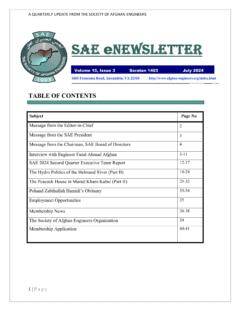
SAE Newsletter – July 2024, Volume 15, Issue 3, Saratan 1403
Table of Contents
- Message from the Editor-in-Chief
- Message from the SAE President
- Message from the Chairman, SAE Board of Directors
- Interview with Engineer Fazal Ahmad Afghan
- SAE 2024 Second Quarter Executive Team Report
- The Hydro Politics of the Helmand River (Part II)
- The Peacock House in Murad Khani-Kabul (Part II)
- Pohand Zabihullah Hamidi’s Obituary
- Employment Opportunities
- Membership News
- The Society of Afghan Engineers Organization
- Membership Application
Message from the Editor-in-Chief
Dear respected colleagues:
I am pleased to present the quarterly update from the Society of Afghan Engineers (SAE) in this issue of the SAE e-Newsletter. As the new Editor-in-Chief, I have been invited by Mr. Jalal Masumi, SAE President, and the editorial board members of the SAE, to take on this important responsibility for the current administration term of office running to December 2026. I am delighted to be part of this endeavor and will make every effort to provide you with up-to-date information, news, and valuable technical, educational, and informational articles on engineering, architecture, and urbanism that may be appreciated by our readers.
With this prediction, I should mention that the important intent and goals of the Newsletter cannot be accomplished without the hard work, advice, support, and efforts of the editorial board members. My special thanks to Ustad Mujtaba, Dr. A. Wahed Hassani, and Ustad Manan Khalid for their continuous support and membership of the Editorial Board. It will be an honor to continue working with them.
It is important to acknowledge the hard work by my predecessors: Professor Hafiz Wardak, who served as Editor-in-Chief in the previous administration, and Mr. Najim M. Azadzoi, who assumed the role of Acting Editor-in-Chief while also serving as SAE President. The April 2024 and July 2024 issues of the Newsletter, jointly prepared by Ustad Mujtaba and Ustad Manan Khalid, who took on the responsibility as Acting Editor-in-Chief, were excellently published. It is noteworthy to mention that Ustad Mujtaba served as the Editor-in-Chief of the e-Newsletter from 2011 to 2022. I am very grateful for all their services and the important roles they played in the continuous publication and on time distribution of the SAE e-Newsletter.
As we begin this new chapter together, I am confident that the SAE e-Newsletter will continue to thrive. Your contributions are essential to its success, and I encourage and invite you to submit your technical and educational articles, comments, suggestions, and opinions for the publication. Your input and support will be greatly appreciated. We hope that you find this issue of the newsletter interesting and useful. Please let us know if you have any questions or comments.
I am looking forward to sharing this journey with you.
Warm Regards,
Bashir Kazimee, AIA
Professor Emeritus
Washington State University
Former Chairperson: SAE-Architecture and Urban Design Division
Message from the SAE President
At the service of the Society, I am grateful to address you through this July 2024 Issue of SAE Newsletter.
During the last quarter (April/May/June) our Afghan community cherished and celebrated two ominous occasions of Eid-al-Fitre and Eid-al-Adha as heavenly rewards. At the dawn of another summer season, I hope global warming and climate change trends don’t turn out to inflict a high toll on humanity at large, and the local communities that our dear members reside in. Notwithstanding this humble hope, however, is the rage and destruction caused by recent floods that swept some of the provinces in Afghanistan during May, inflicting heavy losses of life and property to residents of Baghlan, Ghor, Logar, and Faryab provinces. It was elating to see SAE members acting passionately to extend a helping hand of limited financial support for the victims of that natural disaster.
With hopes for positive outcome, I continue to pledge my devotion to working in concert with all members to make SAE more relevant and responsive to the moment. Involvement of all members may appear to manifest itself in the prism of elected directors. But it does not quite make up for hands-on participation by all members to share in tackling and executing SAE business. On that note I humbly request every member who reads this message to please reflect with their suggestions/feedback on what can be done and what they can do as far as goals and achieving them are concerned. As a segway, I am so delighted to announce that very recently Professor Bashir Kazimee graciously accepted a request to take charge of SAE Newsletter as its editor-in-chief. I remain grateful for his kind acceptance and very expeditious endorsement of this appointment by the Board of Directors.
Elsewhere in this Newsletter edition you will find information about SAE activities during the quarter ending June 30, 2024, and planned activities for the quarter ending September 30, 2024.
Enjoy the summer season with your families and loved ones.
With warm and kind regards,
Jalal Masumi
President
Message from the Chairman, SAE Board of Directors
Dear readers of the SAE eNewsletter,
First, I would like to congratulate and welcome Professor Kazimee as the next Editor-in-Chief of the SAE eNewsletter. I am confident that under his leadership this quarterly publication will flourish further and become a vibrant source of news and useful information.
By the time you read this massage, Eid will be behind us. I hope you had a happy and healthy Eid and hope you prayed for the well-being of humanity, and especially the impoverished people of our homeland.
It was heart breaking to watch the horrors brought on the local population in parts of Afghanistan by the recent destructive floods, causing them grave suffering. It makes me think that sometimes even nature is merciless to our people. I recently read the horror story of the “Johnstown Flood” that happened in the State of Pennsylvania a while ago, and would not like for our trouble-stricken people to go through such an ordeal ever. Unfortunately, and regrettably, lack of resources, preparedness and awareness causes our people to continue to build shelters and live in flood prone areas.
A 2017 World Bank report prepared by GFDRR (Global Facility for Destruction Reduction and Recovery) states that “within low-income countries, Afghanistan takes second place, only surpassed by Haiti in terms of the number of fatalities from natural disasters …”. That is quite an alarming ranking. INFORM ( Index for Risk Management) 2022 Index (EU, 2022) places Afghanistan as the third most at risk country among the highest risk prone countries from natural disasters which is just one degree higher than the World Bank ranking.
There are many factors that places Afghanistan in such rankings, and the unplanned urban sprawl is one of the major factors. There have been numerous studies, reports and risk assessments, but to date, the focus has been on response and recovery rather than prevention and preparedness. We cannot control nature, but as professional and experts in the field, we can certainly help those in the path of such destructive forces with awareness and technical expertise. Presentations by some of our collogues have kick started this important issue. Let’s continue on that path to find and recommend more means for prevention and preparedness.
Have a great summer.
Manan Khalid, PE, LEED AP (BD+C)
Chairman, Board of Directors
Interview with Engineer Fazel Ahmad Afghan
By: Jalal Masumi
Interview Opening:
Dear Engineer Sahib Afghan. On behalf of the Society of Afghan Engineers (SAE), it is a great pleasure for me, Jalal Masumi, to conduct this interview with you, to be published in the Society’s quarterly Newsletter. The Editorial Board of the SAE Newsletter determined it appropriate to conduct, from time to time, interviews with senior members of our professional community, with the intent to share their reflections and experiences for the benefit of Society membership at large and as a measure of interest in and recognition of such senior members. Please accept sincere appreciation of the SAE Newsletter Editorial Board in availing yourself for this interview.
As a point of information for the readers, I, Jalal Masumi, completing this interview with you on behalf of SAE, has had the privilege of knowing you closely as a mentor, guide, effective manager, and a dedicated servant of Afghanistan for the last half a century.
Q-1: Please tell us about your birth place and location of your primary, secondary, college and graduate educations.
R-1: Dear respected colleagues of the Society of Afghan Engineers, I would like to extend my sincere thanks and appreciation for the opportunity to interview with you.
I was born in Salihan, a village located in the Panj-Wayee District of Kandahar. My birth name is Fazel Ahmed. After migrating from our homeland due to political upheavals of the 1980’s, I took interest in free lance writing, and chose “Afghan” as my pen name. I completed my primary education up to grade nine in Habibia High School, followed by grades ten to twelve at the Afghan Institute of Technology (AIT) in Kabul. I attended Kabul University and obtained my bachelor’s degree from the Faculty of Engineering in Kabul, in 1964; and finally, I earned my master’s degree from the University of Manitoba in Canada in 1972.
Q-2: Please tell us about your career path in Afghanistan and in other countries.
R-2: In the fourth year of college in the Faculty of Engineering, the late Dr. Qaisani, Dean of the Faculty, was teaching us soil mechanics. One day when he entered the classroom, he wrote three names on the board: Engineer Sahib Abdul Qayum, Engineer Sahib Abdul Shokoor, and a third person whose name I cannot remember now. He mentioned that these three individuals would work on designing six teacher training colleges financed by US AID after graduation. As the third individual declined the offer, Dean Qaisani named me instead. At that time, there was no engineering office in the Ministry of Education. So, after graduation we were assigned to work under two American engineers and an architect in the US AID office in Kabul. After some time, it dawned on me that as Afghans working on Afghan projects in Afghanistan, we should rather have our own office in our country instead of working in an American office. I convinced the two Americans to help establish an office inside the Ministry of Education, physically closer to the decision-makers. Once they agreed, I arranged a meeting with the late Dr. Akram Khan, the deputy minister of education. He concurred with the idea and we were granted an office and a spacious room for engineering personnel. We moved to the new office and set up engineering tables and chairs. At that time (1965), the Ministry only had a general directorate of maintenance in its organization for schools in Kabul City. With the set up of this engineering office inside the Ministry, the general directorate got upgraded to a presidency unit as Construction Division, and late Abdul Ghafoor Khan Ahmadi, was appointed as its acting president. After a year, Engineer Sahib Shokoor and I, one after another, were sent for 7-months practical training in engineering to Los Angles, California with a firm of consultant architects, engineers, and planners known as DMJM abbreviation for Daniel, Mann, Johnson, Mendenhall. Upon completion of this training and return to Kabul, the late Mohammad Akbar Saifi was serving as president of Construction Division. When I reported to work following return from training in DMJM, I was appointed as the director of the engineering and technical office. In 1969, I pursued graduate studies, arranged under a scholarship, and obtained my master’s degree in Canada. Before my return home in 1972, I was already considered to serve as the vice president of the Construction Division.
Q-3: What are your most outstanding impressions as a student during school life in any cycle of education?
R-3: School life at Habibia High School during primary cycle was filled with fun. However, after transitioning to AIT, I matured and became more focused on my education. I also had a wonderful time with my classmates and our friendly, knowledgeable teachers. In grade twelve, I was so happy to have the honor of being the president of a conference in celebration of Teachers’ Day at AIT. Following graduation from AIT in 1960, I enrolled in the Faculty of Engineering and Agriculture. The faculty facilities at the time were located in a building behind the Faculty of Medicine in Ali Abad. The facilities later moved to the new campus for Kabul University (Pohantoon) in Jamal Mina in 1963. After four years of hard work and plenty of enjoyable moments, I finally graduated in 1964. We were fortunate to have excellent Afghan professors including the esteemed Dr. Sahib Zarjan Baha who taught us surveying in the field during the freshman year. I am proud to be a graduate of the Faculty of Engineering and to be called an engineer and now being a member of SAE.
Q-4: What are your most memorable experiences as an engineer?
R-4: After graduating from the Faculty of Engineering, I played a key role in setting up the engineering department within the Ministry of Education for a brief period. Following this, I had the opportunity to gain valuable experience during practical training in the U.S. at the renowned engineering firm, DMJM. This experience provided me with insights into design, inspection, and the overall operations of an engineering project. Additionally, simultaneously, I took a night course on stress analysis at University of California in Los Angeles (UCLA), which I personally funded and found it incredibly beneficial. However, upon my return to Kabul, I found myself primarily focused on supervising engineering and administrative tasks rather than directly engaging in engineering.
Q-5: What are your most memorable experiences in the civil service when working for the government?
R-5: (1) One of the most memorable experiences in my beloved country was when I faced numerous challenging tasks after being appointed the vice president of construction division. One significant challenge was the difficult task of replacing foreign engineers and architects with knowledgeable and hardworking Afghan professionals, ultimately aiming to reduce costs paid in foreign currency to the foreign personnel. To achieve this, I arranged a meeting with the late Dr. Qaisani to visit the Faculty of Engineering and meet with graduating class of civil engineering students, as a recruitment attempt. During this meeting, I discussed the work of construction division in the Ministry of Education and the important tasks ahead, encouraging students to join us after graduation and offering them scholarships for further education. I also spoke with the late Ghulam Sakhi Khan who was serving as AIT Principal to address the graduating class of students, urging them to consider working in the Ministry of Education as draftsmen and technicians. As a result, Engineer Sahib Ata Jan Tajyar, Engineer Sahib Jalal Jan Masumi, the late Engineer Sahib Zahir Jan Aman, Engineer Sahib Khwaja Yaqub, and the first female graduate from the architecture department, Miss Shukria Jan Aman, along with Engineer Sahib Atar Sing and other graduates from various institutions, joined our team. This influx of talent allowed the engineering department to handle a wide range of projects independently, without the need for foreign expatriates. I proudly once in a meeting informed the late President Sardar Mohammad Daud, his soul be in peace, that in the Construction Division that he had assigned me, there were no foreigners – all staff were Afghan. I was truly enjoying my achievements.
(Jalal Masumi Note: I recall vividly the memory of a summer day in July 1972, towards the end of the Highway Engineering class, being taught by Ustad Dr. Saboor Rahim, who introduced a young tall handsome man dressed in black suit as Mr. Fazel Ahmad the vice president of the construction division of the Ministry of Education. Mr. Ahmad, on a recruiting spree, made an impressive job of convincing some of us (including myself) to be persuaded by his presentation and sign up to be employed by the Ministry of Education, as we were about to graduate in August that year.)
R-5: (2) Before the establishment of our engineering department, school designs were all being handled by the Construction Division of the Ministry of Public Works. This process often took months, from administration and design to the final blueprint reaching the provincial directorates of education. In order to streamline this process, our Division with UNESCO experts help, divided the country into five zones based on climate, earthquake occurrence, and frost lines underground. We accordingly created construction prototype plans for primary and secondary schools to be constructed in rural areas using local materials, and in urban areas using red bricks and concrete. This approach allowed us to expedite the sending of blueprints to the provincial directorates of education to construct school buildings.
R-5: (3) Up until when I was appointed as the president of the Construction Division in October 1973, all aspects of planning, budgeting, administration, employment, and finances were being managed and handled within the administrative setup of the Ministry of Education. This setup posed challenges for tasks such as hiring and firing employees, creating yearly budgets for schools, and securing internal and foreign financial resources for school construction projects. To address these issues and streamline the process, I made the decision to separate the Construction Division from the administration of the Ministry of Education. I proposed and recommended to establish a semi-autonomous construction unit directly under the Minister of Education, granting it the freedom to make decisions independently in various matters to expedite the work. I am grateful that my proposal was accepted and during my tenure as the president of the Construction Division, I was able to successfully implement this change.
R-5: (4) In 1966, the USAID provided financial aid to construct several agricultural schools, with the condition that the design would be done in the USA. However, during the budget approval process by parliament, it was noted that the cost of the design was prohibitively high, leading to the cancellation of the project. Later, when I served as the president of the construction unit, the USA once again proposed financial assistance for these agricultural schools. This time, I advocated for the design to be done within the country by our professional engineers and architects available in the Faculty of Engineering in Kabul University under an organizational umbrella called Center for Engineering Consultancy Service and Research (CECSAR for short). Thankfully, the USAID agreed to this proposal, and it received approval from the Ministry of Planning and the late President Sardar Mohammad Daud. He was pleased with the decision I made, and the project’s design was entrusted to the Faculty of Engineering, under the leadership of the esteemed Dr. Zarjan Baha. This experience stands out as one of the most memorable moments during my time as president of the construction unit.
Q-6: You are an SAE member. Please tell us how the Society can improve its services to the community.
R-6: Before answering your question, I would like to pay tribute to the founders of the Society for their dedication and hard work since its establishment. Their vision and efforts have laid the foundation for the success and growth of the organization. I express my deepest condolences for the loss of those who have unfortunately passed away, and we honor their contributions and legacy.
To those who have retired, I extend my warmest wishes for a long, healthy, and happy life. Indeed, their years of service and commitment have made a lasting impact on the Society, and we are grateful for all that you have done.
To the present members, I wish a long, healthy, happy, and successful journey ahead. Your continued dedication and passion are essential to the continued success of the Society. May you all thrive and achieve great successes together.
With this short note, and with great pleasure, I would like to address your very important and fundamental question.
As we are all aware, since April 1978, many of our professional engineers and architects have left the country in search of better opportunities, leading them to even take on non-professional jobs in order to support their families. Some who initially intended to join professional associations for voluntary services found themselves compelled to seek income elsewhere to sustain their livelihoods. This unfortunate reality has resulted in a loss of the dignity and honor they had strived for back home. It is crucial to make significant changes within the Society to provide meaningful employment opportunities for our professionals, allowing them to utilize their expertise and live with dignity. To address this issue, transforming the current non-profit model into a profitable “Afghan Engineering Consultancy” is proposed. This transformation would not only create opportunities for Afghan engineers and architects to join the consultancy but also attract organizations such as the World Bank, UNESCO, UNICEF, World Food Programme, and USAID who seek consultancy services and advice for project design and management in third-world countries.
Below, I outline the details of this proposal.
Proposal: Transformation of the Society of Afghan Engineers into Afghan Engineering Consultancy
Introduction:
The Society of Afghan Engineers has long been dedicated to promoting the interests and professional development of engineers and architects in Afghanistan. Recognizing the evolving needs of the engineering industry and the potential to contribute on a global scale, I humbly propose a transformation of the Society into a comprehensive engineering consultancy.
Objective:
The primary objective of this transformation is to establish the Afghan Engineering Consultancy as a reputable organization capable of providing consultancy services furnished through international organizations such as USAID, World Bank, UNESCO, UNICEF, the World Food Programme, and the like. This consultancy will leverage the expertise of Afghan engineers and architects to address critical challenges and provide innovative solutions in various sectors worldwide specifically.
Scope of Services:
The Afghan Engineering Consultancy will offer a wide range of consultancy services including but not limited to:
- Infrastructure Development: Providing expertise in designing, planning, and implementing infrastructure projects such as roads, bridges, utilities, and more.
- Environmental Engineering: Offering solutions for environmental conservation, sustainable development, water resource management, and renewable energy projects.
- Urban Planning: Assisting in urban and rural development projects including city planning, land use management, schools/educational facilities, other public service facilities such as hospitals, historical places and housing initiatives.
- Disaster Management: Providing expertise in disaster risk reduction, emergency response planning, and rebuilding efforts.
- Capacity Building: Offering training programs, workshops, and skill development initiatives for local engineers and architects.
Partnerships and Collaborations:
To ensure the success and sustainability of the consultancy, partnerships will be established with relevant stakeholders including government agencies, international organizations, academic institutions, and private sector entities. Collaborations with local and international NGOs will also be sought to leverage resources and expand the reach of the consultancy.
Job Creation and Professional Development:
One of the key outcomes of this transformation is the creation of employment opportunities for qualified engineers and architects in Afghanistan and the engineers and other professionals. By engaging with international organizations and undertaking projects in different countries, the consultancy will provide job opportunities for Afghan professionals to work as advisors and consultants. Additionally, continuous professional development programs will be offered to enhance the skills and expertise of the workforce.
Conclusion:
In conclusion, the transformation of the Society of Afghan Engineers into the Afghan Engineering Consultancy represents a strategic move towards leveraging the expertise of Afghan engineers and architects on a global scale. By providing consultancy services to international organizations, we aim to not only contribute to the development of various sectors worldwide but also create meaningful employment opportunities for Afghan professionals. We look forward to the support and collaboration of all stakeholders in this endeavor.
Interview Closing:
Engineer Sahib Afghan! Thank you for a candid, interesting, and friendly interview. We leave it for the readers to possibly remark on the take they may pick from your wonderful experiences and input, including your recommendation about SAE future.
SAE 2024 Second Quarter Executive Team Report
1. Planned vs Actual
The SAE President submitted the 2024 Proposed Plan to the Board of Directors, on behalf of the Executive Team, on January 22, 2024. It included several action items to be dealt with over the year. The following table captures the 2nd quarter plan items and the corresponding status.
| Item No | Action Item – April 2024 | Status – June 2024 |
|---|---|---|
| 1 | Continue filling vacant positions (if any) in SAE office holders | A pre-requisite for this endeavor was Board approval of an organization frame, which was granted in BOD Meeting 3 on March 7, 2024. President call for volunteers to head Engineering Committee, Architecture Committee, and Advisory Council chair did not come to fruition. One prospective individual member who was approached by President asked for job description details. Preparing this document is in progress. The item will continue to slide to next quarter. |
| 2 | Seek BOD approval for convening annual meeting of Members | BOD Meeting 4 held on April 25 resolved that President and Executive Team decide how to convene the General Assembly Meeting. BOD Meeting 5 held on May 23, 2024 resolved that General Assembly Meeting (GAM) be held virtually on September 28, 2024. |
| 3 | Prepare report on Q2 activities to cover a) What did not go right as planned b) Number of active members – start of Q2 c) Number of active members – end of Q2 d) Bank account balance – start of Q2 e) Bank account balance – end of Q2 | a) i- Relating to filling vacant positions indicated in item 1 above, the aim was to staff three main units (Engineering Committee, Architecture Committee, and Advisory Council) within SAE organization frame. These three units effectively remained out of commission on account of no staffing. ii- Relating to sub-units under Engineering and Architecture, logically, staffing finds shape and form when someone leads the Committees to begin with. iii- Staffing or lack thereof proved a very involved problem beyond the President’s inability to achieve it, and whose details are beyond the scope of this report. But keeping hope alive should not be dismissed. b) Based on initial unverified records, there were 69 members (living in U.S. & Canada) and 20 members living in Afghanistan at the start of Q2. Fresh endeavor, at the end of Q2, shows that the final numbers are higher which need to be verified in the interest of accuracy and accountability. c) Number of members to be verified. d) SAE bank account showed a balance of $27,954 on April 1, 2024 e) SAE bank account shows a balance of $26,240 as of June 26, 2024; major expenditure was $1500 donation to victims of floods in May in Baghlan & Ghore provinces. f) President used an estimated total of 80 hrs during 2nd quarter, handling SAE business. |
2. News from Afghanistan
Online lectures/presentations were provided by SAE in collaboration with Afghan Education for Better Tomorrow (AEBT), as follows:
- Fig. 1: Seminar on renewable energy, presented by Engineer Ghulam Mohammad Feda in May 2024 to Kandahar University students.
- Fig. 2: Lecture No. 17 (in the series of lectures) on methodology of research, presented by Dr. Nadir Atash in March 2024 to students of Medical Faculty of Paktia University.
- Fig. 3: Seminar on pavement design covering highway transportation, presented by Dr. Saboor Rahim in March 2024, to Faculty of Engineering students of Kabul University.
- Fig. 4: Lectures on soil mechanics, presented by Dr. Saboor Rahim in January 2024 to Faculty of Engineering students of Kabul University.
Additional Updates:
- SAE Resident Representative in Kabul (Engineer Walid Howaida) reported that he was invited to the graduation ceremony of students graduating in engineering sciences from Kabul University and Kabul Polytechnic. He reported that all male graduates numbered 772 men in total, 550 of whom earned their bachelor’s degree, and 222 whom earned master’s degree. Sadly, no female students had the opportunity to graduate.
- Fig. 5: Graduation Ceremonies at Kabul and Polytechnic Universities.
- Devastating floods destroyed much of the local developments in Baghlan, Ghor, Faryab and other north-western provinces in May 2024, inflicting heavy tolls of life and property damage. SAE management contributed $1500 donation out of SAE funds to help the victims. Individual members pitched in individually separately.
- SAE has been exploring the prospects of how and if it can be engaged in projects of engineering nature/caliber inside Afghanistan. This exploration is on-going through involvement of its Resident Representative in Kabul in coordination with local authorities.
- On May 27, 2024, Engineer Howaida met Dr. Farouq Azam at the Ministry of Energy and Water, in the attempt to obtain up to date photos of the Dehrawood hydrological station, requested by BOD member Engineer Amanulah Mommandi, in conjunction with the technical paper that Engineer Azimi recently wrote, titled Recharging Kabul’s Aquifers.
- Fig. 6: Mr. Walid Howaida with Dr. Farouq Azam.
- Mr. Howaida also met on May 30, 2024 with Kabul municipality deputy mayor for urban services, Mufty Khalid Sajestani, related to Mr. Azimi’s article on Recharging Kabul’s Aquifers. The deputy mayor reportedly welcomed the topic of recharging Kabul aquifers and appreciated SAE’s offer for cooperation in technical fields.
- Engineer Howaida also reported on his finding commissioned by the Board of Directors about requirements to get SAE registered as an organization in Kabul. Accordingly, in addition to meeting rigid administrative procedures set by Ministry of Justice and Ministry of Economy, payment of registration fee ($5000 per year) is also mandated.
3. News from the U.S.
- 11 SAE members attended a brainstorming session on February 22, 2024 aimed to identify approaches to better organize SAE efforts in being more relevant and successful. A follow up session of this effort was convened on May 15, 2024. The second session resolved that the effort needed to continue further to bring additional input and exchange of ideas, with a TBD timeline.
- 9 SAE members attended an online presentation on April 30, 2024 arranged by Engineer Atiq Panjshiri but prepared and delivered by Engineer Aziz Azimi. The presentation was entitled Recharging Kabul Aquifers, highlighting the dire need for attention to the drawdown of Kabul City underground water levels posing serious future threats.
- Several SAE members attended, at their own expense, an event held on May 26, 2024 in Lake Forest, California, courtesy of an initiative by two former graduates of the Faculty of Engineering, Kabul University. The event intended to provide a re-union of the Faculty of Engineering Alumni and its graduates prior to 1985. SAE President Jalal Masumi had an opportunity to briefly address the gathering and talk about SAE’s past-present-future, and solicit valued involvement of attendees going forward.
The Hydro Politics of the Helmand River (Part II)
An Introduction to the Helmand River and Water Rights Treaties Between Afghanistan and Iran
By: Amanullah Mommandi, M.S, PE
Abstract
Part I was published in the SAE eNewsletter in January 2024 and focused on the context and background related to previous commissions studies and recommendations up to the 1973 Helmand Water Rights Treaty between Afghanistan and Iran. Part II brings to fore the letter written by Abdul Majid Zabuli, who held cabinet position at the time as Minister of National Economy, which was appended to the 1951 Report of the Helmand River Delta Commission. Mr. Zabuli’s letter documents unfair practices by Iran at the time, including widening and deepening of the Sistan River to divert more water to Iran than their allocated share and depriving Chakhansur residents of the necessary water to sustain their livelihoods.
Background:
Water rights related to Afghanistan’s longest river, the Helmand River (Figure 1), have been a point of contention between Iran and Afghanistan for many years. In 1947, the United States began facilitating negotiations between Iran and Afghanistan related to Helmand River. By February 1948, the U.S. Department of State proposed the formation of a neutral technical commission. The Helmand River Delta Commission was formed as a result, comprised of Francisco J. Dominguez, Robert L. Lowry, and Christopher E. Webb.
The Commission officially commenced its work on September 7, 1950. In February 1951, the Commission released its findings in a report titled: “Report of the Helmand River Delta Commission: Afghanistan and Iran”. According to the Commission’s finding, the total water allocation for Iran was determined to be 20.73 cubic meters per second. Nevertheless, Iran did not accept the Commission’s report, seeking a larger share.
Mr. Abdul Majid Zabuli letter carried the caption of “Cultivation in Chakhansur” and was dated November 5, 1950. Zabuli’s letter documents the rich historical agricultural practices of the Chakhansur inhabitants and highlighted the non-cooperative practices of Iran Government related to the widening and deepening of the Seistan River.
Summary of points made by Mr. Zabuli in his letter:
- Historical Water Rights and Agricultural Decline: Ruins of dried-up canals in Chakhansur are cited as evidence of a once thriving community. Changes post-1939 led to decreased water supply, forcing migration.
- Impact of Geographical and Engineering Changes: Structural changes and lack of cooperation from Iran resulted in more water diverting to Iran.
- Socio-economic Consequences and Migration: Approximately 6,000 families migrated between 1947 and 1949 due to water shortage.
- Unilateral Actions and International Mediation: Unilateral actions by Iran using modern engineering manipulated water flow, heightening tensions.
- Technical and Fair Distribution Needs: Advocated for reliable gaging stations to ensure fair distribution.
- Call for Equitable Management and Protective Measures: Emphasized that any technical advancements affect communities across borders.
Conclusion:
The complexities surrounding the hydro politics of the Helmand River illuminate the enduring challenges of equitable water management. Mr. Zabuli’s detailed account from 1950 reveals the patterns of disputes and the critical need for cooperation based on the 1973 Helmand River Water Treaty.
The Peacock House in Murad Khani-Kabul (Part II)
By: Hashmatullah Atmar, PhD
Abstract:
In Murad Khani two styles of architecture are used: Kabuli architecture and English architecture. The first part of the article was published in the April 2024 issue. This article is continuation of part I, discussing doors, cabinets, decorative cantilever peaks, roof gutters, and doorbells.
Peacock House Building Doors:
The doors of the bedrooms are wooden, two panels with nice decorative elements on the top of the cornice. In the family gathering room (Saloon) can be seen wooden cabinets in the middle of the walls. The widths of cabinets are 1100 mm, and the range of their heights is from 1100 mm to 1400 mm.
Decorative cantilever peaks:
There are 200 mm cantilever peaks all-around of inner walls of Saloon with special mud decoration. The construction of peak starts from hammering of wood nails to the wall at each 200 mm distance.
Ceilings are made of three 250 – 300 mm diameter pole beams, then laid wooden plank length of 2000 mm, width 200 mm and thickness of 20 mm, bamboo, 100 – 150 mm mud, 100 mm soil and then 2 layers of thick straw mud.
Peacock House Building Roof:
The roof of all the rooms is flat and has suitable slopes. Each roof has its own wooden gutter. The annual thatching process increases the weight of the roofs over time. After 10 years, the owner removes all layers of thatch and overlays a new one.
Peacock House Building sidewalks:
The courtyard has a red brick sidewalk 1000 mm wide. There is also a water well used for bathing, cooking, drinking, and gardening.
Entrance Gate:
The house has a wooden entrance gate which is thick and has two equal panels. The gate is without hinges; instead, it uses a cylindrical wooden joint moving into holes in the frame (a primitive ball bearing system). A “nose” (wooden structure) is attached vertically to one panel to hide the middle gap.
Own wooden lock (wooden trap):
This structure (400 mm long) allows a person to leave and close the gate from the outside so that it is blocked automatically, without needing another person to lock it from the inside.
Doorbell:
The outer chain, known as the doorbell, is used to notify family members to open the alley gate.
Summary:
The fame of Murad Khani is not only its history, but the fact that the first new school in Afghanistan was established there about 112 years ago. Mahmoud Tarzi also started printing official letters and money in this place.
Pohand Zabihullah Hamidi’s Obituary
January 3, 1939 – June 16, 2024
By: Ghulam Mujtaba, MS, PE, CPM and A. Wahed Hassani, PhD, PE
The Society of Afghan Engineers is saddened by the passing of Professor Zabihullah Hamidi.
Pohand (Professor) Zabihullah Hamidi was born on January 3, 1939, in Ghazni. He earned his BS in Civil Engineering from Kabul University (1962) and his MS from University of Roorkee, India (1967). He conducted research at the University of Cincinnati (1969-1970).
Professor Hamidi was a prominent researcher and lecturer at the Faculty of Engineering, Kabul University. His research included hydraulic performance of pumps, hydroelectric power projects, and material testing. He authored textbooks such as “Materials of Construction” and “Fundamentals of Fluid Mechanics.”
In 1989, he immigrated to Peshawar, Pakistan, joining the IRC Engineering Programs. In 1995, he immigrated to Melbourne, Australia. He passed away on June 16, 2024. He is survived by his wife, Najiba, four daughters, and many grandchildren.
The SAE expresses their heartfelt condolences to his family. May his soul rest in peace.
Employment Opportunities
Planate Management Group, LLC
– Mechanical Engineer (Remote in the US)
– Lead Electrical Engineer (Remote in the US)
– Structural Seismic Engineer (Remote in the US)
– Purchasing Administrator (Remote in the US)
– Industrial Hygienist (Palo Alto, CA)
– Industrial Construction Superintendent (Washington DC)
– Program Manager (to be based in Iraq)
– Property Manager/Deputy Program Manager (to be based in Iraq)
– Safety Manager (to be based in Iraq)
– Lead Mechanic (to be based in Iraq)
Membership News
Expanding membership base is a high priority. Active member is understood as one who has paid annual membership fee. In 2024 so far 4 members (2 female and 2 male) joined SAE and became active members. Currently, 32 out of 80 (40%) members outside Afghanistan have not yet paid their 2024 membership renewal fee.
The 2024 SAE Membership Renewal
The SAE reminds all members that 2024 membership renewal and annual fee of $120 are due. Your membership fee enables us to pay for website security, updating, and hosting events.
The Society of Afghan Engineers Organization
- SAE Executive Committee:
- President: Jalal Masumi
- Vice President: Tooba Roshan
- Treasurer: Mahjan Saleh
- Secretary: Gul Afghan Saleh
- SAE Board of Directors-Officers:
- Chairman: A. Manan Khalid
- Vice-Chairman: Ghulam Mujtaba
- Secretary: Ghulam Feda
- SAE Board of Directors:
- Ghulam Mujtaba, Sharif Hossainy, Manan Khalid, Yar Mohabbat, Amanullah Mommandi, Hadi Rakin, Hashim Baluch, Ghulam Feda, and Zabi Zaca
- SAE Past Presidents:
- Najim Azadzoi, Atiq Panjshiri, Ghulam Mujtaba, Abdul Hadi Rakin, M. Quasem Kadir, Mohammed Hashim Rayek, Ahmad Wali Shairzay, Sohaila Sanie Shekib, and Malik Mortaza
- SAE eNewsletter Subcommittee:
- Chairman: Bashir Kazimee, AIA, M.A, R.A.
- Members: A. Wahed Hassani, Ph.D., P.E.; A. Manan Khalid, M.S., P.E., LEED AP
- SAE eNewsletter Editorial Board:
- Editor-in-Chief: Bashir Kazimee, AIA
- Editorial Board Members: A. Wahed Hassani, Ph.D., P.E.; A. Manan Khalid, M.S., P.E., LEED AP
- SAE Representative in Afghanistan: Ahmad Walid Howaida
Subscribe/Unsubscribe: The subscription to the SAE eNewsletter is free. To subscribe or unsubscribe, contact the editorial board.
Disclaimer: The author, reporter, or agency of each publication is responsible for its content. The Editorial Board, Executive Committee, and Board of Directors are not liable for the accuracy or contents of the information. Inclusion does not imply endorsement.