SAE Newsletter – 2024-10 – Volume 15, Issue 3
Envisions efficiency improvements via Lean Six Sigma methodologies, explores the ancient Minar-e-Jam, and proposes a transformative transport system on the Qosh Tepa Canal.
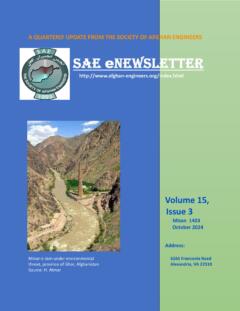
SAE Newsletter – October 2024, Volume 15, Issue 3, Mizan 1403
A QUARTERLY UPDATE FROM THE SOCIETY OF AFGHAN ENGINEERS
SAE eNEWSLETTER
http://www.afghan-engineers.org/index.html
Volume 15, Issue 3
Mizan 1403
October 2024
Minar-e-Jam under environmental threat, province of Ghor, Afghanistan
Source: H. Atmar
Content
- Content 2
- Message from the Editor-In-Chief 3
- Message from the SAE President 4
- Message from the Chairperson, SAE Board of Directors 5
- 3rd Quarter Executive Team Report 6-8
- SAE New Member’s Profiles 9-10
- “Lean Six Sigma,” by Eng. G. Feda 11-16
- “Minar-e-Jam, Part-I,” by Dr. H. Atmar 17-22
- “Establishing a Transport System on Gosh Tepa Canal and Amu Darya” by Mr. S.A. Hossainy 23-31
- Member’s Comments and Responses 32-36
- Dr. Abdul Khaliq Azad’s Obituary 37
- Membership Application Form 38
- The Society of Afghan Engineers Office Holders 39
Message from the Editor-In-Chief
I am pleased to present the quarterly update of the Society of Afghan Engineers (SAE) activities through Volume 15, Issue 4 of the SAE eNewsletter. This issue corresponds to October 2024, and Mizan 1403 in the Hijri Shamsi calendar.
The SAE eNewsletter’s Editorial Board strives to provide you with the latest information, news, and insightful articles on engineering, architecture, and urbanism, ensuring valuable technical and educational content for our readers.
I want to pass my sincere appreciation to Dr. A. Wahed Hassani and Eng. Abdul Manan Khalid for their commitment as members of the Editorial Board of the SAE e-Newsletter. I also extend my gratitude to Ustad Ghulam Mujtaba and Eng. Jalal Masumi for their ongoing support of the eNewsletter.
This issue of SAE eNewsletter features the latest events at the SAE and any other activities important to the growth of our members. Featured topics include messages from Mr. Jalal Masumi, the Society’s President, Eng. Abdul Manan Khalid, Chairman of the Board of Directors, as well as, 3rd quarter Executive Team Report and membership news. We are also excited to introduce our new members in this issue, and publish their brief bios as a token of our appreciation. We look forward to all the great things we’ll achieve together as a society.
Furthermore, we invited esteemed authors and contributors to share their valuable knowledge and experience with our readers. We hope you enjoy and appreciate their contributions. This issue features insightful articles by Eng. Ghulam Feda, Dr. Hashmatullah Atmar, and Dr. Azim Hossainy.
Eng. Ghulam Feda discusses the Lean Six Sigma theory and methodology, highlighting how businesses and organizations can improve efficiency and quality through its application. His article envisions how Lean Six Sigma could enhance Afghanistan’s industrial and business sectors.
Dr. Hashmatullah Atmar writes about the Minar-e-Jam, located in the Ghor province of northern Afghanistan. Built during the reign of Ghiyasuddin Ghori in 1202 AD, the minaret is considered one of the rare masterpieces of Islamic architecture and engineering heritage.
Dr. Azim Hossainy offers valuable insights into his proposal for the Gosh Tepa waterway transportation project in Northern Afghanistan. He predicts that the project will bring significant economic benefits and boost tourism and recreational industries in the region.
Lastly, don’t miss the “Members Comments and Responses,” section, which we hope you find inspiring and useful. The Editorial Board deeply appreciates the encouragement and valuable suggestions from our readers on the previous issue.
I hope that you find the newsletter interesting and useful. If you have any questions or comments, please do not hesitate to contact any member of the Editorial Board.
Very Truly Yours,
Bashir Kazimee, AIA
Editor-In-Chief
Message from the SAE President
Dear Society Members:
At the service of the Society, I am grateful to address you through this October 2024 Issue of SAE eNewsletter.
Now that we have transitioned into the fall season, the hot summer days are behind us. But the engulfing global climate change phenomenon seemingly continues to manifest its effects. Our ancestral land of Afghanistan which suffered severe floods in many central provinces in early August, including Kabul City, was no exception. I venture say many SAE colleague members would probably agree with me the sadness that at individual as well as collective level, we are limited in taking remedial engineering measures to lessen if not eliminate the devastating effects of global warming onto our Afghan countrymen, given the political undertones involved.
Last month the Society experienced two major activities that involved General Membership participation. One was the adoption of the Society revised bylaws (5th Revision). The other was the convening of Members General Assembly Annual Meeting, a tradition or requirement long held and observed. Short for General Assembly Meeting, the GAM was held on September 28th using zoom as the virtual platform. By clicking the hyperlink provided below, the reader can access video recording of the meeting proceeding.
https://us06web.zoom.us/rec/share/tzV7C83-RkQvkE5fFBqmd6RynFkVAqfGiNeH6T1_5UljT452MgmJq0ZaQmSc6xRs.Wh_NHGSgofXnog4p Passcode: 0GW+YemW
Another activity that involved members of the Board of Directors and a few Executives was the endeavor to perform SWOT analysis for SAE. The outcome of this activity necessarily will carry over to the future, and Members will be informed of the outcome. By clicking the hyperlink provided below, the reader can access video recording of the meeting proceeding.
https://us06web.zoom.us/rec/share/oSG2RY5KdVJGksOtf0NnmC4UjE_xOKRAIT5-96Dno1l5SSe42R9Cap8RUyrYG7Sb.so3uSjvLKwcqnUTF Passcode: .BR949Bp.
I continue to pledge devotion to work with all members to make SAE relevant and responsive to the moment. For the success of such pledge hands-on participation by all members is essential. Sadly, however, member participation has been at low levels, while one quarter of the current SAE administration term has been used up by now.
Elsewhere in this Newsletter edition you will find information about SAE activities during the quarter ending September 30, 2024, and planned activities for the quarter ending December 31, 2024.
Let’s keep an interactive approach in taking care of SAE business.
With warm and kind regards,
Jalal Masumi
SAE President
Message from the Chairperson, SAE Board of Directors
Dear readers of the SAE eNewsletter:
I hope you had enjoyed your summer. It has been an unusual summer with heat waves that sweltered most of the United States and other parts of the world including Afghanistan. There is no doubt in my mind that climate change is an undeniable reality. I hope you continue to enjoy the fall season with beautiful colors of the foliage while keeping the suffering of our people in your thoughts. I added this photo to honor the children of our country and to underscore the dire situation of their future. It is heartbreaking!
Now that the Society Bylaws has been finalized, it is time to focus on the actual mission which is to help our people and country. We have started serious discussions on plans for the future. Education remains a top priority as it is the foundation of every society. While others have been moving forward in that arena, we have taken steps to the back. A news report by BBC in September of this year on Japan’s intention to build 165 new schools in Afghanistan, states that 93% of the elementary school children in our country are not able to read in accordance with their age and level of education. These are the future of our country and this is a very sad reality. They are the future engineers, doctors, teachers and scientist, and they are left behind. With today’s technology, one can help from any part of the world without physically being there.
I know our mission is “To present a forum for Afghan engineers, architects, and scientists; to share experiences and knowledge in pursuit of fostering scientific, architectural, and engineering competency in the quest to enhance Afghan capacities in these fields, and to be of service to Afghanistan and its people.”, but it may not prevent us from starting at the bottom. We should continue to present a forum for Afghan Engineers, architects and scientists, but should pursue “service to Afghanistan and its people” even if it may be thinking and helping elementary education. They are the future of Afghanistan. We have to seriously think about the education of women also. They are half of the society and they are left behind.
Please participate in education, whether it be teaching online or helping with some notebooks and pencils.
Sincerely,
Abdul Manan Khalid, P.E., LEED (BD+C)
Chairperson, SAE Board of Directors
Children Apparently Taking an Exam
(source: Unknown)
2024 Third Quarter Executive Team Report
1. Planned vs Actual
The SAE President submitted the 2024 Proposed Plan to the Board of Directors (BOD), on behalf of the Executive Team, on January 22, 2024. It included several action items to be dealt with over the year. The following table captures the 3rd quarter plan items and the corresponding status.
| Item No | Action Item | Status – Sep 2024 |
|---|---|---|
| 1 | Carry-over Item: Continue filling vacant positions (if any) in SAE office holders. | A pre-requisite for this endeavor was Board approval of an organization frame, provided during BOD Meeting # 3 on March 7, 2024. President call for volunteers to head Engineering Committee, Architecture Committee, and Advisory Council chairs did not come to fruition. One prospective individual member approached by President asked for job description details. Job descriptions for the positions has begun but not completed. The item will continue to slide to next quarter. |
| 2 | Carry-over Item: Seek approval of bylaws developed/proposed by GOODWIN | GOODWIN Law Firm provided its final proposed revised bylaws in May 2024. BOD Meeting # 5 on May 23, 2024 resolved to adopt the final document and called for voting from Active Members. The majority of Active Members voted for its approval and adoption, and the 5th Revision of the bylaws became effective September 1, 2024. |
| 3 | Members Annual General Assembly Meeting (GAM) | In compliance with stipulations in BOD Meetings # 4 and # 5 on this subject, the GAM was convened on September 28, 2024. A total of 29 members attended the meeting using zoom as the virtual platform. All participants were members residing outside Afghanistan. The meeting was conducted and ended in an atmosphere of cordiality, comradery, respectful; constructive; and productive engagement. |
| 4 | Report on Quarter-3 activities to cover: a) What did not go right. b) Number of active members – start and end of Quarter-3 c) Bank account balance – start and end of Quarter-3 | a) i- Relating to filling vacant positions indicated in item 1 above, staffing focus was on three main units within SAE organization frame (Engineering Committee, Architecture Committee, and Advisory Council). These three units continued to effectively remain out of commission on account of no staffing. The outcome in this endeavor reflects President’s failure to reach out for assistance, and lack of interest by others within and beyond management circle to follow up or follow through.
ii- Relating to sub-units under Engineering and Architecture Committees, as a starting point, staffing logically finds shape and form when someone assumes leadership responsibility for the Committees. As good news, however, was assignment of Professor Bashir Kazimee who accepted to fill the position of SAE eNewsletter editor in chief in late June. b) Two membership rosters were developed in June. One lists members supposedly residing in Afghanistan. The count of members in this roster in June was 13 with no change since then. None of those listed in this roster responded to email requesting confirmation of their residency. The other roster lists members supposedly living outside Afghanistan. The count of members in this roster was 72 in June going up to 73 in July, with no change since then. Most of those listed in this roster chose not to respond to email requesting members to complete membership renewal form to help the administration build up the missing records. c) SAE bank account balance was $26,501 on July 1, 2024 and was $27,106 on September 31, 2024. |
2. News from Afghanistan
Online lectures/presentations provided by SAE continued in collaboration with Afghan Education for Better Tomorrow (AEBT). In consideration of summer vacation in some provinces and midterm exams, AEBT tele-education program, particularly in engineering, saw reduced activity. However, the classes in Paktia University R&D program and the Girls’ Medical College were highly active. Attendance in some of the Girls’ Medical classes ranged from 40 to 60 participants.
The AEBT program, led by Dr. Nadir Atash, is wrapping up its 30-session Research and Development course for Paktia University’s Faculty of Medical Sciences. The course focused on enhancing research and teaching skills for their professors. Pakia University Vice President for Research and Development praised the program’s impact and suggested expanding it to all universities across Afghanistan, aligning with recent advancements in the nation’s higher education system.
Lecture: (in the series of lectures) on International Statistics, presented by Dr. Nadir Atash in September 17th to students of Medical Faculty of Paktia University.
3. News from the U.S.
SAE’s quest continued during this Quarter to establish strategic planning that would involve “what” & “how” to get engaged with projects of engineering nature/caliber inside Afghanistan. The Board of Directors decided that such strategic planning required a SWOT analysis (short for Strengths, Weaknesses, Opportunities, Threats). BOD Members and Executive Members as well as a few Regular Members held the first session of SAE/SWOT on September 19th.
SAE New Member’s Profiles
We are pleased to welcome our esteemed new members to join the Society of Afghan Engineers (SAE). Your membership demonstrates a true commitment to a community that values collaboration, growth, and mutual support. Within our society, we hope you’ll find opportunities to connect with like-minded individuals, share your ideas, and contribute to our shared goals in elevating progress and reconstruction in our beloved Afghanistan.
Mrs. Khatol Sediq Bio
I was born into a family rich in knowledge, but not material wealth. My parents were our rock and backbone, champions of equal opportunities for both boys and girls – a rare believe is in some part of our country at the time. Their values shaped my path and fueled my pursuit of education.
I attended Nakebakhtee elementary school and graduated from Zarghoona high school in 1979 and continued my journey by joining university in the same year. I completed my degree in electronic electrical engineering in 1983, briefly worked in a Computer Centre before leaving Afghanistan in Oct 1984.
I moved to England in March 1985 where I continued my studies in education and began working in the education sector until 1998. During my time in England, I was honored with the Teacher of the year award, recognizing my dedication and impact in the education sector.
In 1998, I relocated to Canada and started working with the Canadian Red Cross. Over time, my career evolved into one of Ontario’s largest healthcare providers, my career grew as well. Starting at an entry-level position, I dedicated myself to my work, and through perseverance, I successfully climbed the career ladder to the Director level, where I took on significant responsibilities, including covering for the absentees. I served as regional Operations Manager for over a decade. More recently, spearheaded the creation of a new program within our organization. I laid a solid foundation for this initiative and am excited about its next level.
Beyond my professional career, I am an active member of Halton Newcomer Strategy Committee where I volunteer to support newcomers. I also serve on the board of wellness and education, providing guidance and support. Additionally, I participate in an immigration Focus Group in one of Ontario regions, collaborating to provide support from an employer perspective to various immigration and settlement services.
On a personal note, I am a proud mother of two sons, both of whom have masters and PhD, work internationally and teach at universities.
In my free time, I enjoy reading, writing, running and hiking- activities that help me stay connected to my passion and nature.
Eng. Ata Tajyar Bio
- Enrolled in the Faculty of Engineering, Kabul University, 1967.
- Graduated from Kabul University in August 1972, with B.SC. in civil engineering.
- Worked in the Construction Division of the Ministry of Education, Afghanistan 1972 -1998, with a scholarship intermission for higher education.
- Received M.A. degree (School Facility Planning Design) from Lincoln University in Nebraska, USA, in 1978. Re-settled in the U.S. since 1982 working as an entrepreneur.
Eng. Samad Danishwar Bio
- Enrolled in the Faculty of Engineering, Kabul University, 1967.
- Graduated from Kabul University in August 1972, with B.SC. in civil engineering
- Worked in the Environmental Health Division of the Ministry of Public Health, Afghanistan 1972 – 1980, with a scholarship intermission for higher education.
- Received M.S. degree in (Environmental Engineering) from the (University of Calcutta), India, in 1976.
- Re-settled in the U.S. since 1982.
- Worked as an environmental engineer/manager with the City of Los Angeles, California from 1983 to 2018.
Eng. Sayed R. Hussaini Bio
- Born to an Afghan immigrant family in Iran and grew up in an Afghan community.
- Finished high school in Iran in 2011.
- Graduated from University of Birjand (Birjand, Iran) with B.Sc. in civil engineering in 2016.
- Re-settled in the U.S. in 2016, and worked for couple of years as technician and junior engineer in private firms between 2017 and 2019.
- Was hired by Arlington County Government as Design Engineer in October/2019, and have been working with the County as an environmental engineer since October/2019.
- Obtained my P.E. license in spring 2024.
Lean Six Sigma: An Integrated Approach to Process Improvement
By: Ghulam M Feda
(Disclaimer: The views and information expressed in this article are those of the author. The SAE is not responsible for the accuracy of the data, references, or recommendations provided in this article.)
Abstract
Lean Six Sigma is a powerful methodology that combines the waste reduction principles of Lean with the quality improvement techniques of Six Sigma. This paper explores the historical context, core principles, methodologies, tools, and real-world applications of Lean Six Sigma. It provides a comprehensive understanding of how this integrated approach can drive efficiency, reduce variability, and improve overall organizational performance.
Afghan professional organizations can adapt Lean Six Sigma methodology to improve efficiency, minimize resource waste, and enhance service quality, even within the constraints of the current environment.
1- Introduction
In today’s competitive business environment, organizations continually seek ways to improve efficiency and quality. Lean Six Sigma has emerged as a robust framework to achieve these goals. Lean focuses on eliminating waste and optimizing processes, while Six Sigma aims to reduce variability and enhance quality. By integrating these methodologies, Lean Six Sigma provides a comprehensive approach to process improvement. The term Six Sigma originates from statistical quality control, a reference to the fraction of a normal curve that lies within six standard deviations of the mean, used to represent a defect rate.
2- Historical Context
Lean originated from the Toyota Production System (TPS) developed in the mid-20th century. TPS emphasized waste reduction, continuous improvement, and respect for people. Six Sigma, developed by Motorola in the 1980s, focused on reducing defects and improving quality through a data-driven approach. In the late 1990s, organizations began integrating Lean and Six Sigma, recognizing the complementary strengths of both methodologies.
3-Core Principles of Lean Six Sigma
Lean Six Sigma focuses on customer value, waste elimination, process efficiency, and continuous improvement.
3.1- Lean Principles
3.1.1. Value: Identify what customers value in products or services.
3.1.2. Value Stream: Map all steps in the value stream to identify and eliminate non-value-added activities.
3.1.3. Flow: Ensure that the value-creating steps flow smoothly without interruptions.
3.1.4. Pull: Produce only what is needed when it is needed, driven by customer demand.
3.1.5. Perfection: Continuously strive for improvement in all areas.
Figure1: Lean Principles
3.2- Six Sigma Principles
3.2.1- Define: Clearly define the problem, goals, and customer requirements.
3.2.2- Measure: Collect and analyze data to understand current performance.
3.2.3- Analyze: Identify root causes of defects and process variations.
3.2.4. Improve: Develop and implement solutions to address root causes.
3.2.5. Control: Monitor and control processes to sustain improvements.
Figure 2: Six Sigma Principles
4- Methodologies and Tools
Lean Six Sigma combines the principles of Lean (which focuses on waste reduction and efficiency) with Six Sigma (which focuses on reducing variability and improving quality). This integration creates a powerful methodology for process improvement. Below are the key methodologies and tools used in Lean Six Sigma:
4.1- Lean Tools
4.1.1- Value Stream Mapping (VSM): A visual tool to analyze and design the flow of materials and information.
4.1.2- 5S (Sort, Set in order, Shine, Standardize, Sustain): A workplace organization method to improve efficiency and safety.
4.1.3- Kaizen: A philosophy of continuous improvement involving all employees.
4.2- Six Sigma Tools
4.2.1- DMAIC (Define, Measure, Analyze, Improve, Control): A structured problem-solving methodology.
4.2.2- SIPOC (Suppliers, Inputs, Process, Outputs, Customers): A tool to map and analyze processes.
4.2.3- Control Charts: Graphical tools to monitor process stability and control.
4.2.4- Failure Mode and Effects Analysis (FMEA): A systematic method for identifying potential failures and their impact.
Figure 3: Six Sigma Tools
5-Integration of Lean and Six Sigma
Lean Six Sigma combines the best of both worlds: the speed and efficiency of Lean with the precision and accuracy of Six Sigma. The integration involves using Lean tools to streamline processes and eliminate waste, followed by Six Sigma techniques to reduce variability and improve quality. The DMAIC framework is often enriched with Lean tools to enhance process improvement efforts.
Figure 4: Integration of Lean and Six Sigma
6- Real-World Applications
Lean Six Sigma has been successfully implemented across various industries, including manufacturing, healthcare, finance, and service sectors. Examples include:
6.1- Manufacturing: Reducing cycle times and defects in production lines.
6.2- Healthcare: Improving patient flow and reducing wait times.
6.3- Finance: Streamlining loan processing and reducing errors.
6.4- Services: Enhancing customer satisfaction and operational efficiency.
7- Benefits and Challenges
Lean Six Sigma improves efficiency, quality, and customer satisfaction by streamlining processes and reducing waste. However, it can be resource-intensive and complex to implement. Despite these challenges, the long-term benefits of cost savings and continuous improvement make it a valuable approach for organizations committed to operational excellence.
7.1- Benefits
7.1.1- Improved Quality: Reduction in defects and variability.
7.1.2- Increased Efficiency: Elimination of waste and optimized processes.
7.1.3- Cost Savings: Lower operational costs through efficient resource utilization.
7.1.4- Customer Satisfaction: Enhanced product and service quality.
7.2- Challenges
7.2.1- Cultural Resistance: Difficulty in changing organizational culture.
7.2.3- Sustaining Improvements: Maintaining gains over the long term.
7.2.4- Complexity: The need for specialized knowledge and training.
7.2.5- Resource Intensive: Significant investment in training and implementation.
8- Lean Six Sigma in Manufacturing and Engineering
Six Sigma is a methodology that aims to improve processes by identifying and removing the causes of defects and minimizing variability. In manufacturing and engineering, it can be applied as follows:
8.1- Define: Set project goals and customer requirements.
8.2- Measure: Collect data on current processes.
8.3- Analyze: Identify root causes of defects or inefficiencies.
8.4- Improve: Implement solutions to address issues
8.5- Control: Maintain improvements with new standards and monitoring.
8.6- Sustain: Continuously refine processes for ongoing success
By applying Six Sigma, manufacturers and engineers can enhance product quality, reduce costs, and improve overall efficiency.
Figure 5: Implementation of Lean Six Sigma in an engineering environment, including various stages like project selection, the DMAIC framework, and the use of Lean and Six Sigma tools.
Conclusion
Lean Six Sigma represents a powerful methodology for organizations aiming to improve quality, efficiency, and overall performance. By integrating the principles of Lean and Six Sigma, organizations can achieve substantial improvements in their processes. However, successful implementation requires commitment, cultural change, and continuous effort.
References
- Womack, J. P., Jones, D. T., & Roos, D. (1990). The Machine That Changed the World. New York: Free Press.
- George, M. L., Rowlands, D., Price, M., & Maxey, J. (2005). The Lean Six Sigma Pocket Toolbook. New York: McGraw-Hill.
- Liker, J. K. (2004). The Toyota Way: 14 Management Principles from the World’s Greatest Manufacturer. New York: McGraw-Hill.
- Pande, P. S., Neuman, R. P., & Cavanagh, R. R. (2000). The Six Sigma Way: How GE, Motorola, and Other Top Companies are Honing Their Performance. New York: McGraw-Hill.
Images
- Figures 2 & 3: https://goleansixsigma.com/ GLSS (GoLeanSixSigma.com) is an online educational platform that specializes in industry-recognized training and certification for Lean Six Sigma.
- Figures 1 & 4: Author (Ghulam Feda, August 2024).
- Figure 5: The image was generated using an AI tool to illustrate the implementation of Lean Six Sigma in an engineering environment.
Eng. Ghulam M Feda’s Bio
Ghulam M Feda earned his master’s degree in electrical and computer engineering from the University of Cincinnati, along with a BSEE from Kabul University, Faculty of Engineering. With more than 35 years of engineering experience, he has primarily held leadership roles in industrial R&D projects, focusing on optimizing organizational efficiency. Notably, his significant contributions have been within Owens Illinois, a global glass technology company headquartered in Ohio. Furthermore, he has provided guidance by serving on advisory boards for various state colleges and universities. Presently, he stands as the visionary founder and president/CEO of Afghan Education for a Better Tomorrow, an organization spearheading the development and delivery of educational resources to the conflict-affected regions of Afghanistan.
Engineer Feda has been honored with a patent award in “Glass Technology” and a Congressional award for his work in implementing innovative energy efficiency projects. He also holds a certification as a Lean Six Sigma Black Belt (LSSBB).
Mr. Feda is passionate about projects that utilize technology to transform education, especially tele-education, to foster deeper learning in underserved and under-resourced communities, particularly in regions with significant needs.
Apart from his professional pursuits, Mr. Feda is an avid traveler and has authored several articles on the architectural techniques of ancient civilizations, as well as topics related to Afghan history and culture. Besides, he has been a guest on several TV shows, where he shares his scientific and historical knowledge with others.
Moreover, Engineer Feda is deeply involved with several other non-profit organizations. He holds an active membership with the Society of Afghan Engineers (SAE) and holds positions as a board member for both International Orphan Care and Immigrant Integration and Empowerment. Additionally, he is the visionary founder of the Afghanistan Relief Alliance, an organization dedicated to providing crucial relief supplies to the most vulnerable and poverty-stricken families in disaster-stricken areas of Afghanistan.
Minar-e-Jam Part-1
By: Hashmatullah Atmar, PHD
(Disclaimer: The views and information expressed in this article are those of the author. The SAE is not responsible for the accuracy of the data, references, or recommendations provided in this article.)
Introduction:
“Minar-e-Jam is located 60 km north-east of Shahrak district in Jam village. The Minar-e-Jam was built during the reign of Ghiyasuddin Ghori in 1202 AD (the period of the Ghorid dynasty 1175-1215 AD), which is the second minaret in terms of size and ancient architecture after Qutub minaret in Delhi and is considered one of the rare masterpieces of the world”.(1)
Architecture of Minar-e-Jam:
In terms of its architectural magnificence, great decorations and Kufic writings, Minar-e-Jam with 63 meters hight is second only to Delhi’s Qutub Minar. It is regarded as one of the rare masterpieces of Islamic architecture and engineering heritage. In comparison, the Minar Bukhara, which is known as Kalyan Minar, has a height of 45.6 meters and 48 meters according to some accounts.
The first person who recognized Minar-e-Jam as an important historical relic in the 20th century was Abdullah Malikyar, the governor of Herat province. According to French scientist Charles Kiefer, who came across Minar-e-Jam during his travels to Ghor and informed Ahmad Ali Kohzad, a prominent Afghan historian and archaeologist, about the discovery.
“Charles Kiefer wrote these things in the article he published in (1961 AD) called Sultan Ghiyasuddin minaret in Firouzkoh. The re-discovery of Jam Betos minaret by the Belgian scientist Andre Marik on August 17 (1951 AD) made a lot of noise in scientific circles worldwide. Even the British scholar called it the greatest success in new discoveries. Andre Marik studied the Jam minaret in detail and then published the results of his studies in 1959 AD”. (1)
Andre Marik writes about Minar-e-Jam: “At the same point where the water of Jam village joins Harirud, in the middle of dark mountains, a golden silhouette of a tall tower was raised, and in the upper part of it, belts of blue tiles caught the eye. The accuracy and correct fit of its three floors during construction made the tower bearable. The view of Burj Balad reminds me of the view of Delhi’s Qutub Minar that I had seen a few months ago.
The wall of the first floor is completely covered with decorative surfaces, around which the inscription in Kufic script is wrapped; the ornaments are arranged in such a way that they look simple; and four large belts of Kufic script break the vertical jump of the minaret and make the building look more luxurious”. (2)
The base of the tower is octagonal and has three cones placed on top of each other. The front of the first section features a portico (Duqandaq). On top of the first two sections, there was once another portico (Gandaqs) now destroyed. The third Gandaq was crowned with a lantern that did not have a cover.
We should also mention that one side of the octagonal structure measures three and a half meters. Today, you can enter the minaret through a small door which is located on the northern side. Inside, there is a staircase that spirals around the central pillar. It appears that the staircase once extended all the way down, but it is now blocked by debris and other materials. (Fig.1)
This is a characteristic feature, where no gate can be seen, as if there were a hidden path from underground or beneath the sea leading into the palace. It should be noted that Andre Marik is referring to the palace here, as he believes that Firouzkoh palace once stood in this location, with its ruins still visible on the opposite side of the river.
To reach the first decorative cantilever, one need to climb over 150 steps. For the second decorative cantilever, ascend a staircase with ten steps on one side. The third decorative cantilever is accessible via staircases connected to the corners of the Minar. While you can reach the plastered coating, there is no way to go beyond it. (2)
In the photographs, the grandeur and heavy weight of the Minari Jam are clearly evident. The structure is solidly built, and the intricate decorations that adorn its lower sections add unique beauty and feature. These features give the illusion that the minaret is smaller than it truly is—a deceptive view. This large, fully decorated tower is remarkable in that no part of it seems unnecessary, and its silhouette on the horizon is striking. (Fig. 2)
Its decorations are generally excellent and very elegant, and it is a great honor to its architect that he has created such a masterpiece in such a suitable location. The building of the minaret in its current state seems to be proportionate to its height in general, as observed by Fan Ghohan. The decorations cover the entire surface of the building and reach the highest level of richness and sophistication.
The lower part of the tower, as far as the belt of the tile inscription, is covered with carpet decorations, and it is far from excessive, it shows a neat dress and is of fundamental and special importance. The decoration is done on plaster, and it is very interesting and catchy. This base is divided into eight horizontal parts, and the roofs and circular surfaces are built in different shapes and distances. Its special order and style are unique, so its diversity is surprising.
“The combination of geometric lines are very diverse and always readable, and the meaning is well decorated and when light shines on them, it makes it very charming and interesting. Foundation of the Minar-e-Jam is placed deep and according to archaeologists’ research, it is deduced that it has been tilted 2 degrees from the vertical to one side of this minaret and has lost the angle of 90 degrees”. (1)
The uniqueness of this minaret is evident from its precise design, featuring dimensions and an original concept without borrowing from or resembling any other minaret. The minaret starts with an octagonal base and transitions to a circular form as it rises. Further up, it adopts various forms. The base measures 14 meters, and the top is capped with a cone-like structure to protect the minaret from snow and rain. (fig.3)
By paying attention to the proportions of this minaret, it is clear that the upper part and its roof exhibit a proportion of 1:8. The main building material of this minaret is made of baked clay (terra-cotta), however, nothing has been said about the material of the minaret. Looking at the facing, it can be said that lime has been used in combination with other materials. Regular geometric shapes have been used in the decoration of this minaret.
The reported height of the minaret varies according to different sources, with numbers ranging from 63.3 meters to 65 meters and its construction in 1194 AD during the reign of Sultan Ghiasuddin Ghori. However, due to natural disasters, parts of the minaret, including its foundation, have been damaged and require urgent restoration.
Writings:
A lengthy inscription adorns the eight octagonal sides at the bottom of the minaret. The written text begins immediately from the bottom half of the flat surface, in the form of a circular pattern, and the text is similar to the beginning of the faces number 8 and 5. This text is from the 19th part of the Quran. It was selected from the Surah of Hazrat Maryam and it has a total of 916 endowments. While the beginning of the text is not clearly recognizable on one verse, the other verses are all checked and highlighted in the text. The order of the verses is as follows:
On the 8th face of octagon is the thirty-second verse (ayah), on the 1st face of octagon is the forty-third verse, on the 5th face of octagon is the fifty-fourth verse, on the 6thface of octagon is the seventy-seventh verse, and on the 3rd face of octagon is the ninety-second verse. This religious inscription is the result of such order that its motivation is known and it has been established for a specific purpose.
Recording the verses of the Holy Quran on the building is not a coincidence, but it was related to the purpose of the buildings and its name, and they wanted the beauty of this world, and the goodness and honour of the hereafter. Ghiyas al-Din Muhammad bin Sam, the founder of the minaret, was interested to transcribing copies (verses) of the Holy Qur’an. He also had founded them in his coin circuit, and left them as part of 816 endowment.
Other inscriptions that are located in the middle and upper parts of the minaret are described by Andre Marik in a very concise way below:
1- The text of the first inscription starts from top to bottom with the word Tayyaba Shahadat:The witnesses of Allah, Allah, Muhammad, the Messenger of Allah.
2- The second text of this verse of the Holy Quran is: Nasrman Allah, Fath Gharib, Bishr al-Mu’minin, or Iha Al-Dhin Aminwa (following this verse of Karima 67, Surah 78) three words from the blessed verse come. O you who have converted! The same style can be seen in the inscriptions of the Fatimid period, and this method goes beyond that.
3- The strip of Kufi inscription recorded in its upper half is simple: Sultan al-Maaz Ghiyath al-Dunya, the parents of Abul Fatah Muhammad bin Sam.
4- The central inscription is made of tile, in which the titles were officially addressed are recorded, and the last six words placed above the line are: Written in fine print: (A) Al-Sultan al-Maazam, Shahnashah al-Azam, Ghiyath al-Dunya, the parents of Moazal Islam and Muslims, Abu al-Fath Muhammad bin Sam. (B) Qassim Amirul Momineen Khaldullah Queen…
5- Two lines are written above the second long text after the background text, below the beginning of the second line. The first three words are not legible and it is difficult to read, and it is the handwriting of the person who gave that decoration, and more interesting is the signature of the architect: The action of Ali Ibn… is also seen. It should be noted that in the era we are studying, both the Naskh and Kufi scripts were common, and are recorded on the monument.
6- The inscription under the building has a part that has fallen and only two words of it are legible: 811words, which is written in the beautiful artistic style of Kufi, woven and highlighted.
Figs. 4 and 5 : Writings on Minar-e-Jam
“There are four registered shapes (see Fig.4), three of which are different and tied to the right and left on each top so that it forms a heart, it is read: “Abul Fatah, whose term will be Ghiyas al-Din Muhammad after that, these words are recorded on 3rd level. These writings have been done very delicately and all the details of Ebniye’s writing, which appears to be in Farsi, have been observed in it, so it is felt that the writings in their integrated form have formed the adornment of the building”.(2)
Andre Marik’s article about Minar-e-Jam, which was published in 1959, contained useful information, based on the discovery and information of Abdullah Malkiar, the former governor of Herat, in 1958, Mr. Ahmed Ali Kohzad traveled to Jam and published an article about Jam in Kabul magazine, and in In 1958, he published the results of his research in English. In 1961, Mr. Charles Kiefer, a Frenchman, published an article on how to discover Minar-e-Jam by Abdallah Malkiar, but the rediscovery and publication of Andre Marik’s article really opened a new chapter in scientific research on the history of Ghorians and Ghors, written in general in the years after it is 1951 AD.
“In 1961, Le Berrere, the director of the French archaeological mission in Afghanistan, did a preliminary excavation at the foot of the Jam minaret for a short period of time. Unfortunately, as far as we know, the results of his research have not yet been made available to those interested. It was based on these memories that (Charles Kiefer) informed the readers about the researches of (Lee Burr). The first person who after Lee Burr in 1968 studied the Minaret of Jam from the point of view of architecture was the Italian engineer Andrea Bruno Abruno. In 1915-1917, with the help of German engineer, he was assigned to restore the Minaret from the danger of falling.” (3)
Conclusion:
It is crucial to preserve and maintain Minar-e-Jam, including the two-degree tilt it has developed. However, the minaret has faced significant threats, particularly from the recent floods in Ghor province, which surrounded the minaret. These floods have put immense pressure on its foundations, potentially threatening its stability and longevity.
Recent floods have revealed that the existing retaining walls are insufficient to protect the Minaret, highlighting the need for additional measures and action. The floods also uncovered several ancient artifacts at the base of the minaret, which have since been transferred to the museum by officials of the Islamic Emirates. To prevent further damage and ensure the preservation of this historic site, it is crucial to address the risk of flooding and rising water levels in the area as soon as possible.
Reference:
- Architecture of Afghanistan/Hashmatullah Atmar /2014-translated from Russian to Dari/Kabul- Afghanistan).
- Jam minaret an inspiration for Qutub Minar/Hashmatullah Atmar 2022/Dari /Kabul- Afghanistan.
- Jam or Kalyan (kalan)/ Hashmatullah Atmar 2022/Dari /Kabul- Afghanistan.
Dr. Hashmatullah Atmar, Bio
Hashmatullah Atmar son of Shamsulhaq Atmar, born on 24 May 1963 in Bulan village, Qarghae Distract of Laghman province, Afghanistan.
He has completed his primary and high school education at Aqa Ali Shams School and Habibia High School in Kabul. Mr. Atmar earned both his bachelor’s and master’s degrees at the Faculty of Architecture at the Azerbaijan Civil Engineering Institute (now the Azerbaijan University of Architecture and Construction), between 1982 and 1988. He continued his studies in architecture, obtaining a Ph.D. from the same university from 2005 to 2007.
Mr. Atmar began his professional career at PAMA (Central Planning Project Institute) as the head of the Education and Health Department. He also served as a part-time lecturer at the Faculty of Engineering at Kabul University for 10 years.
From 200, he started to work with Zone of Maximum Design (ZMD), a Turkish design and Construction Company as a project manager in Kabul. He continued his tenure as technical Manager with Technology Innovation Manufacturing (TIM International) at Turkish based prefab company in Kabul until 2017.
Mr. Atmar is currently working as Controller of architectural projects for Directorate of Design of Construction Affairs as well as lecturer of engineering faculty at Salam University. Alongside to his working tenure he designed more than 800 architectural details, small, middle, large, complexes and shop drawings for Afghanistan, out of country in this period.
Furthermore, he is author of 95 books, in which 40 of these books are about architecture (especially Afghan architecture), the remaining 11 are architecture and the Islamic religion. The last 44 are navels in English, Pashto and Dari languages. In additional he is author of 32 Articles in Dari, Pashto, Russian and English languages.
Establishing a Transport System on the Qosh Tepa Canal and Amu Darya
By Said Azim Hossainy
(Disclaimer: The views and information expressed in this article are those of the author. The SAE is not responsible for the accuracy of the data, references, or recommendations provided in this article.)
Abstract:
This article presents a comprehensive plan to establish a transportation system on the Qosh Tepa Canal and its connection to the Amu Darya. The plan aims to foster economic development, enhance regional cooperation, and improve trade and tourism between Afghanistan and its neighboring countries. By creating a navigable waterway, the Qosh Tepa Canal can become a vital corridor for transporting goods and passengers, thus strengthening Afghanistan’s economic ties with Uzbekistan, Tajikistan, and Turkmenistan. The article highlights international examples of successful canal projects and outlines the key components, benefits, and implementation stages of the proposed plan. Emphasis is placed on the importance of addressing existing challenges, particularly the need to modify the railway bridge over the canal, to fully realize the project’s potential.
Introduction:
The establishment of a transportation system in the Qosh Tepa Canal and its connection to the Amu Darya offers a unique and promising opportunity for economic development and regional cooperation in Central Asia. This initiative aims to develop a reliable waterway that will link Afghanistan with its neighboring countries—Uzbekistan, Tajikistan, and Turkmenistan—and create a significant corridor for trade and tourism. By enhancing connectivity, the Qosh Tepa Canal has the potential to boost economic activities and foster deeper regional integration.
Initially, the Qosh Tepa Canal project was met with surprise and controversy among Central Asian countries and partners along the Amu Darya. Despite these initial reservations, decisive actions by Afghanistan have led these countries to accept the project. However, as of now, there have been no formal negotiations regarding the development of maritime transport on the Amu Darya and the Qosh Tepa Canal.
This project holds significant transformative potential and highlights the need for further discussions and collaborations among the involved countries to fully capitalize on its benefits and effectively address any existing challenges.
Brief Description of the Qush Tepa Project:
The Qush Tepa Project involves the development of the Qush Tepa Canal, located in northern Afghanistan. This canal, originally constructed for irrigation purposes, is being repurposed to serve as a key transportation route. The project aims to connect the Qush Tepa Canal to the Amu Darya River, creating a significant waterway for regional trade and transportation.
The initiative involves several key components, including the construction of ports, dredging and rehabilitation of canal sections, and the establishment of shipping routes to neighboring countries such as Uzbekistan, Tajikistan, and Turkmenistan. The project seeks to enhance regional connectivity, reduce transportation costs, and foster economic development through improved access to international markets.
Objectives:
- Enhance the use of the Qosh Tepa Canal in the Amu Darya and neighboring countries.
- Connect the Qosh Tepa Canal to Uzbekistan, Tajikistan, and Turkmenistan through maritime transport and navigation.
- Develop water transportation in the region.
- Transport goods and trade shipments and complete customs procedures directly from Afghanistan’s provinces to neighboring northern countries via ship at low cost.
- Promote and strengthen trade and investment between Afghanistan and neighboring countries.
- Strengthen regional cooperation.
Benefits of Establishing a Transportation System in the Qosh Tepa Canal:
- Economic Development: Water transportation is cheaper and more efficient than land transportation, which can reduce trade costs and increase Afghanistan’s exports. This, in turn, can boost trade and investment between Afghanistan and neighboring countries.
- Future Opportunities:
- Create job opportunities in the transportation, logistics, maritime tourism, and services sectors.
- Access new markets for Afghanistan’s agricultural and industrial products.
- Aid in creating job opportunities and economic prosperity in the country.
- Increase trade and investment between Afghanistan and neighboring countries.
- Strengthen economic and political relations between Afghanistan and neighboring countries.
- Regional Cooperation: Connecting Afghanistan to its neighbors through the Qosh Tepa Canal can:
- Enhance regional stability and security through joint cooperation.
- Strengthen economic and political relations among these countries.
- Contribute to creating a more stable and secure region in Asia.
- Tourism: Water transportation can act as a new tourist attraction in Afghanistan and create new opportunities such as:
- Attract tourists to Afghanistan by creating new water routes and tourist attractions.
- Improve living standards in rural and remote areas.
- Enhance access to services and amenities.
- Increase government and private sector revenues through the tourism industry.
Connecting the Qosh Tepa Canal to Uzbekistan, Tajikistan, and Turkmenistan via the Amu Darya:
To maximize the benefits of establishing a transportation system in the Qosh Tepa Canal, it is necessary to connect this canal to Afghanistan’s neighboring countries, including Uzbekistan, Tajikistan, and Turkmenistan via navigation. This will help create a regional water transportation network that can facilitate trade and tourism across Central Asia.
Establishing a transportation system in the Qosh Tepa Canal and connecting it to the Amu Darya offers an exceptional opportunity for economic development and regional cooperation in Central Asia. With careful planning and appropriate investment, this plan can benefit Afghanistan and its neighbors.
Main Components of the Plan:
Connection to the Amu Darya and Neighboring Countries:
- Constructing a port on the shore of the Amu Darya for loading and unloading goods.
- Dredging and rehabilitating sections of the Amu Darya to facilitate navigation.
- Establishing shipping traffic from the Qosh Tepa Canal to the borders of Uzbekistan, Tajikistan, and Turkmenistan.
- Building bridges and border crossings to facilitate the movement of goods and people over the canal, adhering to technical conditions and using cargo ships suitable for the canal’s capacity.
- Concluding international agreements with neighboring countries to regulate the use of the Amu Darya.
- Establishing professional maritime transport and navigation schools for the Qosh Tepa Canal and the Amu Darya.
Transportation of Goods:
- Transporting various goods, including agricultural products, minerals, manufactured and consumer goods, between the provinces of Balkh, Faryab, and Jawzjan.
- Transporting various goods, including agricultural products, minerals, manufactured and consumer goods, between Afghanistan and neighboring countries.
- Reducing transportation costs and increasing the competitiveness of Afghan goods in regional and international markets.
Passenger Transport:
- Establishing shipping lines for passenger transport within the provinces of Balkh, Faryab, and Jawzjan.
- Establishing shipping lines for passenger transport between Afghanistan and neighboring countries.
- Providing professional and safety training measures for maritime operations to ensure their safety at sea.
Figure-1: Sample of cargo vessel navigating through a canal.
Role of Various Stakeholders:
Afghan Government:
- Leading and managing the project.
- Providing part of the project financing.
- Creating the necessary legal and regulatory framework for the project.
Private Sector:
- Investing in the project.
- Constructing and operating related infrastructure, such as ports and terminals, and establishing commercial and tourist shipping parks for this purpose.
International Organizations:
- Providing financial and technical assistance to the project.
- Facilitating cooperation among regional countries.
Steps to Begin Work and Implement the Plan:
- Establishing an Independent Maritime Authority:
- This authority is responsible for liaising with high-level representatives from neighboring countries, international organizations, and the private sector.
- Duties include:
- Guiding and overseeing project implementation.
- Resolving disputes among various stakeholders.
- Garnering political and financial support for the project.
- Conducting Feasibility and Technical Studies:
- These studies should include:
- Technical assessment of the canal route.
- Environmental and social impact assessment of the project.
- Project cost estimation.
- Economic and financial analysis of the project.
- Feasibility and technical studies should be conducted by an international consulting firm with experience in similar projects.
- These studies should include:
- Preparing a Comprehensive and Detailed Project Plan:
- The plan should include:
- A detailed map of the canal route to facilitate water and shipping traffic.
- Technical specifications for canal structures, such as ports on the Amu Darya, the three provinces, and bridges considering high capacities and adaptability for maritime transportation (types of cargo and passenger ships, including tourist vessels).
- Entrance and navigation systems for ships from/to the Amu Darya into the canal.
- A project implementation schedule.
- Accurate project cost estimates.
- The comprehensive and detailed project plan should be prepared by an engineering firm experienced in designing and implementing water projects.
- The plan should include:
- Securing Project Financing:
- Project financing can be secured through a combination of domestic and foreign sources, including:
- The Afghan government budget.
- Loans from international development banks, such as the Asian Development Bank and Islamic banks.
- Private sector investment.
- Attracting cooperation from regional organizations like ECO, CAREC, and Shanghai Cooperation Organization.
- To attract private sector investment, the project must be economically and financially attractive.
- Project financing can be secured through a combination of domestic and foreign sources, including:
- Obtaining Necessary Permits:
- Necessary permits from relevant authorities in Afghanistan and neighboring countries must be obtained for project implementation.
- These permits may include environmental permits, construction permits, and water use permits.
- Project Execution:
- The project should be executed according to the schedule and with the highest quality standards. Project implementation should be monitored by an independent supervisor.
Economic Benefits of Connecting the Qosh Tepa Canal to the Amu Darya and Regional Countries:
- Increase Trade and Investment:
- Connecting the Qosh Tepa Canal to the Amu Darya and regional countries will create new trade routes between Afghanistan and its neighbors, improving exports and imports of goods and services.
- By reducing transportation costs, trade between Afghanistan and its neighbors will become more attractive and competitive, potentially attracting foreign investment to Afghanistan.
- Access to new markets will create new opportunities for Afghan producers and exporters, helping to diversify Afghanistan’s economy and create new job opportunities.
- Tourism Industry Boom:
- Connecting the Qosh Tepa Canal to the Amu Darya and regional countries will create new water-based tourism routes between Afghanistan and its neighbors, increasing tourist numbers and tourism revenues.
- By creating new tourist attractions, such as waterways and ports, Afghanistan can become a more attractive tourist destination.
- The tourism industry can create new job opportunities in various sectors, such as hospitality, restaurants, transportation, and handicrafts.
- Infrastructure Development:
- Implementing the Qosh Tepa Canal connection project to the Amu Darya and regional countries requires the construction of new infrastructure, such as ports, terminals, bridges, and roads. This can boost the construction sector and create new job opportunities in this sector.
- New infrastructure can also improve public services and enhance the quality of life for people in rural and remote areas.
- Enhanced Security and Stability:
- Economic development and regional cooperation can enhance security and stability in Afghanistan and its neighboring countries.
- Increased trade and investment will provide greater incentives for peace and stability in the region.
- Regional cooperation in various fields, such as security, water, and energy, can address common challenges and create a more stable and secure region.
- Achieving Sustainable Development Goals:
- Connecting the Qosh Tepa Canal to the Amu Darya and regional countries can help achieve sustainable development goals, such as reducing poverty, hunger, and inequality.
- This project can improve access to clean drinking water, health, and education for people in rural and remote areas.
- By protecting the environment and using natural resources sustainably, we can help preserve the planet for future generations.
Proposals for Cooperation with Neighboring Countries:
Establish a joint expert group to examine various aspects of the project and develop an operational plan for its implementation.
The comprehensive and innovative shipping plan in the Amu Darya and Qosh Tepa Canal presents a unique opportunity not only at the provincial and national levels but also for economic development and regional cooperation in Central Asia. Drawing on successful international experiences, this plan can enhance trade, boost the tourism industry, develop infrastructure, improve security and stability, and achieve sustainable development goals. With careful planning, appropriate investment, and strong political commitment, this plan can benefit Afghanistan and its neighboring countries.
Reminder:
It is worth noting that the significant foundational work already done or to be done on the Qosh Tepa Canal is undoubtedly commendable and highly valued. The present plan in no way undermines the great achievements made but aims to complement and supplement them. However, to avoid future mistakes, it is crucial to acknowledge and address engineering errors, such as those involving the rail bridge (Photos 2, 3) over the Qosh Tepa Canal.
Photos 2 & 3: The newly constructed bridge is a major factor in establishing the maritime transport system in the Qosh Tepe Canal.
If the proposed project is to be implemented and one or several public or private transportation shipping parks are to be established in the Qosh Tepa Canal, it is crucial to address the railway bridge over the Qosh Tepa Canal, which is a major obstacle to creating a maritime transport system in the canal. The railway bridge should be replaced immediately with a sturdy bridge that allows ships to pass. Future bridges along the canal, of which there will undoubtedly be many, must be constructed with serious attention to avoid hindering or creating problems for the maritime transportation system. Failure to make a prudent decision now will voluntarily deprive us of the benefits of establishing and maintaining a maritime transportation system, which has extensive national and international applications in other countries. This will lead to future generations’ reproach and cause significant economic damage to the country, which will be unforgivable.
It is important to emphasize that establishing a maritime transportation system will benefit the country’s economy. Through the canal, the three provinces will be connected to Tajikistan, Uzbekistan, and Turkmenistan, facilitating easier and cheaper commercial exchanges between Afghanistan and these countries, as well as between the northern provinces. With the opportunities available and the precise management of the Qosh Tepa Canal, a new chapter in Afghanistan’s economic prosperity can be opened, paving the way for regional economic integration, which will bring significant economic benefits to the country. To support these explanations and viewpoints, I present practical examples of shipping, hoping that the responsible authorities will pay attention to them.
International Precedents:
The Brandenburg Waterways in Germany: Between Berlin and the Baltic, you can explore a network of lakes and canals that take you past castles and beautiful, interesting towns.
Photo 4: The Brandenburg Waterways in Germany (www.setara.com)
Along the way, you’ll see herons standing silently in the shadows and turquoise kingfishers darting along the water’s surface. In the summer evenings, fishermen line the riverbanks, and at sunset, they try their catches at local restaurants where carp and other fresh fish are considered special dishes.
The Volga-Don Canal:
Photos-5: The Volga-Don Canal (www.setara.com)
The Volga-Don Shipping Canal connects the Russian rivers Volga and Don, forming an essential water route that links the Sea of Azov (an extension of the Black Sea) and the Caspian Sea to major oceanic networks. Construction of the main canal began in the sixteenth century, and this route has been notable for facilitating significant traffic, enabling the connection of Western European shipping networks to their counterparts.
The Baltic Sea Canal, Russia:
Photos-6: The Baltic Sea Canal, Russia (www.setara.com)
In the White Sea, there is a crucial 225-kilometer waterway that starts in the White Sea in the north and ends in the Baltic Sea in the south, capable of regulating traffic within Russia’s waterways. Constructed in 1933, the Baltic Sea Canal, although important for navigation, is not suitable for large commercial ships.
Conclusion
Implementing the proposed project, establishing a robust transportation shipping system in the Qosh Tepa Canal, and addressing the railway bridge obstacle will yield significant economic benefits. The three provinces will connect to Tajikistan, Uzbekistan, and Turkmenistan, facilitating easier and cheaper trade exchanges. With proper management and leveraging the Qosh Tepa Canal, Afghanistan can usher in a new era of economic prosperity and regional integration, bringing about major economic advancements for the country. Practical examples of successful shipping canals highlight the importance and feasibility of such initiatives, and I hope responsible authorities will consider these insights.
International Requirements for Canal and River Navigation:
The United Nations Convention on the Law of the Non-Navigational Uses of International Watercourses (1997) provides a framework for the use of international watercourses and ensures that countries sharing these waterways cooperate to manage and protect them. It emphasizes the equitable and reasonable utilization of watercourses and the prevention of harm to other states. In addition, the International Maritime Organization (IMO) Regulations, sets global standards for the safety and environmental performance of international shipping. Regulations such as the International Convention for the Safety of Life at Sea (SOLAS) and the International Convention for the Prevention of Pollution from Ships (MARPOL) are relevant for navigation in canals and rivers, particularly concerning vessel safety and pollution control.
Permits and Implementation Plan:
For large-scale canal and river navigation projects, obtaining various permits and preparing a detailed implementation plan are typically required. These permits and plans include the Environmental Impact Assessment (EIA) for any major project, that must be conducted to evaluate the project’s effects on the environment and to propose measures to mitigate any adverse impacts. Other permits such as building permits, transport and navigation permits, security and health permits, and project implementation permits should be abstained. By adhering to these permits and implementation plans, the canal and river navigation projects can be executed effectively and in compliance with international laws and regulations.
References
- setara.com
- Panama Canal Authority. (n.d.). Panama Canal Expansion: Economic Impact and Construction Overview. Retrieved from Panama Canal Authority Report.
- Suez Canal Authority. (n.d.). Suez Canal Development Project Report. Retrieved from Suez Canal Authority Report.
- European Commission. (n.d.). Rhine-Alpine Corridor Development Report. Retrieved from European Commission Report.
- U.S. Army Corps of Engineers. (n.d.). Mississippi River Navigation Improvement Project Report. Retrieved from U.S. Army Corps of Engineers Report.
- Bangladesh Water Development Board. (n.d.). Ganges-Brahmaputra Delta Management Report. Retrieved from Bangladesh Water Development Board Report.
- Brazilian Ministry of Transportation. (n.d.). Amazon River Navigation Improvement Project Report. Retrieved from Brazilian Ministry of Transportation Report.
- United Nations Convention on the Law of the Non-Navigational Uses of International Watercourses (1997)
- International Maritime Organization (IMO)
- Regional Agreements: Rhine Navigation Convention; Danube River Protection Convention.
- Bilateral and Multilateral Treaties.
- International Association of Ports and Harbors (IAPH)
- Customs and Border Control Regulations (WCO)
Mr. Said Azim Hossainy Bio
Said Azim Hossainy, son of the late Sayed Karim, was born on August 31, 1951, in Kabul. He graduated with high distinction from Ghazi High School in 1967 and briefly attended the Faculty of Agriculture at Kabul University. In 1972, after earning a scholarship, he pursued higher education in the Soviet Union, obtaining a Master’s degree in Industrial Planning Economics from the National Economic Institute in Odessa, Ukraine.
Upon returning to Afghanistan in 1977, Hossainy worked as Development Planning Manager at the General Directorate of Provisions and Public Supplies, rapidly advancing to General Planning Manager. By 1981, he became the Commercial Director and soon after, the General Director. In 1984, he was appointed Deputy Minister of Domestic Trade at the Ministry of Trade.
In 1988, Hossainy was appointed as Afghanistan’s Commercial and Economic Representative in Moscow, later serving as First Secretary at the Embassy of Afghanistan in Moscow until 1991. After returning to Afghanistan, he eventually migrated to France in 1997 due to the country’s situation. He returned in 2006 to contribute to Afghanistan’s reconstruction, serving in advisory roles at the Ministry of Commerce and Industry, the New Kabul City Development Authority, and the Capital Region Development Authority.
Hossainy is married with four children. In addition to his professional work, he has published several books on trade and history and contributed to the Great Dictionary of Afghanistan. Notable works include The History of Trade in Afghanistan and Analysis of Afghanistan’s Foreign Trade. He continues to work on historical and analytical studies of Afghanistan’s industrial growth and investment trends.
Reader’s Comments and Responses
The Editorial Board of the SAE e-Newsletter invites comments and suggestions from our Society members and readers. Your feedback and responses may be shared with all readers in future editions of the SAE eNewsletter.
Dear Ustad Mohtaram, Bashir Kazimee, AIA
Editor-In-Chief SAE eNewsletter Asallam-o-Alaikom, I acknowledge receiving your email, regarding the third quarterly issue of the July 2024 SAE e-Newsletter. Thank you and Editorial subcommittee, Ustad Mohtaram Mujtaba Khan, Ustad Mohtaram Manan Khalid and Mohtaram Dr. Hassani’s. for kind efforts and volunteering.
Best Regards
Sharif Hossainy
Mohtaram Hossainy Sahib:
Thank you for your kind note, I am happy that you enjoyed receiving the SAE eNewsletter for the July 2024 issue.
Best Regards,
Bashir Kazimee, AIA
- Dear Mr. Bashir Kazimee !
Great issue! Thank you for publishing of my II parts of article regarding Peacock House in Murad Khani.
Best Regards
Hashmatullah Atmar
Senior architect, lecturer and writer
Dear Mr. Atmar Sahib:
Thank you for your note, I am happy that you received the SAE eNewsletter for the July 2024 issue. Congratulation on the publication of your article in it.
Kind regards,
Bashir Kazimee, AIA
ﺗﺸﮑﺮ ﻓﺮاوان از دﻋﻮت ﺷﻤﺎ ﺑﺮای ﻣﻘﺎﻟﮫ ﺑﻌﺪی در ﻣﻮرد ﻣﻨﺎر ﺟﺎم.
ﻣﻮﺿﻮع را ﺑﮫ ﻋﻼﻗﮫ ﻣﻨﺪان در ﻣﯿﺎن ﻣﯽ ﮔﺬارم، ﺧﺪا ﮐﻨﺪ ﮐﮫ آﻧﮭﺎ ﻣﻘﺎﻟﮫ ﺟﺎﻟﺐ و ﺧﻮاﻧﺪﻧﯽ را اراﯾﮫ ﻧﻤﺎﯾﻨﺪ.
ﺧﻮدم در ﻣﻮرد ﻣﻨﺎرﺟﺎم دو ﺟﻠﺪ ﮐﺘﺎب ﺗﺤﺖ ﻋﻨﻮان »ﻣﻨﺎر ﺟﺎم اﻟﮭﺎﻣﯽ ﺑﺮای ﻗﻄﺐ ﻣﻨﺎر« و »ﻣﻨﺎر ﺟﺎم ﯾﺎ ﮐﻠﯿﺎن« ﻧﻮﺷﺘﮫ و ﺗﺼﺎوﯾﺮی ﺟﺎﻟﺐ در اﺧﺘﯿﺎر دارم.
ﮔﻨﺠﺎﻧﯿﺪن ﯾﮏ ﻣﻘﺎﻟﮫ در ٠٠٠٢ ﻞﮑﺸﻣ ﯽﻤﮐ ﺮﯾﻮﺼﺗ ﮫﺳ و ﺖﻐﻟ اﺳﺖ، اﮔﺮ اﯾﻦ ﻣﻘﺎﻟﮫ در ﺣﺠﻢ ﻣﺸﺨﺺ ﺷﺪه و در دو ﻗﺴﻤﺖ ﺗﺮﺗﯿﺐ و در دو ﺷﻤﺎره ﻧﺸﺮ ﮔﺮدد ﻋﺎری از ﻣﻔﺎد ﻧﮫ ﺧﻮاھﺪ ﺑﻮد.
ﻣﻦ ھﻢ درﯾﻨﻤﻮرد ﺧﻮاھﻢ ﻧﻮﺷﺖ وﻟﯽ ﺿﺮورت ﺑﮫ ھﻤﮑﺎری اﺻﻼﺣﯽ در ﻣﺘﻦ ﻧﻮﺷﺘﮫ اﻧﮕﻠﯿﺴﯽ دارم، اﻣﯿﺪ ﻣﺜﻞ ﺳﺎﺑﻖ ھﻤﮑﺎری ﻧﻤﻮده ﻣﻤﻨﻮن ﺳﺎزﯾﺪ.
ﻧﮑﺘﮫ:
ﺷﻤﺎره ﻧﯿﻮز ﻟﯿﺘﺮ ﻣﺎه ﺟﻮﻻی ﮐﻤﯽ ﺳﺎده ﺗﺮ و ﺑﮭﺘﺮ ﺷﺪه اﺳﺖ.
ﻣﻌﻤﺎران ﻣﯿﮕﻮﯾﻨﺪ:
زﯾﺒﺎﯾﯽ در ﺳﺎده ﮔﯽ اﺳﺖ.
اﺑﺮاز ﻧﻈﺮ:
اﮔﺮ اﻧﺠﻤﻦ اﻧﺠﯿﻨﺮان اﻓﻐﺎن در ﭘﮭﻠﻮی ﻧﯿﻮز ﻟﯿﺘﺮ ﯾﮏ ﮐﺘﺎﺑﺨﺎﻧﮫ دﯾﺠﯿﺘﻠﯽ اﯾﺠﺎد ﻧﻤﺎﯾﺪ ﺑﮭﺘﺮ ﺧﻮاھﺪ ﺑﻮد ﺗﺎ اﻓﻐﺎﻧﮭﺎ ﺑﮫ ﺷﻤﻮل ﻣﻦ ﺑﺘﻮاﻧﺪ ﮐﺘﺎب ھﺎی ﺧﻮد را در آن ﺑﮫ ﺷﮑﻞ راﯾﮕﺎن ﺑﮕﺬارد، ﺗﺎ ﺟﻮاﻧﺎن، اﻓﻐﺎﻧﮭﺎ و دﯾﮕﺮ ﻋﻼﻗﮫ ﻣﻨﺪان از آن ﻣﺴﺘﻔﯿﺪ ﺷﻮﻧﺪ.
ﺑﺎ اﺣﺘﺮام
ﺣﺸﻤﺖ ﷲ اﺗﻤﺮ
Muhtaram Atmar Sahib, Salaam:
I am happy that you accepted the opportunity to write the article on Munari-Jam for our October issue of the eNewsletter. We look forward to receiving it in September or sooner.
Your suggestion for the SAE to establish a digital library is a great idea. I will bring it to the society’s leadership attention. However, copyright issues, cost, and management will likely be major concerns.
Kind regards,
Bashir Kazimee, AIA
Dear Professor Kazimee and other esteemed members of the eNewsletter Subcommittee, Asalamu Alaikum !
As a member of SAE, I want to extend my heartfelt gratitude to all of you for your dedication and valuable service in delivering the SAE eNewsletter to us each quarter. This e-Newsletter is one of the most cherished offerings of our Society, and I particularly want to thank Professor Kazimee for his role as Editor-In-Chief, continuing the excellent work of his predecessors.
I recently reviewed the July 2024 issue and found it engaging, informative, and valuable. In response to your call for contributions, I would like to share a few comments, suggestions, and questions to foster a constructive discussion.
1. I thoroughly enjoyed the interview with Engineer Saheb Fazal Ahmad Afghan. His insights and experiences were truly inspiring. While I appreciate his vision for the transformation of SAE, I am curious about the assumptions behind the idea that to transform SAE, to Afghan Engineering Consultancy (AEC), would provide job opportunities to Afghan Engineers and serve Afghanistan and the engineering profession.
My question is, as a for-profit company, what mechanisms would ensure that AEC prioritizes employing Afghan Engineers and offers continuous professional development? It seems that the company might focus on its own interests, working in areas that are more profitable and employing the most marketable professionals, which might not align with the current mission of SAE that is dedicated to serving Afghan Engineers and the people of Afghanistan.
Please understand that I am not arguing against the transformation. My intention is to encourage a friendly and professional discussion that aims to transform SAE into a sustainable, professional, and beneficial entity that continues to serve its beneficiaries effectively.
Thank you once again for your hard work and dedication. I look forward to our continued collaboration and discussion on this important topic. I have a few additional comments and suggestions for the latest issue of the eNewsletter, which I hope will be helpful for our ongoing efforts to improve its quality and relevance.
2. SAE’s 2nd Quarter Report: I noticed that the report primarily lists administrative tasks without highlighting activities that promote SAE’s mission and objectives. If the activities reported under “News from Afghanistan” were organized or supported by SAE, this should be reflected as part of our achievements for the quarter. The same applies to the “News from the US” section.
3. Confidential Information: I suggest removing specific bank account balance details, especially items c, d, and e, as they seem confidential and should be handled accordingly.
4. Article Introductions: For the technical sections, I recommend adding an introduction from the eNewsletter Subcommittee to each article. This introduction should provide context, explain the relevance of the subject, and highlight its contribution to SAE’s mission and objectives.
5. Article Disclaimers: In addition to the general disclaimer at the end of the eNewsletter, it would be beneficial to include a separate disclaimer for each article. This would clarify that the views expressed are those of the author and not endorsed by SAE, thus protecting the organization from any potential claims.
6. Employment Opportunities Page: I suggest adding an introduction to this page explaining who can advertise job vacancies, the benefits to SAE members, and how these announcements align with SAE’s mission. This introduction should clarify SAE’s relationship with the job advertisers and relieve the organization from any potential claims related to these announcements.
7. Membership News: The first page of the ‘Membership News’ section is well-done. However, I recommend removing the Membership Rosters from future issues to protect members’ personal information. This would also free up space for more valuable content.
8. SAE Organization Page: Instead of repeating the same information in every issue, this page should focus on highlighting vacant positions and encouraging members to volunteer. Any changes in the roles should be clearly highlighted and elaborated on.
9. Membership Application Renewal Form: I suggest removing this from each issue. Instead, we could provide a reference or link to our website for downloading the form, or an email address where applicants can request it. If we choose to keep it, moving it ahead of the SAE Organization Page would allow the general Disclaimer to be at the end of the eNewsletter that would be more appropriate.
10. Correction: I noticed that the link on page 1 does not work and needs to be removed or validated. http://www.afghan-engineers.org/index.html
Thank you for considering these suggestions. I look forward to our continued collaboration and discussions to enhance the quality and impact of the SAE eNewsletter.
Warm regards,
Gul A Saleh, PE, PhD, PMP, CCM
President, Gul Engineering PLLC
Good evening, Dr Sahib Saleh:
I take the opportunity to chime in, even though your email is appropriately addressed to Professor Kazimee, and even though I am functionally not a member of the Newsletter Subcommittee. I trust Professor Kazimee may also choose to remark. I copied Ustad Mujtaba because he is a member of the Editorial Board.
It is very rewarding to note that, overall, Kazimee Sahib’s acceptance to lead (as editor-in-chief) the charge of publishing and delivering SAE eNewsletter is received positively and warmly by membership. That is obviously very good. I am hopeful that into future issues, we will experience even better products in content and format.
Concerning your comments laid in numerical order, I offer as follows:
1. Engineer Afghan proposal is very loaded and deserves being evaluated thoroughly and diversely. I will greatly appreciate if we get feedback from more members as you offered. DOB discussion about is imperative as is more remark comment from members.
2. About 2nd Quarter Report. The “News from Afghanistan” and “News from the US” seemed befitting material under the caption of REPORT. And, hence, the report is part of achievements. The relative importance and significance of the contents of the two categories can certainly be subjective, and for some may not be so interesting. I agree with you, however, that we have lacked distinct plans driven by mission and objective values except for the brainstorming activity which actually is a work in progress but lacking momentum. The REPORT did touch on it and its status.
3. About Confidential Information, I agree with you that Editorial Board should take a look at it and decide what changes may be appropriate.
4. Introduction of Articles. Your recommendation seems to have merit. Tying a contributor’s writing and article to SAE mission and objectives might be easy, and might also be challenging. I yield to Editorial Board review and decision.
5. Disclaimer Issue. The litigious environment in which we live and operate certainly leads to such focus. The use of the yellow highlighted phrase “not endorsed by SAE,” needs more pondering.
6. Employment Opportunities. I am uncertain if every issue of the eNewsletter carries this advertisement. Your reference to the potential for litigation against SAE is thought provoking, and surely material for Editorial Board to evaluate and decide.
7. Membership News. Your specific recommendation to remove membership roster is covered under (3) above.
8. Organization Page. This seems a constructive suggestion.
9. Membership Application Renewal Form. This seems a constructive suggestion.
10. Correction. The hyperlink evidently is not functioning. Until we find someone who has the capability and expertise to support our website, I suggest we should remove it.
I applaud you for weighing in and offering input with the intent to improve. I am sure under the leadership of Bashir Jaan Kazimee we will achieve the desired improvements gradually.
Regards,
Jalal Masumi
SAE President
Dear Dr Saleh Sahib, and Masumi Sahib:
I want to thank you both for your notes on the July eNewsletter. I was about to write, not so much a response, but to accept many of Dr. Sahib’s valuable comments to improve our newsletter in the future. I really appreciated that Dr. Saleh took the time to review the issue, and his valuable comments and recommendations for the improvement of the eNewsletter are very welcome. As Ustad Mujtaba suggested, it would be an honor to have Dr. Saleh serve on our editorial board, and I hope he accepts the offer. Thank you, Masumi Sahib, for your thoughtful responses, which I couldn’t have answered better myself.
I hope you all enjoyed the 4th of July holiday with your families and friends.
Best to all,
Bashir Kazimee, AIA
Dear SAE member, Salaam Wa Adab to all!
I would like to take this opportunity to express my welcoming and gratitude to Professor Kazimee as Editor-in- Chief, SAE eNewsletter. It is an honor and privilege to have his valuable inputs along our publication!
As everyone stated, I also found the contents entertaining and appealing.
It was comforting to witness SAE’s support for flood victims in Afghanistan, and they are always in our prayers and thoughts.
As a woman who strongly believes in the value of education, as much as I was happy to learn that students graduated from Kabul University, it was heartbreaking to bear the absence of female graduates. I understand and share their disappointment and sadness.
Since I have deep interest in biography and history, the interview with Engineer Afghan and biography of Engineer Mommandi, was very informative and engaging.
Last but not the least, the Peacock House, was a lesson in history, architecture and interior. The details in carving wood, textile, and even dimensions was amazing.
Once again, many thanks and great appreciation for all your efforts and contribution to SAE!
Best,
Tooba Roshan
Thank you, Tooba Jaan for your kind words and positive comments on the July eNewsletter. I am happy you enjoyed reading the issue.
Hope all is well with you and your family!
Regards,
Bashir Kazimee, AIA
………also want to extend my heartfelt thanks for the release of the second quarter eNewsletter. The exceptional work featured in this publication, along with the insightful messages from the Editor-in-Chief, President of the Society, and the President of the Board of Directors, truly reflect the society’s dedication to its members and the engineering community.
I would like to acknowledge and appreciate the efforts of Engineer Sahib Said Jalal Jan Masumi, the President of the Society of Afghan Engineers, for publishing the interview conducted with me and for his kind opening message. Their commitment to promoting collaboration and knowledge sharing within the society is truly commendable.
I wish the Society of Afghan Engineering continued success in all its endeavors. May Afghan and its engineering community be blessed by God.
Warm regards,
Engineer F.A. Afghan
Muhtaram Eng. Masumi Sahib, Assalam Alyaikum, hope you and your respected family are well InShaAllah
First of all, I would like to Congratulate and thank you as the President of the Society of Afghan Engineers (SAE), secondly, esteem thanks to you, the Chairman of the Board of Directors, SAE Board of Directors, and SEA Editor-in-Chief for all the efforts of past and current SAE administration. As such, to extend appreciation for SAE eNewsletter July, all the information is very informative and useful to benefit our beloved native country Afghanistan, and abroad.
Best regards,
Nadir Sidiqi
Dr. Nadir Sidiqi Ph.D.
President/Dean of Academic
Bio Natural Healing College
Dr. Abdul Khaliq Azad’s Obituary
In Memoriam: Dr. Abdul Khaliq Azad, Distinguished Afghan Engineer and Scholar
The Society of Afghan Engineers (SAE) deeply mourns the loss of Dr. Abdul Khaliq Azad, a pioneering figure in the Afghan engineering community in the United States, who passed away on September 20, 2024. Dr. Azad’s remarkable contributions to both engineering and academia have left an enduring legacy, making him one of the most accomplished and respected members of his generation.
Born in Kandahar, Afghanistan in 1925, Dr. Azad completed his early education at Lycee Ahmad Shah Baba, graduating in 1949. He earned a prestigious academic scholarship that brought him to the United States, where he pursued his passion for engineering. Dr. Azad began his higher education at George Washington University, where he studied mechanical engineering, later advancing to graduate studies and ultimately earning a Ph.D. in Aeronautical Engineering and Physics from Catholic University in Washington, D.C.
Dr. Azad’s career in aeronautics spanned several decades, during which he gained significant renown for his work, including his notable tenure at NASA, where his efforts contributed to the advancement of aeronautical science. Alongside his engineering achievements, he also found time to share his knowledge and passion for education, teaching as a lecturer at Howard University and Catholic University.
Following his retirement, Dr. Azad became involved in the Afghan-American community in northern Virginia, dedicating his time to civic engagement and offering his expertise and wisdom in numerous capacities. The SAE e-Newsletter had recently sought to document his extraordinary career and life’s work, but, regrettably, his health declined before this endeavor could be completed.
Dr. Azad’s passing represents a profound loss not only for SAE but for the broader Afghan diaspora. Funeral and Fateha services were held on September 23, 2024, with family, friends, and members of the Afghan community from the greater Washington D.C. area gathering to pay their respects. He is survived by his beloved wife, sister, and extended family. The SAE extends its deepest condolences to his family and prays for his eternal peace.
Dr. Abdul Khaliq Azad’s legacy as an engineer, academic, and professor will continue to inspire generations to come. His contributions to science, education, and the Afghan community will be remembered with profound respect and admiration.
The Society of Afghan Engineers Office Holders
SAE E-Executive Committee Members:
* President: Jalal Masumi
* Vice President: Tooba Roshan
* Treasurer: Mahjan Saleh
* Secretary: Gul Afghan Saleh
SAE Board of Directors-Officers:
* Chairman: A. Manan Khalid
* Vice-Chairman: Ghulam Mujtaba
* Secretary: Ghulam Feda
SAE Board of Directors:
Ghulam Mujtaba, Sharif Hossainy, Manan Khalid, Yar Mohabbat, Amanullah Mommandi, Hadi Rakin, Hashim Baluch, Ghulam Feda, and Zabi Zaca
SAE Past Presidents:
Najim Azadzoi, Atiq Panjshiri, Ghulam Mujtaba, Abdul Hadi Rakin, M. Quasem Kadir, Abdul Hadi Rakin, Mohammed Hashim Rayek, Ahmad Wali Shairzay, Sohaila Sanie Shekib, and Malik Mortaza
SAE eNewsletter Editor-in Chief:
Bashir Kazimee, AIA
SAE eNewsletter Editorial Board Members:
A. Wahed Hassani, Ph.D., P.E., and A. Manan Khalid, M.S., P.E., LEED AP
SAE Representative in Afghanistan:
Ahmad Walid Howaida
Subscribe/Unsubscribe:
The subscription to the SAE e-Newsletter is free. If you are not receiving the SAE eNewsletter directly and would like to subscribe, please send a note to: bashirkazimee@gmail.com with the subject “Subscribe: SAE eNewsletter”. To unsubscribe, send a note with the subject “Unsubscribe: SAE eNewsletter”.
Disclaimer:
The author, reporter, or agency of each publication, project, news, and products is included in this newsletter. Additional contact information of the authors and their agencies are available with the Editorial Board of the newsletter and may be provided upon request. The Editorial Board of the Society of Afghan Engineers, Executive Committee, Board of Directors, or any of its members are not liable for the accuracy or contents of the information. The reports and information are included as provided by the authors and agencies without any changes in the substance of the documents. The information about the agency products or services is not the SAE endorsement.