SAE Newsletter – 2025-01 – Volume 15, Issue 4
Highlights the integration of traditional knowledge and modern science for climate-resilient water management and introduces the historical timeline presented in the new book, “Afghanistan Untold.”
SAE Newsletter – January 2025, Volume 15, Issue 4, Jadi 1403
Quarterly Update from the Society of Afghan Engineers
SAE eNewsletter
Empowering Engineers, VA – The Society of Afghan Engineers
Volume 15, Issue 4
Jadi 1403 / January 2025
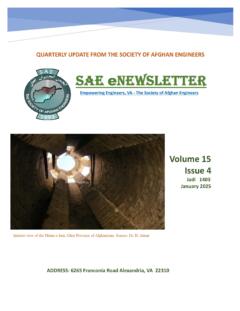
Interior view of the Minar-e-Jam, Ghor Province of Afghanistan. Source: Dr. H. Atmar
Table of Contents
- Table of Contents
- Message from the Editor-In-Chief
- President’s Greetings
- Board of Directors Chairperson’s Message
- SAE Executive Annual Report for 2024
- Members’ News and Recognitions
- New Book “Afghanistan Untold,” by Atta Arghandiwal
- Arch. Tooba Roshan’s Page
- “Leveraging Traditional Knowledge and Modern Science for Climate-Resilient Water Management in Afghanistan,” by Dr. Gul Afghan Saleh, Ph.D, P.E.
- “Urban Storm Drainage Design: Improving Kabul City’s Drainage Without Substantial Investment by Kabul City Municipality Through Retention Ponds,” by Amanullah Mommandi, M.S., P.E
- “Minar-e-Jam, Part-2,” by Dr. Hashmatullah Atmar, Ph.D.
- Readers’ Comments and Responses
- Annual Meeting (GAM 25)
- Job Opportunities
- Obituaries
- The Society of Afghan Engineers Office Holders
Message from the Editor-In-Chief
I am pleased to present the quarterly update on the activities of the Society of Afghan Engineers (SAE) through Volume 15, Issue 4 of the SAE eNewsletter. This issue marks the beginning of the New Year 2025 correspond with the month of Jadi 1403 in the Hijri Shamsi calendar. The editorial board extends its warmest wishes for a Happy New Year and hopes all our members enjoy a year filled with joy, prosperity, productivity, and good health.
I am delighted to welcome Dr. Gul Afghan Saleh and Eng. Amanullah Mommandi to our Board of Editors, as both of them graciously accepted our invitation to join the editorial board. We also extend our sincere appreciation to Dr. A. Wahid Hassani for many years of his valuable contributions as an editor of our eNewsletter. It is with regret that we note his recent decision to step down for personal reasons. We wish him the very best of health and wellness in the years ahead. Furthermore, I am pleased to confirm that Eng. Abdul Manan Khalid will continue his contributions as a member of the Editorial Board of the SAE eNewsletter. I would also like to express my gratitude to Ustad Ghulam Mujtaba and Eng. Jalal Masumi for their continued support, which has been invaluable to the success of the eNewsletter.
This issue of SAE eNewsletter features the latest events at the SAE and any other activities important to the growth of our members. Featured topics include messages from Mr. Jalal Masumi, the Society’s President, Eng. Abdul Manan Khalid, Chairman of the Board of Directors, as well as, SAE Executive Annual Report for 2024, and membership news. We are pleased to include the abstract of a new book on “Afghanistan Untold,” by renown Afghan author Mr. Atta Arghandiwal in this issue. Furthermore, we invited esteemed authors and contributors to share their valuable knowledge and experience with our readers. We hope you enjoy and appreciate their contributions.
Arch. Tooba Roshan’s page, posted an intriguing assemblage of media representations. Our readers might be curious about the message, meaning, or intent this page is trying to convey. But our author likes to leave it open for the viewers to interpret and discover the meaning and expressions for themselves.
Dr. Gul Afghan Saleh’s article on “Leveraging Traditional Knowledge and Modern Science for Climate-Resilient Water Management in Afghanistan,” cites that the integration of traditional knowledge with modern scientific approaches presents a unique strategy for enhancing water resilience in Afghanistan. While, Eng. Mommandi choses the use of retention ponds, in his article “Improving Kabul City’s Drainage,” that represent a practical, low-cost solution to Kabul’s stormwater challenges.
The second part of Minar-e-Jam by Dr. Hashmatullah Atmar Ph.D, continues discussion on the Minar-e-Jam, located in the Ghor province of northern Afghanistan that is considered one of the rare masterpieces of Islamic architecture and engineering heritage.
I hope that you find the newsletter interesting and useful. If you have any questions or comments, please do not hesitate to contact any member of the Editorial Board.
Very Truly Yours,
Bashir Kazimee, AIA
Editor-In-Chief
President’s Greetings
Dear Society Members,
First and foremost, I wish each and every one of you and your beloved and respected families a year of tranquility and peace during 2025. I extend this wish to come true for all Afghan sisters and brothers regardless of where they are currently living, and to all peace-loving members of the human race.
With 2024 just closing, it seems prudent to take a quick look at how SAE did during the year.
As positive note
- The Society embraced endorsement of the 5th Amendment of its Bylaws by the majority of its participating members through a Yes/No/Abstain voting process, respectively at 82.8 % and 11.4 % and 5.8 %.
- The Society developed a strategic plan in September, covering:
- a 12-month period first.
- a 30-month period following.
- A dedicated member (Professor Bashir Kazimee) volunteered to lead the charge of compiling and releasing the quarterly eNewsletter publication.
- Membership pool expanded through attracting 8 new members (3 in Afghanistan and 5 in USA and Canada).
- Members Annual Meeting (GAM) for 2025 will be held in-person in Virginia.
As negative note
- No success in getting membership participation to volunteer taking charge of heading committees, as vacant positions.
- No success in developing operational guidelines and associated support governance documents, commensurate with the 5th Amendment of the Bylaws.
- No success in securing receipt of membership fee payment from ALL eligible members. Delinquent accounts stand at 25 out of 73, or 34%.
- No success in launching tangible projects of engineering nature inside Afghanistan, majorly due to the political climate in the country.
It is my profound hope and wish that the bullets under negative label could be reversed during 2025, and that in a similar broadcast next year I would be able to report on more positive achievements. A report of SAE performance during 2024 is provided elsewhere in this edition of the eNewsletter.
With warm and kind regards,
Jalal Masumi
SAE President
Board of Directors Chairperson’s Message
Dear readers of the SAE eNewsletter,
Happy New Year!
I wrote this message in 2024, but by the time of your reading, it will be 2025. It is hoped that the new year brings positive changes to our beloved Afghanistan. There is plenty happening in the world stage too, and let’s hope that they will result in better turn of events. Let’s pray that education, the solid pillar of every society, will become available to all in our country.
Education and educating has become a motto here at the SAE too. In line with that, SAE recently adopted a new strategic plan with the immediate goal of providing education within Afghanistan. This effort will be conducted through, and in collaboration with, the Afghan Education for Better Tomorrow (AEBT) who has been a leader of such efforts for a while. I would like to mention that a team of architects have also been training and helping architecture students in Afghanistan. Regardless of whether such effort is provided through SAE, AEBT or personal initiatives, it is very much appreciated and is a noble cause.
As a further initiative and in order to align ourselves with the strategic plan, we have started a “Who is Who” survey of the Afghan architects and engineers in the United States with a long term goal of extending that to other parts of the world. A database will be prepared from the received surveys. We have received information from some but not most of our colleagues which prompts us to refresh our campaign as additional effort. This database will provide us an indicator of our capacities and expertise that can be solicited for participation in the education of our compatriots and any project that SAE may undertake in the future. Of course, future projects will depend on the laws of the domicile country and condition on the ground in Afghanistan.
With optimism and a hope for a brighter future, I wish you a happy, healthy and prosperous year ahead.
Sincerely,
Abdul Manan Khalid, P.E., LEED (BD+C)
Chairperson, SAE Board of Directors
SAE Executive Annual Report for 2024
The table below shows 2024 Plan Items that SAE President submitted to the Board on January 22, 2024. Across each Plan Item corresponding actual status as of December 22, 2024 is furnished providing for a performance report comparing Plan vs Actual.
| NO | Plan | Actual |
|---|---|---|
| 1 | Expand SAE membership pool. | January 2024 numbers built on unverifiable available data from March 2023 showed (20) members in Afghanistan and (54) members outside Afghanistan for a total of (74). In December 2024, the count of those members respectively registered at (23) and (59), indicating a 10.8% increase or 8 members. |
| 2 | Increase SAE membership fee. | In January 2024 the Board of Directors approved increase of annual membership fee from $100 to $120. |
| 3 | Identify members to accept heading the Architecture and the Engineering Committees. | No member from the membership pool responded to request to volunteer and chair the two committees. |
| 4 | Identify members to accept serving in the Advisory Council. | No member from the membership pool responded to volunteer and head this newly established position. |
| 5 | Identify manageable projects for SAE pursual by soliciting input from former SAE office holders and other sources. | Brainstorming exercise was held in February with follow-up in May, which identified online education as the most potential pursuit given available conditions and resources. In September, a 12-month and a 30-month strategic plan were developed and approved, to be implemented in succession. |
| 6 | Finalize bylaws being developed by Goodwin Law Firm. | Goodwin Law Firm turned in its last draft proposed bylaws in May. Board of Directors the resolved to present it to general membership. After membership pool voted in favor of the draft in August, the Board resolved to adopt it as the 5th Revision of SAE Bylaws, effective September 1, 2024. |
| 7 | Develop Operational Guidelines to supplement the bylaws and to serve as a governance document. | No progress has been achieved in this regard, indicating a clear failure but for what is inherited from years in the past. |
| 8 | Evaluate the Society’s eNewsletter publication for relevancy/content/format. | Luckily, in June, one SAE member (Mr. Bashir Kazimee) graciously accepted to serve as editor-in-chief of the Society’s eNewsletter. In August the eNewsletter guidelines were revisited but their modification was deferred to a future time. |
| 9 | Evaluate introducing additional operational/maintenance functionalities into SAE website. | No progress has been achieved in this regard, despite several attempts, due to special technological know-how needed which is lacking, however. This is another area of failure. |
| 10 | Evaluate bank services to assure efficient tracking of financial information and providing accountability. | The Executive Team assessed whether a change of the Society bank account was needed or advantageous. It was concluded that current level of service provided by Truist Bank was satisfactory/acceptable. |
| 11 | Help foster environment of cordiality and cooperation among members by maintaining communication, answering questions, and soliciting feedback. | President communicated with the general membership pool several times (about 6-7) via email, and with groups of members in specific instances. SAE President considers himself fortunate to have the cooperation of Executive Team comprised of Vice President, Treasurer, and Secretary. |
| 12 | Finalize provision of SAE resident representative service in Afghanistan. | In March a service contract was executed between SAE management and its Resident Rep in Kabul covering 2024 which allowed renewal for succeeding years when mutually agreed. |
| 13 | Prepare for and convene General Membership Annual Meeting. | General Membership Annual Meeting (GAM) was convened virtually via zoom on September 28th. Total of (30) members attended. Major outcome was the assignment for the Society to pursue delivering online education to the youths of Afghanistan. |
| 14 | Ensure that the Society operational framework meets legal obligations set by governing laws and local ordinance. | SAE annual registration in the Virginia State Corporation Commission was renewed in September. The Executive Team obtained indemnification insurance quote in November. |
| 15 | Prepare annual budget and submit for Board approval. | The Board approved a budget of $13,938. Total actual expenditures were $5,160. Total revenue (dues + donations) was $7,545. SAE Res. Rep. salary in Kabul made up 58% of expenditure. Delinquent dues from 22 members reduced revenue by $2,440. |
| 16 | Prepare quarterly and annual performance reports. | The Executive Team prepared quarterly reports for the first three quarters. This report serves as the fourth quarter coverage. |
| 17 | Invite executive and other regular members to the Board meetings. | Email invitations were sent out. Limited (3 female) members showed interest and participated. |
| 18 | Convene and hold Executive Team meetings as often as needed. | The Executive Team held 8 meetings discussing relevant business matters. |
As un-planned activity of 2024, the Board of Directors endorsed the call to hold 2025 Members Annual Meeting (GAM 25) as in-person event in conjunction with Engineers/Architects Alumni Gathering of 2025.
Afghan Education for a Better Tomorrow and Society of Afghan Engineers Educational Program
Afghan Education for a Better Tomorrow (AEBT) is a non-profit organization committed to providing quality education to underserved communities in Afghanistan, with a focus on empowering youth and promoting gender equality.
In addition to the online programs for Afghan university students, AEBT, in collaboration with the Society of Afghan Engineers (SAE), has expanded its efforts to offer specialized online classes in Engineering, and Computer Science for Afghan university girls who are currently banned from attending higher education institutions. While the broader online program supports a wide range of students across various disciplines, this targeted initiative specifically addresses the urgent need to provide Afghan women with uninterrupted access to quality education.
Through this joint effort, SAE contributes by supplying experienced professors and subject matter experts, particularly in the field of Engineering, ensuring the delivery of high-quality, industry-relevant education. These virtual classrooms provide live sessions, recorded lectures, interactive discussions, and mentorship opportunities.
- Fig 1: Basic Hydrology class by Eng. Amanullah Mommandi
- Fig 2: Basic Aspect of Geotechnical Engineering by Dr. Saboor Rahim
- Fig 3: Structural Design Building Code, by Eng. Amin Mahmood
Members’ News and Recognitions
Congratulation to Bamiyan International Student Housing Competition Team
The November-December 2024 issue of MIT Alumni News featured the Bamiyan International Student Housing Competition for Afghanistan. The article, found on page 60, also highlighted the three MIT alumni names. The competition was held in 2023, and the following were the Competition Organizer Members:
- Arch. Najim Azadzoi: President of the Society of Afghan engineers.
- Professor Bashir Kazimee (Team Leader): School of Design and Construction, Washington State University.
- Professor Rafi Samizay, School of Design and Construction, Washington State University, USA.
- Professor Mehdi Sabet, Department of Interior Design, Zayed University, Dubai, UAE.
- Professor Dr. Reinhard Goethert, MIT, School of Architecture, Cambridge, MA, USA.
- Arch. Hamayon Ibrahim, IMEG Senior Civil Designer.
- Eng. Donya Amiri, CEO & President, AIM Engineering Consultants Inc. California, USA.
- Eng. Walid Hwaida, SAE representative in Kabul, Afghanistan.
The Society of Afghan Engineers (SAE) has several MIT Alumni: the former SAE President is an MIT graduate, Najim Azadzoi (SM Architecture. ‘84) and the Chairperson of the SAE Architecture and Planning Division is Prof. Bashir Kazimee (M.Arch. Advanced Study ‘77) with Prof. Rafi Samizay (M.Arch. Advanced Study ’73) and Dr. Reinhard Goethert (M.Arch.’70) all key members of the team.
Ironically, the winners and several ‘honorable mentions’ were all-female teams, including a team of 4 female students from Kabul University. The overwhelming participation of women was significant and invites interpretation. Out of the 9 winning teams, six were all-women teams, and two were mixed. From the total of 76 student participants, 41 or 54% were women and 35 or 46% were men.
Congratulations to Dr. Gul Afghan Saleh for Receiving the Prestigious USAID Alumni Association Award for 2024
According to the October 2024 USAID Alumni Association (UAA) newsletter, Dr. Gul Afghan Saleh was awarded the USAID Alumni Award for 2024.
Dr Saleh is recognized not only for his courageous service as a Senior Engineering Foreign Service National to USAID Afghanistan, as one of its first FSNs following the dispersal of the Taliban after 9/11, but also his steadfast continued professional engineering contributions in the United States and his dedicated voluntary services since his arrival in the USA in 2014.
Dr. Saleh has over 35 years of professional experience in engineering, and has worked or studied in many countries, including Japan, Egypt, Thailand, India, Germany, Pakistan, and many more. In the Fall of 2021, when USAID asked the UAA to help the large group of Afghanistan FSN evacuees with their job searches here in America, Dr. Saleh volunteered and assisted 50 UAA alumni in providing this support.
Afghanistan Untold: A Profile and Historical Timeline
Afghanistan’s history is often characterized by conflict, foreign interventions, and terror, but there is much more to the story. “Afghanistan Untold” is a contemplative and insightful look into Afghanistan’s profile, its true beauty and cultural heritage, the lives of the Afghan people, and a glimpse at the country’s history from its independence in 1919 to the present day.
This coffee-table historical book is a pictorial guide through captivating and memorable glimpses into its geography, history, ethnic groups, and customs. This unique combination of visuals and texts provides readers with a rich and engaging experience.
Author’s Biography: Mr. Atta Arghandiwal
Atta Arghandiwal is an Afghan American author who arrived in Germany as a refugee in August of 1980, shortly after his native country’s invasion by the Soviet Union. He later immigrated to the United States, where he built a successful twenty-eight-year career in banking. Atta is the author of three other books: Lost Decency, Immigrant Success Planning, and The Self-Sufficient Global Citizen.
Arch. Tooba Roshan’s Page
[An intriguing assemblage of media representations intended for viewers to interpret for themselves.]
Leveraging Traditional Knowledge and Modern Science for Climate-Resilient Water Management in Afghanistan
By: Dr. Gul Afghan Saleh, P.E.
Introduction
Afghanistan, a landlocked country with a predominantly mountainous terrain, faces significant challenges in water management due to its arid to semi-arid climate and erratic rainfall. The integration of traditional knowledge with modern scientific approaches offers a promising strategy for enhancing climate-resilient water management.
Traditional Knowledge in Water Management
Afghanistan has a long history of traditional water management systems, most notably the Karez (or Qanat) system. This ancient method consists of a series of vertical shafts connected by gently sloping tunnels that channel water from an underground aquifer to the surface. Community-based management involving local stakeholders such as Mirabs ensures equitable distribution.
Integrating Traditional Knowledge with Modern Science
Modern scientific approaches can significantly enhance the efficiency of traditional systems. Remote sensing and GIS can map existing Karez systems and monitor their condition. Climate modeling can provide insights into how traditional systems might perform under climate change scenarios. Hybrid management strategies are essential for sustainability.
Urban Storm Drainage Design: Improving Kabul City’s Drainage Without Substantial Investment by Kabul City Municipality Through Retention Ponds
By: Amanullah Mommandi, M.S., P.E
Abstract
Kabul City faces critical challenges in managing urban flooding. This article outlines cost-effective solutions by highlighting the increase in runoff caused by urbanization and emphasizing retention ponds as a key intervention.
The Rational Method
The Rational Method calculates peak discharge (Q) using: Q = 0.278CIA.
In urban areas, impervious surfaces like rooftops and concrete roads prevent infiltration, causing nearly all rainfall to become surface runoff. In a 50-acre example for Kabul, post-development runoff was calculated to be more than four times greater than pre-development runoff.
Recommendations
The author recommends mandating the inclusion of retention ponds in all new developments. For private developments, retention ponds must be part of project budgets. This proactive approach will protect infrastructure and safeguard livelihoods.
Minar-e-Jam, Part-2
By: Dr. Hashmatullah Atmar, Ph.D.
Introduction
The Jam minaret was built during the reign of Ghiyasuddin Ghori in 1202 AD. Standing 63 meters tall, the Minaret is currently experiencing a vertical tilt of approximately 2°, believed to result from erosion caused by the nearby Harirud River.
Interior of Minaret
The interior consists of four main parts:
1. The central column base (approx. 2m diameter) with an inner staircase.
2. Circular stairs (1.5m wide) divided into three parts reaching up to 41 meters.
3. External walls with a width of 1.7 meters.
4. The final part (55.5m to 63m) which has no staircase, likely constructed using wooden scaffolding.
Repairs and Conservation
Partial repairs have been made to the octagonal surfaces of the base. Protective retaining walls have been built, but recent floods suggest their height is insufficient to fully protect the minaret. UNESCO and the Ministry of Information and Culture have been involved in strengthening the site and cleaning up the area.
Readers’ Comments and Responses
Manan Khalid: The eNewsletter, its contents, formatting and organization look splendid! Thank you for your time and hard work.
Hashmatullah Atmar: Many thanks to the leadership and the editorial board of SAE for publishing the first part of my article under the title: Minar-e-Jam.
Reinhart Goethert: Nice Newsletter, It seems the newsletter is a great way to get the SAE moving! Looks good! Interesting content!
Gul Afghan Saleh: I would like to thank you for publishing my comments and for your efforts in making the eNewsletter one of the best tools through which the Society interacts with its members.
Zarjon Baha: I would like to congratulate you and your editorial board for preparing such an outstanding publication. The three articles were exceptional. I have been thinking that the bridges on the Qush-Tepa canal could have been cable bridges.
Annual Meeting (GAM 25)
The SAE Board of Directors has endorsed the call to hold the 2025 Members Annual Meeting (GAM 25) as an in-person event in conjunction with the Engineers/Architects Alumni Gathering.
Job Opportunities
Planate Management Group is pleased to list the current job opportunities. Applications can be sent to recruitment@planate.com.
- Senior Construction Representative (Nashville, TN and Jamestown, KY)
- As-Built Drafting Technician (Palo Alto, CA)
- FF&E Drafting Technician (Palo Alto, CA)
- Electrical Engineer (Palo Alto, CA)
- Industrial Hygienist (Palo Alto, CA)
- Fire Extinguisher and Environmental Safety Technician (Palo Alto, CA)
- Construction Engineer/Auditor (Nauru)
- IT Information System Security Analyst (Orlando, FL)
Obituaries
Dr. Ghulam Ahmad Nasir
The SAE mourn the sad loss of Professor Dr. Ghulam Ahmad Nasir. Dr. Nasir was born in Kabul in 1940 and graduated from the Faculty of Engineering, Kabul University in 1961. He earned his doctoral degree from Carnegie Mellon University in 1970. He served as the first chairman of the Center for Engineering Consultancy and Applied Research (CECSAR). Dr. Nasir passed away on October 29, 2024, in Kabul.
Rafiq Azimi
The SAE mourn the loss of Engineer Rafiq Azimi who passed away on November 6, 2024. Engineer Azimi earned his B.Sc. in civil engineering from Kabul University and worked in the ministry of rural rehabilitation and development. He immigrated to the United States in 1980. We sincerely pray for his eternal comfort.
The Society of Afghan Engineers Office Holders
SAE Executive Committee Members:
* President: Jalal Masumi
* Vice President: Tooba Roshan
* Treasurer: Mahjan Saleh
* Secretary: Gul Afghan Saleh
SAE Board of Directors Officers:
* Chairman: A. Manan Khalid
* Vice-Chairman: Ghulam Mujtaba
* Secretary: Ghulam Feda
SAE Board of Directors:
Ghulam Mujtaba, Sharif Hossainy, Manan Khalid, Yar Mohabbat, Amanullah Mommandi, Hadi Rakin, Hashim Baluch, Ghulam Feda, and Zabi Zaca.
SAE eNewsletter Editor-in Chief:
Bashir Kazimee, AIA
SAE eNewsletter Editorial Board Members:
Dr Gul Afghan Saleh Ph.D., A. Manan Khalid, M.S., P.E., LEED AP, and Eng. Amanullah Mommandi, M.S., P.E.
SAE Representative in Afghanistan:
Ahmad Walid Howaida