SAE Newsletter – 2025-07 – Volume 16, Issue 2
Showcases ASTM International’s role in Afghanistan’s infrastructure, details the utility of check dams for rural water storage, and explores Lean Six Sigma in industrial energy efficiency.
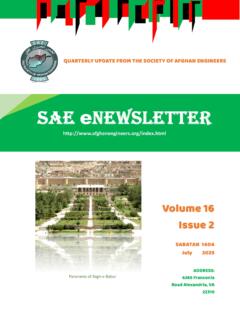
SAE Newsletter – July 2025, Volume 16, Issue 2, Saratan 1404
SAE eNewsletter
https://www.afghanengineers.org/index.html
Panorama of Bagh-e-Babur
Volume 16
Issue 2
SARATAN 1404
July 2025
QUARTERLY UPDATE FROM THE SOCIETY OF AFGHAN ENGINEERS
Table of Contents
- Message from the Editor-In-Chief
- President’s Greetings
- Message from the Chairperson of the Board of Directors
- SAE Performance Report (January – June 2025)
- News From Kabul
- Online Education Initiatives for Afghan Students
- Afghan Architecture Studio Classes for students in Afghanistan
- Interview with Eng. Gulam Feda
- Hidden Architecture and Historic Treasure, Bagh-e-Babur, by Arch. Tooba Roshan
- Building Back with Standards: How International Expertise is Shaping Afghanistan’s Quality Infrastructure, by Jim Olshefsky
- Check Dams (small water storage and streambed grade control structures) by Amanullah Mommandi
- Afghan Engineers & Architects Alumni Reunion, 2025
- Job Opportunities
- Readers’ Comments and Responses
- 2025 Membership Renewal & Fee Payment Status Charts
- The Society of Afghan Engineers Office Holders
Message from the Editor-In-Chief
I am pleased to share the second quarterly update from the Society of Afghan Engineers (SAE) through Volume 16, Issue 2 of the SAE eNewsletter, dated June 30, 2025, which corresponds to Saratan 1404 in the Hijri Shamsi calendar.
Since taking on the role of Editor-in-Chief less than a year ago, I have been committed to elevating each issue with meaningful content and thoughtful articles. Alongside organizing editorial pieces, I have also taken on the challenge of designing the newsletter’s graphics, with the intention to engage our readers through visually appealing layouts, particularly the cover design.
In this issue, you might be drawn to the colors of the Afghan flag along the top edge of the cover. Your observation is not misplaced. The choice of these three striking colors was not intended to invoke national identity or political sentiment. Rather, they were selected purely for their visual harmony. Enhanced by geometric patterns, this design seeks to captivate the eye and inspire appreciation for its artistic merit beyond symbolism.
Afghanistan, our beloved homeland, is blessed with an extraordinary palette of natural and cultural beauty. Its landscapes, traditions, and people form a vivid mosaic that resonates deeply our nostalgic sentiments, especially with those living in the diaspora. I hope this edition stirs a sense of connection and pride among our readers.
This issue features a compelling interview with Eng. Gulam Feda, a highly accomplished professional recognized for his industry awards and his leadership in promoting Lean Six Sigma theory. His tireless commitment to the Afghan Education for a Better Tomorrow (AEBT) initiative further highlights his contributions to our Afghan community.
Architect Tooba Roshan’s article, “Hidden Architecture and Historic Treasure: Bagh-e-Babur Garden,” is an engaging study that explores the Islamic Garden architecture of Afghanistan.
Mr. Jim Olshesky, Head of ASTM Global Outreach International, shares insights on “How International Expertise is Shaping Afghanistan’s Quality Infrastructure.” I am confident our readers will find his discussion both informative and inspiring.
Eng. Amanullah Mommandi’s informative article titled “Small Water Storage and Streambed Grade Control Structures,” presents a practical method for safe irrigation in rural villages. This approach helps prevent land degradation and reduces the risk of human and animal loss during floods.
Finally, I would like to express my sincere appreciation to Dr. Gul Afghan Saleh, Eng. Amanullah Mommandi, and Eng. Abdul Manan Khalid for their dedication and hard work as members of the Editorial Board. I am also deeply thankful to Eng. Jalal Masumi, the President of the society, and Ustad Ghulam Mujtaba, for their unwavering support, which has played a pivotal role in the continued success of this publication.
Bashir Kazimee, AIA
Editor-in-Chief
President’s Greetings
Dear Society Members:
I am privileged and happy to have the opportunity of addressing you through this June 2025 Issue of SAE eNewsletter.
As the year is drawing to its mid-point now, and summer days being in full swing upon us, I hope the socio-politically charged atmosphere of daily life is not intolerably stressful and difficult. As it happens, the current SAE administration is also at the mid-point of its assigned life. How well we (SAE) have done or otherwise, remains a question for time to answer.
In the interest of addressing the question, driven by charge of accountability, accuracy, and transparency, your attention is invited to a report on PLANNED ACTIVITIES and ACTUAL STATUS, provided elsewhere in this Issue of SAE eNewsletter, covering the first six month of the year (ending June 30th).
With warm and kind regards
Jalal Masumi
President
Message from the Chairperson of the Board of Directors
Education in Crisis and Hope: A Tale of Two Realities
In a time when Afghanistan must focus on rebuilding and investing in its future, the role of education—and the infrastructure that supports it—has never been more critical. With nearly half the population excluded from continuing their education, we find ourselves at a crossroads. Are we investing in the minds that will shape tomorrow, or slowly abandoning them?
To underscore the importance of educational investment, I want to share a perspective from the organization I work for in New York City. This isn’t to draw an unfair comparison, but rather to offer a glimpse of what’s possible when a society treats education as a non-negotiable right.
I work for the New York City School Construction Authority (NYCSCA). Our current five-year capital plan totals $20 billion—about $4 billion per year. Of this, $2 billion annually is allocated solely for the design and construction of new schools and the rehabilitation of existing ones. On average, we build 10 new schools each year while continuously maintaining and upgrading a stock of 1,500 school buildings.
Due to the scarcity of land in New York City, we often purchase and demolish existing structures—such as old churches or former private schools—to build new educational facilities. This is no small endeavor. With unionized labor and mandated prevailing wages, new construction costs range between $1,000 and $1,200 per square foot, or roughly $10,000 per square meter. One recently completed high school building cost nearly $300 million—a staggering figure for a single school. Even rehabilitating older schools is costly, projects often involve replacing roofs, windows, restoring façades, and repairing structural elements—all to ensure safety and functionality. Depending on a building’s size, these efforts can cost up to $75 million per school. Yet, despite economic fluctuations, funding for school infrastructure remains a constant priority—because the belief in education remains unwavering.
And that’s just construction. Educational spending itself is a separate matter. New York City spends an astounding $36,200 per student per year—on teachers, materials, support programs, and more. That level of investment clearly signals how deeply the city values every student’s right to learn and thrive.
While we may never match New York City’s level of investment, we must at the very least fight to ensure that every Afghan child receives the dignity of a desk, the empowerment of a book, and the promise of a future.
Because when we invest in children and schools, we invest in peace. When we educate children and build classrooms, we build our nation.
Sincerely,
Abdul Manan Khalid, P.E., LEED (BD+C)
Chairman, SAE Board of Directors
A quote on the wall of an old school
SAE Performance Report (January – June 2025)
By SAE President
Bound by accountability, accuracy, and transparency, this report intends to provide SAE members with a summary on overall performance of the Society during the first six months of 2025. It focuses on the 10-item annual plan for the year approved by the Board of Directors in January. Black fonts below indicate Plan items and red fonts indicate Actual status. The Annual Plan items did not follow a given order of priority, nor were they confined into quarterly segments.
Annual Plan Items and Actual Status
-
Expand SAE membership pool.
Two new female members joined SAE in the first quarter, one from Afghanistan and one from the U.S. Three (3) young students from Afghanistan joined SAE as new members during the second quarter. -
Start and complete the 12-month strategic plan that Board approved in October 2024.
SAE devised a Strategic Plan in October 2024 to provide, in partnership with Afghan Education for a Better Tomorrow (AEBT), online education and training in architecture and engineering sciences to the Afghan youths residing in Afghanistan. Using virtual modes of delivery, during the last 6 months approximately twenty (20) classes or training sessions were delivered. Male and female students took interest and attended these sessions. The number of participating students ranged from 15 to 40, depending on the topic of presentation and attendance opportunity. Presentations covered various practical and interesting topics such as Renewable Energy, Earthquakes, Avalanche Management, Artificial Intelligence, Recharging Kabul Aquifers, Pavement Design, Use of Building Codes, Hydrology, Architectural Design Studio, Fire Safety, to name a few. -
Identify members to accept serving as heads for the Advisory Council, the Architecture Committee, and the Engineering Committee, as an organizational structure that the Board had approved in early 2024.
Regrettably, there has been little success in this endeavor even though it has been a carry-over item from the previous year. This situation seemingly reflects personal failure on the part of the organization President and CEO. But the best way I thought this staffing issue could be handled, as an initial attempt, was direct approach to a few individuals who appeared qualified. This attempt did not meet success, however. As an alternate approach, I used email as a tool to reach out to SAE at-large members and colleagues a few times, requesting volunteer participation. This approach did not bear any result either. I hope through this reporting forum a lucky strike happens, and someone with a helping hand steps in. As I re-visited individual contact very recently, I am immensely pleased to report that last week Mr. Yar Mohammad Mohabbat offered his mohabbat and accepted to head the Architecture Committee. I gratefully shake the hand of cooperation he has extended, and wish him and SAE fruitful opportunities of service. -
Develop and formalize Operational Guidelines to supplement the 5th Revision of Bylaws adopted in September 2024, and to serve as a supplemental governance document.
An attempt to assign a 3-member task force to undertake this task began in April. But due to challenges of availability and differing point of view, it could not move to action. Alternatives need to be explored! -
Evaluate Society’s e-Newsletter publication for relevancy/content/format, as may be warranted.
Fruitful and constructive engagement was realized in this endeavor with the addition of two new members to the Newsletter editorial board. These two members (Mr. Amanullah Mommandi and Mr. Gul Afghan Saleh), in the meantime, are additionally serving in other SAE positions. I feel obliged and grateful to them for their cooperation.
Evaluate introducing additional operational/maintenance functionalities into SAE website. This item is a carry-over task since 2024 efforts in this pursuit did not come to fruition.
Absent reliable and working special technological knowledge, the Executive Team experienced significant challenge in moving ahead satisfactorily with this task. After extensive discussions, a decision was made in May to continue involvement of GoDaddy who currently hosts SAE website and provides associated technical service. Hopefully, desired enhancements will gradually be worked and installed within the next few months.
-
Prepare for convening members General Assembly Meeting (GAM 25).
Members 2025 general assembly meeting (GAM 25) is anticipated to be held as an in-person function from 2:30 pm to 5:30 pm on Sunday October 12th, in Virginia. Attempts will be made that members who cannot attend the in-person function, may have the option to join it online and attend virtually. Furthermore, members will be requested and encouraged to share input towards the meeting agenda. -
Ensure that the Society operational framework meets legal obligations set by governing laws and local ordinance.
SAE was founded and established in Virginia. It therefore must remain compliant with requirements stipulated by the State Corporation Commission (SCC) of the Commonwealth of Virginia. At present, SCC website identifies our Society with ACTIVE status. -
Prepare a proposed line-item annual budget for 2025.
In January the Board of Directors approved a line-item annual budget in the amount of $11,000 detailed below.
| NO | Item | Approved Budget | Actual Used |
|---|---|---|---|
| 1 | Indemnification Insurance | $1,100.00 | $945.00 to Hartford on 2/27/25 |
| 2 | Website Enhancement | $2,500.00 | $935.37 to GoDaddy on 6/3/25 |
| 3 | Website Annual Maintenance Fee | $300.00 | $275.88 to GoDaddy on 6/9/25 |
| 4 | Domain Account Annual Fee | $40.00 | $23.00 to GoDaddy on 4/8/25 |
| 5 | SAE Annual Registration Fee | $30.00 | $10.00 to SCC on 4/18/25 (reinstatement) |
| 6 | Zoom Service Subscription | $330.00 | $177.90 on 3/17/25 annual subscription, $60.00 monthly service |
| 7 | Bank Fees | $100.00 | TBD |
| 8 | Resident Representative in Kabul | $3,000.00 | $1500 (Jan to Jun 2025) |
| 9 | Annual Meeting | $2,500.00 | TBD |
| 10 | Digital Storage Hardware | $400.00 | $148.39 to Micro Center on 2/27/25 |
| 11 | Miscellaneous | $700.00 | $47.66 to Florist (GOODWIN) 3/7/25 |
| TOTAL | $11,000.00 | $4,123.20 as of 6/30/25 |
- Prepare quarterly and annual performance reports.
This report constitutes the 2nd quarter report.
The 2025 Membership Renewal and Fee Payment Status can be viewed on pages (52-55).
News From Kabul
By Eng. Walid Howaida
SAE Representative in Afghanistan
1. Based on request of Mr. Mommandi and leadership of SAE, I could manage to meet Mullah Mohammad Esa Saani minister of public work.
Based on SAE leadership direction to explore venues how it may get involved in helping share and provide technical know-how and experience to our beloved ancestral homeland Afghanistan, I managed to meet Mullah Mohammad Esa Saani the Minister of Public Works in his office on May 22, 2025. During the half-hour long meeting, I introduced SAE to him, and explained the background and capacity of SAE and what it might be able do for the Ministry of Public Works. He very warmly welcomed the idea, and thanked and appreciated SAE members’ feelings and dedications to their homeland. The Minister apparently had prepared for the meeting as he handed me a list (type written in Pashto but not dated) of notes covering instances/topics that SAE could help his Ministry. The 7-item list included:
- What are polymers and how useful are they in relation to asphalt pavements?
- What are the causes of early onset of cement as well as asphalt concrete pavement degradation, and how can they be prevented?
- What are the causes of rock slides and rockfalls along mountainous paths of Afghanistan highways, and what remedies may be possible?
- What options are available to provide low-cost repair (materials and methods) of roadway surface pavement? If possible, can technical literature be made available to the Ministry?
- Can short term online workshop training be provided to Ministry personnel regarding maintenance procedures and techniques of roadway networks? If possible, can technical literature be shared with and provided to the Ministry engineers and personnel?
- Can short term online workshop training be provided to Ministry personnel regarding construction/maintenance project management? procedures and techniques of roadway networks? If possible, can work experiences be shared with the Ministry engineers and personnel?
- Provide information on management of axle load and high tonnage vehicles control in the United States and other countries.
The last paragraph in the Minister’s notes reads “It is my hope and request that the Society (SAE) would hold long term and continuous relationship with the Ministry of Public Works relating to construction and maintenance of roads, and share with us their technical and professional know-how and experiences on a continued basis.”
The closing note in the list reads “With Appreciation”.
2. On May 25, 2025, a certificate distribution ceremony was organized by Howaida on behalf of the Afghan Architecture Studio (AAS) for six female architecture students who had been nominated for recognition.
The event took place at the office of an international NGO, led by an Afghan-British director. Several prominent and dedicated women from various women’s organizations also attended, adding significance and inspiration to the occasion.
During the ceremony, Howaida spoke about the online teaching sessions, emphasizing their importance and the positive impact they have had on young women who have been banned from pursuing higher education. He also expressed appreciation for the leadership and commitment of the Afghan Architecture Studio.
During the ceremony food and refreshment were provided by Howaida for the participants. Cash prizes and certificate expenses were all covered by AAS.
Figure-2: The 6 girls of architecture students after receiving certificates
During the month of May, Mr. Walid Howaida attended several online sessions and meetings both on architecture and civil engineering topics.
Online Education Initiatives for Afghan Students
Collaborative Efforts to Advance Engineering Education in Afghanistan
In a significant effort to improve access to technical education for Afghan engineering students, the Society of Afghan Engineers (SAE) and the Afghan Education for a Better Tomorrow (AEBT) have launched a joint initiative focused on expanding online learning opportunities, particularly for female students who face systemic educational barriers.
This collaborative initiative began with a special meeting held on February 13, 2025, where SAE and AEBT discussed the development of targeted virtual courses to help bridge the gap between Afghan engineers living abroad and students inside Afghanistan. The goal is to transfer critical knowledge, expose students to global best practices, and equip them with the skills needed to thrive in a rapidly evolving field.
To strengthen this educational effort, a joint virtual meeting was held on May 26, 2025, bringing together representatives from SAE, AEBT, and several Afghan university engineering faculties. The discussion focused on the expansion of online engineering classes and technical seminars to broaden and democratize access to quality education across Afghanistan.
During the session, participants identified key challenges facing Afghan engineering students and outlined strategies to improve course delivery and content. Emphasis was placed on incorporating emerging technologies, promoting hands-on learning, and aligning with international engineering standards to ensure Afghan students remain academically competitive and professionally capable.
In the months leading up to the meeting, SAE and AEBT had already begun offering a series of online classes in core engineering subjects. These classes were organized and managed by AEBT, and included:
- Structural Design, Building Code Definition and Earthquake-Resistant Design, taught by Engineer Amin Mahmood
- Fundamentals of Hydrology and Stream Stats, taught by Engineer Amanullah Mommandi
- Transportation and Road Construction, taught by Dr. Saboor Rahim
- Power Distribution and One Line Diagram, taught by Engineer Ghulam Feda
- Nuclear Fusion Seminar by Engineer Ghulam Feda
This educational collaboration reflects the shared commitment of SAE and AEBT to invest in the professional development of Afghanistan’s next generation of engineers. By empowering students with technical expertise, critical thinking skills, and global perspectives, the program aspires to nurture future leaders who can contribute to the sustainable development and reconstruction of Afghanistan.
Through continued cooperation, both organizations reaffirm their belief that education is a cornerstone of national progress — and that every talented student deserves the opportunity to learn, grow, and make a difference.
Figure-1: The Society of Afghan Engineers (SAE) and Afghan Education for a Better Tomorrow (AEBT) held a special meeting on February 13 to develop targeted educational programs, particularly online courses, for engineering students—especially female students who are deprived of educational opportunities.
Figure-2: The Society of Afghan Engineers (SAE), Afghan Education for a Better Tomorrow (AEBT) and representatives from some of Afghan university engineering faculties, in a joint Virtual Meeting to Enhance Engineering Education in Afghanistan.
Figure-3; Dr. Saboor Rahim’s class on Road Construction.
Figure-4: Eng. Amin Mahmood’s class on Building Structures.
Figure-5: Eng. Amanullah Mommandi’s class on Basic Hydraulics
Figure-6: Eng. Ghulam Feda’s on Power Distribution.
Figure-7: Eng, Ghulam Feda’s seminar on Nuclear Fusion.
Afghan Architecture Studio (AAS)
Update on virtual classes for architecture students in Afghanistan.
We are delighted to celebrate the accomplishments of our first cohort of students who attended both upper and lower-level studio classes during our inaugural semester, which ran for 14 weeks from October 28, 2024, to February 15, 2025. A total of six students, out of more than 40 students enrolled, completed the program, two in the upper-level studio and four in the lower-level.
These dedicated graduates were honored with beautifully designed certificates of accomplishment and cash awards. The awards were presented during a private luncheon ceremony held at a Kabul-based women’s NGO center on May 25th 2025. The event was made possible through the invaluable support of Mr. Walid Hwaida, the Society of Afghan Engineers’ (SAE) representative, whose efforts we deeply appreciate, especially under the current restrictions on female activities imposed by the government.
We extend our heartfelt congratulations to these talented students, who have bravely pursued their dreams of advancing their education in architecture, despite being unjustly banned from formal academic institutions.
All expenses related to the ceremony, including certificates, and cash awards, were generously covered by our faculty. In addition, throughout the semester faculties have supported the students with their financial needs. Students’ Internet monthly fees were paid and those in need of tablets, notebooks, pens, and sketch papers received assistance as well. We receive no funds from any sources, and we will not accept any.
Figure-1: Photographs of the graduation ceremony. Additional picture is exhibited by Walid Howaida, page-10
For safety reasons, we have been advised not to disclose the names of the graduates in this publication. The Afghan Architecture Studio (AAS) wishes all of our graduates a bright and successful future in the years ahead.
The second round of classes began on April 14, 2025, with an initial enrollment of 45 to 60 students, all young women who had previously been unable to complete their education. In this round, alongside returning students from the first cohort, we welcomed new students who expressed interest in the design program. To support their learning, the team established an advanced capstone class for graduates of the previous session, which also included newly enrolled students. Additionally, intermediate design courses were offered for previous students as well as the new commers.
The faculty includes the following members:
- Najim Azadzoi, AIA, (Coordinator)
- Bashir Kazimee, Architecture Professor and AIA
- Mehdi Sabet, Architecture Professor and AIA
- Mehrangez Danishwar, Architecture Instructor
- Tooba Rooshan, Architect
- Hamayon Ibrahim, Architect.
- Aziz Ghani, AIA
Eng. Walid Howaida, SAE representative in Kabul, is helping with the logistic and coordination in Afghanistan.
Eng. Gulam Feda of Afghan Education for Beter Tomorrow (AEBT) helping the AAS with the logistics and coordination of online issues.
Professor Rafi Samizay, Dr Mahmoud Samizay, and Reinhard Goethert as external supporters and advocates.
We extend our sincere appreciation to all of them for their support.
Figure-2: Snapshots of faculty during ZOOM teaching. From upper left to right: Arch. Tooba Roshan, Arch. Najim Azadzoi, Arch Mehrangez Danishwar. Lower left to right: Prof. Mehdi Sabet, Prof. Bashir Kazimee, and Arch Aziz Ghani.
Most of our students come from Kabul University and Polytechnic University, with a few from Herat, Mazar, and Jalalabad Universities. Classes take place every Monday and Wednesday for about 2 hours, starting at 8:00 PM Kabul time, 11:30 AM New York time, and 8:30 AM California time.
In conjunction to design studio nature, lectures will be provided on various aspects of architecture design including, programming, site analysis, space planning, and conceptual design. Each lecture is provided with PowerPoint slides, and lasts about an hour. Students are given time to ask questions and express their thoughts.
As the number of students increased and their skill levels varied, we initially divided them into three groups.
Group A: students are selected from architecture graduates or from the upper level of previous design studios. They are assigned a capstone design project focused on the research, evaluation, and analysis of existing modern buildings in Kabul. The course is structured to deepen students’ architectural understanding while enhancing their investigative, analytical, and critical thinking skills. Students will engage in a guided research project, supported by reflective discussions, fieldwork, and peer critique. The course schedule and program is led by Ms. Mehrangez Danishwar while all other faculties participate in teaching and it runs for a duration of 14 weeks.
Group B: The course Capstone was prepared by Professor Bashir Kazimee for students of upper-level 4th and 5th year students. The course was structured to design and develop a housing project in Kabul, but due to the limited time it was decided to postpone the course for next semester.
Group C: This course is designed for 3rd and 4th year students. As the number of students increased and many students from other engineering disciplines showed interest in enrolling, therefore attendance in this class is open to regular students and listeners. Students are given an assignment to design the Bagh-e-Babur Visitor Center project for the intermediate-level design studio. The project aims to create a public space that combines exceptional aesthetic value with environmentally sustainable design, serving as a model for how to build a unique and responsible place. The project is programed to serve the visitors of Bagh-e-Babur and exhibit a remarkable, eco-conscious building, seamlessly integrated into the historic garden landscape. The course is taught by Professor Mehdi Sabet and will run for a duration of 11 weeks.
All courses are taught jointly by all faculties, while one of the faculties take the responsibility of leading the class.
Figure-3: Snapshots of the faculty during ZOOM teaching. From left to right; Arch. Tooba Roshan, Arch. Najim Azadzoi, and Prof. Mehdi Sabet. Bottom left to right; Arch Hamayon Abrahim, Prof. Bashir Kazimee, and Arch. Mehrangez Danishwar.
We also had the honor to have volunteer lecturers participating in our online teaching program.
On May 14, 2025, Architect Abdul Hasib Latifi, a graduate of the department of architecture in Kabul University and then a practicing architect with many years of experience with NGOs and International communities in Afghanistan and a faculty member at Kabul University, gave a lecture on the history and restoration of the Bagh-e-Babur. He served as the project manager with the Aga Khan Trust for Culture in Kabul.
Figure-4: Images of the Bagh-e-Babur from the Arch. Abdul Hasib Latifi class presentation.
On May 19, 2025, Mr. Asadullah Hanif, a former lecturer from Herat University, who has received a PHD degree in Urban Planning from Tehran University join us and introduced himself and offered to take part in teaching urban planning and design courses. Mr. Hanif has several years of experience working with international communities in Afghanistan. Mr. Hanif introduced around 20 students from Herat University that will be interested in attending the AAS online courses.
The above faculties are committed to continuing these online courses for Afghan female architecture students interested in becoming designers until they return to formal college.
Interview with Eng. Gulam Feda
By: Professor Bashir Kazimee
On behalf of the Society of Afghan Engineers (SAE), I am delighted to conduct this interview with our highly accomplished colleague for publication in the Society’s quarterly eNewsletter. The SAE eNewsletter Editorial Board values the opportunity to feature interviews with senior members of our professional community to share their insights and experiences with the broader membership. This serves both as a source of inspiration and as a recognition of their contributions. We sincerely appreciate his time and willingness to participate in this interview.
1. Please share details about your birthplace, primary and secondary education. Include any inspirations, memories, or influences from your early family life that shaped your philosophy and career in later life.
I was born in Kabul, Afghanistan, where my early life shaped my values and aspirations. I attended Ghazi High School, excelling as a top student in math and science. Inspired by my family’s emphasis on education, hard work, and integrity, I developed a deep respect for learning and a commitment to using knowledge and innovation to improve lives.
2. Could you share your university schooling experiences and the degrees you have earned in engineering. What inspired you to choose engineering as your life’s pursuit, and who were the key figures or mentors that significantly influenced your journey in this field?
I earned a Bachelor of Science in Electrical Engineering from Kabul University and a master’s in electrical and computer engineering from the University of Cincinnati. My passion for math and science sparked a lifelong interest in how things work and the potential of technology to transform lives. During my studies at Kabul University, I established the Al-Biruni Science Center in Shar-e-Naw, Kabul, where I taught high school students science subjects for university entrance exams. My father, a science professor at a military academy, was a key inspiration, instilling in me integrity, perseverance, and commitment to service.
3. As the co-founder of the Afghan Education for Better Tomorrow (AEBT) Foundation and Tele-Education Online, you have helped hundreds of Afghan students achieve their educational dreams through these programs. Can you share the history and success of these initiatives and what inspired you to take on such a meaningful mission?
As the co-founder of Afghan Education for a Better Tomorrow (AEBT) and its Tele-Education Online program, I have been deeply committed to expanding educational opportunities for Afghan students, particularly those in remote and underserved areas. The idea for AEBT emerged from my own experiences as an Afghan student and professional, where I witnessed firsthand the barriers to education caused by conflict, limited resources, and restricted access.
AEBT was founded to bridge these gaps by offering virtual learning opportunities, connecting Afghan students with expert instructors and resources from around the world. Since its inception, our Tele-Education Online program has helped hundreds of Afghan students acquire the knowledge and skills they need to succeed academically and professionally. Our focus has been on delivering high-quality education in science, technology, engineering, and mathematics (STEM), as well as providing mentorship and career guidance.
As part of this mission, AEBT launched the Tele-Education Online program as a pilot project at Herat University. To ensure reliable connectivity and power supply, we installed a satellite dish for high-speed internet, complemented by a solar power system for backup energy, and equipped the classroom with all necessary technology and resources. This initiative demonstrated the potential of technology-driven education to overcome infrastructure challenges and deliver high-quality learning experiences to Afghan students. Today, this program has expanded to most universities in Afghanistan, broadening its reach and impact across the country.
What inspired me to take on this mission was a combination of personal experiences and a deep commitment to the development of Afghanistan. I believe that education is a powerful tool for empowerment and social progress. Through AEBT, I aim to contribute to a brighter future for Afghanistan by equipping its youth with the skills and confidence they need to thrive.
4. Can you share your experiences as a project manager at Owens Illinois (O-I) Global Glass Technology, where you have worked for 30 years in that industry? Additionally, you have been honored with the Black-Belt award by this industry, how significant is this achievement in your career?
During my 30-year tenure at Owens Illinois (O-I) Global Glass Technology, I served as a Senior Manager in Research and Development and later as Regional Engineering and Energy Manager.
In the Research Development R&D group, I led a high-performing team of 65 engineers—including master’s and PhD-level experts—focused on advancing global glass technology. Our core mission was to create innovative solutions for complex industrial challenges, particularly in automation, robotics, and process control. By integrating advanced control systems and developing cutting-edge automation technologies, we significantly enhanced precision, efficiency, and product quality across multiple production sites. These innovations not only optimized operations but also reinforced O-I’s leadership in the global glass manufacturing industry.
A major milestone of my tenure was receiving a patent in automation technology for glass production, a testament to the breakthroughs we achieved. This accomplishment reflects my deep commitment to leveraging technology for operational excellence and sustainable growth. These experiences highlight the transformative role of technology and robust process control in shaping the future of glass manufacturing and elevating global competitiveness.
Later, as Regional Engineering and Energy Manager and a Lean Six Sigma Black Belt, I focused on optimizing processes and driving efficiency across multiple O-I facilities. I applied Lean Six Sigma methodologies to implement advanced energy management systems, process controls, and continuous improvement strategies. These initiatives led to significant cost reductions, improved resource utilization, and supported O-I’s sustainability and operational excellence goals.
5. What is the Lean Six Sigma theory in relation to optimizing and reducing energy consumption? How have you effectively applied this method to make data-driven decisions in partnership with agencies to receive energy reduction incentive programs? We understand that you have received the prestigious California Congressional Award for your work in this regard—could you share more details about this achievement?
Lean Six Sigma focuses on minimizing waste, reducing variation, and improving processes through data-driven decision-making. Applied to energy consumption, it offers a structured approach to identify inefficiencies, analyze usage patterns, and implement targeted improvements. By integrating Lean principles with Six Sigma tools, organizations can systematically reduce energy waste, including equipment downtime, excessive consumption, and inefficient practices.
At Owens Illinois (O-I) Global Technology, I championed Lean Six Sigma to uncover hidden energy inefficiencies in complex industrial operations. Collaborating with external agencies like PG&E (Pacific Gas and Electric), we used advanced analytics to design and implement impactful, sustainable energy-saving strategies. These efforts not only reduced O-I’s energy footprint but also delivered long-term cost savings and environmental benefits.
A standout achievement was a large-scale project to optimize furnace efficiency and energy recovery systems. This initiative earned a $1.3 million rebate from PG&E, highlighting both its financial and environmental impact. The project was featured in interviews with Alameda County and O-I North America newspapers and celebrated during a formal ceremony at the Sheraton in Livermore, California.
Fig.1- Dr. Qayumi, president of East Bay University as a Keynote Speaker
Fig.2- Director of PG&E presenting a giant dummy check
Fig. 3 – PG&E Vice President presenting the actual $1.3 million check
Fig.4- Director of PG&E presenting certification of recognition from congresswoman Barbara Lee
I had the honor of inviting Mr. Qayoumi, president of East Bay University and a fellow Afghan, as keynote speaker. The rebate check was later presented to me at a special luncheon in an Afghan restaurant attended by three company vice presidents. This project also received Congressional and Assembly Awards, recognizing the innovation, collaboration, and excellence of our team. These accolades, along with the California Congressional Award we received, underscore the transformative impact of Lean Six Sigma in advancing energy efficiency, sustainability, and operational excellence in industrial settings.
6. Have you engaged in any professional activities or roles following your retirement from Owens-Illinois (O-I)? If so, could you share details about your involvement, contributions, and the impact of these post-retirement endeavors?
After retiring from Owens-Illinois (O-I), I was invited by Gallo Glass Company, which offered me a bonus to join their team. I accepted and assumed a senior management role in the Engineering Department, where my primary focus was on reducing energy and water usage. Leveraging my Lean Six Sigma expertise, I led projects that delivered significant cost savings and environmental benefits.
In addition, I established a dedicated R&D section through a joint venture with the University of San Jose, California, focusing on energy and process optimization. This collaboration facilitated innovative solutions that further enhanced efficiency and sustainability.
My contributions were recognized not only through substantial financial gains for the company but also with a feature article in Gallo Glass’s internal newspaper upon my departure. This recognition highlighted both the tangible results of my work and my commitment to advancing sustainability and operational excellence.
Fig.5-Recognition of Gallo Glass’s internal newspaper upon my departure.
7. Does the Afghan Education for Better Tomorrow (AEBT) have a cooperation plan with the Society of Afghan Engineers for online education? If so, how does this partnership impact online education for Afghan students?
Yes, the Afghan Education for a Better Tomorrow (AEBT) and the Society of Afghan Engineers (SAE) have established a formal partnership to enhance online education for Afghan students. In 2021, we signed a joint venture agreement aimed at promoting online education in Afghanistan. This collaboration combines AEBT’s experience in delivering tele-education programs with SAE’s network of engineering professionals. Together, we work to provide Afghan students with access to high-quality online classes and seminars, particularly in engineering and technical fields. By leveraging their collective resources and expertise, AEBT and SAE aim to bridge educational gaps and empower students across Afghanistan through accessible online learning opportunities.
8. As a member of SAE, what is the most valuable lesson, and one key piece of advice you would like to pass on?
As a member of the Society of Afghan Engineers (SAE), the most valuable lesson I have learned is the importance of collaboration and continuous learning. Being part of a community of dedicated professionals has shown me that sharing knowledge and supporting one another is essential for personal growth and for advancing our collective impact on Afghanistan’s development. My key piece of advice to fellow engineers and students is to embrace lifelong learning with humility and perseverance. Technology and industry are constantly evolving, so staying curious, adaptable, and committed to improving your skills will open doors to new opportunities and enable you to contribute meaningfully to your community and country.
9. Please share any final thoughts or memorable experiences you’d like to share in this newsletter with our readers of the SAE eNewsletter.
During the COVID-19 pandemic, I felt a deep responsibility to help vulnerable communities in Afghanistan. I reached out to several humanitarian organizations, and the response was overwhelming—more than 18 organizations joined me in a collaborative fundraising initiative. Together, we provided food packages to over 2,000 families, enabling them to stay home and reduce the risk of infection.
This powerful collaboration eventually evolved into the Afghanistan Relief Alliance (ARA) (www.afghanra.org), a formal humanitarian organization dedicated to providing essential supplies to families in need. Over the next two years, ARA successfully reached more than 7,000 families across every province of Afghanistan, offering critical support during one of the most challenging times in recent history. This experience was a memorable and deeply fulfilling journey of humanitarian service, one that underscored the power of collaboration, compassion, and community.
Figs. 6 & 7 – Food distribution for needy families in one of Afghanistan’s provinces
https://youtu.be/yy_BZAoqjEg?si=hwV7KxeD_C6VfwB-
Hidden Architectural and Historic Treasure Bagh-e-Babur Garden
ﮔﻨﺠﯿﻨﮫ ﭘﻨﮭﺎن ﻣﻌﻤﺎری و ﺗﺎرﯾﺨﯽ ﺑﺎغ ﺑﺎﺑﺮ
By Arch. Tooba Roshan
Introduction
Nestled in the heart of Kabul, Afghanistan, on the slopes of Kuh-e Sher Darwaza, Bagh-e-Babur (Babur’s Garden), stands as one of the most significant cultural and historical landmarks in Central Asia. Created in the early 16th century by the founder of the Mughal Empire, Zahir-ud-din Muhammad Babur, the garden reflects the confluence of Persian garden traditions and Timurid aesthetics, encapsulating both personal sentiment and imperial grandeur. The garden is 11.5 hectare large and arranged in 15 terraces along a central axis in the east west direction. From the top terrace, visitors have a magnificent vista over the garden and its perimeter wall, across the Kabul River toward the snow-covered mountain. Beyond its aesthetic appeal, Bagh-e-Babur serves as a historical document, revealing the aspirations, identity, and cultural priorities of a nascent Mughal dynasty.
Historical Significance of Bagh-e-Babur
Founding and Personal Connection
Zahir-ud-din Babur, a descendant of King Timur on his father’s side and Genghis Khan on his mother’s, founded and established the Mughal Empire after his victorious Battle of Panipat in 1526. Yet despite his political success in the Indian territories, Babur harbored a deep nostalgia for his homeland in Central Asia. In his memoirs, the Baburnama, he expressed about his longing for the cool climate, mountainous terrains, and the orderly Persian-style gardens of his youth. The Indian plains were unaccustomed and culturally unsuitable for him.
“In this context, Bagh-e Babur was conceived not just as a physical retreat, but as a spiritual and emotional haven—a recreation of the paradisiacal gardens described in Islamic and Persian texts.” 1 He handpicked the location of Sher-Darwaza Mountain for its sweeping and panoramic views of Kabul and for its natural water streams, which are vital for garden design rooted in chahar-bagh (four-part garden) structure and the axis points toward Mecca. When Babur died in 1530, he was initially buried in Agra, India, but between 1539 and 1544 Sher Shah Suri, fulfilled his wishes and interred him at Babur’s Garden further cementing the garden’s personal and dynastic significance. The headstone placed on his grave read “If there is a paradise on earth, it is this, it is this, it is this.” 2
Persian and Timurid Aesthetic Legacy
Bagh-e-Babur, a classic example of Mughal Garden—the garden design reflects the influence of Persian and Timurid garden traditions. The garden is laid out as a series of 15 stepped terraces, and it represents the lifestyle synthesis that defined the Mughal Empire. Drawing upon Timurid architectural sensibilities and Persian landscaping principles, the garden featured symmetric design, terraced layouts, axial water channels, shaded walkways, and abundant flora. These elements symbolized not only paradise as described in the Qur’an, but also the power and refinement of imperial rule.
This template of garden design—fusing nature with order and beauty—would be replicated throughout the Mughal Empire, notably in the Shalimar Bagh in Kashmir and the famed gardens of the Taj Mahal in Agra. As such, Bagh-e-Babur can be seen as the prototype for Mughal Garden architecture, influencing generations of design and urban planning in South and Central Asia.
Periods of Decline and Restoration
Over the centuries, Bagh-e-Babur suffered from abandoned, political instability, and environmental deterioration. The garden has changed drastically from the Mughal impression of the space to the present. Despite the reigns of later Mughal emperors and the shifting centers of competency, Kabul’s significance dwindles, the garden retained symbolic value; various rulers, including British colonial officials and Afghan monarchs, undertook minor restorations.
In 1993, the space was converted into a public recreation space with pools and fountains. In the late 1970s, a modern greenhouse and a pool were added to this vicinity.
The garden faced its most severe destruction during the late 20th century, particularly during the Soviet occupation, and the subsequent Afghan Civil War (1992-1996). Zahra Breshna, an architect with the department preservation and rehabilitation in Afghanistan, argues that “emphasis should be on developing and strengthening the partially forgotten local and traditional aspects, whilst placing them in a contemporary global context. The goal is to preserve tradition without hindering the development of a modern social, ecological and economic institution”. 3 These ideas seem to fall in line with the plan of Aga Khan. In the early 2000s, the Aga Khan Trust for Culture, in collaboration with local Afghan authorities and international donors, launched an extensive restoration project. The plan put by Aga Khan included restoration of Babu’s tomb, the rehabilitation of Shah Jahan Mosque, and reconstruction of the perimeter walls. This initiative not only revived the garden’s original layout and structures but also reinvigorated it as a public cultural space, fostering a sense of continuity and heritage for a war-torn nation.
Modern Cultural Significance
Today, Bagh-e-Babur stands not only as a relic of Mughal imperial history, but also as a symbol of Afghanistan’s rich and multifaceted cultural identity. Its restoration has transformed it into a vibrant public space for art, education, and recreation. The site serves as a reminder of the country’s potential for cultural renewal and the resilience of its historical memory.
Moreover, the garden’s survival and rehabilitation underscore the importance of cultural preservation amidst conflict. In the global context where heritage sites are often at risk due to war or neglect, Bagh-e-Babur is a powerful example of how historical sites can be both preserved and re-integrated into contemporary civic life.
Architectural Significance of Bagh-e-Babur
Origins and Design Principles
Bagh-e Babur was established in the early 16th century, shortly after Babur’s conquest of Kabul in 1504. Influenced by his Timurid heritage and the Persian tradition of chahar bagh (four-part garden), Babur envisioned a space that embodied the Islamic concept of paradise (jannat). These gardens were typically arranged with quadrilateral symmetry, water channels representing the rivers of paradise, and shaded pavilions for reflection and repose.
The only hint of the design lies in an 1832 sketches and short description by Charles Masson, a British solider, which was published in 1842.
What makes Bagh-e-Babur particularly notable is its adaptation of these ideals to the natural topography of Kabul. Unlike later Mughal gardens built on flatter terrain, Bagh-e-Babur is constructed on a sloping hillside, using a series of terraces to integrate with the mountainous landscape.
Key Architectural Structures of Bagh-e-Babur: A Legacy of Mughal Design
Bagh-e Babur, or the Garden of Babur, is one of the most iconic historical gardens in Afghanistan and a foundational precedent pattern of early Mughal architecture. Built by the first Mughal emperor, Zahir-ud-din Muhammad Babur, in the beginning of 16th century, the garden is more than a peaceful sanctuary—it is a sophisticated model of landscape and architectural design that reflects the cultural and spiritual values of its time. At the heart of Bagh-e-Babur are several key architectural structures, each with deep symbolic and functional significance.
1. The Terraced Garden Layout
The garden is designed on a sloping hillside south of Kabul, using a series of 15 interconnected terraces that descend gradually from the mountain base. These terraces are not just practical, they create a sense of movement, rhythm, and hierarchy. Water flows down from one terrace to the next through a carefully constructed series of channels and pools, offering both visual delight and symbolic meaning.
2. Water Channels and Pools
Water is a defining feature of Bagh-e-Babur. A central water channel runs down the central axis of the garden, linking the terraces and feeding into small reflecting pools and fountains. This network not only cools and irrigates the garden but also reinforces the spiritual and visual experience. In Islamic Garden design, flowing water represents life, purity, and divine presence. The use of gravity-fed irrigation and precisely engineered stone channels demonstrates a high level of environmental awareness and technical skill by the architects and planners of the time.
3. Babur’s Tomb
One of the most significant architectural features of the garden is the tomb of Babur himself. Positioned on a high terrace overlooking the garden and the city beyond, the tomb is a simple marble cenotaph placed under open sky, surrounded by pine and cypress trees. Unlike the grand mausoleums of later Mughal rulers, such as Humayun or Shah Jahan, Babur’s tomb is intentionally modest reflecting his personal humility and his wish to rest in a natural, serene setting. The open-air design also aligns with Central Asian traditions of burial and reverence for natural landscapes.
4. Mosque and Prayer Pavilion
In the 19th century, during the reign of Amir Abdur Rahman Khan, a small mosque was added to the garden. Built using traditional Afghan architectural elements such as carved wood and local stone, the mosque provides a space for worship within the garden. It reinforces the sacred character of the site and supports its function as a place of reflection and spiritual retreat. A prayer platform or open pavilion is also located near Babur’s tomb. This space serves as a focal point for visitors to pause, reflect, and appreciate the spiritual and architectural harmony of the garden.
5. Perimeter Walls and Gateways
Bagh-e Babur is enclosed by a stone boundary wall that helps define its sacred and protected status. In its restored form, the wall also serves to shield the tranquil space from the noise and chaos of the surrounding city. Historic gateways provide controlled access, reinforcing the sense of entering a special, elevated place—both literally and spiritually. These entrances often feature traditional decorative elements such as pointed arches and geometric motifs, consistent with Mughal-era design.
6. Prototype for Mughal Garden Architecture
Bagh-e-Babur represents the first major expression of what would become a hallmark of Mughal imperial architecture: the garden as a space of political authority, spiritual reflection, and personal pleasure. Later Mughal gardens in Lahore, Delhi, Agra, and Kashmir would expand upon its template, incorporating larger scale, more intricate ornamentation, and monumental tombs or palaces. In this way, the garden serves as both architectural prototype and ideological blueprint. It encapsulates the Mughal ethos of harmonizing nature with geometry, and earthly rule with divine inspiration.
Figure-1: Top left: views of the garden panorama – Bottom left: the pavilion Poarch, and the carpet museum (courtesy of Professor Bashir Kazimee)
Restoration and Contemporary Architecture
The gardens were heavily damaged during the Afghan Civil War (1992-1996). A detailed survey of the perimeter walls of the garden, part of which are thought to date from the late 19th century, was undertaken by the Agha Khan Trust for Culture foundation. These were built of a mix of traditional hand-laid earth (pakhsa) and sun-dried brick on stone foundations-techniques still widely used in rural construction in Afghanistan. After careful documentation, damaged sections were repaired or rebuilt between 2002 and 2004, during which nearly 100,000 workdays were generated for skilled and unskilled workers.
As part of efforts to ensure an appropriate degree of accuracy in the conservation and rehabilitation works, a range of documentation was identified and reviewed AKTC. In addition to specific reference to Bagh-e-Babur itself, contemporary accounts of types of trees and arrangements for the distribution of water were reviewed and advice was sought from those who have studied and undertaken rehabilitation work on other Moghul gardens in the region.
Since 2003, the focus of conservation has been on the white marble mosque built by Aurangzeb in 1675 to mark his conquest of Balkh; restoration of the Babur’s grave, enclosure; repairs other garden pavilion dating from the early 20th century; and reconstruction of Tajbeq Palace. In addition, a new caravanserai was built on the footprint of an earlier building at the base of the garden (where the base of a gateway built by Shah Jahan has been preserved) and a swimming pool outside the garden precinct.
Significant investments have been made in the natural environment of the garden considering the historic nature of the landscape and the needs of contemporary visitors. A system of partially piped irrigation was installed, and several thousand indigenous trees were planted including planes, cypresses, hawthorn, wild cherry (alubalu) allegedly introduced by Babur from the north of Kabul, and other fruit and shade trees. Based on the results of archaeological excavations, the relationship between the 13 terraces and the network of paths and stairs have been reestablished.
Since January 16, 2008, the garden had been managed by the independent Bagh-e-Babur Trust, with support from the Kabul Municipality, the Afghan Minister of Information and Culture and the Agha Khan Trust for Culture. The gardens have seen a significant increase in visitor numbers and revenue. Nearly 300,000 people visited the site in 2008, and about 1,030,000 people visited the site in 2016.
Figure-2: Top left: the Shah Jahan Masque, and landscape elements – Bottom left: the restored old parameter wall, and the Caravanserai complex. (Courtesy of Professor Bashir Kazimee)
Figure-3: Top-left: the swimming pool, the Shah Jahan Mosque, and the central water channel – Bottom-left: the Queen’s Palace exterior architectural images. (Courtesy of Engineer Walid Howaida—Kabul, June 2025)
Conclusion
Bagh-e-Babur holds enormous architectural significance as the founding of Mughal Garden design. Its integration of Persian aesthetics, Islamic symbolism, and natural landscape laid the foundation for decades of architectural innovation across South Asia. Its terraces, water channels, and axial design reflect a deep philosophical and environmental sensitivity. Furthermore, its recent restoration underscores the relevance of architectural heritage in shaping contemporary cultural identity. In essence, Bagh-e-Babur is more than a garden, it is a masterpiece of landscape architecture, a personification of old and new, and a blueprint of imperial vision etched into the earth. As a design prototype, it seeded the garden culture that would become emblematic of Mughal rule. And as a restored public site, it continues to inspire hope, pride, and connection among Afghans and scholars of Islamic and South Asian history alike. In essence, Bagh-e-Babur is a testament to the enduring power of landscape to tell stories of empires, of memory, and of renewal. A monumental book of history, architecture, and landscaping—truly a treasure for new learners to explore!
Works Cited:
1. https://culturalheritageofafghanistan.org/en/civilisation/b13b6c1d1e9b4db3
2. https://www.wikiwand.com/en/articles/Gardens_of_Babur
3. https://themuralsource.com/mughal-garden-sample/
4. https://www.kaarwan.com/blog/architecture/mughal-garden-design-at-the-taj-mahal?id=620
Arch. Tooba Roshan Biography
After finishing Zarghoona High School in Kabul, I attended the Faculty of Engineering, Department of Architecture in 1979. In 1983, I moved from Kabul, Afghanistan where I spent the first twenty years of my life to the U.S. For several years after working with different remodeling and new construction builders, in 1994, my husband and I started to work from our home. Subsequently, in 2000, we founded AR Architecture Group, providing architecture service in Maryland and Virginia. In 2015, we expanded our service to design build and added TR Construction Group to our firm. Unfortunately, in October 2017, my beloved husband, my life, and business partner passed on. RIP. To keep his legacy alive, I began a dual duty architecture and construction firm.
Today I am the Principal Designer at AR Architecture – TR Construction Group. We design and build custom homes, restaurants, shopping centers, assisted living facilities, in Maryland and Virginia. Most of our projects are in Bethesda, Davidsonville, Baltimore, and Stafford.
As a child of academic parents, receiving an education meant the world to me. I truly believed in the power and value of education. Therefore, all these years, I attended community college as a part time student while working to grow my business. Finally in 2002, I received my Associate’s degree from Anne Arundel Community College, and in 2009, I received my Bachelor’s degree in architecture and interior design (summa cum laude, Dean’s List) from Howard University. In 2017, I begun graduate studies at Saint John School of Liberal Arts, which I had to drop the classes to take care of our family. I am the Vice President of Society of Afghan Engineers and Faculty Member with Afghan Architecture Studio. My specialties include Auto CAD, space planning, and construction project management.
Building Back with Standards: How International Expertise is Shaping Afghanistan’s Quality Infrastructure
By Jim Olshefsky, Head, Global Outreach, ASTM International
Afghanistan is endowed with a rich variety of mineral resources—including base and ferrous metals, precious and semi-precious stones, hydrocarbons, and a wide array of industrial minerals such as granite, limestone, marble, and clay. The growth of the construction materials sector has been prioritized as a key driver of economic recovery and long-term resilience. Alongside this, Afghanistan has seen increasing investment in value-added manufacturing, particularly in metal and plastics production.
Despite years of conflict that have weakened industrial capacity, the country’s rebuilding efforts depend heavily on the efficient, sustainable, and quality-assured use of its construction materials. To meet this need, Afghanistan must not only harness its natural resources but also implement robust quality assurance systems. This is where international standards are beginning to play a vital role—helping to ensure that materials, whether produced locally or imported, meet performance and safety benchmarks essential for infrastructure development and economic progress.
One of the key enablers in strengthening Afghanistan’s Quality Infrastructure is access to globally recognized technical expertise—something organizations like ASTM International are uniquely positioned to provide. With a legacy dating back to 1898, ASTM has developed over 12,000 voluntary consensus standards across a broad range of sectors, including construction materials, engineering, energy, mining, manufacturing, and environmental management.
Quality Infrastructure is generally understood to be the totality of the institutional framework (public and private) required to establish and implement standardization, metrology(scientific, industrial and legal), accreditation and conformity assessment services (inspection, testing and product- and system certification) necessary to provide acceptable evidence that products and services meet defined requirements, be it demanded by authorities or the marketplace. It is important to understand that Quality Infrastructure, consisting of a number of institutions or service providers, can only function properly as a whole, and that the incompetence or absence of any one of the constituents will compromise the effectiveness and ultimately the efficiency of the whole system, thereby negatively impacting the business environment. The foundational parts of a quality infrastructure are the standards, metrology, and accreditation organizations/institutions. Because of their importance, it is imperative that governments play an active and continuous role in their establishment and sustainability.
ASTM International is a not-for-profit private organization with Headquarters near Philadelphia, Pennsylvania U.S.A. ASTM provides a forum for the development of voluntary international consensus standards. These standards establish important benchmarks but also have bottom-line implications. They are the common language that promote the flow of goods between buyer and seller and protect the general welfare. Standards fuel global trade in international markets, create a healthier and safer world for people everywhere, and drive innovation in products and services. They are used by individuals, companies and government agencies around the world. Purchasers and sellers incorporate them into contracts; scientists and engineers use them in their laboratories and offices; architects and designers use them in their plans; government agencies reference them in codes, procurement, regulations, and laws; and many others refer to them for guidance.
The quality and relevance of international standards are reflective of and grounded in the process by which they are developed. In ASTM’s open and transparent standards development process, individual technical experts participate and vote directly – there are no national delegations. This makes the ASTM process more direct and responsive. Each individual can vote, and every vote must be addressed on its technical merits. That’s one of the reasons why ASTM standards are known for their rigor, and why they are so widely trusted by regulators in most countries around the world. ASTM produces effective and relevant standards that respond to needs and changing conditions, new hazards, or emerging technologies. To the extent possible, the focus is on performance based technical requirements. ASTM’s work is driven by research, data, and science-based decisions. The focus is on science and technical quality.
The World Trade Organization (WTO) Technical Barriers to Trade (TBT) Committee Decision on Principles for the Development of International Standards, Guides, and Recommendations provides guidance in the form of six principles to help regulators determine which standards may be considered international for the purposes of the TBT Agreement. The WTO does not designate specific bodies that develop international standards – instead outlines principles that should be observed when international standards are developed. ASTM International is laser focused on meeting the demands of our global stakeholders, and on embracing the rules and decisions from the members of the World Trade Organization and the guidance they have carefully articulated concerning the principles of international standards.
In addition, ASTM collaborates with other standards bodies to avoid duplication and promote global coherence. We have cooperation agreements with other international standards bodies such as the International Organization for Standardization (ISO) and the International Electrotechnical Commission (IEC) in Geneva, regional bodies such as the European Committee for Standardization (CEN) in Europe, and over 100 national standards bodies throughout the world.
For a country like Afghanistan, where industries are rebuilding and evolving, ASTM’s internationally harmonized standards offer more than just technical specifications—they provide the know-how needed to establish consistent quality, ensure safety, support innovation, and facilitate access to global markets. These standards help local manufacturers produce materials that meet performance requirements, guide infrastructure projects toward more sustainable and durable outcomes, and assist regulators in setting clear benchmarks for compliance and inspection.
Since 2005, ASTM has had a Memorandum of Understanding (MoU) in place with the Afghanistan National Standards Authority (ANSA). ANSA was established in 2004 by Presidential Decree 952 under the Ministry of Commerce and Industries to manage and improve quality infrastructure, standards, and conformity assessment in Afghanistan. Its main objectives include improving commercial interactions, building technical infrastructure and capacity, developing human resources, and fostering partnerships between relevant institutions. As a result of the MoU, each year ANSA receives access to all ASTM standards at no cost for consideration of reference, adoption, or use as the basis of the Afghanistan national standards. In its Annual Reports to ASTM, ANSA has cited over 500 ASTM standards from a number of different technical areas. ASTM standards can come in many forms, including product specifications, test methods, manufacturing practices, operational and purchasing guides, classifications, and standardized terminology.
Highlighting the long-standing partnership between ASTM International and the Afghanistan National Standards Authority (ANSA), Sroush Nikzad, one of ANSA’s Standards Development Experts, recently shared the following reflection: “Since the signing of the Memorandum of Understanding (MoU) in 2005, the Afghanistan National Standards Authority (ANSA) has benefited from a productive and professional relationship with ASTM International. This collaboration has supported ANSA’s efforts to develop national standards that reflect international best practices. One of the most impactful elements of this partnership has been ANSA’s free access to ASTM Compass, which provides our institution with the full library of ASTM standards. This access enables our experts to consult, adopt, and harmonize ASTM documents as national standards across a wide range of sectors. It has greatly empowered us in the process of standards development and implementation.
A significant number of Afghanistan’s national standards, particularly in the fields of petroleum, chemicals and plastics, construction materials, mining, have been directly based on ASTM standards. In the Petroleum Technical Committee, ASTM test methods and specifications have been adopted for materials such as bitumen, liquefied petroleum gas (LPG), jet fuel, turbine oils, hydraulic fluids, lubricants, and industrial solvents. These standards form the basis for regulatory checks and are essential to ensuring the quality and safety of fuels and lubricants used across the country.
In the chemicals and plastics sector, we have developed national standards based on ASTM for products like vertical storage tanks, plastic pipes, resins, acetone, hydrochloric acid, and liquid chlorine—each critical to our industrial processes and public safety. In mining, standards related to gas content in coal and the Ultimate and Proximate Analysis of coal and coke help improve environmental compliance and resource efficiency. In construction materials, ASTM standards are the basis for key documents on precast concrete structures, fiber-cement drainage pipes, cement, aggregates, and more.
In addition, other technical committees such as those working on cosmetics and hygiene products, medical devices, textiles, and leather goods also rely on ASTM standards as a credible and internationally trusted reference.
We consider ASTM International a respected technical partner whose support has contributed to the advancement of our national standards system. Our collaboration is based on shared professional values, and Afghanistan remains committed to strengthening its quality infrastructure through both international cooperation and national expertise.”
ASTM has similar MoU’s with 116 other individual standards bodies in emerging economies and 10 agreements with regional standards organizations. In total, over 9500 ASTM standards have been cited globally through the Annual Reports of ASTM’s partners. In its most recent Annual Report to ASTM, ANSA reported adopting ASTM standards for steel, cement, limestone, and clay tile. By engaging with ASTM and adopting its standards, Afghanistan is not only aligning with global best practices but also laying the foundation for a resilient, transparent, and internationally respected quality infrastructure—essential for long-term economic growth and national development. ASTM International stands ready with over 40 technical committees who cover nearly all aspects of infrastructure construction – with thousands of members from around the world involved in this area.
Equally important is ASTM’s emphasis on capacity building. Through training programs, workshops, and technical exchange, ASTM supports professionals, laboratories, and institutions in developing the skills needed to apply standards effectively. This transfer of knowledge is especially vital for Afghanistan as it works to bridge gaps in technical expertise, establish credible testing and certification systems, and build trust in its domestic products.
In April 2025, ASTM held a virtual orientation for about a dozen engineers at ANSA who help lead the standards activities. In his correspondence to ASTM leading up to the orientation, Mohammad Shafiq Sahibzada, acting Head of the International Relations Department (IRD) at ANSA remarked, “ASTM International, with its rich legacy, strategic contributions, and outstanding achievements in global standardization, is certainly among the top-tier organizations with which ANSA aspires to establish a formal, comprehensive, and long-term partnership.”
In summary, ASTM standards provide a comprehensive set of guidelines and best practices that help ensure the quality, safety, and sustainability of infrastructure projects, contributing to the development of resilient and efficient infrastructure systems. ASTM’s mission has remained constant: Committed to serving global societal needs, ASTM International positively impacts public health and safety, consumer confidence and overall quality of life. We integrate consensus standards – developed with our international membership of volunteer technical experts – and innovative services to improve lives… Helping our world work better.
James (Jim) Olshefsky Biography
Head, Global Outreach
ASTM International
Jim Olshefsky has worked at ASTM International for 27 years supporting the development and promotion of voluntary consensus standards for materials, products, systems and services. In 2007, Mr. Olshefsky assumed the role of Director of External Relations and later became Head, Global Outreach, where he manages, supports, and promotes ASTM International’s emerging economy initiatives and outreach within ASTM’s Global Cooperation Department. His contributions include speaking to international audiences, students, and educators to promote the use of ASTM standards worldwide and to encourage increased standards education at universities.
Check Dams
Small water storage and streambed grade control structures
By Amanullah Mommandi
Abstract
Small water storage dams are constructed on minor streams and dry washes to provide irrigation water to nearby villages, prevent land degradation, and reduce human and animal loss during floods. In contrast, larger dam projects require more comprehensive feasibility studies that evaluate environmental impacts, water availability, and potential effects on upstream and downstream communities, ecosystems, and wildlife. These studies also address water rights and legal issues. Feasibility studies typically examine site stability, geotechnical conditions, construction material availability, and hydrological characteristics. Large dams are often multi-purpose—even when primarily built for irrigation or hydropower generation—and their viability must be justified by a benefit-to-cost ratio of greater than one. While smaller check dams are simpler, they still require basic technical studies to ensure that benefits outweigh the cost. In addition to the fundamentals of check dams, this article will also examine factors that caused the recent failure of a check dam in the Gurbaz District of Khost Province.
Introduction
Small water storage dams play a vital role in rural water management, especially in regions that experience seasonal rainfall and have limited access to large-scale irrigation infrastructure. These structures are typically constructed on smaller streams, dry washes, or seasonal rivers and are designed to store runoff water for agricultural use, reduce soil erosion, and mitigate the risks of flash floods. By controlling streambed gradients and slowing water flow, check dams also help recharge local aquifers and support vegetation growth along stream paths.
Despite their relatively simple design, the success of small dams depends on careful planning, appropriate site selection, and basic technical assessments. Without these, check dams may fail prematurely, causing property damage, environmental degradation, and loss of public trust in infrastructure projects.
Larger dam projects, on the other hand, involve greater complexity and scale. These projects require robust feasibility studies to evaluate environmental impacts, water availability, and legal issues such as water rights and downstream user protections. They also demand thorough geotechnical, hydrological, and engineering analyses to ensure long-term functionality and safety.
Regardless of size, all water storage projects must demonstrate a favorable benefit-to-cost ratio. This article outlines the key steps in planning, designing, and constructing small check dams and discusses the recent failure of a check dam in the Gurbaz District of Khost Province as a case study to highlight potential risks and lessons learned.
Key Steps in Check Dam Construction
1. Site Selection Criteria
- Choose a Geologically Stable Location: Select a narrow canyon or gorge where the banks are composed of stable, erosion-resistant material such as bedrock or dense clay. Narrower sites reduce construction volume and cost.
- Avoid Unstable Soils: Perform geotechnical investigations to identify faults, fractures, karst features, or collapsible soils. Soil boring and core sampling on both banks and the streambed are essential.
- Account for Sediment Load: Select a site with a natural sediment trap upstream or allow for sediment deposition zones in the design. High sediment loads can drastically reduce dam life if not managed.
- Minimize Social and Environmental Conflict: Avoid sites near culturally sensitive areas, wildlife corridors, or downstream communities prone to water disputes.
- Solicit Local Feedback: Involve community elders, farmers, and local water users early in the planning process. While locals often suggest sites based on perceived utility, these must still be technically evaluated. Their historical knowledge of flooding, water availability, and land use can enhance site assessment.
2. Hydrological Studies
- Assess Water Availability: Confirm that the stream has adequate seasonal flow to justify dam construction. In many areas of Afghanistan, long-term stream gauge data is unavailable.
- Use Field-Based Techniques in Data-Scarce Regions:
- Engage an experienced hydrologist or water engineer with field expertise.
- Examine both banks of the stream and surrounding canyon walls for visible flood marks or water stains.
- If absent, inspect upstream and downstream trees along the streambed. Check tree bark for scars caused by sediment-laden floodwaters.
- Look for flood debris, such as tangled branches, hay, or clothing, caught in trees.
- If no physical evidence is found, consult local elders about the historical events and frequency of flooding.
- Establish Flow Depth and Stream Slope:
- Once flow depth is estimated, conduct topographic surveys at the dam site, one cross-section roughly 100 meters upstream and one 100 meters downstream.
- Identify the three lowest points across each cross-section to determine the natural gradient.
- With flow depth, channel cross-sectional area, and slope, apply Manning’s Equation or a comparable method to estimate stream discharge.
3. Design Principles
- Determine Design Flood and Storage Requirements: Select an appropriate flood return period (e.g., 10-year or 50-year) based on watershed characteristics and risk tolerance. Design the dam’s height and storage capacity accordingly.
- Select Appropriate Construction Material: Choose between concrete, stone masonry, or earth-fill depending on site geology and material availability. If angular granite stones are readily available, a stone masonry dam is preferred due to durability.
- Use Concave Upstream Profile: A concave design distributes hydraulic pressure more efficiently than a straight dam and improves structural stability.
- Prepare Abutments Properly: Remove all loose material from both left and right banks and expose competent rock surfaces for anchoring, as recommended in the geotechnical report.
- Spillway Design: Provide an uncontrolled overflow spillway that can safely pass floods larger than the design event. Ensure there is adequate freeboard.
- Incorporate Energy Dissipation Features: Install a stilling basin or riprap apron at the downstream toe of the dam to prevent scouring.
- Construct a Cutoff Wall: Build a cutoff trench or wall at least one meter downstream from the spillway overflow path to control underflow and seepage.
- Include Operational Planning: Develop a maintenance manual for local dam operators with guidelines for routine inspection, sediment removal, and emergency protocols.
- Peer Review: Ensure that the design is independently reviewed by another qualified engineer or team for safety and accuracy.
4. Environmental Impact
- Evaluate Upstream and Downstream Effects: Avoid flooding productive land or disturbing riparian ecosystems.
- Maintain Environmental Flows: Ensure sufficient water continues downstream to support users and aquatic life.
- Support Biodiversity: Where appropriate, include features like fish bypasses, wildlife crossings, or flow releases during dry seasons.
5. Construction
- Clear and Prepare the Site Thoroughly: Begin by removing all loose and unstable material from both side of the l banks as well as the streambed. This will provide solid foundation material, which is essential for long-term structural integrity and will prevent undercutting or seepage.
- Use Local Materials: While sourcing construction materials locally can reduce transportation costs and support local economy, they must be tested for durability, stability, and suitability using applicable engineering principles.
- Implement Rigorous Quality Control: The stability of the dam depends heavily on construction quality. Ensure that embankments are compacted to specification, concrete is properly mixed and cured, and spillways are installed to exact design parameters. Perform field tests (e.g., Proctor compaction, concrete slump, material grading) throughout the construction process.
- Supervise the Construction: A qualified site engineer or technician must be present during every phase of construction to verify compliance with the design, manage quality control procedures, and resolve unforeseen field challenges.
- Design for Future Adaptability: In coordination with the design team, construct the dam in a way that allows future heightening of 5–10 meters without compromising its structural integrity or safety. This includes strengthening abutments, building wider spillway foundations, and considering downstream flow path Account for Sediment Accumulation: Most small check dams fill with sediment within 5 to 10 years, reducing their water storage capacity. By planning for future dam height increases, engineers can prolong the dam’s useful life and reduce the need for entirely new infrastructure.
6. Community Participation
- Involve Stakeholders from the Start: Successful dam projects depend on community support. Engage local leaders and water users during site selection, planning, and construction to build trust and ownership.
- Honor Local Knowledge: Community members often possess valuable insights about water flow, land use, and historical flood events that can inform design and site choice.
- Provide Capacity Building: Train locals in dam maintenance, monitoring for leaks or damage, and how to respond during floods. Clear signage and maintenance manuals should be included.
- Foster Long-Term Stewardship: Establish local water user associations or dam committees responsible for day-to-day operations and emergency preparedness.
Case Study: Gurbaz District Dam Failure
On May 23, 2025, a newly constructed check dam in the Gurbaz District of Khost Province was officially inaugurated. Designed as a small water storage dam to support local irrigation and provide flood control, it was expected to benefit nearby communities during the upcoming agricultural season. However, just five days later, the dam failed catastrophically along its left bank, releasing stored water and sediment downstream. The incident caused damage to agricultural fields and downstream infrastructure, raising serious concerns about the design, construction, and oversight of similar projects across the region. For a video of the dam failure, see: https://x.com/salarkuchy/status/1927493479615320288.
Preliminary reports suggest that the failure may have been due to inadequate embedding of the dam structure into the left abutment, possibly caused by loose or unstable bank material that was not properly excavated or compacted prior to construction (See figure 1). Another likely contributing factor may be due to insufficient quality control during construction, including the possibility that the masonry or concrete may not have been cured properly or that the spillway may have been undersized for unseasonal flows.
The failure of the Gurbaz dam underscores several broader issues in small dam construction considering the limitation of resources. First and foremost, it highlights the importance of thorough geotechnical investigation and proper foundation preparation, especially where abutments are composed of unconsolidated or weathered material. Second, it demonstrates the critical need for independent design review and onsite engineering supervision throughout the construction process. In many cases, projects are fast-tracked for political or funding reasons, which can lead to shortcuts in design verification or oversight.
Additionally, the incident has had reputational consequences for implementing agencies and contractors involved in rural infrastructure development. It raises important questions about governance, accountability, and post-construction inspection mechanisms, especially for donor-funded or government-backed projects where long-term maintenance is often neglected.
Finally, the failure serves as a reminder that community trust and safety are directly tied to engineering rigor. Future check dam projects in Afghanistan and similar contexts must place a stronger emphasis on technical soundness, robust site selection, and field-tested hydrological and geotechnical assessment. Periodic inspection, realistic contingency planning, and early-warning systems for downstream communities are no longer optional; they are essential.
Figure 1. Image of failed Gurbaz check dam.
Source: https://8am.media/eng/poor-project-implementation-newly-built-water-dam-in-khost-collapses-five-days-after-inauguration/
Recommendations
The failure of the Gurbaz check dam highlights the importance of rigorous technical planning, construction oversight, and post-construction monitoring. To reduce the risk of similar failures and improve the long-term performance of check dams and small water storage structures, the following are recommended.
Structural Integrity:
* Ensure all constructed check dams are thoroughly inspected, with a focus on proper embedding into both streambanks, ideally into solid rock.
* Where solid rock is not present, stabilize local foundation materials through grouting or other seepage prevention techniques.
* Prioritize arch-shaped stone masonry designs over straight-line configurations for greater structural resilience, particularly in narrow valleys or gorges.
Hydraulic Safety:
* Review and verify that spillway dimensions are adequate for passing floods larger than the design flood event.
* Including basins or energy dissipators at the toe of the spillway to prevent downstream erosion and structural undermining.
Risk Management and Emergency Preparedness:
* Develop a community-based warning system for all downstream areas, including flood alerts and evacuation protocols.
* Conduct annual emergency drills in coordination with local authorities and community leaders to ensure preparedness in case of dam failure.
Design Preference and Long-Term Functionality:
* In regions with high sediment loads, opt for small water storage dams with engineered outlets rather than traditional check dams to improve sediment management and water retention.
* Design dams with the possibility of 5–10 meters of height increase in the future, allowing for continued functionality as sediment accumulates over time.
Figure 2. This streambed was exposed to shell rock, prior to the construction of a check dam / grade control structure.
Figure 3. The check dams are embedded for 20 feet into the stream bank on both sides to prevent dam failure. Figures 2 and 3 are at the same site.
Figure 4. check dam constructed concave up and embedded into both banks for 20 feet to prevent water bypass. Poor wetlands on both banks of the stream in the top image, and healthy grass/wetlands in the bottom image.
Figure 5. The Grade control structure built across Cherry Creek in Colorado.
Figure 6. Check dam across Plum Creek during construction in Castle Rock, Colorado.
Figure 7. Check dam / grade control structure across Plum Creek in Castle Rock, Colorado.
Conclusion
The successful implementation of a small check dam project depends on careful planning, appropriate site selection, and sound engineering practices. Choosing a narrow gorge with stable banks can significantly reduce construction costs while enhancing structural stability.
Accurate hydrological assessment is essential, not only to ensure the availability of sufficient water but also to prevent overtopping and structural failure during high-flow events. Well-designed spillways are critical for safely managing floodwaters that exceed the dam’s design capacity.
Moreover, consistent quality control during construction, such as proper compaction, material testing, and adherence to design specifications is vital to the long-term performance and safety of the structure. A robust and well-engineered design not only reduces maintenance requirements over the life of the dam but also builds community confidence in water infrastructure.
Incorporating community knowledge and participation from the outset further strengthens both project outcomes and long-term stewardship. Ultimately, thoughtful integration of technical design, field expertise, and local engagement ensures that check dams remain reliable tools for water management, erosion control, and rural resilience.
The Gurbaz check dam failure as a “Lesson learned: reference for similar future projects. For better quality control, recommend stone masonry concave check dams over earth filled check dams.
From a structural point, an arch dam is longer than the gorge opening where it is built. Water cannot push a longer mass through an opening that is shorter than the arch length, causing compression on the arch structure. In contrast, a straight-line dam is as long as the gorge and is subject to bending from water pressure which makes it more susceptible to failure.
Inspect all newly constructed check dams. Make sure the dam embankments are adequately embedded into the right and left banks hills and mountains to prevent the Gurbas dam style failure.
Check all dams for adequate energy dissipators at the toe of the dams. Construct at least three meter deep and one-meter-wide stone masonry cutoff walls to prevent the dam toe from scouring and failure.
The preferred option for uncontrolled spillways must be upstream for earth filled dams. For concrete and stone masonry check dams the location for spillway can be a low weir at the middle of the dam.
By following these recommendations, future projects can better safeguard lives, protect infrastructure investments, and ensure the sustainable delivery of water resources to rural communities across Afghanistan.
Reference:
Source: https://8am.media/eng/poor-project-implementation-newly-built-water-dam-in-khost-collapses-five-days-after-inauguration
en.wikipedia.org+148am.media+14pajhwok.com+14
Mr. Amanullah Mommandi Biography
Mr. Mommandi was born in Logar, Afghanistan in 1947. He graduated from the College of Engineering at Kabul University with a bachelor’s degree in civil engineering in 1968. Subsequently, he joined the Water and Soil Survey Authority in the Ministry of Agriculture and Irrigation where he served as a water resource engineer until 1973.
Mr. Mommandi pursued graduate studies in Water Resource and Hydraulics at Colorado State University located in Fort Collins, Colorado where he obtained his master’s degree in 1975.
Mr. Mommandi then returned to Afghanistan and started working for the Ministry of Water and Power (MPW) initially as a water resource engineer before assuming the roles of General Director of Planning, General Director of Technical Monitoring, and Inspection, and finally as the President of Kunduz Khanabad Water Resource Authority.
After immigrating to the United States, Mr. Mommandi briefly worked in the private sector as a consultant before joining the Colorado Department of Transportation (CDOT). Mr. Mommandi’s career at CDOT spanned over 35 years before his retirement in 2019. At CDOT, he served as the Hydraulic Program Manager and later as the Director of the Applied Research and Innovation Branch. Mr. Mommandi co-authored many publications related to water resources and transportation.
https://www.codot.gov/programs/research
In 2012 Mr. Mommandi presented various water resource hydraulics and transportation applications at the Ministry of Public Works and at the College of Engineering at Kabul University. Mr. Mommandi accompanied Minister Aoudjan and others to inspect the highway from Kabul to Khenjan, including the Salang Tunnel. He also Joined Mr. Aoudjan and his delegation to Inspect Eisenhour-Johnson Memorial Tunnel along I-70 west of Denver, Colorado, USA. The author facilitated the signing of Technical Memorandum between Afghanistan Minister of Public Works and CDOT.
Mr. Mommandi joined the Society of Afghan Engineers (SAE) in the early nineties, chaired the SAE Colorado Chapter and served two terms as member of SAE Board of Directors and Vice President. He is currently SAE Board member.
Amanullah Mommandi, M.S., P.E.
Email: mommandia@gmail.com
Afghan Engineers & Architects Alumni Reunion-2025
and the Society of Afghan Engineers Annual General Assembly Meeting (GAM-25)
The Society of Afghan Engineers (SAE) is pleased to announce the convening of the 2025 Afghan Engineers and Architects Reunion, a collective endeavor by Afghan Engineering School Alumni and SAE, scheduled to take place on Saturday, October 11th, 2025, in Northern Virginia.
We warmly encourage and invite all willing and able Afghan engineers and architects to take part in this exciting event. It is a wonderful opportunity to connect with college friends and colleagues. Please mark your calendar and save the date!
Event Details:
Date: Saturday, October 11th 2025 Starting at 6:00 PM
Location: Bellevue Conference & Events Center
43350 John Mosby Hwy (Route 50), Chantilly, VA 20152
Cost: $150 per person (everyone requires their own ticket, including significant others)
Organized by Afghan Engineering Schools Alumni with collaboration from SAE
For All Afghan Engineers/Architects and Professors
Saturday Oct. 11th 2025 from 6:00 pm to 1:00 am
at Bellevue Conference and event center, Chantilly, VA
Reconnect, Reminisce, Reunite
Meet with colleagues and friends, honor senior Afghan engineers/architects, share insights, enjoy fine Afghan cuisine and live entertainment by Afghan Engineers and Architects Alumni.
The registration fee will be used for organizing this event. Registration deadline is extended till June 30th 2025.
Registration Information:
To secure the venue and ensure your participation, please pay the registration fees by June 30th 2025. Please fill out and submit your information for registration at the link below and proceed with payment:
https://docs.google.com/forms/d/1hqSjIBAYcMDQItqIWiiptGTRm5q_YJoeBuxduLPg7sU/edit
Payment Options:
Please use Zelle app to submit your registration fees to SAE Bank Account using telephone number provided below:
* SAE Bank Account through Telephone number 703-678-8880
Care of SAE President Mr. Jalal Masumi
Note: Canadian and European attendees, or those who don’t have access to e-payment, can write a check, or send money order via Western Union to the address provided by organizers.
Contact Information:
Hamida Miller (703) 477-8550
Atiq Panjshiri (703) 407-2600
Sohaila Sanie (703) 615-6785
Aisha Hakimi (817) 360-2096
Please note that SAE 2025 General Assembly Meeting (GAM 25) is planned to be held as an in-person event the next day on Sunday October 12th in the afternoon from 2:30 until 5:30. This is a separate independent event open to all registered participants.
Job Opportunities
Planate Management Group is pleased to list the current job opportunities for the upcoming period. Interested candidates may contact the recruitment manager directly for additional information.
- Engineering Technician (Grand Junction, CO)
- Business Analysis Intern (Orlando, FL)
- Quality Control System Manager (Kwajalein Atoll)
- Senior Engineering Manager – U.S. & Global Infrastructure Programs
- Construction Inspector (Night Shift)
Very Respectfully,
Ed Perito
Recruitment Supervisor
Planate Management Group
1800 Diagonal Road, Suite 600
Alexandria, VA 22314
www.planate.com
Readers’ Comments and Responses
The Editorial Board of the SAE e-Newsletter invites comments and suggestions from our Society members and readers. Your feedback and responses may be shared with all readers in future editions of the SAE eNewsletter.
Note: I would like to include a correction regarding the March 31st issue of the SAE eNewsletter. On page 11, Figure-1, there was an error in the order of the photo clip. The correct order should have been: “Top left to right: Hafiz Wardak, Najim Azadzoi, Tooba Roshan, Mehdi Sabet, and Jalal Masumi. Bottom left to right: Rafi Samizay, Hamayon Ibrahim, Bashir Kazimee, Mehranges Danishwar, and Gulam Feda”. We apologize for this oversight and extend our sincere apologies to Dr. Hafiz Wardak and Rafi Samizay.
Comment – Manan Khalid
Muhtaram Kazimee Sahib,
The eNewsletter looks great! Clearly, it requires time, dedication, patience and a lot of effort. Thank you for your hard work, and for making every issue better than the one before.
Kind Regards,
Response – Bashir Kazimee, AIA
Thank you, Mohtaram Khalid Sahib, for your encouraging remark and support of the newsletter.
Best regards,
Comment – Ahmad Walid Howaida
Dear Kazimee sahib,
Appreciate your hard work and efforts. I regularly share my activities in Afghanistan with the leadership of SAE.
As an example, in January 2025 I attended the graduation ceremony in Polytechnic university and also in February 2025 there was a 3 days international conference on WATER in Kabul Polytechnic University and I was officially invited and participated the conference and had a speech behalf of SAE as Mommandi sahib was witness, but nothing was reflected in the Newsletter!!!
I would appreciate if you could consider my reports in the SAE newsletter in the future!!!
Regards
Response – Bashir Kazimee, AIA
Dear Hwaida Saahib:
Thank you for your kind note. I apologize for not receiving any submissions about your activities in Afghanistan for publication in the March eNewsletter. I typically remind our members and contributors at least a month before the newsletter’s release deadline. For future editions, I would be happy to include your activities under the “News from Afghanistan” section. Please send a summary of your reports directly to me for inclusion.
Best regards, and wishing a happy Eid-al-Fitr to you and your respected family.
Comment – Reinhard Goethert
Looks good! Particularly like the Rafi life story – Imagine several combined in a booklet!!! Capture history – invaluable!!! (Walid could be interesting, also the current president? Perhaps figure out a format?)
Walid’s complaint: maybe reinforce at end/front for members to add their activities for next newsletter – send DIRECTLY to you (with photos?)
Newsletter is put on web site? FIRST thing visitors see of SAE when accessing site! (Have SAE pay student at WSU to do this – they have $$. Also could keep website updated a little?)
I note that the State dept has included Afghan in their ‘do not travel list’. (And they also included Bhutan!!!)
Response – Bashir Kazimee, AIA
Thank you for your encouraging note. In your remarks, you suggested” …..Perhaps figure out a format?” do have any advice on it?
And, about the Website – I am sure this issue is under the SAE leadership consideration.
Comment – Gulam Feda
Dear Professor Kazimee,
I sincerely appreciate your dedication and hard work in publishing the SAE e-Newsletter. The newsletter contains valuable materials and insightful information. I am also grateful for the inclusion of my article, Afghanistan’s Energy Resources, which explores the country’s fossil fuel and renewable energy potential. The article highlights how these resources could not only make Afghanistan self-sufficient but also position it as a potential energy exporter in the region.
Thank you for your efforts in sharing knowledge and fostering important discussions.
Best regards,
Response – Bashir Kazimee, AIA
Feda Sahib, thank you for your kind note, as always, I appreciated your valuable contribution to the SAE eNewsletter.
Best regards,
Comment – Sharif Hossainy
Dear Professor, Bashir Kazimee, AIA Editor-In-Chief SAE eNewsletter Asallam-o- Alaikom,
I hope you are in good health and spirits. I acknowledge receiving your email, regarding the quarterly issue of the April 2025 SAE e-Newsletter. It has been prepared very well and beautifully. May God Almighty grant you and all the respected editorial board members a great reward for the hard work you have endured, I wish you more success. It is seen that this issue coincides with the celebration Eid. So I thank you for your warm wishes, as well as I wish you and editorial board members a happy Eid-al-Fitr. I sincerely thank you, for publishing my book. Again, thank you and Editorial subcommittee, for kind efforts and volunteering.
Best Regards
Response – Bashir Kazimee, AIA
Thank you, Dr. Sahib Hossainy for your encouraging note. I also appreciated your contribution to the newsletter, and I am happy that you like the issue.
Best Regards,
Comment – Najim Azadzoi
Very well done. The Newsletter looks great. One minor error: on the snapshot zoom of the Architect’s online teaching; from left to right, the first person is Hafiz Wardak, not Amin Mahmood.
Have a great end of Ramazan. And see you in a zoom meeting after Eid Bakhair.
Yours,
Response – Bashir Kazimee, AIA
Thank you, Najim Sahib, sorry for the mistake- will put a note about this in the next issue.
Comment – Hamayon M. Ibrahim
Kazimee sahib sallam,
Thank you for the publication. I noticed a small mistake in names who were present at the student student’s online presentation on Fig.-1.
The top left is Hafizullah Wardak, not Amin Mahmood.
The bottom left is Samayzai sahib, not Aziz Ghani.
Just wanted to share with you.
Thanks,
Response – Bashir Kazimee
Thank you, Hamayon jaan, sorry for that mistake, will put a note of correction in the next issue.
Comment – Tooba roshan
Muhtaram Professor Saheb Kazimee Salaam,
Please accept my gratitude for facilitating such a wonderful and informative issue! Every single page of this eNewsletter adds to our knowledge, insights.
Best,
Response – Bashir kazimee, AIA
Thank you, Tooba Jaan, for your wonderful remark on the newsletter. I appreciated your contribution to it, and I am happy you liked the issue.
Comment – Ahmad-Shah Duranai, B.Arch, MBA, OAA, BTC, MTVA
Thank you, Dr. Sahib Kazemee, for producing such rich newsletter. It is a priceless document and should be save by everyone who sees it.
In the meantime allow me to say Eid Mubarak to all members of the society – my greetings in the attached.
Response – Bashir Kazimee
Dear Mohtaram Duranai Saahib,
Thank you for your wonderful remark on the SAE eNewsletter. I am happy that you found the content and the issue useful. The newsletter board of editors always strive to bring valuable materials and insightful information to our readers.
Best regards,
Comment – Fazel Ahmed
I sincerely acknowledge the receipt of the SAE eNewsletter and extend my heartfelt appreciation for the dedication and effort put into making this issue more informative and meaningful. From the bottom of my heart, I congratulate the esteemed AIA Editor-in-Chief of SAE eNewsletter, dear Professor Bashir Kazimee, my respected brother, SAE President Mr. Said Jalal Masumi, and my esteemed brother, Mr. Abdul Manan Khalid, Chairman of the SAE Board of Directors, along with all the respected members for their unwavering commitment and contributions. Wishing you all a very happy Eid Mubarak —may you celebrate this joyous occasion with your loved ones. May God bless you all.
Warm regards,
Response – Bashir Kazimee, AIA
Mohtaram Fazel Ahmed Sahib – Thank you, for your encouraging message, I am happy that you found the recent SAE eNewsletter useful and informing.
Best, regards,
Comment – Atta Arghandiwal
Salam and best wishes from Ecuador to all respected friends and professionals.
I realized that I may have just pushed the “Reply” button only after the kind inclusion of my latest book’s launch and publication by our dear and respected friend, Mr. Kazimee. I want to once again send my sincerest thanks and gratitude to Engineer Feda for introducing me to Mr. Kazimee, and a few get-togethers to get to know him. The introduction to Mr. Kazimee and his friendship now serves as a true reminder of pride, accomplishment, and pure kindness. I am truly honored and thankful for their kindness and support while embracing, sharing, and promoting our country’s heritage.
What an honor to be included in this outstanding cadre of professionals!
Response – Bashir Kazimee, AIA
Dear Arghandiwal Sahib:
Thank you for your thoughtful note and kind words. It’s truly an honor to know you and to be familiar with your wonderful work and publication on Afghanistan.
Kind regards, and enjoy your trip to Ecuador,
With unconditional love and respect.
Comment – Hafizullah Wardak
Mohtarem Kazimee Sahib, Salam:
Eid Mubarak to you and your family. I hope you all are doing well.
Thank you for the note regarding page 11 of the Newsletter. That is okay, I did not even notice that, I appreciate that you saw that and will correct it in the next issue- it will be forgotten anyhow.
The Newsletter looks great, I like the cover page with the map of Afghanistan, it is an excellent cover page as well other contents.
Regards
Response – Bashir Kazimee
Wardak Sahib, Salamona and Eid Mubarak- hope all is well.
On the recent SAE eNewsletter, page 11, reviewers snapshot, I mistakenly written Eng Amin Mahmoud name instead of yours – Please accept my apology for this error. I want make sure to put a note about it in our next issue.
Best regards,
2025 Membership Renewal & Fee Payment Status Charts
It seems worthy to also report on membership renewal and fee payment status as reflected in the chart below as of June 2025.
| No | Last Name, First Name | Fee | Donation | Total | Payment Date | Method | Application Form (Y/N) |
|---|---|---|---|---|---|---|---|
| 1 | Abass, Farid | $240.00 | $240.00 | 6/19/25 | Zelle | Yes | |
| 5 | Afghan, Fazel Ahmad | $120.00 | $30.00 | $150.00 | 2/10/25 | Check | No |
| 6 | Afshar, Reza | $120.00 | $80.00 | $200.00 | 2/3/25 | Check | Yes |
| 10 | Aslami, Qamar | $120.00 | $120.00 | 1/24/25 | Zelle | Yes | |
| 15 | Baha, Zarjan | $120.00 | $180.00 | $300.00 | 2/3/25 | Check | No |
| 16 | Baha, Abraham | $120.00 | $120.00 | 2/10/25 | Check | Yes | |
| 19 | Corcoran, Edward | $120.00 | $120.00 | 2/21/25 | Check | Yes | |
| 20 | Danishwar, Abdulsamad | $120.00 | $120.00 | 3/27/25 | Check | Yes | |
| 23 | Farooqi, Najibullah | $120.00 | $80.00 | $200.00 | 4/8/25 | Check | Yes |
| 25 | Feda, Ghulam | $120.00 | $30.00 | $150.00 | 1/17/25 | Zelle | No |
| 29 | Hassani, Abdul Waheed | $120.00 | $120.00 | 2/3/25 | Check | No | |
| 30 | Hossainy, Said Sharif | $120.00 | $48.72 | $168.72 | 2/10/25 | Check | Yes |
| 32 | Ibrahim, Hamayon | $120.00 | $120.00 | 1/22/25 | Zelle | Yes | |
| 33 | Kazimee, Bashir | $120.00 | $30.00 | $150.00 | 2/3/25 | Check | Yes |
| 35 | Khalid, Khalid | $120.00 | $80.00 | $200.00 | 1/17/25 | Zelle | No |
| 38 | Masumi, Jalal | $120.00 | $80.00 | $200.00 | 1/2/25 | Check | Yes |
| 40 | Miller, Hamida | $120.00 | $180.00 | $300.00 | 1/27/25 | Zelle | Yes |
| 41 | Mohabbat, Kamela | $120.00 | $120.00 | 1/17/25 | Zelle | Yes | |
| 42 | Mohabbat, Yar | $120.00 | $120.00 | 1/17/25 | Zelle | Yes | |
| 43 | Mommandi, Amanullah | $120.00 | $80.00 | $200.00 | 2/10/25 | Check | Yes |
| 44 | Mujtaba, Ghulam | $120.00 | $100.00 | $220.00 | 2/3/25 | Check | No |
| 45 | Munir, Yacob | $120.00 | $120.00 | 2/5/25 | Zelle | Yes | |
| 50 | Poya, Najib | $120.00 | $80.00 | $200.00 | 9/13/24 | Check | Yes |
| 53 | Rakin, Hadi | $120.00 | $180.00 | $300.00 | 1/17/25 | Zelle | No |
| 55 | Roshan, Tooba | $120.00 | $80.00 | $200.00 | 1/13/25 | Zelle | Yes |
| 58 | Saleh, Gul Afghan | $120.00 | $120.00 | 1/16/25 | Zelle | Yes | |
| 59 | Saleh, Mahjan | $120.00 | $80.00 | $200.00 | 1/7/25 | Zelle | Yes |
| 61 | Samizay, Rafi | $120.00 | $80.00 | $200.00 | 3/6/25 | Check | No |
| 66 | Sediq, Khatol | $120.00 | $47.67 | $167.67 | 3/6/25 | Check | Yes |
| 67 | Shekib, Sohaila | $120.00 | $120.00 | $240.00 | 2/3/25 | Check | Yes |
| 69 | Sidiqi, Nadir | $120.00 | $80.00 | $200.00 | 1/27/25 | Zelle | No |
| 70 | Tajyar, Ata | $120.00 | $120.00 | 3/5/25 | Zelle | Yes | |
| 72 | Wardak, Hafizullah | $120.00 | $120.00 | 2/10/25 | Check | No | |
| 74 | Yamayee, Zia | $120.00 | $400.00 | $520.00 | 3/27/25 | Check | Yes |
| 75 | Zaca, Zabiullah | $120.00 | $80.00 | $200.00 | 1/17/25 | Zelle | Yes |
| TOTAL | $ 6,346.39 |
Note: (1) Membership application for 41 out of 76 [53%] members available on file. (2) Membership renewal fee missing from 40 out of 76 [52%] members.
SAE Members Residing in Afghanistan (Membership Fee Exempted)
| No | Last Name | First Name | Application form on file |
|---|---|---|---|
| 1 | Kamran | Matiullah | No |
| 2 | Momand | Mohammad Ishaq | No |
| 3 | Momand | Mohammad Fazil | No |
| 4 | Zahid | Hasibullah | No |
| 5 | Saberi | Safi | No |
| 6 | Asim | Arif | No |
| 7 | Naimi | Kazim | No |
| 8 | Hamdard | Sahar | No |
| 9 | Howaida | Ahmad Walid | No |
| 10 | Maihan | Regina | No |
| 11 | Alizoi | Mohammad Azim | No |
| 12 | Hussaini | Muzhda Sahadat | No |
| 13 | Qadery | Qadria Shewa | No |
| 14 | Nazarian | Tayebeh | No |
| 15 | Momand | Abdul Bari | No |
| 16 | Atmar | Hashmatullah | No |
| 17 | Halimi | Rukhsar | No |
| 18 | Farzeen | Zohal | Yes |
| 19 | Bakhshi | Roina | Yes |
| 20 | Shoresh | Sadia | Yes |
| 21 | Rizaee | Muhadesa | No |
| 22 | Ahmadzai | Maryam Maki | No |
| 23 | Ramehry | Khadija | No |
| 24 | Merzayee | Sharifa | No |
| 25 | Ebrahimi | Mursal | No |
| 26 | Khaliqi | Ehsan | No |
| 27 | Bakhshi | Fatima | No |
| 28 | Sadeqi | Zhila | No |
| 29 | Asghari | Najla | No |
| 30 | Sharif | Salma | No |
| 31 | Sayedi | Diba | No |
| 32 | Didar | Hamid | No |
| 33 | Maroof | Obaidullah | No |
| 34 | Mujaddedi | Sara | Yes |
| 35 | Rahmati | Gulnaz | Yes |
Note: Membership application for 5 out of 37 [13%] members available on file.
The Society of Afghan Engineers Office Holders
SAE Executive Committee Members:
President: Jalal Masumi
Vice President: Tooba Roshan
Treasurer: Mahjan Saleh
Secretary: Gul Afghan Saleh
SAE Board of Directors-Officers:
Chairman: A. Manan Khalid, Vice-Chairman: Ghulam Mujtaba
SAE Board of Directors:
Ghulam Mujtaba, Sharif Hossainy, Manan Khalid, Yar Mohabbat, Amanullah Mommandi, Hadi Rakin, Hashim Baluch, Ghulam Feda, and Zabi Zaca
SAE Past Presidents:
Najim Azadzoi, Atiq Panjshiri, Ghulam Mujtaba, Abdul Hadi Rakin, M. Quasem Kadir, Abdul Hadi Rakin, Mohammed Hashim Rayek, Ahmad Wali Shairzay, Sohaila Sanie Shekib, and Malik Mortaza
SAE eNewsletter Editor-in Chief:
Bashir Kazimee, AIA
SAE eNewsletter Editorial Board Members:
Dr Gul Afghan Saleh Ph.D., A. Manan Khalid, M.S., P.E., LEED AP, and Eng. Amanullah Mommandi, M.S., P.E.
SAE Representative in Afghanistan:
Ahmad Walid Howaida