SAE Newsletter – 2026-03 – Volume 17, Issue 1
Reflects on the foundational history of engineering education in Afghanistan and outlines the severe socioeconomic implications of hydrological data secrecy in the Kabul River Basin.
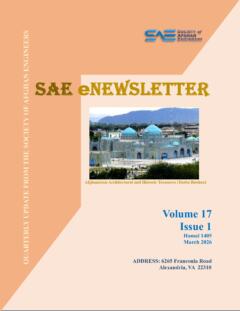
SAE Newsletter – March 2026, Volume 17, Issue 1, Hamal 1405
Quarterly Update from the Society of Afghan Engineers
Afghanistan Architectural and Historic Treasures (Tooba Roshan)
Volume 17
Issue 1
Hamal 1405
March 2026
Table of Contents
- Message from the Editor-In-Chief
- President’s Greetings
- Message from the Chairperson of the Board of Directors
- AEBT-SAE Online Education Program
- Book Review, by Dr. Reinhard Goethert
- History of Engineering Education and Engineers in Afghanistan, By: Dr. Zarjon Baha
- Afghanistan Architectural and Historic Treasure, By Arch. Tooba Roshan
- Implications of Data Secrecy and Scarcity in the Kabul River Basin, By: Dr. Gul Afghan Saleh
- Readers’ Comments and Responses
- Obituary
- The Society of Afghan Engineers Office Holders
Editor-In-Chief Message
I am pleased to present the quarterly update on the activities of the Society of Afghan Engineers (SAE) through Volume 17, Issue 1 of the SAE eNewsletter. This issue of March 31st 2026 corresponds with the month of Hamal 1405 in the Hijri Shamsi calendar. The Editorial Board extends its warmest wishes to all our members and wishes you a beautiful spring season filled with joy, prosperity, productivity, and good health.
This issue of SAE eNewsletter features the latest events at the SAE and any other activities important to the growth of our members. Featured topics include messages from Mr. Jalal Masumi, the Society’s President, Eng. Abdul Manan Khalid, Chairman of the Board of Directors, as well as, SAE Executive Annual Report for 2024, and membership news.
We are pleased to include a review of a new book entitled “The Finest Hotel in Kabul,” by Dr. Reinhard Goethert in this issue. Furthermore, we invited esteemed authors and contributors to share their valuable knowledge and experience with our readers. We hope you enjoy and appreciate their contributions.
A special invitation was extended by Jalal Masumi, the President of the Society, and myself to Dr. Zarjon Baha to write an article titled “History of Engineering Education and Engineers in Afghanistan.” He graciously accepted our request and prepared the article for this issue. We are deeply indebted to him for the time and effort he devoted to completing it on schedule. I am sure his writing will evoke a sentimental reflection on our shared educational history – something each of us can appreciate.
Arch. Tooba Roshan, our enthusiastic architect contributor, has prepared an inspiring article titled “Afghanistan’s Architectural and Historic Treasures,” which showcases the architecture of Rawza-e-Sharif, widely known as the shrine of Hazrat Ali. This stunning Blue Mosque is one of the most important and significant religious and cultural landmarks in Afghanistan.
Dr. Gul Afghan Saleh’s article, “Implications of Data Secrecy and Scarcity in the Kabul River Basin,” is the third in our newsletter’s series addressing the critical water resources and challenges in Afghanistan. His research, findings, and recommendations are highly professional and provide important insights that merit serious consideration.
Finally, I would like to express my sincere appreciation to Dr. Gul Afghan Saleh, Eng. Amanullah Mommandi, and Eng. Abdul Manan Khalid for their dedication and hard work as members of the Editorial Board. I am also deeply thankful to Eng. Jalal Masumi, the President of the Society, for his unwavering support, which has played a pivotal role in the continued success of this publication.
I hope that you find the newsletter interesting and useful. If you have any questions or comments, please do not hesitate to contact any member of the Editorial Board.
Very Truly Yours,
Bashir Kazimee, AIA
Editor-In-Chief
President’s Message
Dear Society Members,
I am privileged and happy to have the opportunity of addressing you through this issue of SAE e-Newsletter.
First and foremost, please accept my best wishes extended to each of you and your families for just having completed the holy month of Ramadan and observance of Eid-al-Fitr that followed it, a marking of our obedience and subservience to Almighty Allah (SWT). I also extend best wishes to celebrate arrival of the New Year (1405 in the solar calendar). May it turn to be a year filled with divine rewards for the prosperity and tranquility of humanity as a whole, and particularly that of our Afghan compatriots and other followers of this calendar.
After well wishes, I would like to inform you of how the Society is doing.
In its Meeting 18 on February 5th the Board of Directors approved a 10 line-item work plan for 2026 that included following highlights:
- Advance three priority technical topics
- a) Kabul Water Crisis (June/July)
- b) Afghanistan’s Transportation & National Economy Link (August/September)
- c) Afghanistan’s Renewable Energy Potential (October/November)
- Continue Providing Online Education (January-December)
- Hold 2026 Elections (August/September)
- Convene GAM 26 – General Assembly Meeting (August/September)
- Support 2026 A&E Alumni Reunion (August/September)
- Complete SAE Operational Guidelines (July)
- Improve Public Outreach Through Website Use (January-December)
- Issue Membership ID (June/July)
- Expand Membership Pool (January-December)
- Furnish Quarterly Progress Reports (March/June/October/December)
The Board also approved a $16,000 proposed budget for FY 2026 to materialize program development, new website design, outreach activities, and admin operation.
To satisfy Plan Item 10, brief coverage of the Society activities during this Quarter (January 1st – March 31st) follows below:
- Plan Item 1(a): Lead person is Engineer Manan Khalid. A few members responded positively to take part in an exercise which is yet to be identified more relevantly.
- Plan Item 1(b): Lead person is Engineer Hadi Rakin. Support team members yet to be identified.
- Plan Item 1(c): Lead person is Engineer Ghulam Feda. Support team members yet to be identified.
- Plan Item 2: To better undertake this effort, the Board approved formation of an Education Committee. Arch Mohammad Yusuf Afrooz accepted to serve as its chairman, pending Board concurrence.
- Plan Item 3: Prospective search for members to serve as Election Commission was rewardingly successful. The 5-Member Commission will be announced after the Board of Directors formally endorses them and the framework of their undertaking.
- Plan Item 4 & 5: The A&E Alumni Reunion of 2026 is being hosted by Afghan Canadian Engineers (ACE) organization in Toronto, Canada, in September. Their call to SAE for support has been heeded. Attempts are being made to convene SAE General Assembly Meeting (GAM 26) capitalizing on this opportunity.
- Plan Item 7: Efforts to negotiate a service contract to build a functioning and responsive website have progressed satisfactorily. The new website will be operational in a few months after SAE and the vendor sign and executes the contract.
As we aim to fulfill our obligations at individual and collective levels, I pray and hope that the year 1405 in the Hijri Shamsi calendar provides us with positive and constructive thoughts and actions for the good of our professional Society, and our living society whether in Afghanistan or abroad, and for the good of humanity all over the world. I close by wishing each of you and your loved ones a blissful and prosperous Happy New Year, and with warm and kind regards,
Jalal Masumi
SAE President
Message from the Chairperson of the Board of Directors
Consequences of Kabul’s Looming Water Crisis
Dear Members of the Society of Afghan Engineers, friends and colleagues. I hope you made duaa for our country and people during the holy month of Ramadan, and may those prayers be accepted. Belated Eid Mubarak and Happy Nowruz!
A dear member of the Board of Directors recently forwarded me an alarming article that was published in Hasht-e Subh Daily in January of this year. It highlighted serious concerns about possible sinkholes resulting from the impending water crisis in Kabul. Despite researching the groundwater crisis and holding a degree in groundwater hydrology, I had not fully considered the issue described in that article.
Naturally, when stored material—in this case water—is pumped from underground reservoirs without being sufficiently replenished, underground voids can form. As Kabul is currently pumping water at a rate approximately 44 million gallons greater than its natural recharge, the creation of underground voids becomes inevitable and a serious cause for concern. It may only be a matter of time before some of these voids collapse, creating sinkholes that could swallow whatever lies above them.
With this emerging phenomenon, Kabul may unfortunately be joining cities such as Mexico City and Jakarta, where uncontrolled groundwater extraction has caused significant land subsidence. An article titled “The Kabul Water Crisis Edition” by Colin Nagy, published in August 2025, brings renewed attention to these concerns about Kabul. The article notes that Mexico City—where about 22 million people depend heavily on groundwater—has experienced such extensive over-extraction that parts of the city are sinking at alarming rates. Internet sources indicate that some areas are subsiding by as much as 30 to 50 cm per year. The article further notes that the situation in Jakarta is no better; the city is sinking at a rate of approximately 25 cm per year, making it one of the fastest-sinking cities in the world.
This is indeed alarming. We must roll up our sleeves and work together to save the beautiful city of Kabul before it joins the ranks of these unfortunate examples. As engineers and experts, we may be among the few who can meaningfully contribute to addressing this problem. Let us think collectively and seriously, and propose practical solutions to prevent these potential disasters.
Happy New Year!
Sincerely,
Abdul Manan Khalid, P.E., LEED (BD+C)
Chairman, SAE Board of Directors
AEBT-SAE Online Education Program
Quarterly Education Report: First Quarter – 2026
Overview
During the first quarter of 2026, Afghan Education for a Better Tomorrow (AEBT), in collaboration with the Society of Afghan Engineers (SAE), conducted a series of online academic courses and professional seminars aimed at strengthening technical knowledge and academic development among Afghan students and young professionals.
The program brought together experienced engineers, architects, and educators who volunteered their expertise to deliver high-quality instruction through online platforms. Both male and female students participated in the program, providing young learners across Afghanistan with access to professional knowledge and mentorship from experienced specialists.
Courses and Technical Seminars Conducted
| Course / Seminar | Instructor |
|---|---|
| Architectural Precast | Eng. Amin Mahmood |
| Electrical Circuit Analysis | Eng. Naim Hakimi |
| Structural Analysis | Ustad Hafiz Wardak |
| General Architecture | Arch. Tooba Roshan & Arch. Yusuf Afrooz |
| English Literature and Writing | Prof. Dennis Briskin |
| Avalanche Mitigation and Wingwall Design Seminars | Eng. Amanullah Mommandi |
| Different Solutions of Artificial Intelligence (AI) – Seminar | Abdulla Nasser |
| Islamic Architecture – Seminar | Eng. Ghulam Feda |
| Roller-Compacted Concrete – Seminar | Eng. Aisha Hakimi |
| Afghanistan Coal Mines and Electrical Power Generation – Seminar | Eng. Ghulam Feda |
Educational Contribution
The courses and seminars offered during this period covered a range of subjects including civil engineering, electrical engineering, architecture, artificial intelligence, language and communication, and energy systems. Through these programs, students enhanced their technical understanding while interacting with professionals who shared both academic knowledge and practical industry experience.
The participation of both male and female students reflects the commitment of AEBT and SAE to support inclusive education and provide equal learning opportunities for Afghan youth. By connecting students with experienced professionals and educators, the program helps build the next generation of engineers, architects, and specialists who will contribute to the future development of Afghanistan.
The academic schedule included a temporary pause during the holy month of Ramadan. Educational activities are expected to resume after Ramadan with additional courses and expanded participation.
Acknowledgment
AEBT and SAE express their sincere appreciation to all volunteer instructors who generously shared their knowledge and time, as well as to the students who actively participated in the program. Their dedication and commitment to education play an important role in strengthening academic and professional development opportunities for Afghan youth.
- Fig.1, Structural Analysis Class, taught by Eng Hafiz Wardak
- Fig. 2, Architectural Precast, taught by Eng. Amin Mahmood
- Fig. 3, General Architecture, taught by Arch. Tooba Roshan & Arch. Yusuf Afrooz
- Fig.3, Roller-Compacted Concrete – Seminar taught by Eng. Aisha Hakimi
- Fig.4, Wingwall Design of Skewed-Crossing Concrete Box Culverts taught by Eng Mommandi
- Fig.5, Different Solutions of Artificial Intelligence (AI) – Seminar taught by Abdulla Nasser
- Fig.6, English Literature and Writing taught by Prof. Dennis Briskin
- Fig.7, Electrical Circuit Analysis taught by Eng. Naim Hakimi
Book Review
By: Dr. Reinhard Goethert
THE FINEST HOTEL IN KABUL – A People’s History of Afghanistan, by Lyse Doucet, 2025
Recently reviewed in the New York Times, New Yorker magazine, Wall Street Journal and others.
This is the story of the meeting place for journalists, diplomats, politicians and warlords that has functioned as a vital institution of Afghanistan’s public life. It served as the nation’s first international luxury hotel, one of the most visited by foreigners since its opening. Inaugurated in 1969 by King Zahir Shah, the InterContinental was Afghanistan’s first authentically international luxury hotel—designed and built by the British.
This historical account of the Hotel Inter-Continental is by a Canadian BBC journalist through stories of the people who work there, from manager to cooks, waiters and others. It traces the staff’s resilience through decades of war, from the 1970s, to the US withdrawal, and the 2021 Taliban return and offers perspectives of the changes on the building and their daily lives.
Readers must already have an understanding of the country’s history to appreciate the context to the stories. Some formal reviewers felt it had very little of Afghanistan and was disappointing. For a detailed review see:
Photograph from The Guardian: Theodore Liaii/Alamy
History of Engineering Education and Engineers in Afghanistan
By: Dr. Zarjon Baha
Emeritus Professor of Purdue University
Former Dean of School (Faculty) of Engineering at Kabul University
(Disclaimer: The views and information expressed in this article are those of the author. The SAE is not responsible for the accuracy of the data, references, or recommendations provided in this article.)
There were few engineers in Afghanistan before the establishment of the School of Engineering at Kabul University.
This list, arranged in alphabetical order, is not claimed to be complete but is presented for the readers’ information. It is possible that these names may not be spelled correctly, and, in some cases, the full name was not known. These engineers were educated abroad and served the country before the formation of the School of Engineering at Kabul University in 1956. Some of the names I found with the help of Engineer Ehsanullah Mayar are as follows:
Abdul Hai Qazi – Abdul Mahboob Wardag – Abdul Samad Salim – Abdul Wahab Hamid – Abdullah Ali – Abdullah Breshna – Abdullah Mobin – Ahmadullah – Akbar Saifi – Akram Parvanta – Ali Asghar Danish – Amanudin Amin – Amirudin Shansab – Aref Mehr – Asmat Enayat Seraj – Badrudin Sharafi – Bashir Ludin – Daoud Musa – Ehsanullah Ferzad – Ehsanullah Mayar – Fazal Ahmad Aimaq – Fazel Dost – Ghousudin Matin – Ghulam Ali – Ghulam Hosein Saadaat – Ghulam Mohammad Farhad – Ghulam Nabi Natiq – Hafizullah Nawabi – Husein Anwari – Kabir Ludin – Mahbubullah Azad Seraj – Malak Nuristani – Mir Ali Akbar Reza – Mohammad Aman – Mohammad Husien Masa – Nawabi – Omar Naikzad – Qudus Majid – Sayed Abdul Ahad – Sayed Amanudin Amin – Sayed Hashim Mirzad – Sayed Mahboob – Tawab Asefi – Wahab Hamid – Yaqoub Lali
The two institutions of higher learning that trained and educated students to become engineers were the School of Engineering at Kabul University and Kabul Polytechnic.
The following historical information for the Polytechnic University was provided by Guljon Saber, one of the early (fifth group) Polytechnic graduates. I hope in the future someone can do research on this topic and write a more comprehensive presentation of Polytechnic’s role in engineering education.
Brief Information About Kabul Polytechnics
Kabul Polytechnic Institute was founded with the help of former Soviet Union in the fifth district of Kabul, called the government employee district, to train engineers in different fields. The construction of the Polytechnic Institute started in 360 Jeribs (~180 acres) land in 1963. In the construction of the Polytechnic Institute, instruction buildings, laboratories, a library, dormitories for students, living quarters for academic staff, dining facilities, Jumaat (prayer place), fields for sport activities, a complete gymnasium, recreation places, and green spaces were considered.
When the instruction buildings and laboratories were complete, the first group of students were enrolled in 1967. The first group of students graduated in 1973, and after that, until 1978, hundreds of engineers graduated from the five-year program in the seven engineering fields to society.
Kabul Polytechnic was treated as a School of Kabul University until 1979 and was a five-year program with a bachelor’s degree.
Kabul Polytechnic had seven engineering fields that had graduated tens of graduates who were hired in the various ministries and institutions in the country. The seven engineering fields of study in the Kabul Polytechnic were as follows:
- Building Construction Department
- Dams and Canals Department
- Roads and Bridges Construction Department
- Chemical Technology Department
- Mining Exploration and Finding Department
- Petroleum Exploration and Finding Department
- Solid Mining Extraction Department
In addition to the Engineering fields the institute had general departments, where students would receive the respective instruction and these were as follows:
- Higher Mathematics Department
- General Chemistry Department
- Physics Department
- Electrical Technology Department
- Technical Drawing and Geometry Department
- Geodesy and Cartography Department
- Theoretical Mechanic and Strength of Material Department
- Russian Language Department
- Sports and Physical Education Department
- Islamic Culture, General Economic and Industrial Economic Department
*The first group graduated one year behind due to the general strike in the institute.
School of Engineering at Kabul University
Having spent 20 years (1962-1982) in the School of Engineering, including serving as its Dean, I will focus on the School of Engineering before the communist’s takeover. I intend to write a separate article about the school activities in 1977 until the communist takeover, which merit such consideration.
Engineering education has become a concern in the country. There was a seminar held at Kabul University by the National Committee for Engineering Education (NCEE), October 2-6, 1976, where I presented the status of our School.
History:
The School of Engineering was first introduced and established within the School of Science in 1956. In early 1960, the first group of graduates received their Bachelor of Science degree from the School of Engineering.
Through a contract with the United States Agency for International Development (USAID) and the Royal Government of Afghanistan, the University of Wyoming assumed the responsibility of guiding the new school. The University of Wyoming supplied staff members and equipment and established a four-year “General” engineering program.
In 1958, a joint School of Engineering and Agriculture came into being independent from the School of Science. The school was placed in temporary quarters, that had been built for the Aliabad Hospital Surgery Department.
In 1963, the School of Engineering was separated from the School of Agriculture. At approximately the same time a new team, the United States Engineering Team (USET), took over from the University of Wyoming the responsibility for assisting and guiding the School of Engineering. USET was the agency in Kabul charged with operation responsibility by a consortium known as the Kabul-American Program. It was comprised of the Education Development Center, in Newton, Massachusetts, along with eleven American institutions; namely, Carnegie-Melon University, Georgia Institute of Technology, Illinois Institute of Technology, Leigh University, North Carolina State University at Raleigh, Purdue University, Rice University, Steven Institute of Technology, University of Cincinnati, University of Notre Dame, and Washington University (St. Louis, MO).
Also of great significance was the move into new and permanent quarters at the end of 1963. This new building was one of several newly constructed buildings for the new campus of Kabul University through the joint efforts of the Royal Government of Afghanistan and the United States Government. The Engineering Building covered an area of about 3810 square meters, of which 2880 square meters comprised laboratories and the remainder were classrooms and offices. The new building was inadequate for growth needs and construction of an annex was initiated later. The annex covered an area of 3000 square meters and included additional classrooms, laboratories, offices, shops, and storage space.
In 1970, a five-year curriculum was adopted. The last batch of the four-year curriculum students graduated in 1970, and the first graduating class under the five-year curriculum was the class of 1972*. The five-year curriculum was comprised of nine semesters of academic work and a six-month practical training period.
The University of Nebraska Team through USAID contract, came to Kabul University in 1974 to help the Faculty of Engineering with four consultants.
In 1974 the Department of Vocational Technical Education (VTE), which was part of the School of Education, transferred to the School of Engineering. This program was designed to train students to become Vocational Education Teachers for the Vocational High School of Afghanistan. At that time three types of vocational high school were in operation: American system, AIT; German system, Mechanical school; and Soviet Union system of Technicum. In early 1977 the VTE Department graduated the first batch of four-year graduates with Bachelor of Science degrees.
Enrollment in the School of Engineering increased gradually, starting with twenty-three students in 1956 and reaching 850 in 1976. The first female student graduated in 1970 and eight more had graduated by 1976.
The number of graduates increased from four in 1960 to seventy-five in 1976, a total of 558 graduates by then.
The School of Engineering offered programs of study and awarded degrees in the following fields:
* Agriculture Engineering (administrated jointly with the Faculty of Agriculture)
* Architecture
* Civil Engineering
* Electrical Engineering
* Mechanical Engineering
* Vocational Technical Education
*One year of strike made the graduation delayed by one year to 1972.
Commodities and Facilities
Laboratories are an integral part of any engineering education program. The school had many well-equipped laboratories. These labs were designed for a smaller number of students. There was concern that more labs needed to be added due to the increase in enrollment and the introduction of new technology. The laboratory facilities with total expenditure of about $1,000,000 are listed below:
- Architecture: Architecture Studio
- Civil Engineering: Soils, Material Testing, Fluid Mechanics, Hydraulics, Surveying, and Sanitary.
- Electrical Engineering: Electronics, Electrical Measurement, Electrical Machines and Power
- Mechanical Engineering: Engines, Heat and Refrigeration, Kinematics and Dynamics, Instruments, Electrical Machines and Power.
- Science: Physics and Chemistry
Architecture Department
The goal of introducing the architecture program at the School of Engineering of Kabul University in 1967 was to provide quality architects who would be able to meet the ever-increasing demands for building modern Afghanistan. The program was structured in such a way that the education was to move from general architectural and design skills in the early years to specific solutions for cotemporary problems in later years. Parallel to the architecture courses, intensive requirements for learning related engineering skills that prepared the students as competent professionals enabled them to deal with rapidly changing technological aspects of architecture in Afghanistan. The graduates of this department were prepared to make valid contribution to the architecture and planning issues of modern Afghanistan.
The architecture curriculum was introduced in 1967 as a five-year program, beginning at freshman level. Two years later, the program was restructured into a four-year architecture curriculum, starting at sophomore level, with the freshman year being shared with all engineering students. The program had one semester of practical training which gradually was dropped in favor of more professional courses.
After years of experimentation and feedback from the practice and government agencies, the next step would be the creation of two options or separate majors: one in Architecture and another in Urban Planning. The Architecture Department had 11 faculty members 2 of whom were Americans.
Civil and Agricultural Engineering Department
The Agricultural Engineering program was jointly carried out by the School of Engineering and the School of Agriculture. Agricultural Engineering students took general courses common with the rest of engineering students and were also taking classes with civil engineering students that were mainly related to water resources. The graduates were mostly employed by the Ministry of Agriculture.
The Civil Engineering curriculum was designed to provide basic training to students in various fields of civil engineering. The subjects in the Civil Engineering curriculum included fields such as Transportation, Soils and Foundation, Structures, Sanitary, and Water Resources Management. The purpose of the program was to prepare graduates for technical and administrative positions in the Design, Construction, Operations and Management of engineering projects.
Due to the water resources of the country being one of the important assets that needed to be controlled and utilized for beneficial purposes, the immediate need for engineers in this discipline became understandable and obvious. The Civil Engineering Department considered initiating a program of Irrigation and Water Resources Engineering as an option. The Department had 19 faculty members with an advisor from the University of Nebraska at Omaha, USA.
Mathematical – Electrical Engineering – Physics (MEEP) Department
As the name implies, the Electrical Engineering Department encompassed two basic and fundamental support areas of engineering, namely Mathematics and Physics. These areas, recognized as vital in engineering, addressed the electrical engineering program primarily. Mathematics and Physics courses of the core curriculum were covered by the staff of MEEP Department.
The Department’s primary objective was to provide well-trained electrical engineers for positions of responsibility throughout Afghanistan. These included positions within the Sectoral Ministries and private enterprises. The broad base program provided graduates with a well-rounded background of the discipline so that he/she could work in areas of electrical engineering, such as circuits, electronics, communications, control, power systems, energy conservation, instrumentation, etc. There were 22 faculty members in this Department with an advisor from the University of Nebraska at Omaha, USA.
Mechanical Engineering Department
The four principal areas of concentration in Mechanical Engineering are: Heat and Power, Machine Design, Process Engineering, and Engineering Management. The curriculum of the Mechanical Engineering Department was designed to prepare qualified engineers in these areas.
The program of study prepared the students to be a practical generalist in Mechanical Engineering while still meeting specific requirements of specialization. Only during the students’ last year of study did the curriculum provide specialization areas or options. Thus, a more flexible education program was assured. If national needs for specific specialization were developed one year in advance, students’ program could be adapted to meet these needs.
The Mechanical Engineering Department was participating in consultation and research ventures as needed by the governmental and private agencies. These activities broadened the practical knowledge of both the staff and students of this Department. The Department was also responsible for Chemistry program in the school. There were 13 faculty members in the Department in 1976 with an advisor from the University of Nebraska at Omaha, USA.
Vocational Technical Education (VTE) Department
The purpose of Vocational Technical Education was to provide students and teachers with contemporary technical skills to identify educational needs of our society; implement the acquired learnings at B.S. degree level for teachers in all technical high schools of Afghanistan. In 1976 there were three systems: American system (AIT), German system (Mechanic), and Soviet Union system (Technicum).
The graduates of this 4-year B.S. program were expected to be able to operate, maintain, and handle modern machines and tools in a professional manner within their respective majors. The VTE program was intended to take leadership to implement the new Educational Reform of Afghanistan, which greatly emphasized vocational education in the country.
The role played by science and technology in economic and social progress was a main concern of the government. It was recommended that VTE develop an Industrial option where the graduates would be skilled professionals with B.S. degree level education to be employed in local industries. There were 9 faculty members serving in this Department in 1976 with an advisor from the University of Nebraska, at Omaha, USA.
English Department
There were 9 faculty members teaching the English language, most of them being American peace corps volunteers.
Students
The School of Engineering had been successful in attracting quality students. In 1976, the students admitted to the first year of Engineering program were rated among the top three schools at Kabul University, according to the university entrance examination scores.
Figure-1: Student Enrollment Chart (1956-1976)
Figure-2: Number of Graduates (1956-1976)
The two-year gap accounts for a 1-year change from the 4 to 5-year program (1971), and the second gap is due to the one-year strike demonstration (1972) where students did not go to school.
Academic Staff
The School of Engineering started with virtually all academic staff members from the United States of America through USAID program. Necessary and gradual steps were taken to begin training qualified Afghans, especially those who were graduates of the School of Engineering, to take the responsibilities of training engineers within the country. In 1976 more than 90% of academic activities were carried by the Afghan staff members in all Departments except the English Department.
Seismic Center
The only seismic center in the country was constructed in the 1960s below Kargha dam, near the Paghman mountain, with the help of USAID. The seismic data collected was being shared on daily basis with the USA.
Center for Engineering Consulting Services and Applied Research (CECSAR)
CECSAR was established in the School of Engineering in the early 1970’s and was working on materials testing, designing projects, and giving professional advice to the various government organizations in the country. The faculty and students were receiving compensation for their work. The important contribution resulting from CECSAR was that faculty staff were getting familiar with engineering challenges in the country, which gave them firsthand experience in local problems. They could utilize examples in their lectures and assignments for students related to the local engineering issues in the country.
Figure-3: School Structure Chart detailing the Dean, Assistant Dean, Academic Office, Business Office, and various committees (Curriculum, Seismic, Shop Operation, etc.).
Dr. Zarjon Baha Biography
- Born on October 15, 1939, in Yousafkhail, Wardag
- Attended Takya elementary school in Wardag, 1946-1951
- Attended Darul-Mo-Alimine Mutawasita, high school in Kabul, 1952-1957.
- Attended School of Engineering at Kabul University, 1958-1962. Appointed as Engineering faculty at Kabul University, January 1962. Master’s degree in civil engineering (Structures) at Washington University and Purdue University, 1963-1966.
- Worked at the School of Engineering at Kabul University, 1966-1968. Worked on Ph.D. program in Civil Engineering (Structures) at North Carolina State University at Raleigh, NC, 1969-1973.
- Worked at the School of Engineering at Kabul University, 1973-1982 in different capacities: I served as a faculty member and Head of the Department of Civil and Agricultural Engineering, having been elected by the department faculty, and as the Dean of the School, which was appointed through a cabinet meeting of the country, from April 8, 1975, to May 17, 1978.
- Worked as Engineering faculty at Kabul University, 1978-1982. Left for the UNESCO conference in Bombay, India, January 11, 1982, and stayed in India until I left for USA, on June 8, 1982.
- I started working at Purdue University as a professor of construction management, from August 18, 1982, until May 15, 2022, when I retired.
- While at Purdue University, I served as an Associate Professor (1982-1990), Full Professor (1990-2022), as well as Associate Department Head and Interim Department head. I also served as the Resident Program Coordinator for a $20 million World Bank project in Malaysia from 1995-2000.
- Since 2020, Hafizullah Wardak and I have written three volumes of Structural Analysis books in Pashto. We have also translated “Mechanics of Materials” by Russel Hibbeler in Pashto which came into two volumes.
Afghanistan Architectural and Historic Treasures
اﻓﻐﺎﻧﺴﺘﺎن ﮔﻨﺠﯿﻨﮫ ﻣﻌﻤﺎری و ﺗﺎرﯾﺨﯽ
By: Arch. Tooba Roshan
Rawza-e-Sharif روﺿﮫ ﺷﺮﯾﻒ
Mazar-e-Hazrat-e-Ali ﻣﺰار ﺣﻀﺮت ﻋﻠﯽ
(Disclaimer: The views and information expressed in this article are those of the author. The SAE is not responsible for the accuracy of the data, references, or recommendations provided in this article.)
Introduction
Rawza-e-Sharif, often simply known as the Shrine of Hazrat Ali–the stunning Blue Mosque, is one of the most important and significant religious and cultural landmarks in Afghanistan. Located in the city of Mazar-e-Sharif in northern Afghanistan, for centuries this shrine has played a central role in the spiritual and social life, urban development, and cultural identity of the region. Its function as a place of worship, Rawza-e-Sharif represents a fusion of faith, and collective memory in Afghanistan. Its history, architecture, and cultural practices, illustrate the deep interplay between religion, tradition, and identity in Afghan society.
In the present day, Rawza-e-Sharif contributes to social unity; every year, thousands of visitors from different regions and backgrounds come to pray, seek blessing, and admire the beauty of this revered religious monumental shrine.
The Historical Background
Rawza-e-Sharif has a notable and prolong history that is closely connected with the development of Mazar-e-Sharif as a major religious and cultural center. Anthropologically, Rawza-e-Sharif can also be recognized as a collective site (Halbwachs, 1992). Locals believe that Rawza-e-Sharif is the final resting place of Hazrat-e-Ali ibn Abi Talib (RA), the cousin and son-in-law of the Prophet Mohammad (PBUH) and the fourth Calipha of Islam. While most Muslims and Islamic traditions believe that Ali is buried in Najaf, Iraq, Afghan tradition holds that his body was secretly transferred to Balkh and buried here to protect him from desecration during periods of political unrest.
Historical narratives suggest that the location of the tomb was rediscovered in the 12th century following a divine revelation or dream experienced by local religious figures. Subsequently, in 1136 CE, during the reign of Sultan Ahmad of the Seljuk Dynasty, a shrine was constructed at the site. Under his patronage, Persian and Asian architects and craftsmen adorned the structure with intricate mosaics and lapis lazuli, geometric motifs and elegant calligraphy—hallmark of temorid architecture. This event led to the establishment of the city, whose name Mazar-e-Sharif, literally means “Noble Shrine”.
Architectural Importance
Rawza-e-Sharif, also known as the Blue Mosque, is one of the most important architecture masterpieces in Afghanistan. It represents the peak of Islamic architecture in central Asia and reflects centuries of artistic, cultural, and religious development. Its design, decoration, and construction make it a symbol of Afghanistan’s architecture heritage.
One of the most significant architectural features of Rawza-e-Sharif is its extensive use of blue turquoise tiles. These glazed and gleaming tiles cover the domes, walls, and minarets, creating a brilliant visual effect that changes with sunlight. Blue in Islam architecture symbolizes spirituality, heaven, and peace, making the mosque not only visually striking but also spiritually meaningful. The detailed tilework demonstrates advanced craftsmanship and knowledge of ceramic era.
The mosque symmetry and geometric design highlights key principle of Islamic architecture. Repeating stars, polygons, and interlacing lines, symbolize order and the infinite nature of creation, pointing the unity of God. Balanced proportions, repeated patterns, and harmonious layout create a sense of sequence and unity.
Floral motifs and geometric shapes which are central to Islamic architecture, are carefully combined with Quranic calligraphy, reflecting how art and faith integrated, showing both aesthetic and beauty. Floral design draw inspiration from nature and represent growth, life, and paradise as described in Islamic tradition. The calligraphy is not merely decorative; it serves as spiritual reminder and an essential architectural element.
Architecture as Cultural Text
From an anthropological viewpoint, architecture can be read as a cultural text. The blue tile work, geometric patterns, floral motifs, and Quranic inscriptions of Rawza-e-Sharif communicate religious meaning and social values non-verbally. Together, these designs avoid figurative imagery and create intricate and harmonious surfaces expressing art, faith, and mathematics in Islamic culture. As Clifford Geertz (1973) suggests, symbols are vehicles through which culture explore and reinforce systems of meaning.
The dominance of blue-a color associated with heaven, protection, and transcendence—visually reinforces the shrine’s sacred status. The careful spatial organization of the courtyard facilitates both communal gathering and individual contemplation, reflecting the dual social and spiritual functions of the site.
Resilience, Identity, and Cultural Continuity
The shrine of Hazrat-e-Ali stands as a prominent symbol of Afghan identity, and resilience that has survived numerous conquests, conflicts and political transformation. It has had a tumultuous history, destroyed by Genghis Khan in the 13th century and was rebuilt in 15th-century Timurid-era, showing the capacity of Afghan people to rebuild. Furthermore, in a country marked by decades of conflict, Rawza-e-Sharif functions as a stabilizing cultural anchor. It preserves ethical values, collective memories, and social coherence across generations.
Cultural and Social Importance
The Blue Mosque holds great cultural and social importance in Afghanistan, especially for the people of Mazar-e-Sharif and surrounding regions—an epicenter of Persian New Year ceremony. Beyond being a place of worship, it serves as a major center for social gatherings and cultural traditions. One of the most significant events held at Rawza-e-Sharif is the celebration of Nowroz, the Persian (Hijri) New Year, during which the sacred banner known as Jahenda Bala is raised, in celebration and symbolizing rebirth and spring, when the city is beautifully furnished with vibrant, and wild tulips (Gul-e-LaLa).
Contemporary Challenges (2021-Present)
Rawza-e-Sharif has faced drastic changes since Taliban regained governing of Afghanistan in 2021. The government of Taliban has implemented significant restriction—women’s access is limited to the shrine, and festivities of Nowroz celebrations is banned and closely monitored. The shrine has been shifted to mosque and is treated more as a historic center than a cultural and devotion center. The rulers emphasize mosque-based worship over the shrine reverence.
The shrine needs restoration for structural aging, weather damage and mostly has sustained damage due to regional earthquakes and needs urgent restoration. Rawaz-e-Sharif needs restoration to survive-it needs neutrality, expertise and respect, not political or ideological redesign!
Arch. Tooba Roshan Biography
Today I am the Principal Designer at AR Architecture – TR Construction Group. We design and build custom homes, restaurants, shopping centers, assisted living facilities, in Maryland and Virginia. Most of our projects are in Bethesda, Davidsonville, Baltimore, and Stafford. In 2009, I received my Bachelor’s degree in architecture and interior design (summa cum laude, Dean’s List) from Howard University. I am the Vice President of Society of Afghan Engineers and Faculty Member with Afghan Architecture Studio.
Implications of Data Secrecy and Scarcity in the Kabul River Basin
By: Dr. Gul Afghan Saleh
(Disclaimer: The views and information expressed in this article are those of the author. The SAE is not responsible for the accuracy of the data, references, or recommendations provided in this article.)
1. Introduction
The Kabul River Basin (KRB) is one of the most important transboundary water systems in South and Central Asia. Originating in the highlands of Afghanistan and flowing into Pakistan, the river supports millions of people through irrigation, hydropower, drinking water supply, and ecological services. Despite its importance, the basin remains one of the least understood major river systems in the region. Reliable hydrological data is limited, monitoring networks are weak, and information sharing between Afghanistan and Pakistan is minimal or non-existent.
2. Background: Hydrology and Geopolitics of the Basin
The Kabul River Basin is shaped by a complex hydrological system driven largely by snowmelt, seasonal rainfall, and contributions from glacial sources. Its flow varies significantly throughout the year, with high discharge during spring and early summer and low flows in winter. The basin is also politically sensitive. Afghanistan and Pakistan share the river but do not have a formal water-sharing treaty.
3. Nature of Data Scarcity and Secrecy
Across the basin, several categories of information are either unavailable, incomplete, or not shared openly:
* Streamflow measurements at key points
* Snowpack depth and seasonal melt patterns
* Glacier mass balance and retreat rates
* Groundwater levels and extraction volumes
* Sediment loads and erosion trends
* Irrigation withdrawals and agricultural demand
* Reservoir operations and hydropower release schedules
4. Implications of Data Scarcity and Secrecy
- Hydrological: Poor flood forecasting and uncertain water availability.
- Environmental: Over-extraction of groundwater and degradation of habitats.
- Socioeconomic: Unpredictable irrigation supplies and urban water shortages.
- Political: Mistrust deepens and lack of transparency fuels speculation.
5. Pathways Toward Transparency and Cooperation
- Technical: Rehabilitate hydrometric stations and use satellite-based remote sensing.
- Institutional: Establish a Kabul River Basin Joint Commission and data-sharing protocols.
- Policy: Frame water as a shared resource and support community monitoring.
Dr. Gul Afghan Saleh’s Biography
Dr. Gul Afghan Saleh, PE, PMP, CCM, is a seasoned engineering and project management professional with more than three decades of experience in infrastructure development. He currently serves as a Construction Engineering Lead with ATCS. He has held leadership roles in several professional organizations, including the American Society of Civil Engineers (ASCE) and the Society of Afghan Engineers (SAE).
Readers’ Comments and Responses
Comment: Fazel Ahmed Afghan
Thank you for your excellent efforts in preparing and sharing the SAE eNewsletter, Issue 4. Your dedication and professionalism are truly appreciated.
Response: Bashir Kazimee
Dear Afghan Sahib, thank you for your kind and encouraging message. I am glad this issue of the newsletter is to your liking.
Comment: Edward Corcoran
Thanks for keeping after the newsletter. The class efforts and on-line training are wonderful. That is what could have a real impact on the country.
Response: Bashir Kazimee
Thank you, Ed., for your wonderful note on the SAE eNewsletter. I appreciate your thoughtful review of the content.
Comment: Dr. Sharif Hossainy
Indeed, with the effect of your untiring efforts, more and more attraction has been created in the SAE e-Newsletter.
Response: Bashir Kazimee
Dear Dr. Hossainy Saahib: thank you for your kind message, and your encouraging and thoughtful remarks.
Obituary of the Late Professor Abdul Azim Bahrami
The Society of Afghan Engineers (SAE) deeply mourns the loss of Professor Azim Bahrami, a pioneering figure in the Afghan engineering community, who passed away on January 15th 2026 in California, United States.
Professor Abdul Azim Bahrami was born on June 18, 1936 in the Guzara District of Herat. In 1959, he was among the first graduates of the newly established Faculty of Engineering at Kabul University. In 1966, Professor Bahrami joined Kabul University’s Faculty of Engineering as a professor of civil engineering, specializing in surveying.
In 1968, he earned his Master’s degree in Civil Engineering from Purdue University. From 1976 to 1978, he served as Director of Planning, Design, and Construction at Kabul Municipality. He remained a pillar of Kabul’s academic community until 1987. Professor Bahrami was a man known for his kindness, humility, and devotion to education. His legacy will endure in the institutions he strengthened and the students he inspired.
The Society of Afghan Engineers Office Holders
SAE Executive Committee Members:
* President: Jalal Masumi
* Vice President: Tooba Roshan
* Treasurer: Mahjan Saleh
* Secretary: Gul Afghan Saleh
SAE Board of Directors-Officers:
* A. Manan Khalid (Chairman)
* Ghulam Mujtaba (Vice Chairman)
SAE Board of Directors:
Ghulam Mujtaba, Sharif Hossainy, Manan Khalid, Yar Mohabbat, Amanullah Mommandi, Hadi Rakin, Hashim Baluch, Ghulam Feda, and Zabi Zaca
SAE Past Presidents:
Najim Azadzoi (2021-2023), Atiq Panjshiri (2015-2020), Ghulam Mujtaba (2011-2014), Abdul Hadi Rakin (2008-2010), M. Quasem Kadir (2007-2009), Abdul Hadi Rakin (2004-2006), Mohammed Hashim Rayek (2001-2003), Ahmad Wali Shairzay (1998-2000), Sohaila Sanie Shekib (1995-1997), and Malik Mortaza (1993-1994)
SAE Representative in Afghanistan: Ahmad Walid Howaida
SAE eNewsletter Editor-in Chief: Bashir Kazimee, AIA
SAE eNewsletter Editorial Board Members: Dr Gul Afghan Saleh Ph.D., A. Manan Khalid, M.S., P.E., LEED AP, and Eng. Amanullah Mommandi, M.S., P.E.
Disclaimer: The author, reporter, or agency of each publication, project, news, and products is included in this newsletter. The Editorial Board of the Society of Afghan Engineers, Executive Committee, Board of Directors, or any of its members are not liable for the accuracy or contents of the information. The information about the agency products or services is not the SAE endorsement.