Championing Renewable Energies and Power Distribution in Afghanistan
The Society of Afghan Engineers, in partnership with Afghan Education for a Better Tomorrow, is empowering the next generation of Afghan engineers through innovative tele-education seminars on renewable energy. These initiatives aim to harness Afghanistan’s vast potential in solar, wind, hydro, and geothermal resources, paving the way for a sustainable energy future and reducing dependency on fossil fuels.
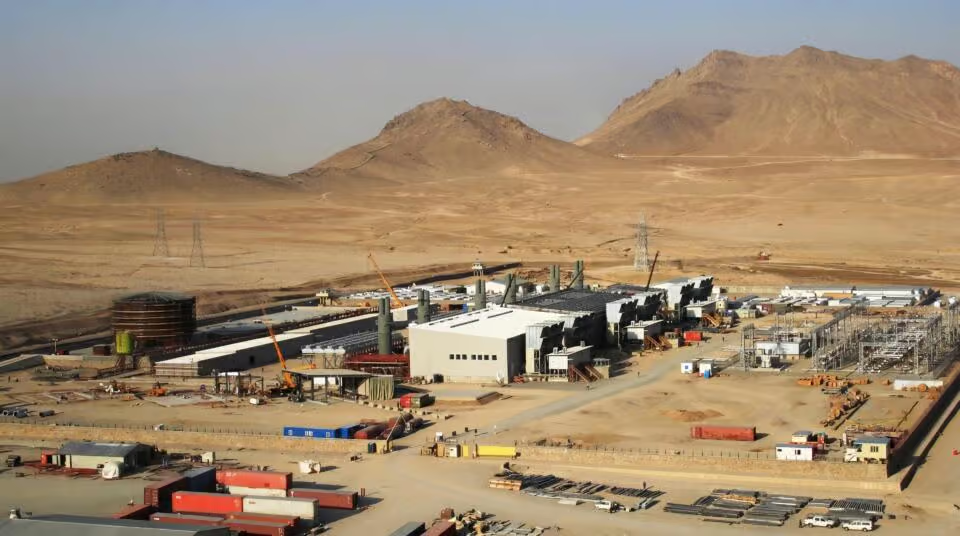
The Society of Afghan Engineers (SAE), working in close collaboration with the Afghan Education for a Better Tomorrow (AEBT) and our dedicated expatriate experts, have conducted specialized seminars and feasibility studies to highlight the value of renewable energy and modern power distribution systems. Utilizing advanced tele-education technologies, we delivered these vital educational programs directly to students and faculty at Afghan institutions—such as Kandahar University and Herat University—from 2021 through 2026. By bridging the geographical gap, we provided in-depth instruction on solar, wind, hydroelectric, and geothermal technologies, equipping the next generation of Afghan engineers with the knowledge necessary to address our country’s critical energy shortages and future infrastructure demands.
The Imperative for Alternative Energy Sources
Energy access and energy security are key requisites for the socio-economic growth of Afghan societies. Currently, the primary reliance on finite fossil fuels presents significant environmental and economic challenges, as burning these fuels releases greenhouse gases that contribute to global climate change. Recognizing that alternative energy could be a highly effective and sustainable path to energy self-sufficiency for Afghanistan, we have prioritized educating our engineering community on these vital technologies.
Through our publications and seminars, led prominently by our members such as Eng. Ghulam M. Feda, we have emphasized the basic concepts of sustainability, renewability, and pollution reduction. Our educational outreach highlights that Afghanistan is a “sunbelt country” with tremendous untapped potential. We estimate Afghanistan’s renewable energy potential to be over 300,000 MW, consisting of solar (222,849 MW), wind (66,726 MW), hydro (23,310 MW), and biomass (4,000 MW). By introducing these concepts, we aim to demonstrate that investing in this sector will have far-reaching economic and social consequences, ultimately helping free Afghanistan from its dependency on recurrent foreign aid.
Tele-Education Seminars and Coursework
To ensure this knowledge reaches those who will build the future of our nation, we integrated renewable energy and power distribution topics into our extensive tele-education curriculum. Through our joint venture with AEBT, we utilized real-time, synchronous video conferencing to connect our experts with students inside Afghanistan.
Our specific educational deliveries in this sector have included:
- Renewable Energy Seminars: In May 2024, Eng. Feda delivered a dedicated seminar on renewable energy directly to the engineering students of Kandahar University, focusing on the practical applications and theoretical potential of alternative energy sources in the region.
- Power System Distribution: To address the infrastructure required to deliver energy, we taught classes focused specifically on “Power System Distribution.” These courses covered the intricate design and operation of efficient electrical distribution networks, ensuring students understand how to manage and distribute generated power effectively.
- Advanced Energy Topics: We expanded our curriculum to include specialized technical seminars on topics such as “Afghanistan Coal Mines and Electrical Power Generation,” as well as seminars on “Nuclear Fusion,” ensuring Afghan students are exposed to a comprehensive spectrum of global energy technologies.
Evaluating Renewable Potential and Pilot Projects
Beyond theoretical classroom instruction, we have actively engaged in discussions to implement practical renewable energy solutions on university campuses. On May 24, 2021, we participated in a virtual meeting organized by AEBT to discuss a Feasibility Study for a Renewable Energy Pilot Project at Herat University.
During this meeting, it was noted that Herat University, which supports 21,000 students across 16 colleges, suffers from a short supply of reliable electric power. To address this, we explored options to harness the region’s six months of natural wind and abundant sunny days to seek alternative energy from solar and wind power. Our experts noted that fixed-axis solar power plants in provinces like Herat and Balkh can achieve highly efficient annual net capacity factors of 17% and 14%, respectively. At the conclusion of the meeting, we established a joint effort to conduct a formal feasibility study for this pilot project.
Advancing the Power Sector Through Collaboration
Our commitment to sustainable energy and power distribution has also extended into collaborations with national utility authorities. In 2021, we engaged with the National Water Affairs Regulation Authority (NWARA) to formalize a collaborative agreement. As part of this planned cooperation, we tentatively agreed to jointly work on potential pilot projects for solar-powered water lifting stations on the Sorobi and Murghab rivers, capitalizing on the enormous hydro and solar potential of the Murghab river basin.
Through these targeted seminars, feasibility studies, and strategic partnerships, we continue to foster an environment where Afghan engineers are equipped with the modern technological expertise needed to transition Afghanistan toward a sustainable, clean, and reliable energy future.